Author: Alea Research
Translation: Shenchao TechFlow
Shenchao Introduction: Monad is developed by the former quantitative engineering team at Jump Trading and initially established a market presence with its parallel EVM and high-speed matching performance. However, the latest on-chain empirical data indicates that the network's business model is undergoing a disruptive transformation, its ecosystem revenue structure has completely shifted from high-frequency trading to lending interest.
In the context of a cyclical contraction of the overall decentralized finance total locked value (TVL) across the network, Monad has achieved nearly an eightfold market share surge through Aave deployments and an institutional unsecured credit vault. This research report deeply analyzes its credit-driven liquidity closed loop, annualized interest model, and the token value capture path under low Gas fees.
Key Points Extracted
Counter-cyclical Market Share Expansion: Over the 10 months leading to the end of September 2026, the total locked value (TVL) of all decentralized finance (DeFi) protocols across the network fell from $111.4 billion to $95.5 billion, while Monad's market share steadily climbed from 0.14% to 1.09%. As of October 27, Monad's DeFi TVL ranked tenth among all public chains.
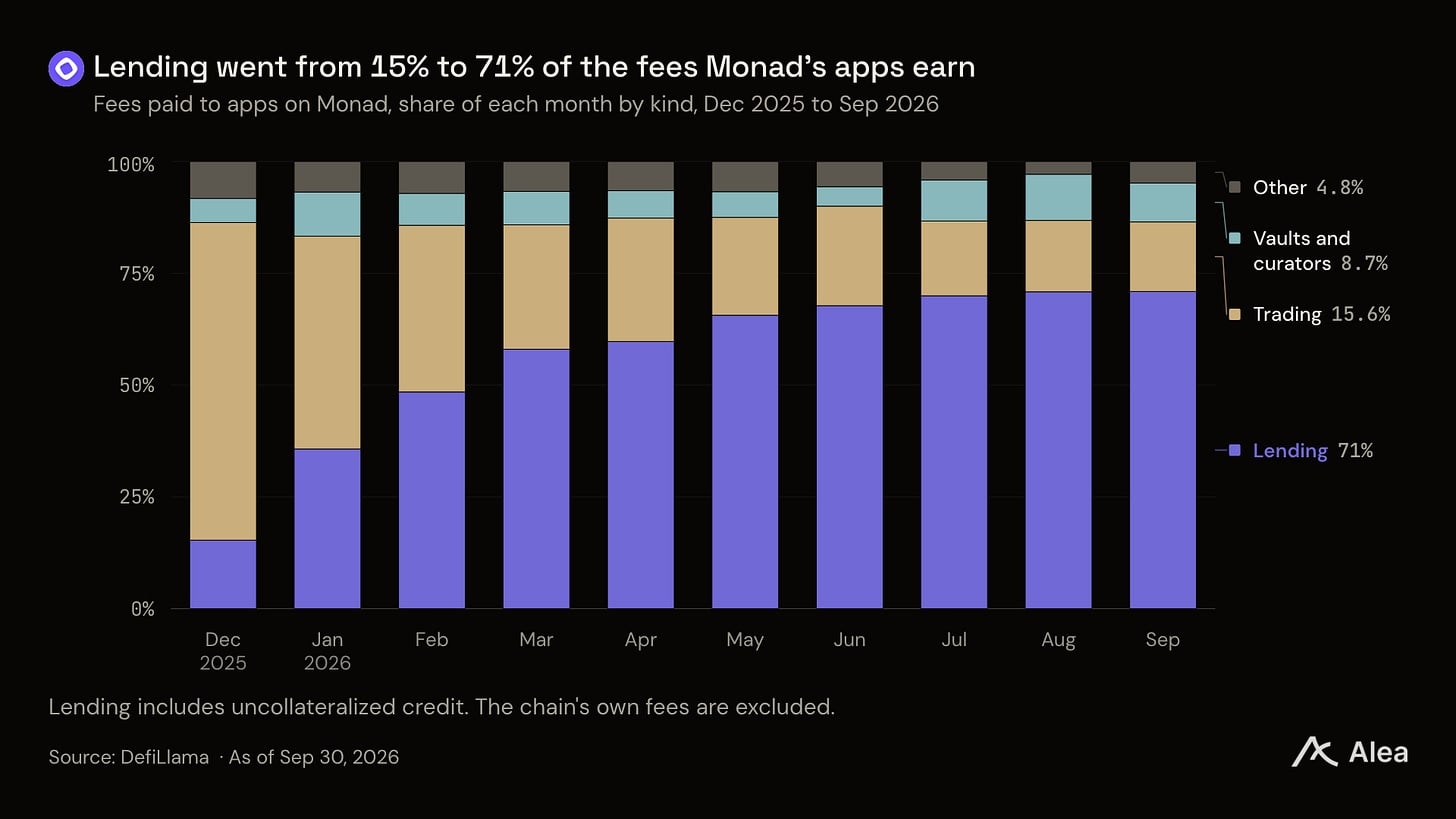
Lending Interest Dominates Eco Revenue: Borrowers currently contribute the vast majority of the fee income from Monad's on-chain applications. In September, lending applications contributed 71% of the network's application fees, while trading applications accounted for only 16%. For that month, borrowers paid an average annualized interest rate of about 6.2% on an average loan balance of $903 million.
Higher Unit TVL Lending Leverage: Each $1 of TVL deposits on the Monad chain corresponds to $0.89 of lending funds, with a utilization rate far exceeding Ethereum's 42% and Base's 45%. Among these, the institutional certified credit vault holds $287 million in loans, and Aave's Monad market ranks third in fees across the entire network.
Token Valuation Significantly Undervalued: The circulating market value of MON is only a quarter (0.25 times) of its on-chain DeFi TVL, while the market values of AVAX, SUI, SOL, and SEI typically range from 7 to 12 times their TVL. Since the first complete trading day, MON's price performance has also noticeably outperformed AVAX, SUI, SEI, and APT.
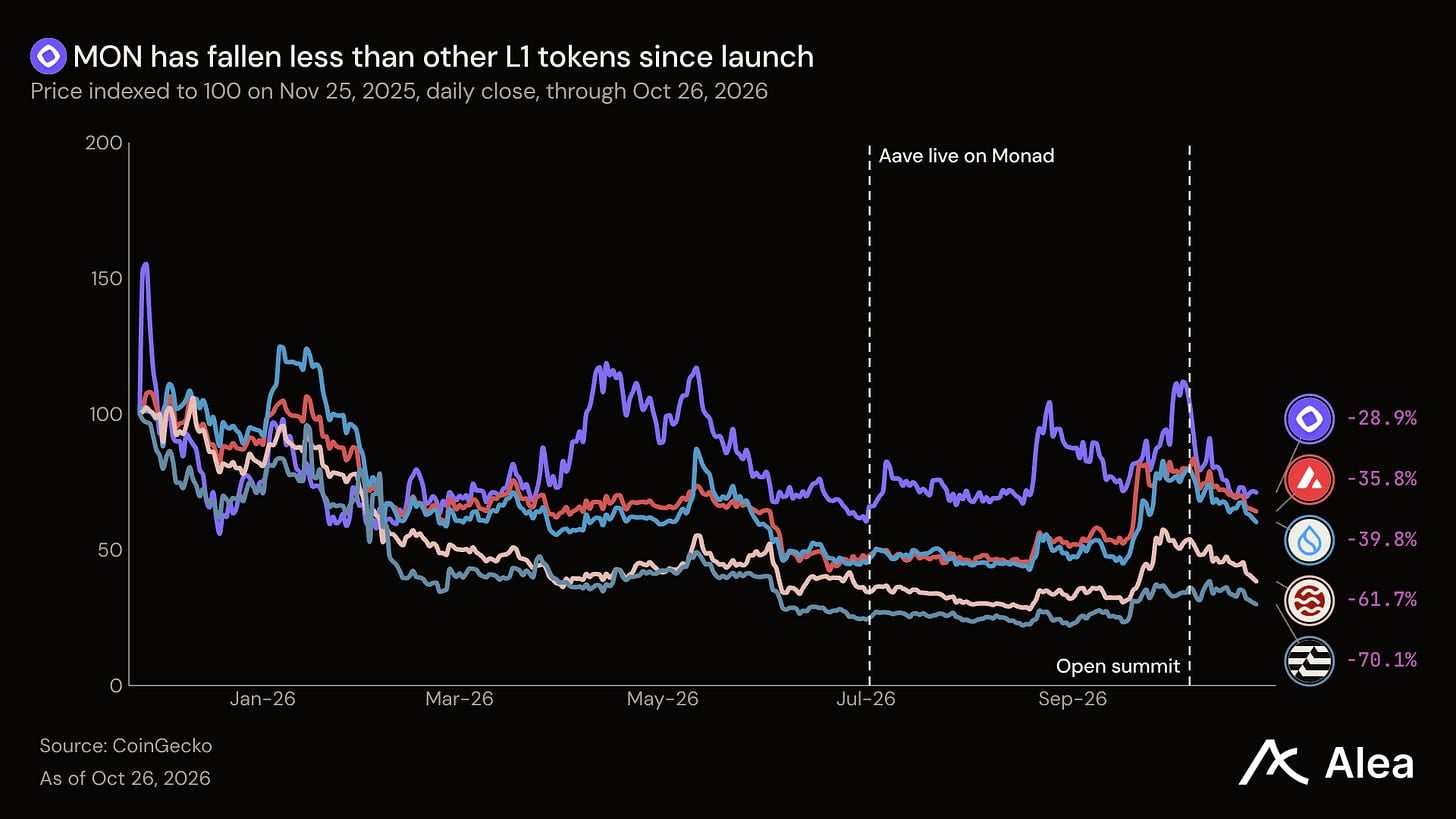
Image: A comparison of the relative price performance of MON and competing public chain tokens since the first complete trading day
Market Share Expansion Against Trends Approaching Eightfold
Monad's official vision is to establish an open-access fair financial market on a neutral underlying network. Its foundation describes the entire economic system as a self-consistent virtuous closed loop: payment settlements introduce on-chain dollar liquidity, the lending market puts funds into operation, and spot trading completes the final asset pricing.
This closed loop demonstrates powerful counter-cyclical resilience amid an overall market downturn. The total locked value of mainstream DeFi protocols has dropped from $111.4 billion on December 1, 2025, to a low of $68.2 billion by June 30, 2026, before rebounding to $95.5 billion by the end of September. During the same period, Monad's DeFi TVL significantly rose from $15.5 million to $104 million, increasing its share of the total network scale from 0.14% to 1.09%, achieving an astonishing nearly eightfold growth.
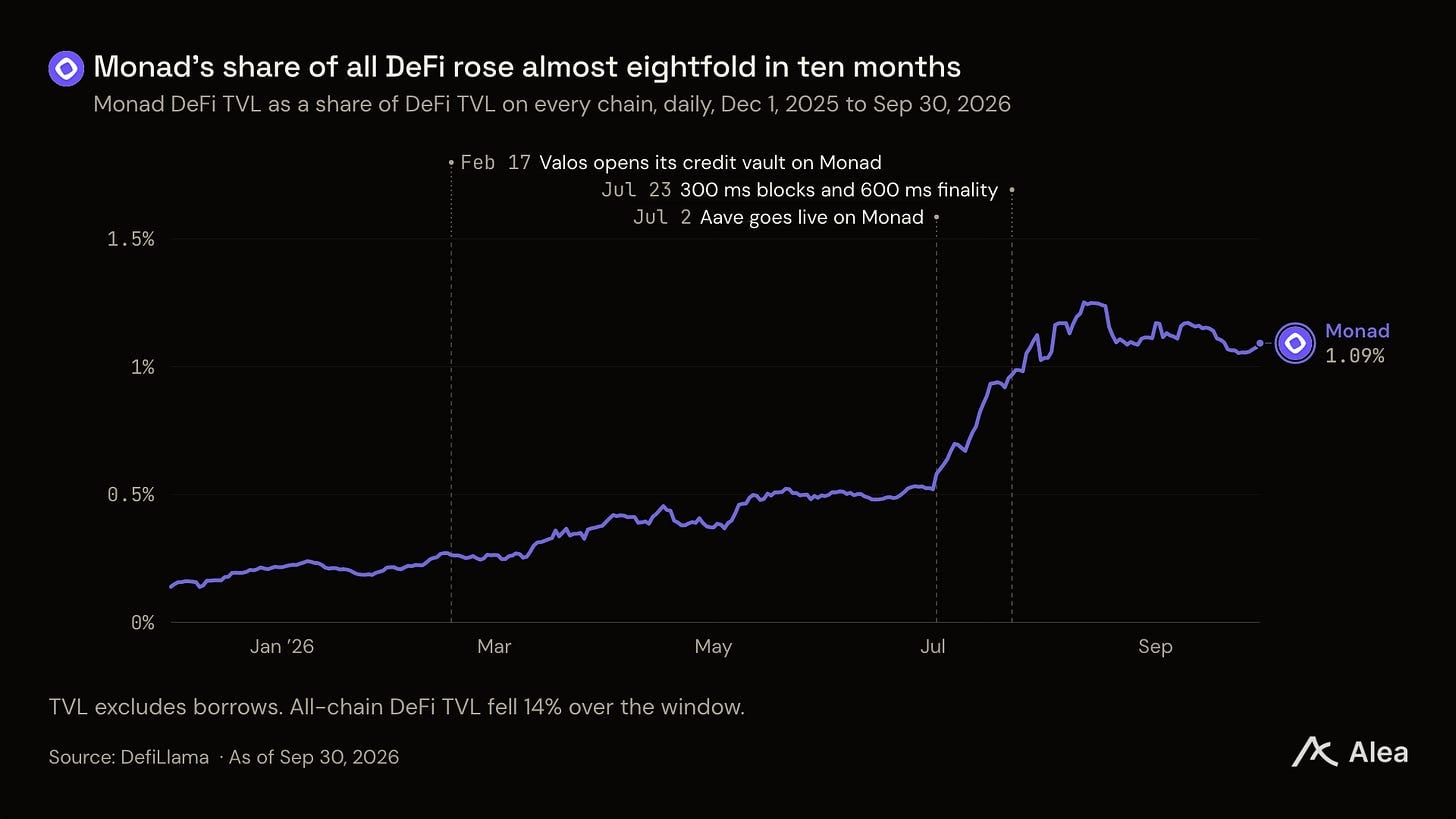
Image: Monad's market share climbed to 1.09% as the total DeFi locked value across the network hit a low of $68.2 billion
The key growth inflection point occurred in July. Aave officially launched on Monad on July 2, opening 12 lending markets on its first day; three weeks later, Monad's official reduced the block generation time to 300 milliseconds. By the end of October, the network had accommodated $985 million in DeFi TVL and $701 million in stablecoin assets, showing explosive growth from the $237 million in its first week on the mainnet.
Fee Income Reconstruction: Lending Interest Becomes Core Pillar
In December 2025, 71% of the fees generated by Monad's ecosystem applications came from trading activities, including spot exchanges, asset launch platforms, and derivatives trading applications. However, by September 2026, lending protocols contributed 71% of the total fees from chain applications, while trading application fees plummeted to 16%, and the remaining 9% came from income vaults and curator protocols. Under this structural shift, the amount of outstanding loans from six mainstream lending platforms under Monad surged from $117 million on December 31, 2025, to $909 million on September 30, 2026.
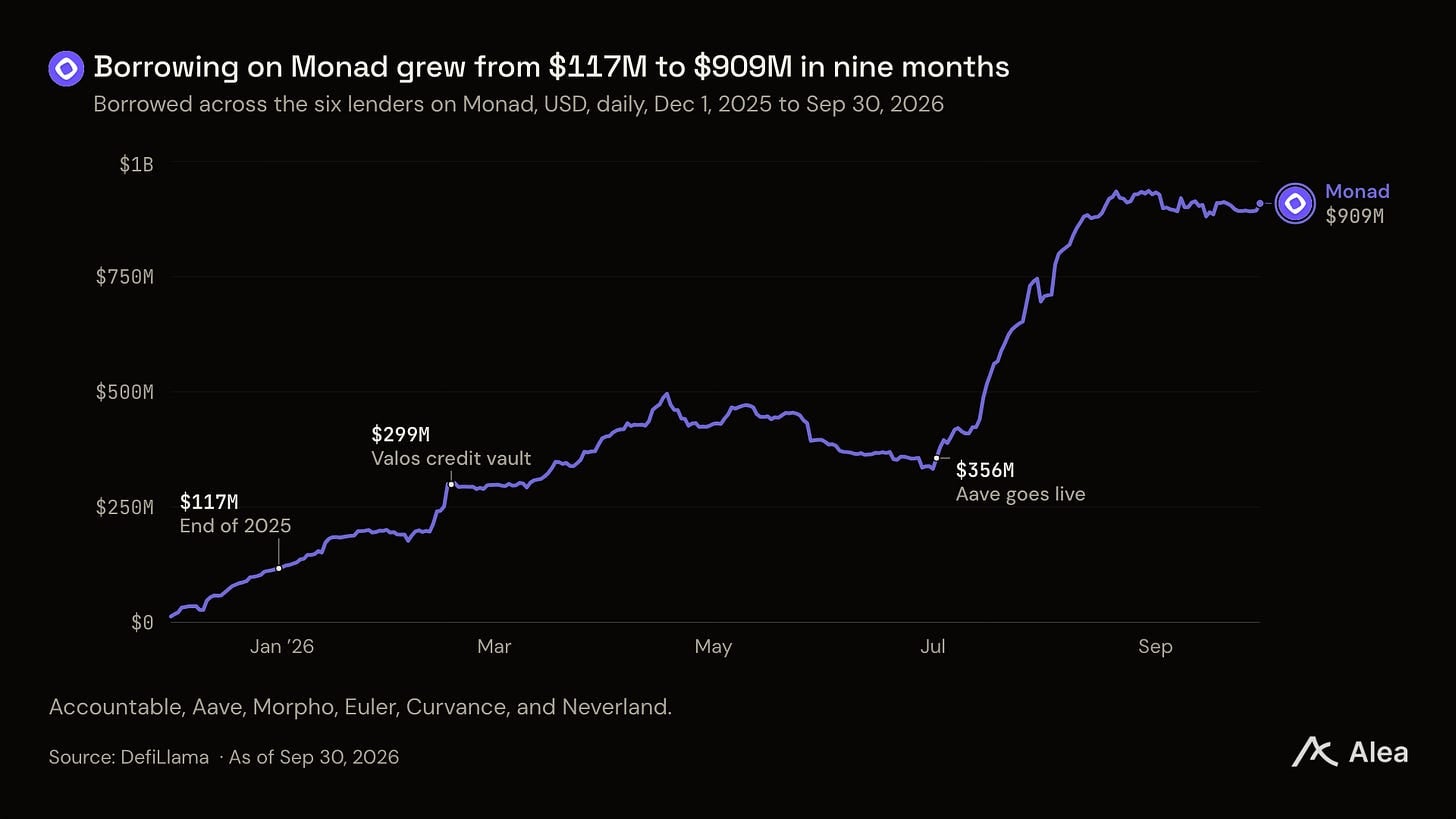
Image: The launch of Valos credit vault and Aave progressively drives stair-step growth of lending interest income
The entire lending landscape is dominated by two major forces. As of the end of September, the Accountable certified credit vault accounted for 33% of Monad's total lending balance, with Aave holding 29%, while local protocols Morpho, Euler, and Curvance shared the remaining market share.
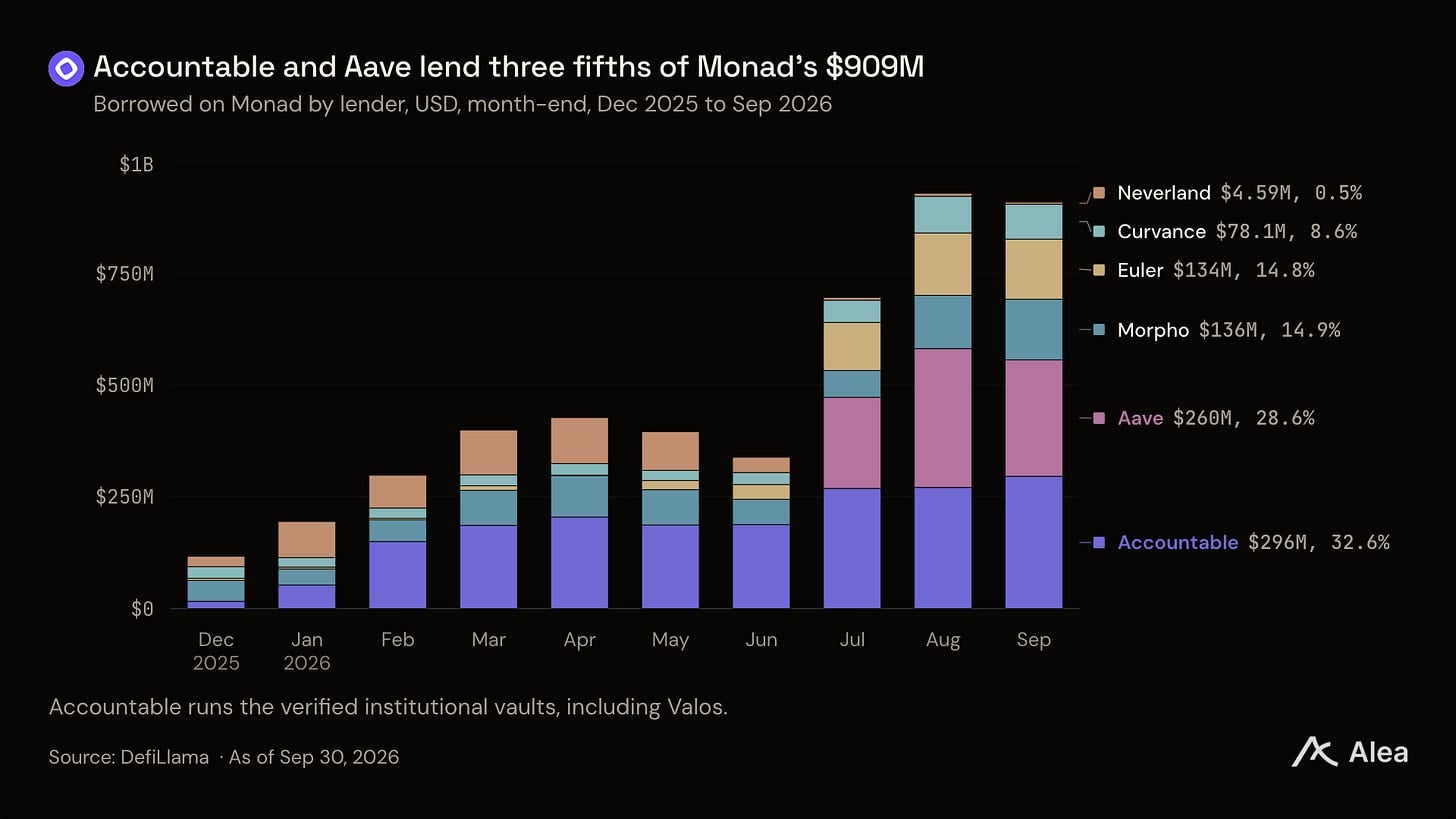
Image: Institutional credit and Aave together occupy about three-fifths of Monad's $909 million lending scale
The core of Accountable's market share comes from institutional credit. Institutional market maker Valos opened a credit vault on Monad in February with an initial amount of $100 million and has cumulatively deployed over $1 billion to various market makers. The Accountable network provides continuous on-chain verification of borrowers' financial status for depositors, fundamentally altering the drawbacks of other public chain credit vaults that rely on low-frequency periodic reporting. In July, Valos raised its credit vault limit on Monad to $150 million.
Currently, Monad accommodates up to $287 million in on-chain unsecured institutional loans, ranking second among all statistical public chains following Ethereum's mainnet at $418 million. These loans are not subject to rigid excess collateralization on-chain but are backed by the borrower's balance sheet and off-chain legal agreements. Market makers borrow stablecoins, conduct market-making arbitrage on Monad's decentralized exchange, and continuously repay interest on loans to the protocol.
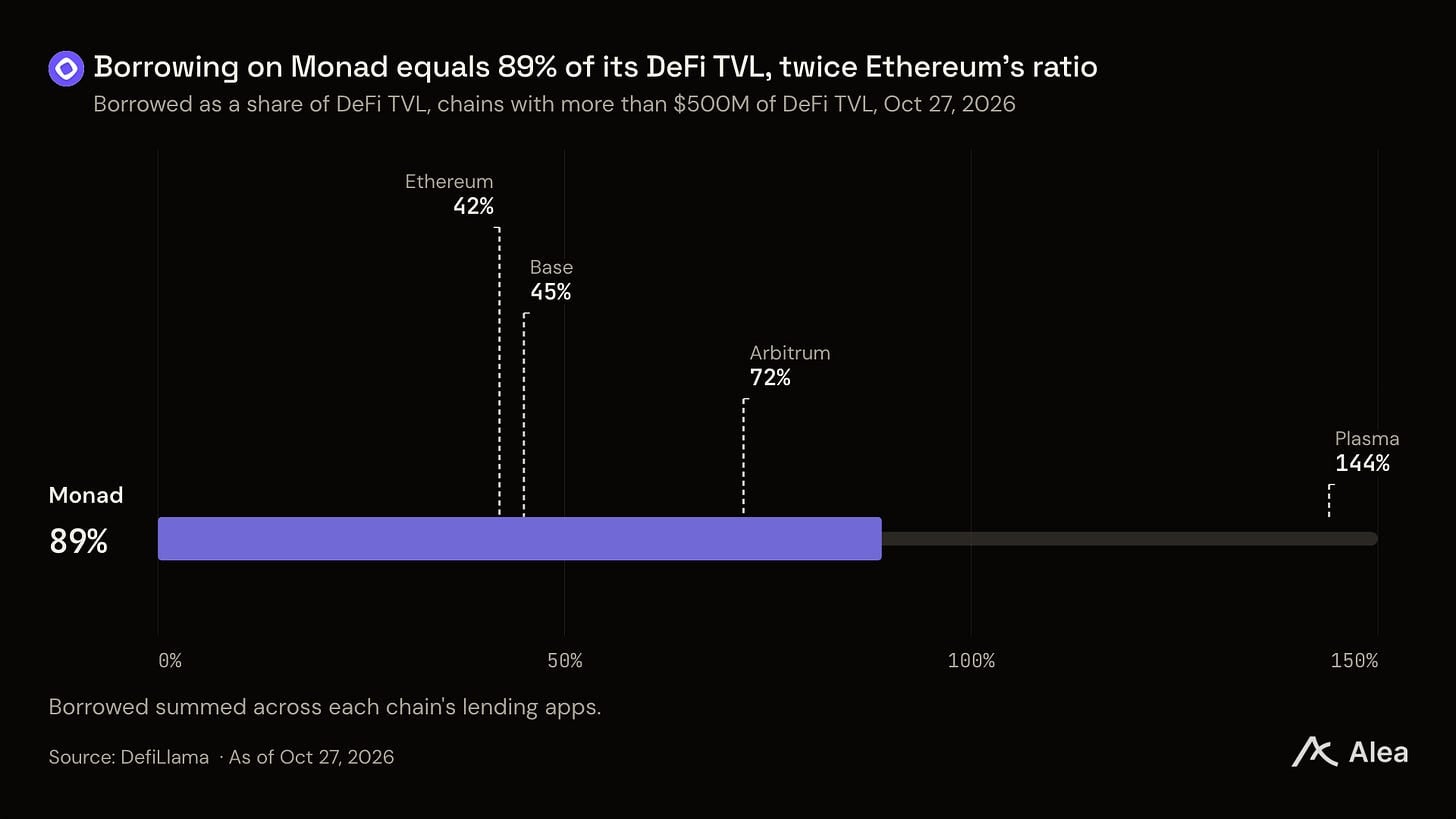
Image: For every $1 deposit on Monad, $0.89 circulates as lending assets, with a utilization rate far exceeding Ethereum and Base
From the perspective of fund flow and distribution mechanisms, borrowers pay interest to liquidity depositors through various lending applications. Taking Aave as an example, the protocol extracts a reserve from the interest (10% for stablecoins, up to 20% for high-volatility assets), while the majority of interest income goes directly to depositors. In September, depositors on Aave at Monad received an average annual percentage yield (APY) of 5.8%, while borrowers paid an average lending rate of 6.4%. Morpho, Euler, and Curvance pass almost all interest directly to depositors, extracting only a small management fee under explicit community governance approval.
Aave Becomes the Third Largest Fee Generating Market
A case study published by Monad in September indicated that Aave's Monad market rose to become the third largest source of fee contributions from all chain deployments of the protocol just 46 days after its launch, following only Ethereum's mainnet and Arbitrum.
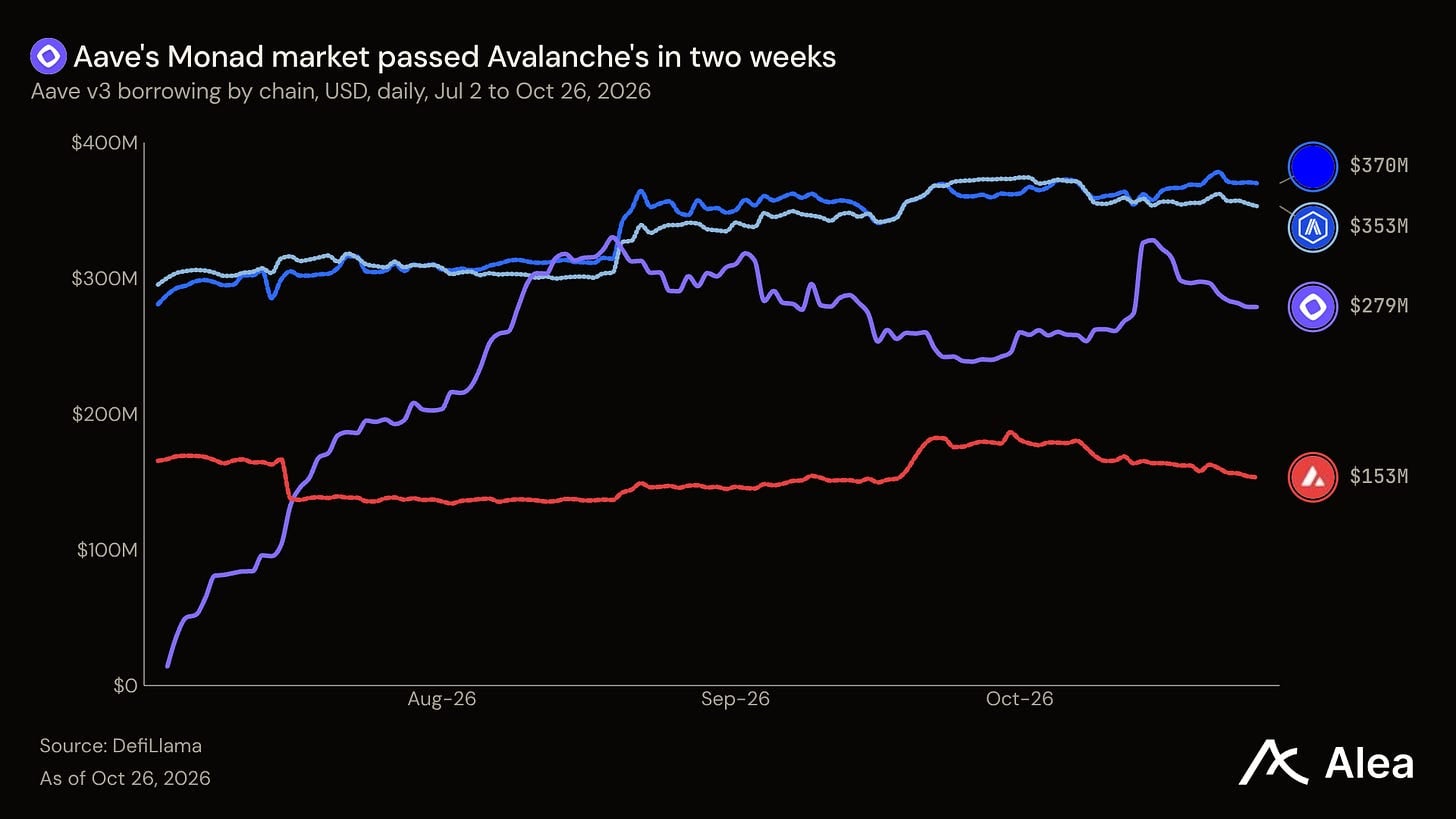
Image: Aave's loan balance on Monad surpassed Avalanche within two weeks and briefly equaled Base and Arbitrum in August
Aave's loan balance on Monad exceeded Avalanche within two weeks of launch and briefly surpassed both Base and Arbitrum in mid-August. In September, its utilization rate remained stable at 78%, significantly higher than Ethereum's mainnet at 65% and Arbitrum's 61%.
Spot Transaction Fees Down to 1.2 Basis Points
Amid the explosive expansion of credit scale, the spot trading volume on the Monad chain has maintained rapid growth, while actual trading costs have significantly decreased. In the 30 days ending September 30, the average liquidity pool fee for spot trading on Monad was only 1.2 basis points (0.012%), far lower than 7.3 basis points in December 2025. During the same period, the monthly spot trading volume across the network surged from $412 million to $4 billion.
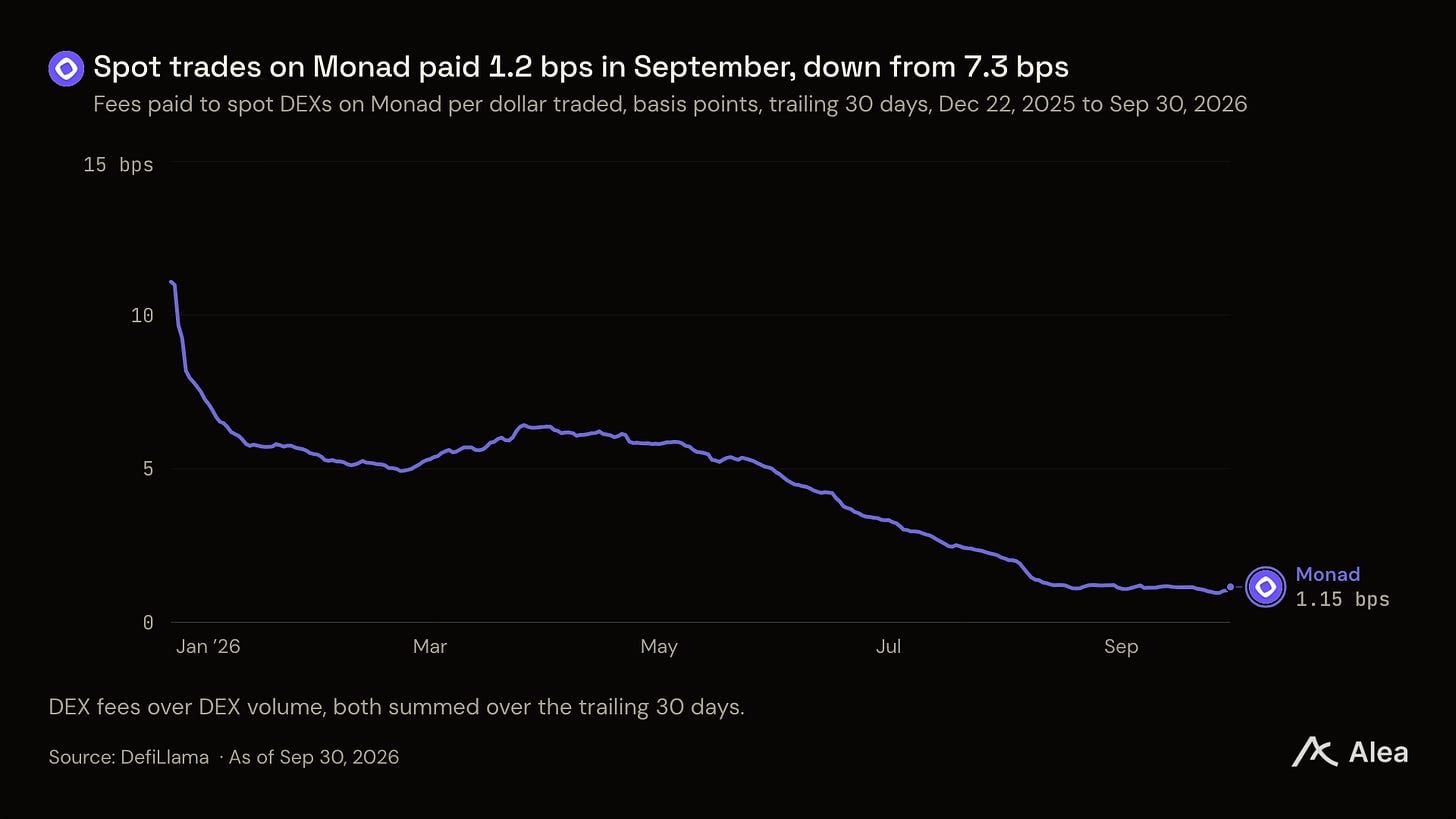
Image: As the monthly trading volume broke $4 billion, Monad's average fee rate for liquidity pools dropped to 1.2 basis points
Two underlying mechanisms contributed to the dramatic decline in trading costs: First, Uniswap V4 supported about half of the total spot trading volume across the chain in the month ending October 26, 2023, and its Hooks mechanism allows liquidity providers to quote tighter bid-ask spreads for stablecoin trading pairs; second, market makers began widely adopting internal routing algorithms to match trades between private pools, bypassing the public AMM pools with larger spreads.
MON Token Value Capture and Significant Valuation Discount
MON tokens are used to pay Gas fees and secure network consensus through a staking mechanism. Monad deliberately maintains very low Gas fee rates from a design perspective: users across the network paid only a total of $33,000 in Gas fees in September, averaging less than one-tenth of a cent per transaction. The staking rewards for validating nodes mainly come from token inflation, with an annual yield of about 4.2%.
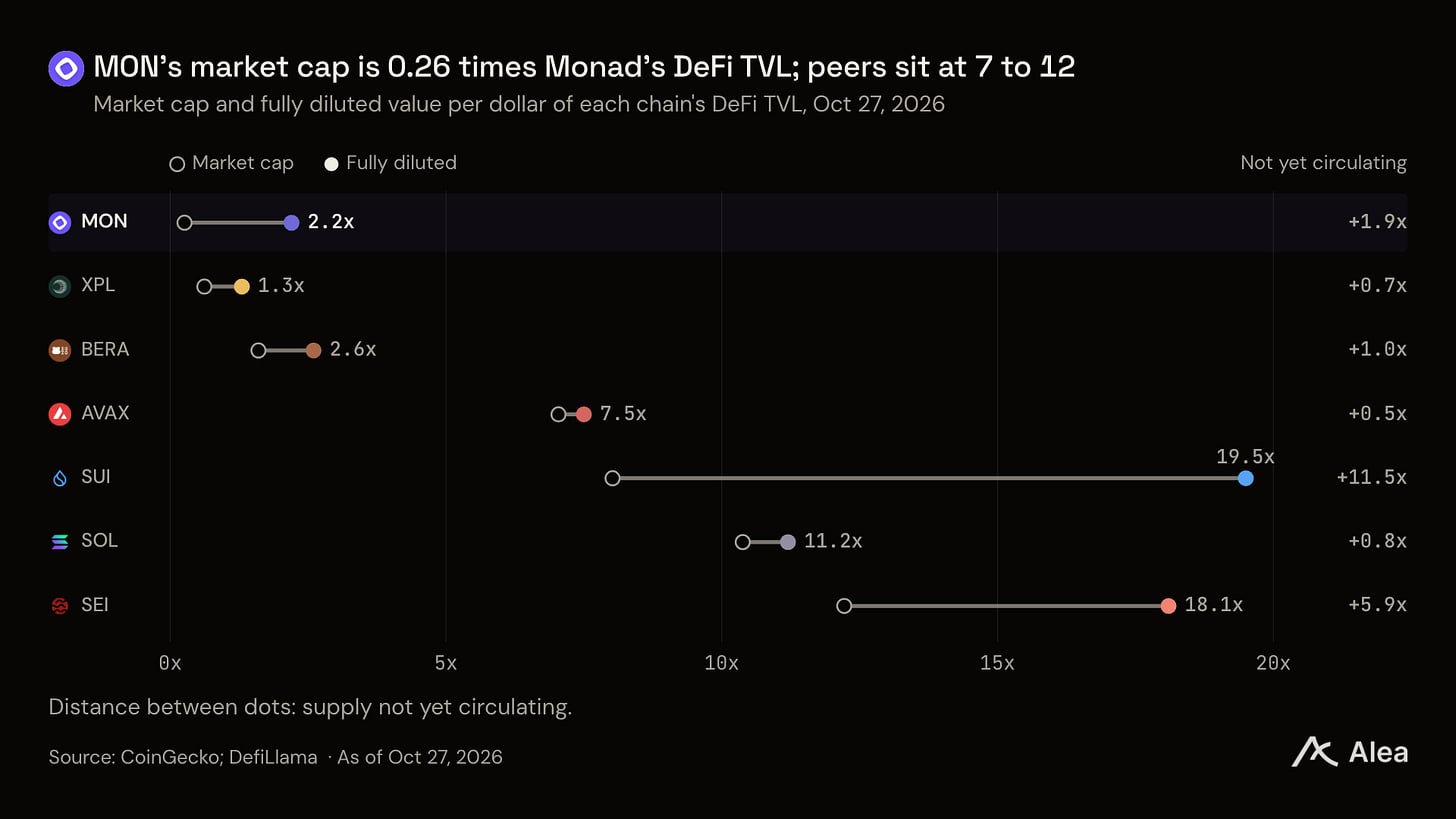
Image: A horizontal comparison of circulating market value and fully diluted valuation versus TVL multiples shows MON's valuation multiple is significantly lower than its peers
Since the first complete trading day in November 2025, MON has fallen by a cumulative 29%, while the declines of AVAX, SUI, SEI, and APT during the same period generally range from 41% to 68%. Based on circulating market value, MON's market capitalization is only about 0.25 times its on-chain DeFi TVL, while competing products maintain multiples between 7 and 12; even when measured by fully diluted valuation (FDV), MON's valuation is only 1.8 times its DeFi TVL, far below the median level of 9.4 times among peers. Previously, Monad had offered a discounted liquidity plan to early seed round investors, but according to official disclosures, nearly all early investors declined the discounted cash-out proposal.
Annualized Interest Model: $56.5 Million Annual Revenue and Credit Expansion Estimates
Monad's current fee income base is essentially a large outstanding loan stock, and its annual interest income is the product of two indicators: the outstanding loan size and the average weighted borrowing rate. As of September 30, the outstanding loan stock from six lending platforms across the chain was $909 million, and the average weighted borrowing rate corresponding to actual fees in September was 6.2%. At this interest rate level, borrowers pay Monad's depositors and lending applications up to $56.5 million in annualized interest.
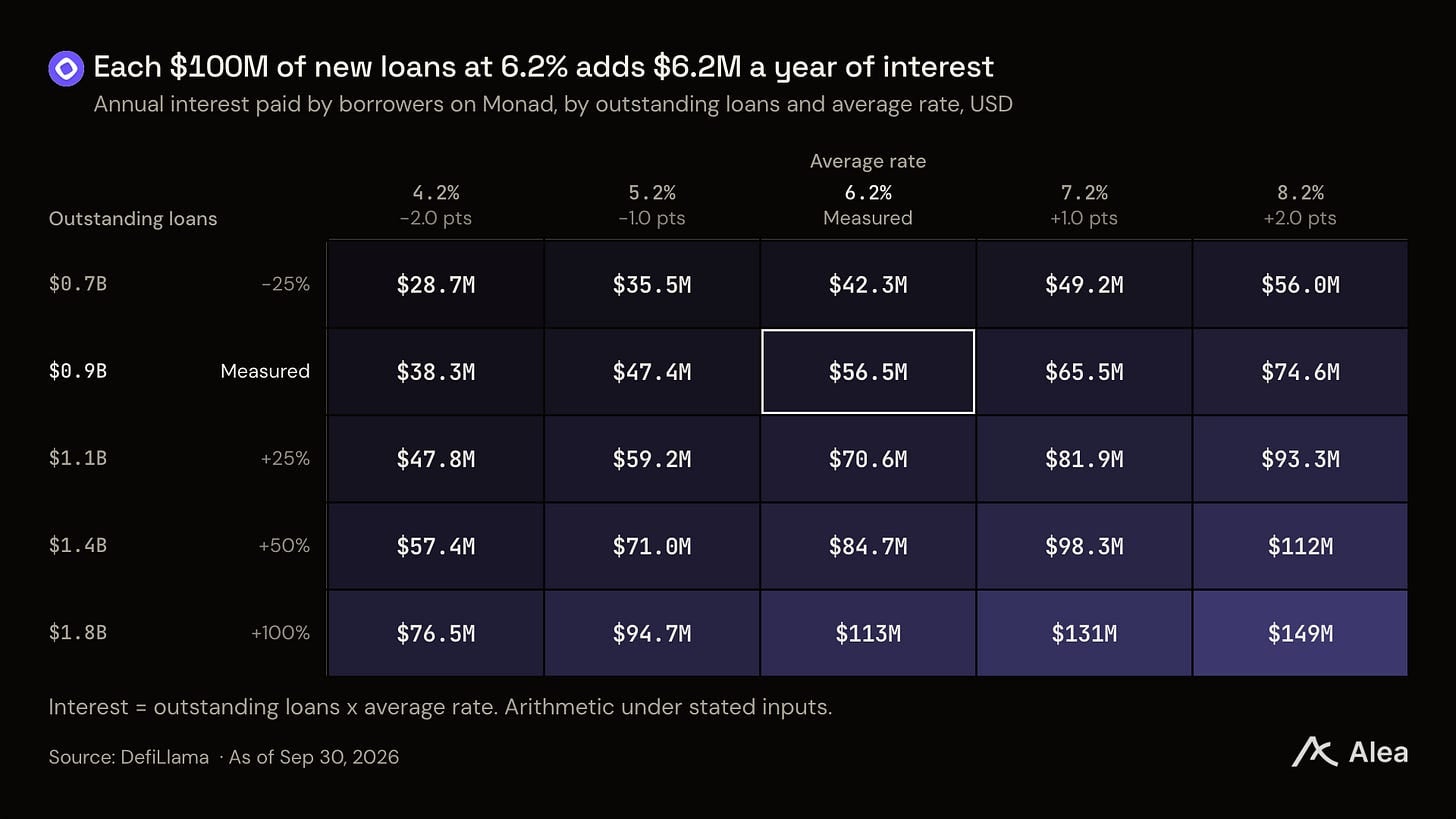
Image: A sensitivity assessment matrix for annual interest income based on outstanding loan size and weighted rate products
At a benchmark rate of 6.2%, for every additional $100 million in outstanding loans, an additional $620,000 in annual interest income can be generated. If the outstanding loan size doubles to about $1.818 billion, the annualized interest at the same rate will exceed $113 million; even if the overall lending scale shrinks by a quarter and the interest rate drops to 4.2%, annualized interest income can still reach $29 million. This sensitivity assessment matrix is not an empty future prediction, as the data growth logic listed above aligns closely with several significant deployment initiatives currently underway: including the launch of Aave V4, introduction of private credit for infiniFi Prime's fintech savings accounts, the issuance of XSGD and XUSD stablecoins on Monad by StraitsX planned for early 2027, and private settlement domains tailored for institutional investors by Category Labs.
In the first year of its mainnet operation, Monad successfully built the financial economic ecology initially envisioned by its founding team, with credit being the core engine of the entire ecosystem. Top quantitative trading institutions borrow large amounts of funds from verifiable vaults, Aave borrowers pay a funding premium higher than Base or Arbitrum, and each credit transaction completes final settlement within 600 milliseconds. Amid a generally contracting cycle for the entire DeFi industry, Monad has achieved an explosive growth of nearly eightfold in outstanding lending scale, safeguarded by a decentralized network maintained by MON stakers.
免责声明:本文章仅代表作者个人观点,不代表本平台的立场和观点。本文章仅供信息分享,不构成对任何人的任何投资建议。用户与作者之间的任何争议,与本平台无关。如网页中刊载的文章或图片涉及侵权,请提供相关的权利证明和身份证明发送邮件到[email protected],本平台相关工作人员将会进行核查。


