The New York Stock Exchange will settle stocks on its proprietary chain based on Avalanche technology, while the Avalanche Foundation also acknowledges that ecological value will not automatically flow to AVAX.
Author: Sanqing, Foresight News
On November 9, The Wall Street Journal reported that the New York Stock Exchange stated that its upcoming 24/7 tokenized securities trading platform will only use Avalanche to settle tokenized stocks. On the same day, Ava Labs announced that Avalanche will provide core ledger technology for the clearing company associated with this New York Stock Exchange platform, and the New York Stock Exchange's pre-market information confirmed this matter.
The platform operates in the form of an Alternative Trading System (ATS), aiming to launch in the fourth quarter, and is still pending regulatory approval. After the news was released, according to Bitget market data, AVAX peaked at 9.01 USDT, and as of the time of writing, it was reported at 8.627 USDT, with a 24-hour increase of 6.86%.
Trading and Settlement Architecture
According to the plan disclosed on November 9, the platform's matching will use the existing Pillar engine from the New York Stock Exchange, with settlements processed by the platform's clearing company on the Avalanche ledger immediately after trades occur, and investors can deposit using stablecoins.
Ava Labs Chief Business Officer John Nahas revealed in an interview that the New York Stock Exchange is not settling on the Avalanche public chain but is operating a blockchain customized according to regulatory requirements based on Avalanche technology.
The New York Stock Exchange announced the issuance arrangements a week prior on November 2: in addition to Securitize and tZERO, Broadridge, Computershare, Equiniti, and Superstate have been added as transfer agents, bringing the total number of partners to 6. The tokens traded on the platform are divided into those issued by custodians and those issued by the issuers themselves, both of which are interchangeable with traditional stocks, and holders enjoy the same dividends and voting rights.
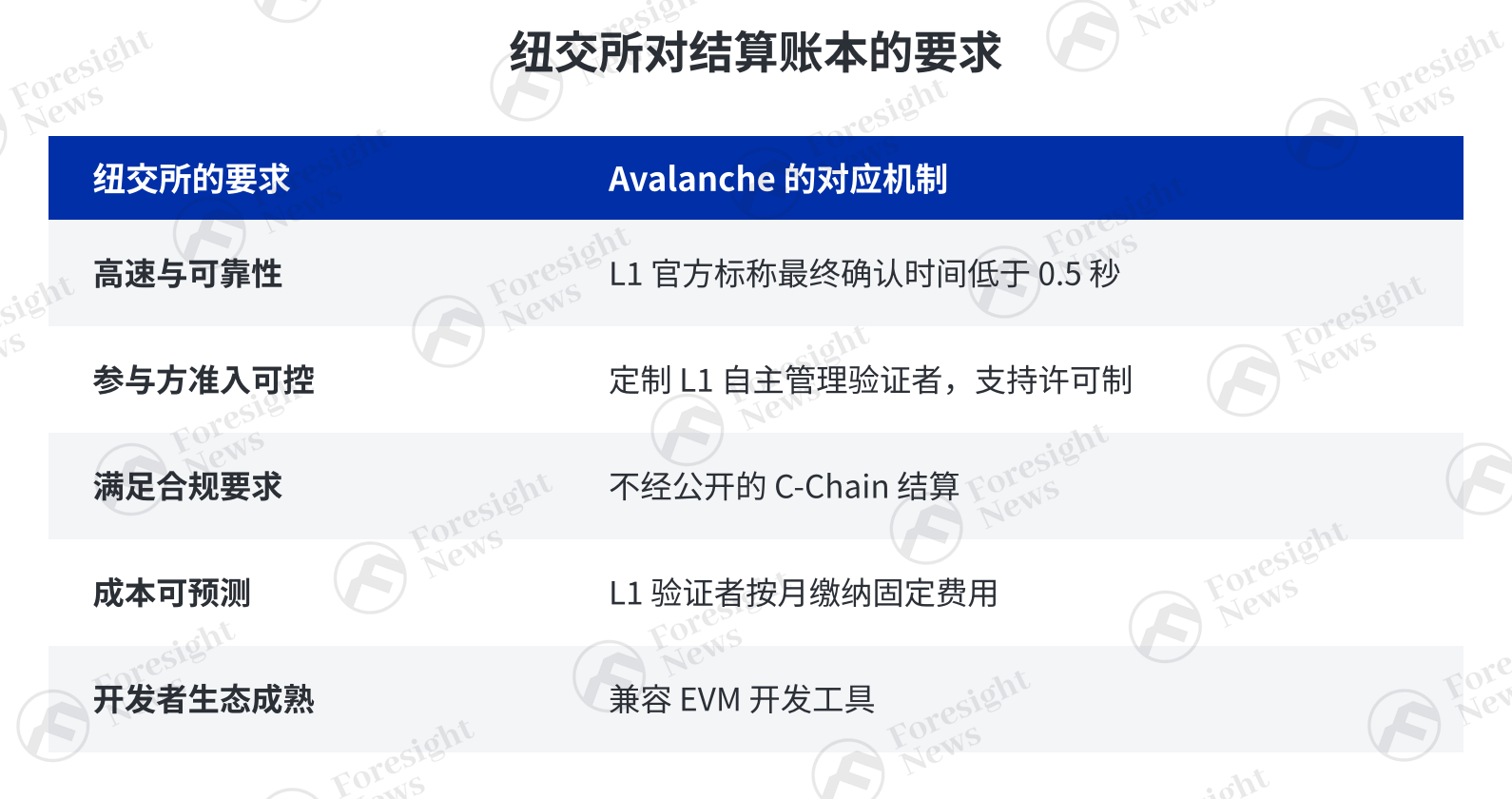
Dennis Lee, head of digital issuance at the New York Stock Exchange, stated that the platform supports the issuance of stocks on multiple chains, but the ledger for recording and settling transactions must be fast, reliable, able to control participants, cost-predictable, and have a large developer community, all of which Avalanche meets. As a result, stock issuance is dispersed among multiple transfer agents and chains, while settlement is uniformly consolidated to the New York Stock Exchange's own chain.
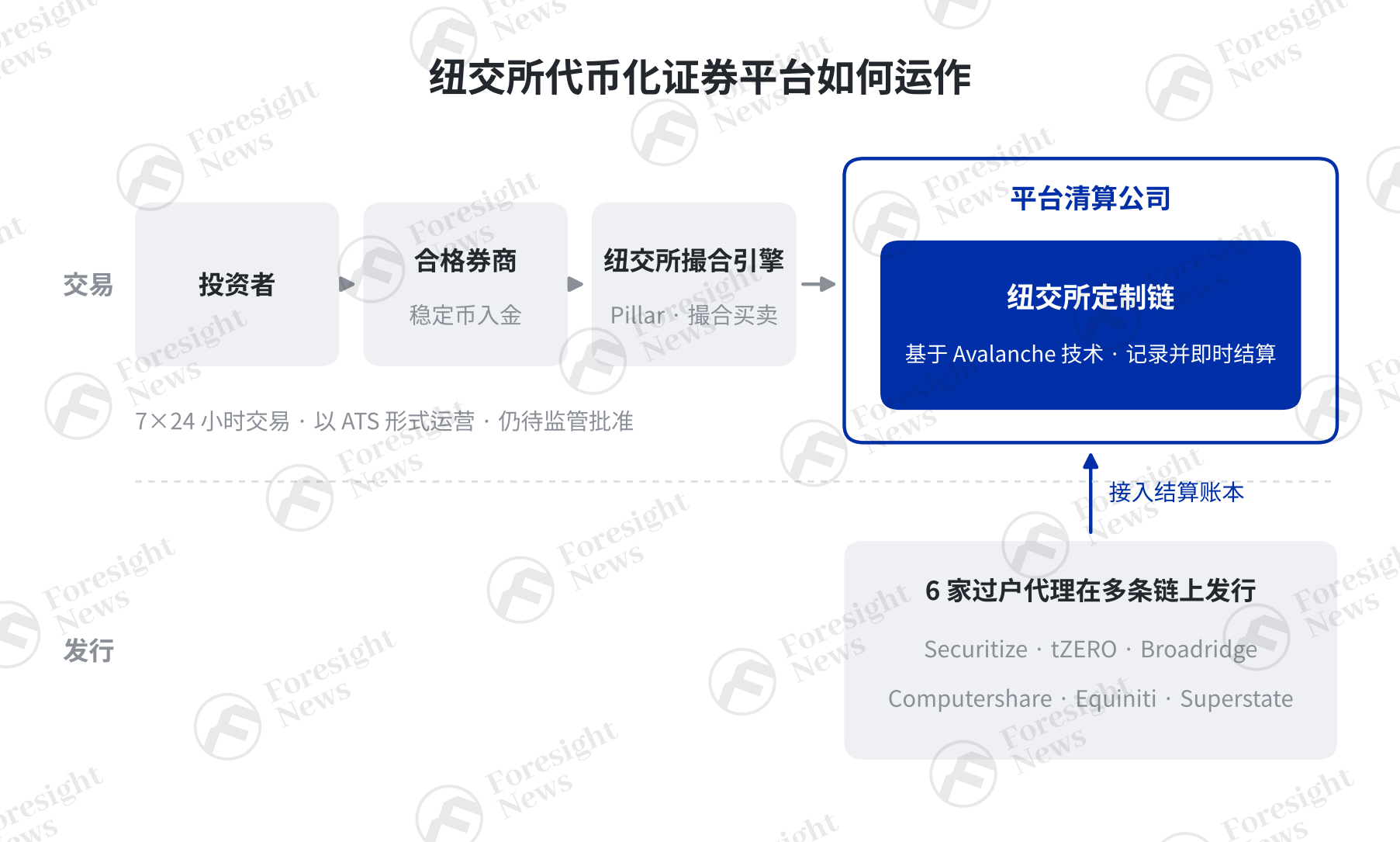
The New York Stock Exchange announced the development of this platform and sought regulatory approval on January 19; on August 31, its parent company Intercontinental Exchange (ICE) signed a memorandum of understanding with tZERO; at the Avalanche Summit in September, Ava Labs President Charley Cooper revealed that the New York Stock Exchange had been testing Avalanche for about a year, but did not announce its selection at that time. Cooper confirmed during the NYSE Live program on November 9 that this deployment is aimed at the production environment, not another pilot.
Compliance Access and Customized L1 Model
The New York Stock Exchange stated in its January announcement that the platform has the capability to support multiple chains for settlement and custody, but by November this narrowed down to only using Avalanche. Kevin Tyrrell, Chief Product Officer of the New York Stock Exchange, said that several suppliers were tested before selection, with emphasis on speed, throughput, and the ability to support controlled networks and compliance requirements. Nahas also stated that both parties completed reviews of technology, business, and ecological aspects before selection, which lasted more than a year.
Among the conditions mentioned by Dennis Lee, controlling participants is the most critical. Participants in stock settlement must go through access approval, while the C-Chain on the Avalanche mainnet is a public chain, allowing anyone to connect, which does not meet this requirement.
The New York Stock Exchange's customized chain corresponds to the self-built L1 model introduced by Avalanche after the Etna upgrade (ACP-77). The institution's self-built L1 operates independently of the mainnet, manages the validator set itself, and can be permissioned; validators do not have to stake 2000 AVAX to become mainnet validators but only need to pay a fixed fee monthly, which also meets the requirement of predictable costs.
Regarding the issue that self-built chains may easily become isolated from external ecosystems, Ava Labs CEO Emin Gün Sirer mentioned in the announcement that this dedicated infrastructure can still connect to a broader asset and liquidity ecosystem, and various L1s on Avalanche can also communicate through native cross-chain messaging.
According to rwa.xyz data, as of November 9, the scale of distributed Real World Assets (RWA) on Avalanche is 1.43 billion USD, and the scale of registered RWA is 11.4 billion USD, with a stablecoin market capitalization of 795 million USD.
The Foundation is Also Looking for Entry Points for AVAX Value
The announcements from Ava Labs and the New York Stock Exchange did not mention the use of the AVAX token in settlements, transaction fees, or staking. According to the mechanism of the customized L1 by Avalanche, the direct revenue of AVAX only comes from continuous fees paid by validators.
According to Avalanche documentation, when there are fewer than 10,000 L1 validators, each validator pays about 1.33 AVAX per month, which will be burned, but this is unrelated to the number and amount of settlements; the transaction fees within L1 can also be priced in tokens determined by the operating party.
On July 30, the Avalanche Foundation acknowledged in announcing its economic research agenda that the value created by the ecosystem will not automatically flow to the AVAX that secures network security, with Chief Investment Officer Matias Antonio stating that this is a core issue the foundation is addressing.
According to an estimate released by the foundation on August 12, among the on-chain economic activities it has tracked, the main capture of value for AVAX currently comes from the destruction of C-Chain transaction fees, totaling about 23.5 million USD since early 2024 (excluding L1 validator fees); revenue sharing from L1 is still under research, with no set mechanism.
The latest monthly data in this estimate is from June: the nominal GCP (similar to on-chain GDP) created on the Avalanche chain is 3.1 million USD, assets like tokenized funds generated returns of 2.7 million USD for holders, and issuers earned 6.9 million USD from reserve assets. The foundation believes that the latter two parts are currently contributing little to the value capture of AVAX.
The improvement directions listed by the foundation include adjusting gas prices based on validator votes (ACP-283), a protocol-owned stablecoin (ACP-67), and revenue sharing for applications and L1, all of which are currently in the research stage.
Under the existing mechanism, the settlement activities on the New York Stock Exchange's customized chain are also not within the capture range of AVAX, with only the validator fees touching AVAX. Meanwhile, as the current main capture channel, the transaction fee scale of the C-Chain itself is not large; according to DefiLlama data, on November 9, the Avalanche C-Chain transaction fees were approximately 26,500 USD.
On the day the news was released, the Avalanche Foundation tweeted that it would track the activities of the platform and its role in the Avalanche economy through its economic research agenda.
The New York Stock Exchange aims to launch this platform in the fourth quarter, requiring regulatory approval beforehand.
免责声明:本文章仅代表作者个人观点,不代表本平台的立场和观点。本文章仅供信息分享,不构成对任何人的任何投资建议。用户与作者之间的任何争议,与本平台无关。如网页中刊载的文章或图片涉及侵权,请提供相关的权利证明和身份证明发送邮件到[email protected],本平台相关工作人员将会进行核查。


