AI computing power financing is spilling over from banks to the blockchain, with GPU mortgage loans becoming a window to observe bubbles and opportunities.
Written by: @PinkBrains_io
Translated by: AididiaoJP, Foresight News
AI Computing Power Debt Soars, On-Chain Credit Fills Bank Gaps
Elon Musk has poured cold water on the AI computing power boom. In response to Chamath, he said that in recent weeks, the debt market has nearly closed its doors to a certain type of company: those that heavily rely on AI data centers and lack other significant sources of revenue.
SpaceX is an exception. It signed a $40 billion financial lease to procure Nvidia's Vera Rubin chips, with lead parties including Apollo and Goldman Sachs, expected to complete by the end of the year. SpaceX claims this is the largest GPU financing ever. It has an investment-grade rating and also generates revenue from Starlink and rocket launches.
Musk's assessment is more severe: more than 200 neocloud companies will face large-scale liquidation and consolidation. Neocloud refers to cloud companies that only rent GPUs, including CoreWeave, Nebius, Lambda, Crusoe, and hundreds of small companies. Amazon, Google, and Microsoft are regarded as "hyperscale cloud providers."
The credit market has started pricing this in. In mid-October, CoreWeave's credit default swaps hit a record, indicating a default probability exceeding 60% over the next five years. Gartner predicts that by 2030, over 80% of neoclouds will cease independent operations.
However, demand for computing power is still rising. The neocloud index from Silicon Data shows that from September 28 to October 27, the hourly rental price for B200 on professional GPU clouds rose from $5.78 to $6.47. More telling is H100: it was released in 2022, and since then, Nvidia has launched two new generations of products, which typically should depreciate; however, the rental price is 45% higher than last December—demand is so strong that even old chips are in demand.
With high demand, operators need to buy more GPUs. GPUs are expensive, and with rapid expansion, operators' capital is insufficient, necessitating borrowing. But bank money only flows to large neoclouds (GPU cloud vendors), and small operators with only a few hundred GPUs mostly cannot borrow.
This financing gap has emerged: small operators have rental income and chips but cannot secure bank loans. Thus, GPUs began to be used as collateral, with on-chain credit supported by stablecoin deposits filling the gap that banks are unwilling to cover.
1. Computing Power Becomes a Debt Business, Banks Only Do Large Deals
AI computing power has become a debt business. American Compute reports that since 2023, there have been 110 disclosed GPU and data center financings totaling $197 billion in new funds, with 92% raised in 2025 and 2026.
Banks dominate the market. Since July 2025, in 49 transactions with clear lenders, 32 were led by JPMorgan, Goldman Sachs, Morgan Stanley, or MUFG.
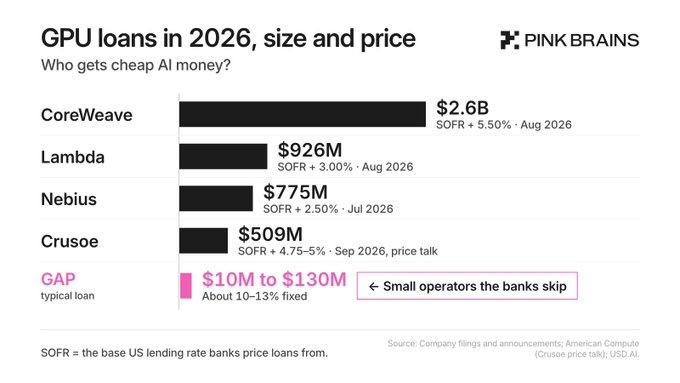
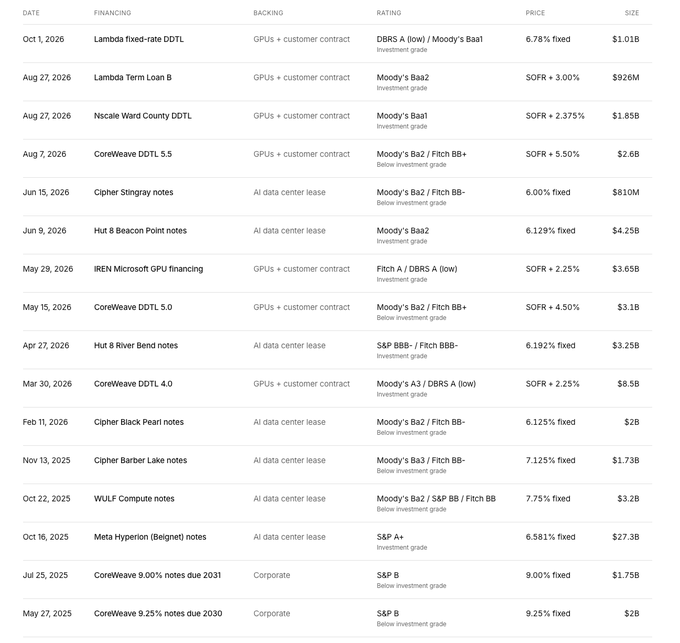
Pricing depends on tenants, not chips. In 2026, the loan rates backed by investment-grade leasing contracts are between SOFR + 2.25% and 3.0%; unrated or sub-investment-grade loan rates are between SOFR + 4.5% and 5.5%, or 9% to 10% fixed rates. SOFR is the overnight borrowing rate collateralized by U.S. Treasury securities and serves as the pricing basis for most U.S. loans.
CoreWeave secured the largest loan on the list at the highest interest rate. Its loan rate is 5.50 percentage points above the benchmark SOFR and 3 percentage points more expensive than Nebius. This level is already at the upper bound for banks lending to sub-investment grade borrowers—borrowing the most, but also paying the most.
Large buyers usually don't borrow company loans directly, but use SPVs. An SPV is an independent legal entity that buys chips, rents them out, and incurs debts, keeping the chips, leases, and debts outside the corporate body.
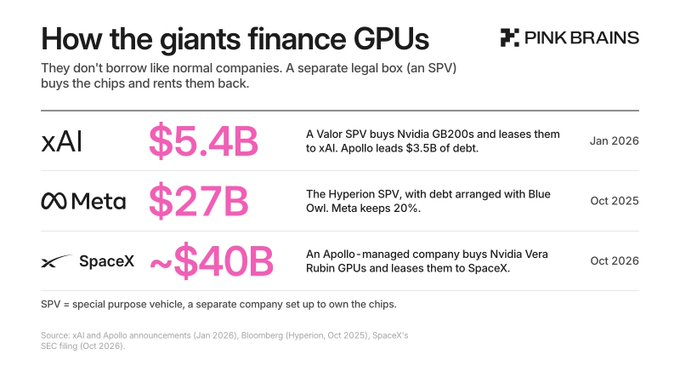
This structure is effective at the top, but becomes uneconomical as it goes down. According to The Token Dispatch, banks' due diligence costs do not vary with the size of the transaction. On a $1 billion loan, this is trivial; on a $30 million loan, the due diligence costs could kill the deal.
The key change is that banks have gained the pricing power for GPU credit but only cover large borrowers worth the due diligence. Who will serve small neoclouds? On-chain credit.
2. GPU Mortgage Loans: Like Auto Loans, Not Like Mortgages
USD.AI is a case in point. It lends using stablecoin deposits, taking GPUs and leasing contracts as collateral. An October report shows it has initiated 20 financings totaling $531 million, ranging from several hundred thousand dollars to $128.9 million per loan.
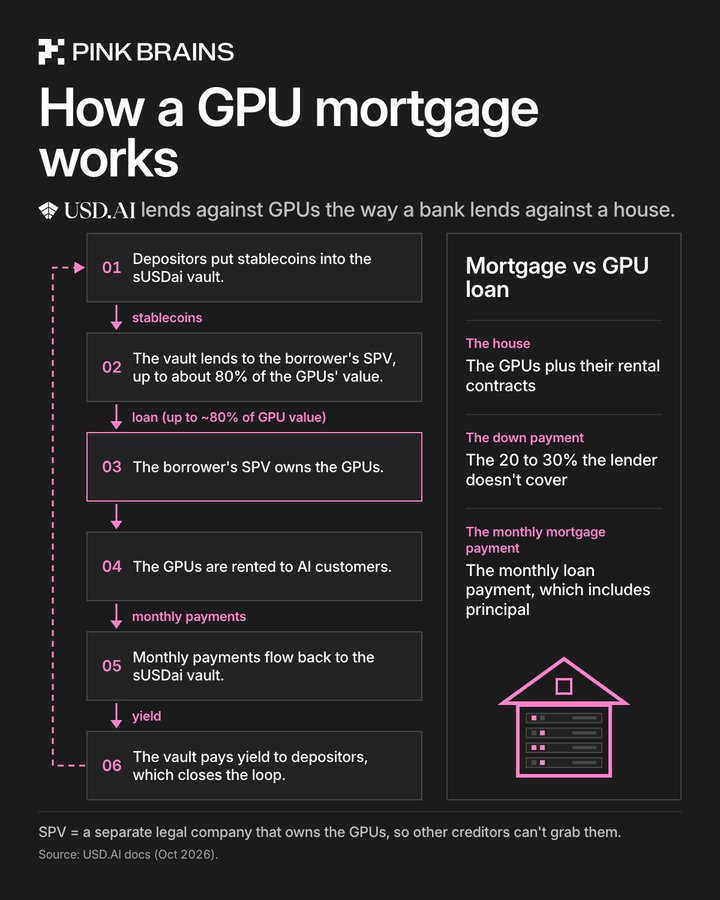
It has scaled down the bank's SPV structure to medium-sized transactions. The borrower's SPV owns the GPUs, while USD.AI holds the first priority lien on the servers and the SPV's equity. Loans typically cover 70% to 80% of hardware costs, with borrowers covering the remaining portion, which is held in an escrow account, and funds are released only after server installation and verification. Rental income is then used to repay the loan.
Borrowers pay more than banks. USD.AI's rates range from 7% for investment-grade leasing contracts to 15% for contracts without deployment. From January to early August 2026, 15 tracked loans had rates between 10% and 15%, with a median of 12%. Bank fixed rates for sub-investment-grade borrowers are about 9% to 10%. The selling point is not the price, but the access and speed: USD.AI claims loans can be completed within 7 days.
What happens in the event of default? The agent first tries to find another operator for the SPV to continue operations or sells the entire SPV to repay the loan; if that fails, the servers are sold off individually through IT asset liquidation companies.
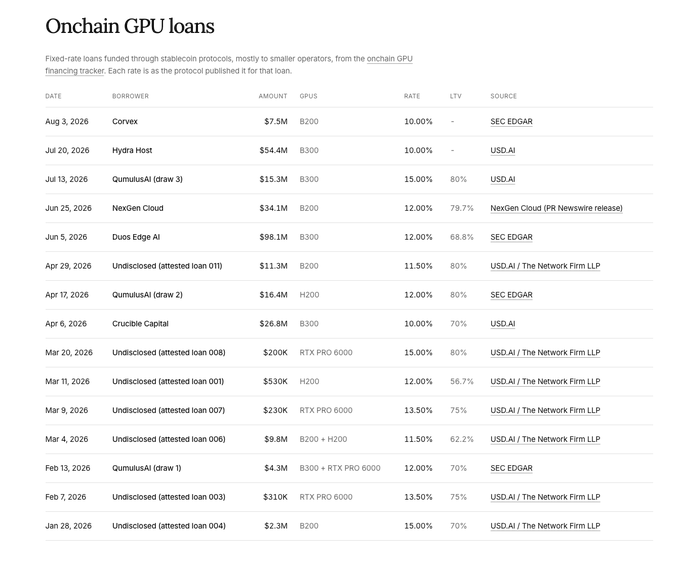
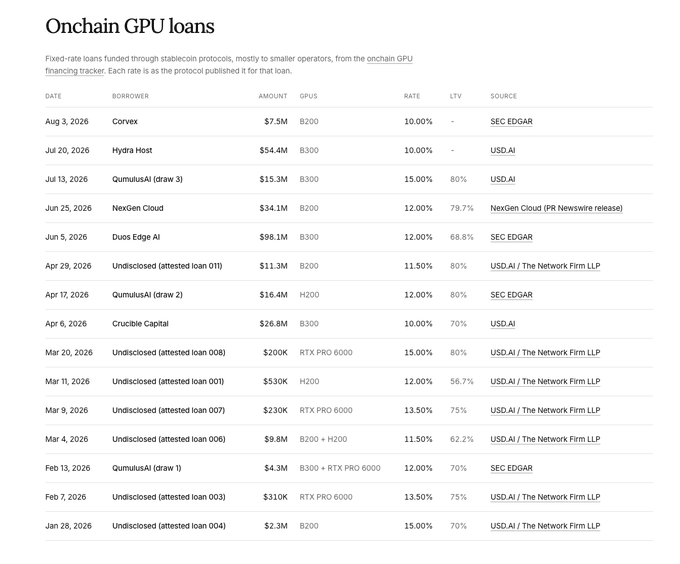
GPU mortgage loans are more like car loans, not like home loans. A house can last 100 years, but a GPU may become obsolete in two to three years. Thus, USD.AI's loan term is about 3 years, not 30; the collateral rules only accept the latest chips: B200, B300, GB200, GB300, VR200, as well as AMD's MI455X and MI430X. The residual value warranty is 150 basis points per year, deducted from profits to cover part of the resale risk.
3. Where sUSDai's Earnings Come From
sUSDai is backed 1:1 by PYUSD, with PYUSD reserves including U.S. Treasuries; sUSDai itself does not earn interest. After staking, it generates sUSDai, which funds loans and accumulates interest. Only sUSDai holders bear the GPU credit risk. Redemptions are processed every 30 days in batches, subject to available liquidity, with loan terms of about 3 years.
The target yield rate is called the CHIP Hurdle Rate, set at 7%. On November 1, the annualized yield for sUSDai was 6.53%, with USD.AI injecting about 128,000 USDai to raise it to 7%. From January to early June 2026, the average yield was 7.0%.
The median interest rate paid by borrowers is about 12%, while depositors earn around 7%. The difference flows to three areas: 150 basis points for the residual value warranty, a 10% commission on interest from the agreement, and idle cash sitting on treasury rates during the waiting period for disbursement.
DefiLlama shows that in October, fees totaled $4.87 million, with protocol income of $487,000. The income is 10% of the fees, consistent with the net interest margin retained by the protocol from sUSDai earnings. In the past year, the protocol's gross revenue was $24.75 million, with initiation fees raising the protocol's share, including a peak income of about $3 million on June 4, the day after Duos' loan announcement.
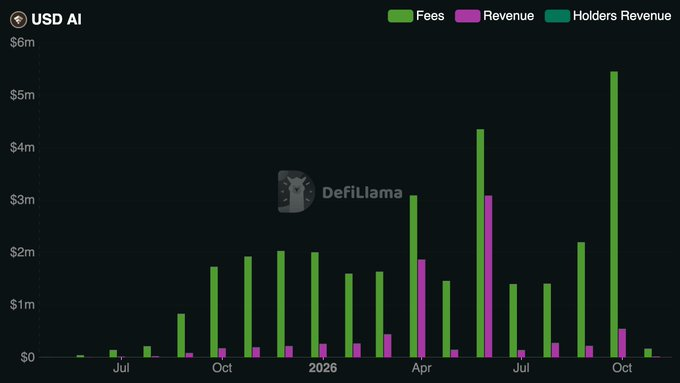
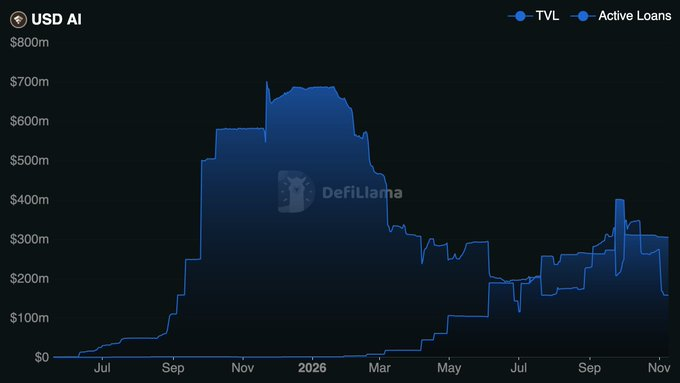
Deposits once far exceeded loans. At its peak of nearly $700 million, loans stood at only about $1 million, influenced by inflows related to airdrop expectations. By mid-October, active loans totaled $177 million, and another $134 million was held in escrow awaiting chip delivery; DefiLlama's $309.5 million in active loans is close to the sum of both. Idle cash still earns interest but only at treasury rates. GLX was designed to deploy idle funds more quickly.
4. GLX: Selling Loans and Lending Again
For USD.AI, holding a 3-year loan means bearing 3 years of default risk. Moreover, if the borrower scales up, they may switch to cheaper bank loans—Sharon AI recently transferred to a bank at a 9.95% interest rate.
There is also pressure on funding. Depositors can redeem every 30 days, but loans last up to 3 years. Such a maturity mismatch once led to Celsius' collapse. A 30-day queue can slow down a run but can't eliminate the mismatch. Many deposits still come from airdrops: peaking at nearly $700 million, lending less than $1 million. As of October 15, about $311 million was deployed, with $177 million in active loans and $134 million in escrow.
GLX launched on October 1, breaking the one-to-one correspondence between deposits and loans. sUSDai funds a loan, which is "seasoned" with timely repayments for several months before being sold, with cash then used to fund new loans. External lenders can also join at the initiation. On October 29, Silver Point Capital and Victory Park Capital teamed up with USD.AI to provide a $106 million 4-year loan to NexGen Cloud for 1,728 B300s in Finland. GLX's cumulative circulation has exceeded $200 million.
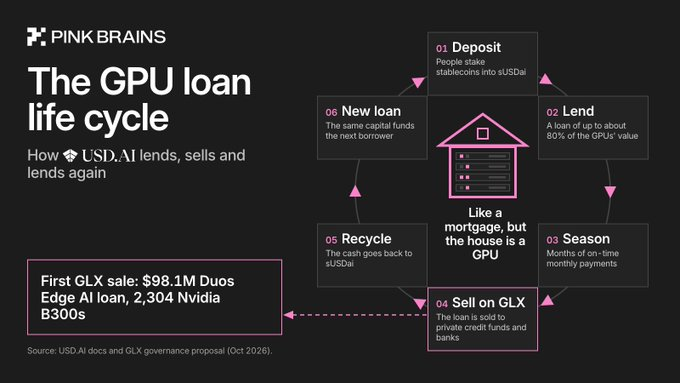
In terms of pricing, loans are sold at a minimum of par value 100, which means no discount, sold at original price. Above 100.5 is the "commercial guide price," encouraging sales at this level but not a strict minimum price. 99.5 is the floor price, only allowed in one case: if after 30 days of redemption queue, the redemption requests still exceed available cash, meaning liquidity is tight, minimal discount sales are permitted.
In terms of revenue, 60% of the proceeds from sales go to USD.AI Inc., which operates GLX, and 40% goes to Yield Reserve. Yield Reserve is a profit reserve used to bring sUSDai's yield to the 7% target. Discounted sales do not participate in the revenue share.
As for buyers, they cannot have economic connections with proposers, to prevent self-dealing.
For instance: a $10 million loan sold at 100.5 yields $50,000 in profit, split into $30,000 and $20,000. A processing fee of 2% to 3% as quoted by USD.AI can further lend this $10 million to earn an additional $200,000 to $300,000. The profit lies in the re-lending, not the selling price.
The only completed exit loan currently is from Duos Edge AI.
On June 5, 2026, USD.AI issued a $98.1 million 3-year loan to Duos Edge AI, a subsidiary of the publicly listed company Duos Technologies, with collateral of 2,304 B300 chips. If the loan defaults, USD.AI can only pursue the SPV and chips, but not Duos itself—the risk is isolated within the SPV.
In September, another GPU operator, Axe Compute, purchased the entire SPV, paying off about $87.8 million in loans. Axe received a computing power cluster that had a signed 5-year lease, expected to generate $364.6 million in revenue.
For USD.AI, this loan recovered most of the funds in less than 4 months, allowing it to continue lending.
5. CHIP Buybacks and Scale Ceiling
For CHIP holders, the aforementioned operations ultimately fall to the protocol's 10% claim on sUSDai's interest. The more loans the treasury issues, the larger the claim.
GLX has two sides. Selling loans removes interest, and initiation fees go to USD.AI Inc.; however, cash that comes back is re-lent at about 12% instead of lying idle at treasury rates.
Buyback programs have already started. Net interest margins from sUSDai, after deducting CHIP Foundation costs, are 100% used for programmatic CHIP purchases. USD.AI has not set fixed amounts or timelines. Initiation fees remain with USD.AI Inc., and any surplus can be used to purchase CHIP; loan sale proceeds are distributed at 60% and 40%. The expense switch for USDai has not yet been activated.
Based on the buyback price of October 26, the circulating market value of CHIP is approximately $90 million, corresponding to 2 billion chips at $0.0448 each.
How much can the buyback program purchase in a year depends on the metric: based on the average level of the past 12 months, it could buy about 2.5% of circulating supply; at the current rate, about 6.5%.
On October 26, just two days before the buyback route was initiated, USD.AI Inc. manually purchased about 2.2 million CHIP for approximately $1 million USDC, at an average price of $0.044756, accounting for about 1.1% of the circulating supply.
This purchase equates to running the program for 5 to 6 months based on the past data or 2 months based on current speeds—purchasing both urgently and in volume.
The long-term goal is for the buyback volume to exceed the reward issuance volume. Emissions have already decreased from 3% in the first quarter to 2.25% in the second quarter; once purchases exceed new issuances, rewards will shift to a monthly, income-funded arrangement. Most DeFi buybacks rely on transaction fees, while CHIP buybacks depend on GPU loan interest, only possible as loan scales grow.
The scale remains very small. In 2026, GPU-supported debt fundraising is $48.4 billion, with on-chain lenders holding less than 1%. Based on approximately 12% loan rates and 10% protocol claims, capturing 1% of the market would fund about $5.8 million in CHIP buybacks per year, roughly 6.5% of the current circulating market value; capturing 5% would be about one-third. USD.AI holds 93% of the on-chain portion, with GAIB, Forum Markets, and Falcon Finance trailing behind.
6. Growth Boundaries of On-Chain GPU Financing
GPU loans can exist because collateral can generate rental income, and rents are still rising. The risks are also on the assets: GPUs depreciate rapidly, and Nvidia's next-generation products may simultaneously depress both rental and resale prices, while the small neoclouds served by on-chain lenders are the most likely to be consolidated.
However, there are also many reasons for growth. Banks have essentially closed their doors to small operators, and the lack of uniform regulations across states gives lenders who can complete loans in days an advantage. Potential data center restrictions after the U.S. midterm elections may drive construction towards smaller sites, which are better suited for rapid lending by clusters.
Demand outside of the U.S. is also rising. Nvidia's sovereign AI business revenue has more than doubled this year, exceeding $30 billion, with Canada, France, the Netherlands, Singapore, and the UK as major contributors. Some of this capacity will land through local new clouds like NexGen Cloud and Sharon AI, which are currently the target medium-sized borrowers for on-chain lenders.
Currently, on-chain GPU finance accounts for less than 1% of the total GPU-supported debt in 2026. It fills the gap that banks are unwilling to cover, rather than replacing banks. The growth of the protocol itself does not equate to an increase in token prices.
免责声明:本文章仅代表作者个人观点,不代表本平台的立场和观点。本文章仅供信息分享,不构成对任何人的任何投资建议。用户与作者之间的任何争议,与本平台无关。如网页中刊载的文章或图片涉及侵权,请提供相关的权利证明和身份证明发送邮件到[email protected],本平台相关工作人员将会进行核查。


