Author: thenarrator
Author: Deep Tide TechFlow
Deep Tide Introduction: There is a common structural mismatch in cryptocurrency trading: long positions desire the appreciation of the underlying tokens but must passively bear unpredictable funding rate bills; borrowers need liquidity capital but have to expose themselves to the volatility risk of floating interest rates.
When the additional friction costs that participants must bear to gain core exposure can be separately dismantled, priced, and hedged, hedging uncertainty itself becomes a whole new asset class.
This article delves into the financial engineering logic connecting funding rate policies to prediction market integration, deriving the commercial essence of underlying certainty underwriting capabilities.

Hidden Bills Behind Core Exposure
Deep within almost every transaction in the cryptocurrency market lurks another passive trade that was never part of the original intent.
When a trader establishes Ethereum exposure through perpetual contracts, they must unconditionally bear the costs of funding rate fluctuations while betting on price movements. When a borrower pledges spot to lend funds, they face the shocking impact of rapidly rising floating rates while obtaining immediate liquidity. When project teams build businesses around high-frequency trading, their overall profitability is tightly constrained by the fluctuations of on-chain friction costs.
The first exposure is usually the only reason users actively enter the market; the second exposure, however, is the additional burden that the system forcibly ties to everyone.
This binary division at the essential level gives rise to an enlightening thought experiment: what if the additional risks that participants are forced to bear to stay at the table could be separated and traded independently? What would happen to the entire cryptocurrency ecosystem?
Traders could firmly maintain a bullish outlook on Ethereum while refusing to pay for unpredictable hefty funding rates; borrowers could completely lock in future interest costs while urgently needing liquidity funds. In both typical scenarios, users have a core demand they strongly want to retain and an uncertainty hazard they are willing to pay to transfer.
In modern finance, the pricing capability that takes on and digests such uncertainties is precisely the most undervalued core asset in the current cryptocurrency world.
From Floating Costs to Standardized Financial Instruments
Assuming a trader holds a long position in Ethereum worth $100,000, their core logic is based on the expectation of Ethereum asset appreciation. However, the prolonged high funding rates will incessantly erode the actual economic profits of that position like a blunt knife slicing flesh. Even if their bullish logic is entirely correct, the high cost of maintaining the position may force them to exit before the market realizes.
While closing a long position can immediately stop the bleeding of funding rates, it would also completely give up the long-desired price appreciation; reducing positions lowers the absolute friction expenditure but proportionally shrinks core earnings. If there existed a separate claim certificate specifically for funding rate bills, traders would gain an unprecedented solution: accurately hedging the major part of the uncertainties generated by maintaining that position while fully retaining long price exposure.
Figure: Transformation Path Model from Floating Costs to Independent Standardized Derivative Instruments
At this moment, what originally belonged to the daily friction expense bill details transformed into the underlying asset subjects of a standardized financial derivatives trading market.
Consider designing such a standardized contract: the contract covers a fixed 30-day period, with each minimum trading unit corresponding to a nominal position exposure of $1,000. If the cumulative funding rate generated during the contract's validity period exceeds the baseline threshold agreed upon by both parties, the contract will automatically pay the buyer the premium costs exceeding that threshold until it reaches the reimbursement limit.
Under these rules, a trader holding a $10,000 exposure buys 10 contracts, while a trader holding a $100,000 exposure buys 100 contracts. Everyone competes under the same set of transparent standard rules, with the only variable being the number of contracts each requires.
The Intersection of Hedging Demand and Speculative Pricing Liquidity
The underlying mathematical logic of this mechanism is not complex; what endows it with astonishing commercial vitality is that buyers do not need to hold any perpetual contract positions at all.
Buyer A enters the trade because the soaring funding rates are eating into their spot long profits; Buyer B enters the trade purely because they judge that this rate insurance is severely undervalued based on volatility models and expect to earn multiples through rate surges; and Seller C, the market maker, is willing to provide sell orders on the opposing side because they calculate that the current underwriting premiums are sufficient to cover potential liability in probability distribution.
These vastly different trading motives ultimately point to the same standardized claim.
Figure: Matching Mechanism of Real Insurance Demand and Speculative Liquidity under the Same Payment Rules
This builds a crucial bridge between prediction markets and traditional hedging tools. A mature financial market can allow speculators to express divergences and views on future indicator trends while enabling those exposed to risks in real operations to gain effective protection. Hedgers bring natural real exposure demand, while speculators bring sharp sensitivities to pricing discrepancies; when both sides reach a consensus under the same payment structure, trading occurs naturally through deep matching.
However, once a real protection mechanism is introduced, the delicate construction of the payment curve becomes essential. A binary option that pays $100 only when the funding rate crosses a threshold equates slight overshooting with catastrophic rate surges, which is evidently ineffective for managing actual funding positions. Only continuous payment designs that grow according to premium proportions can truly capture the nonlinear damage caused by unpredictable costs.
Basis Risk and Structural Tension of Standardized Contracts
Simply labeling a product as "risk protection" does not mean it will be effective in the real world; the biggest hurdle in practical implementation lies in the irreconcilable differences between standardized contracts and non-standard personalized positions.
Two traders initially holding $100,000 of Ethereum exposure may face vastly different funding rate bills in actual operation. Each person's dynamic timing of increasing positions, the leverage used, and the chosen trading venues can vary greatly, while standardized contracts can only rigidly apply the unified rules locked upon issuance.
This objective mismatch between individual actual losses and contract payouts is referred to as basis risk in financial engineering. The amount of contract payout may be less than the actual loss, the timing of the payout trigger may lag behind liquidity liquidation points, or the slope of the payout curve may fail to accurately align with the friction changes of the spot position.
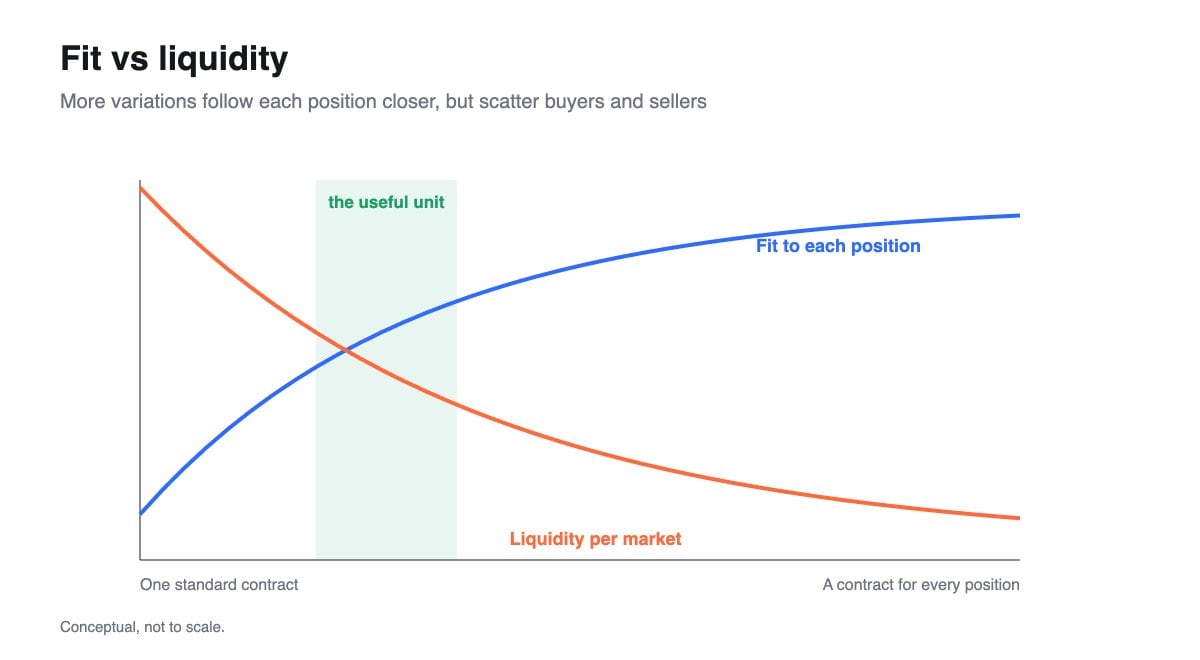
Figure: The Game Balance of Basis Risk between Liquidity Standardization and Personalized Fitting
This constitutes the most critical balancing tension in the entire product design: a finely tailored policy for a large account may perfectly fit its single position mathematically but is so highly non-standard that it lacks market liquidity in the secondary market, with no one willing to take on the offer; conversely, an overly simplistic universal contract may possess ample market-making depth yet struggle to meet institutional-level hedging standards due to excessive basis.
The true commercial sweet spot must lie in the narrow path between the two: finding a set of standard risk slices that can be shared by the greatest common divisor group and are sufficiently close to actual friction costs, while also firmly establishing this structure to support a deep order book for high-frequency circulation.
Underwriting Capability is the Ultimate Base of the Derivatives Market
The time dimension of liquidity cannot be neglected either. High funding rates will not only erode the final surface profits but will also drastically deplete the available margin in accounts before any market movements, forcing traders to face the dilemma of adding collateral or being subject to forced liquidation. The ultimate payout amount and the specific timing of payout arrival in the account are two mutually independent life-and-death attributes of a hedging tool.
This explains why preventing funding friction is never as simple as applying a set of contract codes to conjure up magic. On the opposing side of the contract buyer must stand professional counterparties capable of bearing real capital. Whether that counterparty is an independently actuarial market-making institution or a liquidity asset pool locked by a decentralized protocol, they must be well-prepared with adequate capital reserves for the extreme deviation that may occur.
Figure: Decentralized Underwriting Reserves and Liquidity Market-Making Capital Structure
In the long term, the real genuine profit of the underwriting fund pool entirely stems from its successful navigation and digestion of these extreme volatility risks over an extended period. Capital is not merely a rigid TVL number; it must possess a resilient structure that can continuously fulfill obligations during extreme market stress.
Prediction markets provide the micro-framework for pricing, derivative markets offer the settlement means for liquidity matching, while decentralized lending and market-making pools provide solid payment collateral. When these three mature tools are organically integrated around on-chain friction costs that everyone can genuinely perceive, a vast untapped market emerges.
Funding rates are tangible and visible; borrowing interest is concretely deducted, and users do not need anyone to sell them on why these expenditures are painful. In the unpredictable world of cryptocurrency, transforming the originally passive uncertainties into measurable, fundable, and freely tradable financial assets represents the most imaginative advanced direction of foundational financial engineering.
免责声明:本文章仅代表作者个人观点,不代表本平台的立场和观点。本文章仅供信息分享,不构成对任何人的任何投资建议。用户与作者之间的任何争议,与本平台无关。如网页中刊载的文章或图片涉及侵权,请提供相关的权利证明和身份证明发送邮件到[email protected],本平台相关工作人员将会进行核查。


