Original Author: Long Yue
Original Source: Wall Street Insight
The US stock SOX semiconductor index has fallen a cumulative 38% from its peak on June 22, 2026, to November 5, dropping from 14634 points to 9011 points, over a period of 136 days.
In contrast, analysts at Bank of America, including Vivek Arya, recorded in their latest research report that the last four major down cycles in the semiconductor industry—2011, 2015, 2018, and 2022—lasted an average of 253 days with an average peak-to-trough decline of 32%.
In other words, the magnitude of this decline has exceeded the historical average, but the duration has not yet reached half of the historical average.
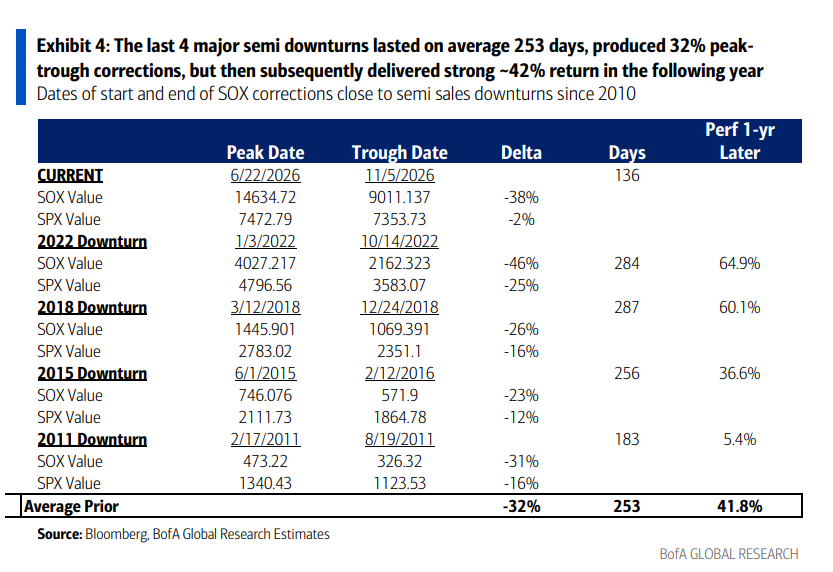
According to Wind Trading Desk, analysts including Vivek Arya predict that: this "indiscriminate selling" may conclude by early 2027. They indicated that the current round of selling has a clear “indiscriminate” characteristic—concerns about a slowdown in AI capital expenditures have led to a blanket selling of chip stocks.
In previous cycles, the declines in the SOX index typically precede actual declines in semiconductor sales by 6-9 months, and after earnings expectations are fully digested, there is an average rebound of about 42%. The report stated:
The peak in late June 2026 conceptually implies that EPS reductions may begin to appear in the first quarter of 2027, at which time policy changes will be reflected in the reductions or slowdowns in capital expenditure in the second half of 2027.
In other words, the true deterioration of fundamentals may not concentrate until 2027—but stock prices may have already absorbed these bad news in advance.
Valuation: How far is it from historical lows?
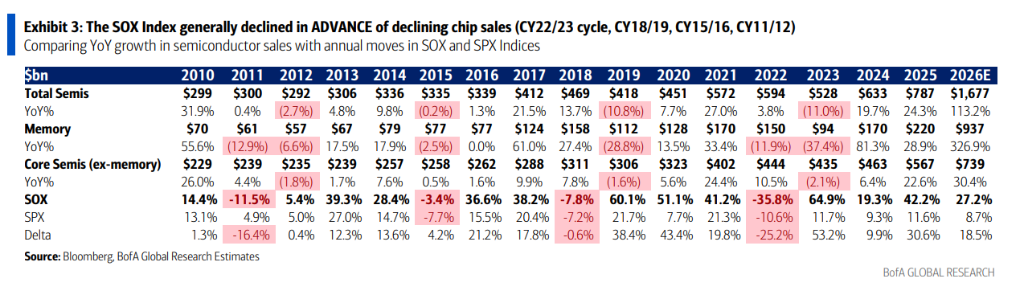
The current forward P/E ratio of the US stock SOX semiconductor index is 13.7 times, while the S&P 500 is 17.7 times, representing a 22% discount for the semiconductor sector relative to the broader market.
In the hottest phase of the AI market, chip stocks were trading at a 15% premium over the market. This transition from premium to discount has a magnitude close to 37 percentage points.
From a historical low valuation standpoint, SOX has an average forward P/E ratio of about 12 times at previous cycle lows. Based on this calculation, the current valuation only has about 12% of downside space remaining to reach historical lows.
Analyst Vivek Arya wrote:
The semiconductor sector is currently trading at a 22% discount, indicating that a significant portion of earnings downgrade expectations may have already been digested. However, we must point out that real EPS downgrades—and not just cheap valuations—are what will truly reassure investors, and this takes time.
Capital Expenditure: How great is the real pressure?
The core concern behind this significant drop is whether AI capital expenditures will contract sharply.
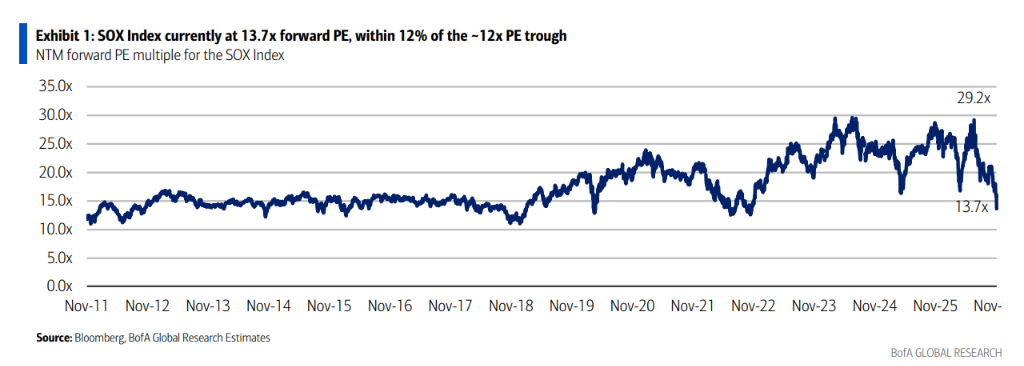
Bank of America data shows that the current quarterly running rate for US cloud computing capital expenditures is approximately $300 billion, annualizing to about $1.2 trillion. The market expectation for the full year 2027 is $1.555 trillion.
In other words, if capital expenditure maintains its current rate, the actual expenditure in 2027 will be about 23% lower than expected.
From the perspective of traditional hyperscale cloud vendors, the expected capital expenditure for 2027 is $1.221 trillion, with a current running rate of $982.5 billion, indicating a gap of about 20%; for emerging cloud vendors, the gap is even larger, around 35%.
Further calculations: $1.2 trillion in annualized capital expenditure, at an average cost of $40 billion per gigawatt, corresponds to approximately 30 gigawatts of computing power deployment, which is lower than Bank of America's baseline assumption of over 40 gigawatts.
If capital expenditure is cut by 20%, what will happen to chip companies' EPS?
Analysts have done a high-level estimate:
If capital expenditures in 2027 are reduced by 20% compared to expectations, AI semiconductor revenues will face more than 20% downward pressure, and EPS will face a 35-40% downside risk—this is generally comparable to the magnitude of EPS reductions in historical cycles.
However, analysts also point out that actual capital expenditure cuts may be more focused on future investments in land, power, and factory facilities, while the next generation of chips with higher computational efficiency (such as Nvidia Vera Rubin) will still be prioritized for procurement. Additionally, demand constraints in one region may also drive up demand in other areas, and AI capital expenditures have become an important driver of US GDP growth.
Three scenarios, what should you buy?
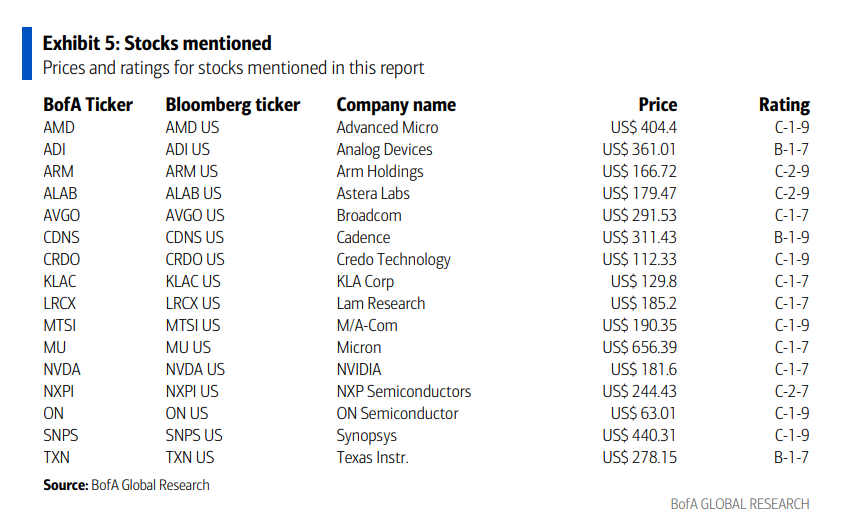
Bank of America provided three investment scenario frameworks:
Base scenario (downside risk of about 10%, bottoming in the first quarter of 2027): Preferentially select leading companies in various sub-sectors—computational chips, network chips, semiconductor equipment, storage, and analog chips.
Bear market scenario (downside continues until mid-2027, capital expenditures clearly remain under pressure until the shift): Defensive varieties will be relatively dominant, including EDA software, high free cash flow analog chips, and companies with smaller AI exposures.
Bull market scenario (capital expenditures rebound above expectations): High elasticity varieties will lead gains, including storage, optics, quantum computing, and CPUs.
What other factors could help stabilize the market?
Bank of America mentioned several potential positive catalysts:
First, policy clarification. Policy clarity at the congressional level in the United States is expected to boost market confidence in the first quarter of 2027.
Second, buyback support. Lam Research announced a $25 billion buyback plan, Nvidia's buyback continues to advance, and Micron will initiate buybacks on December 9.
Third, the slowdown in capital expenditure pace itself could also extend the duration of the semiconductor up cycle.
SOX has historically always led declines in chip sales
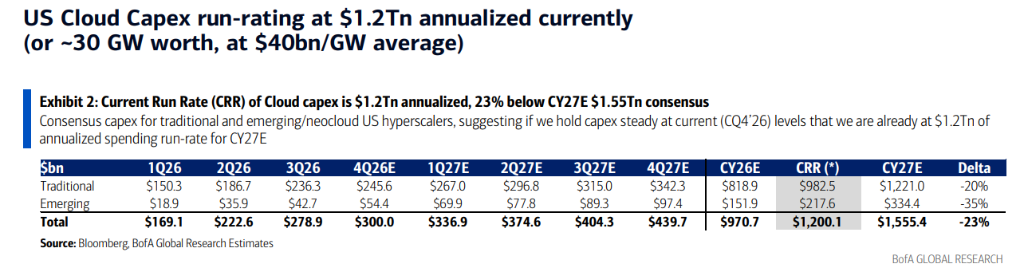
Bank of America’s historical data also shows that the SOX index has almost always declined ahead of the drops in semiconductor sales throughout various cycles—including the 2022/23, 2018/19, 2015/16, and 2011/12 cycles.
From the data, total semiconductor sales for 2026 are expected to reach $1.677 trillion, a year-on-year increase of 113.2%, with significant contributions from memory chips (expected to be $937 billion, growing by 326.9%). Meanwhile, the SOX index has risen about 27.2% so far in 2026, outperforming the S&P 500's 8.7%.
免责声明:本文章仅代表作者个人观点,不代表本平台的立场和观点。本文章仅供信息分享,不构成对任何人的任何投资建议。用户与作者之间的任何争议,与本平台无关。如网页中刊载的文章或图片涉及侵权,请提供相关的权利证明和身份证明发送邮件到[email protected],本平台相关工作人员将会进行核查。


