SEC's default silence allows passage, but companies are united in opposition.
Written by: Sebby Davies, Partner at Primal Capital
Translated by: Chopper, Foresight News
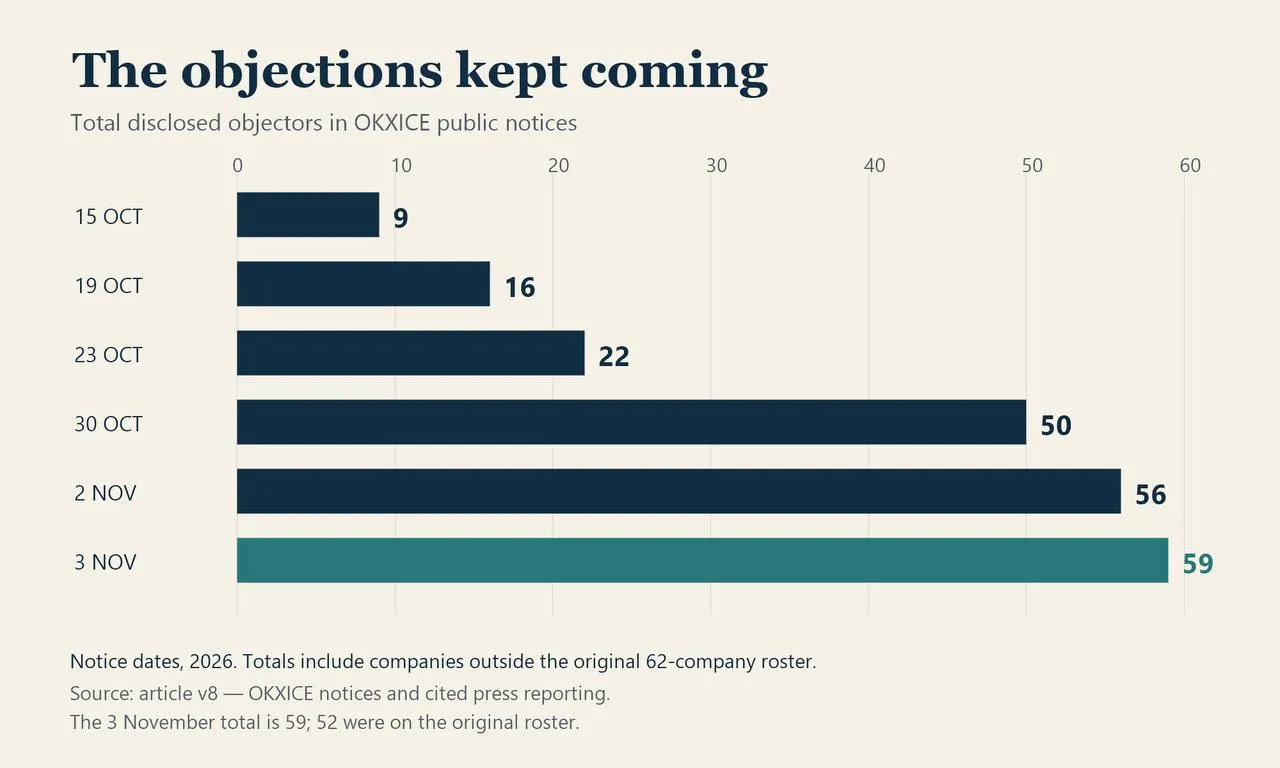
When I first started writing, the statistics were different. On October 23, the tokenized securities trading platform OKXICE, jointly launched by the Intercontinental Exchange (ICE) and OKX, announced the first batch of companies that refused to list tokenized stocks on the platform. The initial list included 62 companies, of which 19 raised objections. I was curious about the remaining 43. According to the new exemption rules from the US SEC: if companies do not respond, silence equates to consent. I wondered what results these silent companies would bring under this default rule.
In the following ten days, another 33 companies from the original list joined the opposition, making me quite anxious. In the announcement updated on November 3, the total number of opposing companies reached 59. Checking against the initial list, 52 came from the original 62, leaving only 10 that did not publicly raise objections. All the leading companies I was monitoring were on the objection list: JPMorgan and Nvidia expressed opposition at the end of October, Amazon and Tesla followed on November 2, and Apple joined on November 3. (Translator's note: As of November 6, last Friday, 56 of the original 62 companies had expressed opposition, leaving only 6 without objections.)
So my question changed. I initially wanted to explore what "silence allows passage" would lead to, but what emerged was this: why did so many companies specifically publish their opposition? And how could they change their minds?
The set of rules set by the SEC
The SEC announced an innovative exemption on September 17 (number 34-106402) allowing tokenized securities trading platforms (TSV) to launch on-chain US stock token trading within five years without registering as traditional exchanges. Tokens must correspond one-to-one with the underlying stocks: brokerages must hold one whole share corresponding to each token, and token holders enjoy equivalent dividends, voting rights, and liquidation claims. There are also trading limits on 75 major stocks: trading volume cannot exceed 0.25% of the underlying stock's average daily trading volume from the previous month, meaning that for every 400 shares in circulation, at most 1 share can go through this token channel.
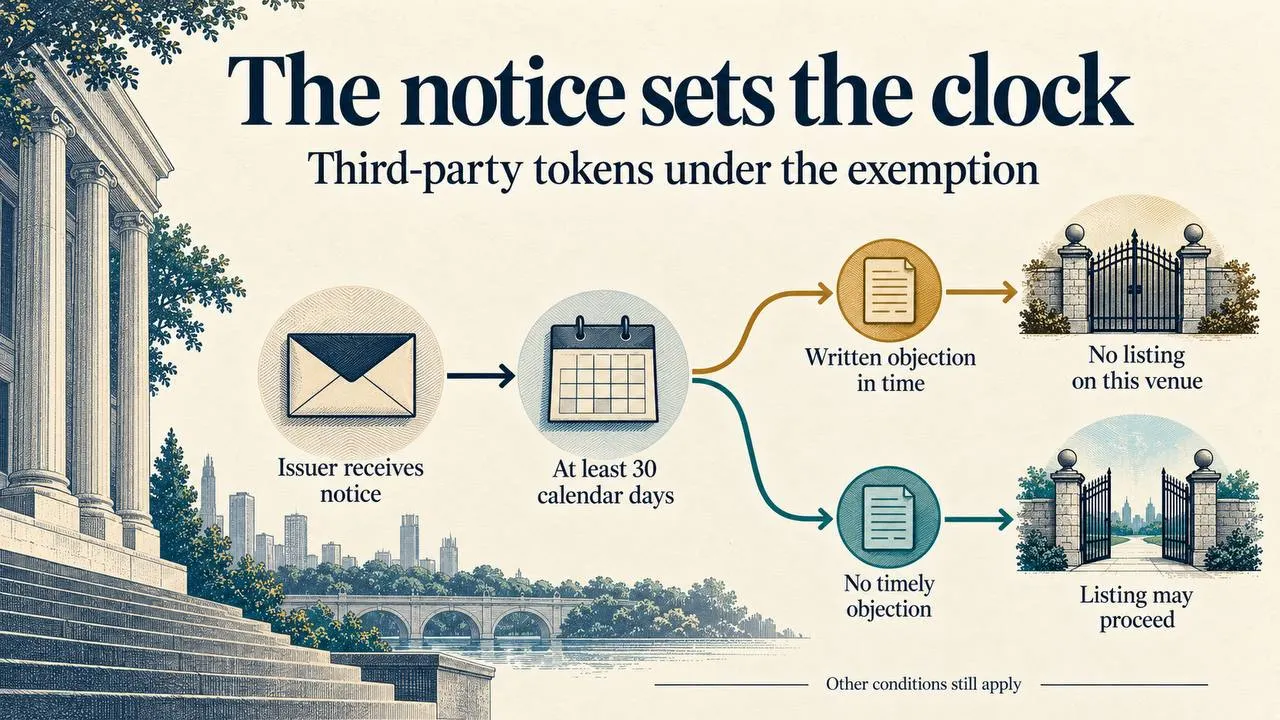
When third-party platforms issue these types of stock tokens, the trading platform must send written notice to the issuing company and wait at least 30 calendar days. Companies can submit written objections during the window period, which can block the token from being listed; if there are no objections, the platform can go ahead and list for trading after meeting the other conditions. Erin Martin, a partner at Morgan Lewis and former SEC senior attorney, accurately stated: companies have no proactive permission rights, only passive objection rights.
The rules themselves have not changed; silence can still allow passage. But surprisingly, very few companies are willing to leave themselves in a "default consent" state.
The process of list changes
OKXICE plans to achieve round-the-clock trading on OKX's XLayer chain through Uniswap liquidity pools, with trading pairs being USDC or USDG. In the announcement on October 4, it planned to list 62 companies, totaling 63 stock codes. Further statistical updates can be found on the official OKXICE page.
The ten companies that did not publicly raise objections are: Strategy, Robinhood, Coinbase, Circle, Securitize, BitGo, Palantir, Super Micro Computer, ServiceNow, and Boeing. Among these, six are themselves companies in the crypto or tokenization sector. It should be noted: not raising an objection does not equal formal approval from the companies, nor does it indicate the end of the window period, nor does it mean the listing is confirmed. (Translator's note: As of November 6, last Friday, ServiceNow, Boeing, Palantir, and Super Micro Computer have also joined the list of objections.)
Companies notified on October 4 had the window period close on November 3, but the notification time did not uniformly reach each company, making each window period independent. Issuers have a maximum of five business days to announce objections, so objections submitted within the stipulated time may still get published.
Why companies choose to oppose
So far, only one company has publicly stated its reasons for opposition. A spokesperson for Applied Optoelectronics, a Texas optical communication component manufacturer, told Fortune magazine: the company "does not see any clear benefits for the business or shareholders from this, which cannot offset the various uncertainties that follow."
This statement reveals the core economic calculus: issuers find it easier to see the potential costs brought by unfamiliar trading platforms, while the benefits remain very vague. The potential benefits are merely a small portion of the new liquidity (with limits), and some participation from on-chain investors, while this trading channel is not under the company's control. The costs, however, are clear.
The first is the issue of price transparency. Nasdaq's FAQ states that such token platforms do not need to display the best quotes and do not need to report to a unified market data system; trading data may be delayed by up to ten minutes, equivalent to "forming a shadow market for stocks." The SEC itself has also indicated that pricing in a liquidity pool is likely determined only by the asset proportions in the pool. Additionally, with the characteristic of round-the-clock trading: during the main market's closing hours (for example, after earnings reports), the liquidity pool will still continue quoting, and this price will be seen by shareholders, but the company cannot explain the price fluctuations.
The second is the stock registration issue. Joris Delanoue, head of Fairmint (a SEC-registered on-chain equity transfer service provider), mentioned: the vast majority of US stockholders own shares through brokerages, and the register reflects DTC nominee accounts. Tokenization would add a layer of records on top of the existing registration, and all records must be confirmed.
The third is the risk of investor misunderstanding. Nasdaq suggested that if investors incur losses trading on that platform, even if the platform itself is independent, investors may blame the stock issuing company. To prevent this, companies only need to send an objection letter, which is a low-cost action.
Some companies may be waiting and watching, observing the market's performance. Andrew Cuomo, co-chairman of OKXICE, mentioned that some companies choose to delay their statements, not wanting to be among the first to test the waters, but prefer to see market performance first. Under this rule set of 30 days, targeting only one platform at a time, "waiting to see" and "refusing" look like the same result from the outside.
Other companies simply do not recognize the OKXICE platform or this structure. OKX is an offshore cryptocurrency exchange with a complex regulatory background, and trading relies on automated liquidity-stablecoin trading pools. Many boards are unwilling to tie their stocks to such channels.
More core to many companies is the demand for control: companies do not oppose stock tokenization itself, but wish to decide the method of tokenization, the operator, and trading terms themselves. This set of rules actually allows companies to initiate tokenization themselves without going through third-party notification objection processes. Payment giants are doing this in the stablecoin space: Mastercard and Visa have chosen to pilot stablecoins at their own pace and under their controlled conditions, rather than passively accepting third-party arrangements.
We cannot determine from the list which of these companies belong to which motivation. Of the 52 objection letters, only one has publicly stated its reasons, while the considerations of the other companies remain undisclosed.
What standards does each party want?
Several major institutions participating in the rules game have their own tokenization layout plans. The Intercontinental Exchange (ICE) warned in its annual report that without continuous innovation, it may be disrupted by new things like tokenized securities, and OKXICE is the solution it proposes. For it, the default rule of "silence equals consent" is most beneficial. Nasdaq even plans to exclude its own stocks from such token platforms. Its proposed investor protection concerns have real grounds, but it also has commercial interests, concerning the ownership of the trading ground for tokenized securities.
The Securities Industry and Financial Markets Association (SIFMA, which includes brokerages and asset management institutions) proposed that third-party tokens wanting to launch on tokenized securities platforms must obtain explicit consent from the issuing companies and cannot regard silence as permission. Goldman Sachs is also one of the opposing parties.
If the model changes to "proactive (voluntary application, explicit consent)," those companies that have not responded at all (that is, the remaining 10) will be directly excluded. But this does not explain why 52 companies specifically chose to actively publish their opposition. In the initial list of OKXICE, the vast majority of companies were unwilling to leave the decision-making to the default rule. What choices the remaining 10 will ultimately make is still uncertain.
The best-case scenario
The veto power of companies only applies to token platforms initiated by third parties under this set of rules and with a 1:1 endorsement. It does not cover offshore tokens or derivative products that only provide price exposure without ownership of equity. In the third quarter, approximately $25.6 billion of tokenized equity trading on the BNB Chain occurred almost entirely outside of SEC orders. This figure only represents trading volume, not the legal structure of all products, but it sufficiently reflects market size. The opposition of companies could even push trading into packaging products that are harder for them to regulate and understand.
However, under this exemption rule, the majority of companies on the original list of OKXICE have submitted their objections on time.
Future directions
I am now more concerned about a specific question: will those companies that reject OKXICE change their minds when the platform, structure, and terms are under their control?
A second route has already emerged. On October 29, Nasdaq-listed small-cap company Canton Strategic Holdings announced plans to launch issuer-led tokenized stocks. Of course, this does not mean that companies rejecting OKXICE will follow suit, but it opens a new observation dimension. The question is no longer "Are there companies willing to do issuer-led tokenization," but whether any of these 52 opposing companies will be willing to attempt it.
The second observation point is similar platforms. This exemption rule is designed based on a licensed AMM liquidity pool, and we can compare it with other platforms under the same rules but with different risk control and data reporting mechanisms. If a traditional order book model is used, the regulatory path would be completely different. If the same company chooses to oppose across different platforms, it indicates that the issue does not lie with OKXICE itself; if different platforms receive different feedback, it shows that platform design and control rights are the core conflicts, rather than a blanket opposition to stock tokenization by companies.
Directions worth observing continuously
I am eager to see the final list of stocks that OKXICE will launch, as it will tell us which stocks the platform can eventually list. However, even when the list comes out, we still cannot know what reasons led to certain stocks not being listed. The speed of industry advancement is fast, so do not assume that these 10 silent companies will definitely launch trading.
I will also continue to track this group of 52 opposing companies: the first company to choose to self-issue tokenized stocks will be a sample of "rejecting third-party platforms, but willing to tokenize under its own rules." Additionally, another platform using the same exemption rule that sends notifications to the same group of companies can also help us see the true attitudes of listed companies towards equity tokenization.
SEC Chairman Atkins and Commissioner Uyeda both anticipate that the subsequent formal solicitation of opinion legislative process will proceed. Whether the "must actively agree" rule proposed by SIFMA can be written into formal regulations will be key. This standard will have the greatest impact on those companies that never respond to notifications and platforms that have smaller audiences and issuing parties that won't notice notifications.
免责声明:本文章仅代表作者个人观点,不代表本平台的立场和观点。本文章仅供信息分享,不构成对任何人的任何投资建议。用户与作者之间的任何争议,与本平台无关。如网页中刊载的文章或图片涉及侵权,请提供相关的权利证明和身份证明发送邮件到[email protected],本平台相关工作人员将会进行核查。


