The impact of LLMs like Astra and Opus on robotics has far exceeded the expectations of many robotic researchers: LLMs are starting to serve as the“cerebellum”for robots. In the past, a common division of labor was that LLMs first understood tasks and made plans, which were then executed by specialized robotic models. However, this division of labor is beginning to loosen today:
• The "LLM arrival faction" believes that since LLMs have begun generating actions, as the models continue to strengthen, task planning and action generation could be entrusted to the same model. This allows embodied companies to create products more quickly, but some advantages of self-developed models may also be caught up with.
• From a practical deployment perspective, whether the model can continuously meet customer demands is fundamental. After generating effective actions, the robot must also satisfy requirements for speed, quality, and stability. Therefore, specialized robotic models still deserve attention.
Behind these disagreements lies a more fundamental question: What research directions in robotics have actually changed due to LLM's advancements? Which capabilities can be directly obtained from general models, and which still require specialized data and training?
To address these questions, we organized an offline Best Ideas event, inviting robotics and LLM researchers to sit together and exchange their experiments, observations, and judgments. We compiled the publicly shareable notes from the event to share with everyone:
1. Whether robots still need independent “cerebellum” models is the main disagreement among today's robotics researchers;
2. Adding memory to robots does not mean they will automatically perform in-context learning;
3. The requirement for action precision in robots may be one reason for the recent rise in UMI data demand;
4. LLMs have prompted researchers to take a fresh look at simulation, but quickly building environments does not equate to accurate physical simulations;
5. The value of dexterous hands is that they enable robots to complete an entire workflow using existing human tools;
6. Embodied companies need to clearly understand their positioning: is it to make the model smarter, or to enable robots to work faster and cheaper?
We also look forward to more researchers from frontier labs and researchers in the directions of Physical AI and AI4S participating in future offline discussions. If you are interested, you are very welcome to add WeChat Unicorn_observer to discuss your ongoing research and the topics you would like to exchange.
/
Insight 01
LLM is beginning to serve as the “cerebellum” for robots
1. The performance of LLMs like Astra in robotic control has far exceeded the expectations of many robotic researchers: Although LLMs have already been able to help robots understand tasks and make plans, the most noteworthy change this time is that LLMs are beginning to directly generate robotic actions. In other words, the capabilities of LLMs are extending from understanding tasks and making plans as the "brain" (System 2) to being responsible for action generation as the "cerebellum" (System 1).
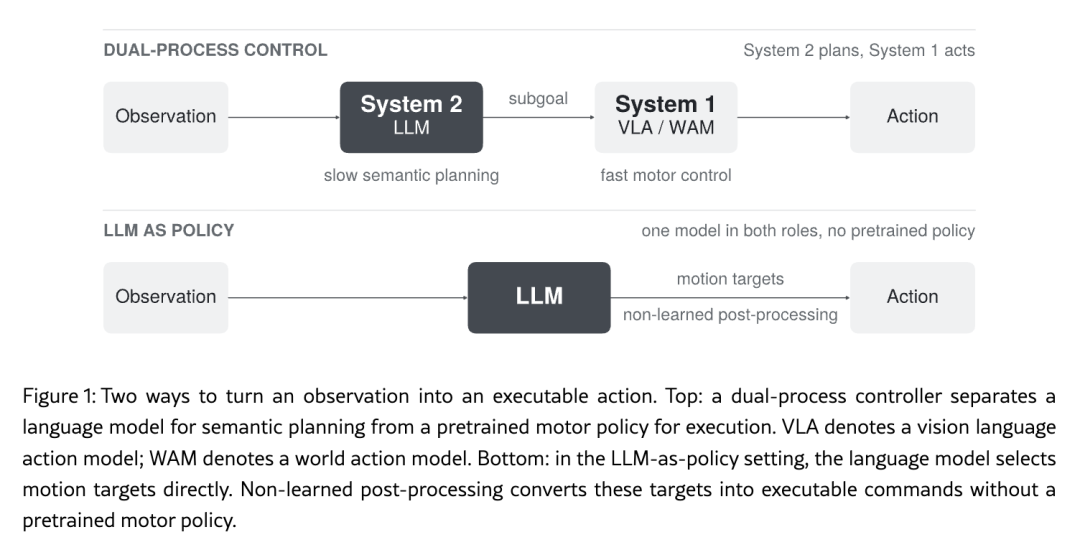
2. Take Astra as an example; although it was not specifically trained as a model for operating robots, it can generate control commands for the robot's position, posture, or joint level based on visual input. It can also flexibly create the operation trajectory for the robot's two hands based on the current scene rather than just reproducing fixed trajectories.
3. In the RoboDojo simulation evaluation, with the reasoning intensity set to medium and a simple zero-shot setup, Astra achieved an average score of 28.97 (out of 100) with an average success rate of 22.48%, surpassing most of the basic models of VLA and WAM type robots evaluated at that time.
In this evaluation, the score reflects how much of the task was completed, while the success rate requires the full completion of the task.
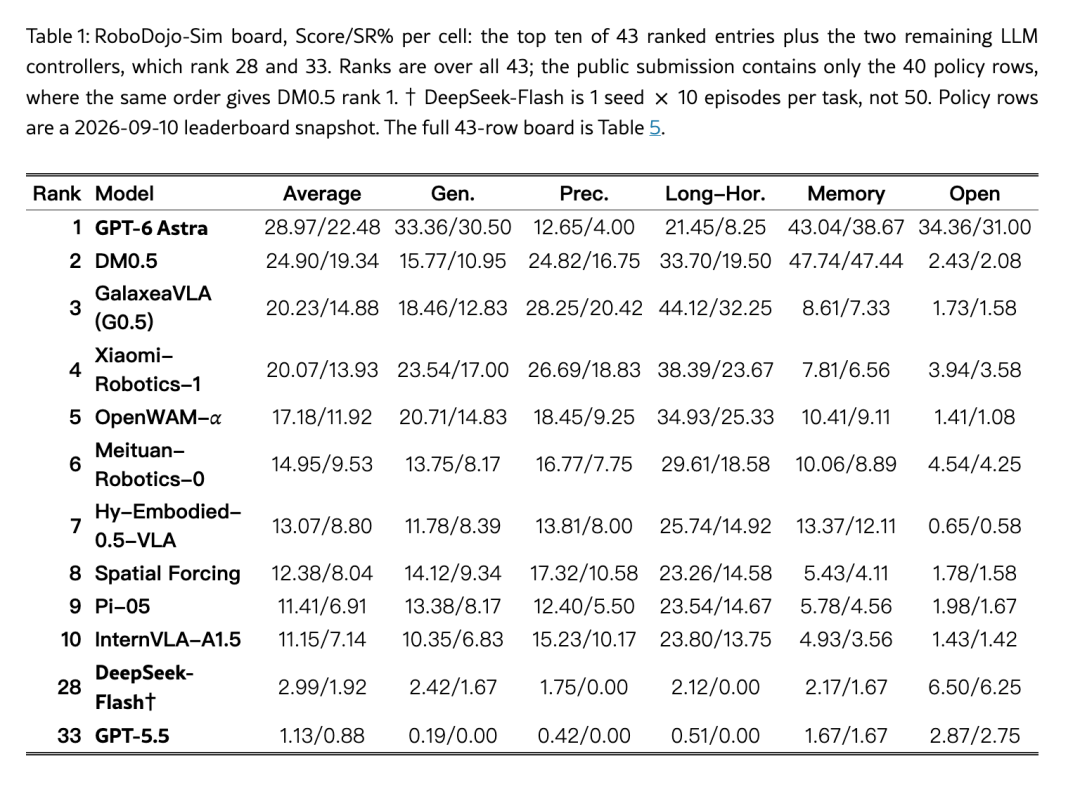
4. However, a score of 28.97 does not necessarily represent the upper limit of Astra's current capabilities. To ensure fair comparison among different models, RoboDojo's initial tests used relatively simple harnesses, essentially allowing the models to output actions directly. If the models could check results and analyze errors after the operations, then adjust their next actions, the effectiveness of task completion could potentially improve further.
5. Some opinions predict that by the end of 2026, there will be models that achieve near-perfect scores in RoboDojo evaluations.
6. Another capability of Astra that has stunned robotic researchers is its ability to generalize across entities: that is, the same model can gradually adapt to robots with different structures based on the robot's physical information and execution feedback.
• One tester provided Astra with information about a homemade robot's appearance, degrees of freedom, type of gripper or hand, and then had Astra operate the robot. Initially, Astra made errors, but after a few retries and reflections, the control gradually improved;
• Another tester allowed Astra to directly control the joints of an unfamiliar robot. The first few frames of actions were somewhat chaotic, but as attempts continued, the control became increasingly precise and the movements smoother.
7. However, some researchers believe that Astra's performances do not indicate a qualitative change in robotic capabilities, as the model's performance in operating robots seems more like a natural extension of existing coding and gaming capabilities. Considering that LLMs have long been able to correctly understand task intentions, the current round of capability enhancement may mainly stem from more accurate three-dimensional position estimation.
• For example, in testing, the model spends a lot of time reasoning and calculating pixel coordinates, estimating camera parameters, and deducing the three-dimensional positions of objects. However, the actions generated primarily change the spatial positions and rarely involve posture adjustments.
8. Nevertheless, slow inference speed is currently one of the most direct problems with such LLM solutions. Moreover, the actions that Astra can currently handle are also very simple, making it currently difficult to directly expand to tasks requiring coordination of dozens or even hundreds of degrees of freedom, such as dexterous hands or full-body robot control.
9. Additionally, the impact of LLMs on robotics has expanded from direct action generation to model training paradigms. For instance, many researchers are beginning to think about how to leverage the development paths of LLMs to enable robot models to possess capabilities like in-context learning; LLMs have also significantly shortened the time needed to build simulation environments, which has made some researchers take a renewed interest in the simulation technology route.
Insight 02
“Cerebral and Cerebellum” Models: Fusion or Continued Division of Labor?
10. As LLMs can both complete task planning and directly generate actions, whether robots still need an independent “cerebellum” model is the primary disagreement among today's robotics researchers.
11. Proponents of integrating the cerebrum and cerebellum believe that both task understanding and action corrections require world knowledge, and that an independent small model may not have enough capacity to master these abilities. Since LLMs can understand tasks and correct errors based on feedback, it is possible for both System 1 and System 2 to be handled by the same model.
• Some researchers anticipate that System 1 and System 2 will coexist in the short term and may merge in the future, but there is currently no consensus on the long-term division of labor.
12. Those advocating for the retention of independent robotic models argue that robotic models not only need to generate correct actions but must also respond promptly to environmental changes. If the reasoning speed of general models doesn't keep up, low-latency action models still hold value.
• Dynamic task scenarios especially require models to provide the next action within a limited time. For instance, when objects on a table are stationary, a robot can pause its actions, waiting for the model to complete its reasoning; but if the robot is carrying out a task like pouring water, which continuously flows, it must adjust its actions in real time.
13. Furthermore, precise contact operations require faster responses. This type of low-level control is referred to as System 0. For example, the contact points of a robotic hand with an object are often visually occluded, but considering the actual operation, just a few millimeters of deviation can cause an object to slip, so the robotic hand needs to quickly adjust based on feedback from sensors such as touch.
• Taking cucumber peeling as an example, a person may initially decide to “peel the skin off,” but once the peeler touches the surface, the hand must quickly adjust force and position to move along the cucumber's surface. If every small contact requires the model to perform complex reasoning again, the actions of the robot will be too slow.
• Some researchers estimate that this kind of low-level control requires responses at least dozens of times per second, while cloud communications combined with model reasoning can introduce delays of hundreds of milliseconds or more. Therefore, even if System 1 and System 2 merge, System 0 may still need to run locally on the robot.
14. For instance, York, the co-founder of Dyna, recently emphasized the requirements for real-time control regarding deployment methods. In his vision, System 2 can provide low-frequency guidance through language, while System 1 and System 0 need to respond promptly. Beyond the speed of model reasoning, network fluctuations can also impact execution, so he aims to run both of these layers locally on the robot while allowing System 2 to retain cloud access.
15. Regarding the division of these models and control layers, some researchers believe that System 0, 1, and 2 do not have fixed boundaries; how the model is divided depends on the range of actions, the speed of response requirements, and the scale of the models needed. Tasks that have a relatively fixed input-to-action correspondence and require quick responses can be assigned to smaller models, while tasks with a wider range of actions and more complex decisions require more knowledge and computation.
Insight 03
In Context Learning: What Methods Can Robotics Learn from LLM?
16. In-context learning is an important direction for improving the generalization capability of robots: the model can adjust actions using human demonstrations and its own execution feedback within the context, without the need to retrain the model for the current task.
17. However, experiments from some teams found that directly adding execution history and reflection capabilities to a VLA did not automatically lead to error correction or adjustment abilities.
• One team attempted to have the VLA utilize historical information. As a result, while the error during model training and validation decreased, during deployment, the model did not perform better and at times even worsened. One possible reason for this phenomenon is that the way historical information was incorporated interfered with the capabilities originally learned by the model during pre-training.
• Another team modified VLA based on Qwen, instructing the robot to place five or six snacks and drinks into their respective areas in a specified order. During training, the team annotated the complete plan, whether each step was completed, and whether it should retry after failing. When tested, the model could articulate the plan and was aware of which step had failed, yet it still repeatedly made incorrect actions. Compared to a regular VLA that did not utilize history, its success rate showed almost no improvement.
18. In fact, for reflective abilities to enhance robotic performance, the model needs to convert language feedback into specific action adjustments. One researcher attempted to make the language feedback and actions more detailed. For example, when a drawer wasn’t fully opened, instead of just saying “failed, try again,” it should describe “the drawer wasn’t pulled enough, pull it open a bit more,” and paired with the corresponding action. As a result, compared to just adding CoT annotations to the training data, adding CoT on top of fine-grained annotations led to better-performing models.
19. However, whether the in-context learning capability of this robotic model must rely on specific failure and recovery data for training is subject to differing judgments among researchers.
• In a demo of Generalist, the robot grabbed too high the first time and lowered its position on the second try. Some speculate that the training data may have already included similar failure and recovery demonstrations, which the model learned from.
• Another view is that the model’s error correction capability may also come from transferring knowledge from other tasks.
1) Considering that the proportion of erroneous demonstrations in existing collected data is relatively low, human errors may not cover the actual execution mistakes of robots; relying solely on such data makes it challenging to train models capable of addressing multiple failure scenarios.
2) Robotic models can retain the input-output methods of LLMs, which also provides robots the opportunity to leverage existing adjustment capabilities that LLMs have, for example, models learn to correct errors based on running results in multi-round coding training, and learn to adjust subsequent operations based on visual feedback in computer usage. Some researchers believe some transfer of these capabilities has already been observed.
20. Even if the model possesses in-context learning capabilities, whether it needs to introduce historical action execution and what information should be included in the context ultimately depends on the specific task.
• Some estimate that about 80% of robotic tasks only need the robot to assess the current state to decide on the next step, and excelling at these robotic tasks can cover a large market.
• Long tasks that depend on previous steps and tasks requiring high precision are more likely to benefit from incorporating action execution history, such as models integrating prior actions and outcomes to infer how robots should move and how the environment responds, and subsequently adjusting the next actions accordingly.
• Additionally, task instructions also represent a useful context. For instance, when a robot encounters furniture it has not seen during assembly training, it may need to read the instruction manual first.
21. Furthermore, as the robot context continues to accumulate, issues of action stability and reasoning latency under long contexts will become apparent.
• One team set the context length of the model at approximately 8K tokens during experiments. As execution history accumulated, once the context reached 7K-8K tokens, the robot's actions began to get chaotic.
• One researcher attempted to use test-time training to compress the context, control delays, and allow the robot to correct errors based on feedback. (ICL retains new information in context, while TTT updates model parameters through training.) However, after testing Astra, he found that Astra’s in-context learning capabilities already achieved many error correction effects he initially hoped to gain through TTT.
Insight 04
Astra makes simulation great again
22. The impact of LLMs on the robotics simulation field has also resonated with researchers: LLMs have dramatically shortened the time required to build simulation environments, which has even led some researchers to take a renewed interest in expanding model training scale through simulation.
• After Astra's emergence, certain evaluation environments that simulation teams originally needed months to set up can now be completed in a few hours or even in minutes.
• Once the simulation environment is built, the robot can repeatedly attempt different actions within it and improve action strategies through reinforcement learning based on feedback. Some researchers even hope to incorporate such trial-and-error learning during the model's pre-training phase.
23. However, speeding up environment setup and achieving more accurate simulations actually solve different problems: ray tracing, three-dimensional reconstruction, and Gaussian representation make what the camera “sees” more realistic, but physical simulation needs to calculate how an object will move, deform, and interact after a force is applied. Being visually more similar to reality does not mean that the same action will yield the same result in simulation and reality.
24. The tasks that simulation can cover still depend on how accurately the underlying physics engine can replicate the physical processes involved in the tasks. Current physics engines have not made qualitative breakthroughs as compared to five or six years ago; simulations of contact forces, tactile feedback, etc., may still diverge significantly from reality. Therefore, there is a view that it is more promising to first expand model training scale in tasks like grasping and transporting fixed-shaped objects that are already more mature in simulation.
• To replicate real objects in simulation, it is necessary to know their movable structures and physical properties. Some labs have purchased thousands of jointed items, such as drawers, scanning and segmenting the movable parts one by one to establish open-close relationships. Even after completing this work, only some properties like mass were measured, while information on opening and closing resistance remains incomplete.
• Although game engines have accumulated a large amount of ready-made materials, they still struggle to provide the nuanced physical feedback required for fine operations. Because games often avoid cumbersome processes like dressing or eating for real-time operation or present them with pre-made animations, these materials can help models learn basic spatial laws like near and far sizes but are difficult to directly provide the physical feedback needed for fine operations.
25. For robotic teams, improving simulation accuracy often raises training costs. The more nuanced the simulation of complex contacts and flexible objects, the slower the computation generally becomes and the higher the costs; under the same budget, the number of actions robots can attempt in simulation decreases. When costs become too high, directly collecting real data may even be more cost-effective.
26. To reduce these costs, GPU acceleration, increasing parallelism, or using AI to optimize underlying code can be employed. However, some researchers believe that currently, the entire industry lacks enough talent and funding for such underlying optimizations.
27. Some teams have also attempted to use world models to predict the state changes brought about by actions to replace part of the simulation computations, thus lowering training costs.
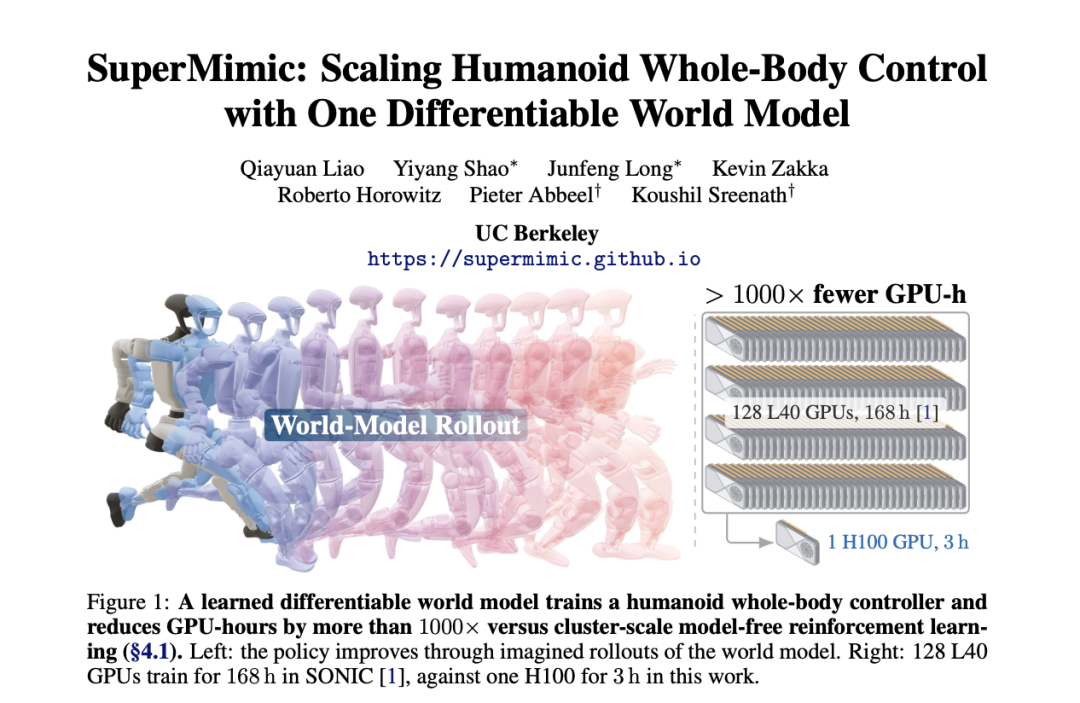
• For example, SuperMimic trains a world model using simulation data to predict how the robot's body state would change after executing a certain action, using these predictions to train the full-body motion control strategies of humanoid robots. However, some researchers have pointed out that while SuperMimic involves complex actions like flipping and rolling, the objects being simulated are still robots composed of rigid parts and joints.
28. However, the capability of the world model actually depends on the training data. If the data only comes from existing simulators, the natural changes it can learn will also be limited by the capabilities of those simulators. Moreover, even if introducing real data can supplement contact and deformation that are difficult for simulation to cover, this real data may not necessarily capture the complete information in the physical world. For instance, when capturing clothing with a camera, the state on the surface of the clothing can be recorded, but the wrinkles hidden beneath it can't, making it challenging for the model to reconstruct the full state of the clothing based solely on these images.
29. Another idea for reducing training costs is to enable the model to learn to adapt to the differences between simulation and reality, thereby reducing the reliance on high-precision simulations. Some suggest starting with the model learning to observe, act, and correct in a coarse-grained simulation, and then adapting to the real world with a few attempts.
• However, this concept has a prerequisite: the effect of the same action in simulation and reality cannot differ too much. If the simulation results consistently deviate significantly from reality, the model will struggle to complete environmental adaptation through a small amount of trial and error.
• In reality, the precision required for simulations depends on the specific task. For example, cleaning fixed-shaped objects in a room may tolerate rough simulations, but precise contact tasks like zipping up a zipper require higher accuracy.
30. Furthermore, some researchers hope that models can accumulate experiences and improve abilities through continuous interactions with their environment. In the robotics field, the concept of Physical RSI is to first let robots perform tasks in reality, utilize the data obtained during execution for simulation training of models, and then repeatedly deploy the updated models back into reality for iteration.
Insight 05
What kind of data is useful for robotic training?
31. Beyond model capabilities and training methods, the training data's impact on the accuracy of robotic actions is also significant. How much improvement one hour of data can bring depends on the tasks and actions included in the data, as well as the degree of similarity between demonstration data and the robot's actual operations.
32. Ego, UMI, and real machine data each have their pros and cons. Generally speaking, the closer the data is to the actions actually executed by the robot, the more challenging it is to collect at low cost and on a large scale.
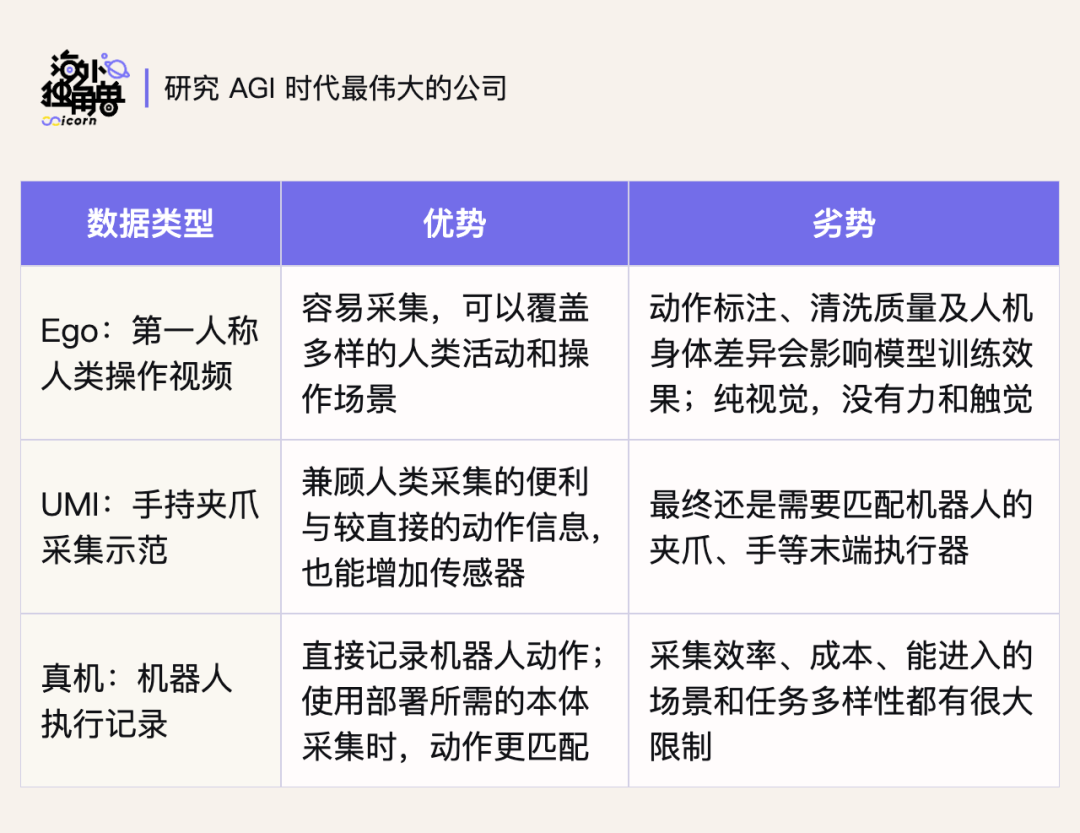
33. One team used Ego data to teach the model how to plan tasks and understand spatial relationships. However, to allow the robot to master how much force to apply during operation and how to perceive contact, it is necessary to collect force and tactile data through devices like sensor-equipped gloves.
34. Those optimistic about the long-term value of Ego believe that future robots will have hands and bodies closer to humans. Paired with better data cleaning, quality control, and diverse tasks, the effectiveness of models utilizing human videos to learn actions may improve.
35. Real machine data is closer to the actions actually executed by robots, but it is costly and more challenging to scale up collection.
• In terms of effective data hours, UMI data is cheaper than real machine data, while Ego data is even cheaper than UMI data, but the total amount of data that can be collected from real machines may be an order of magnitude lower than that of UMI. Therefore, real machine collection can prioritize covering tasks that are difficult to accurately simulate in simulation, such as fluid operations and folding clothes.
• Real machine collection is also subject to scene coverage limitations: in some non-home settings, it is more challenging for robots to enter, while UMI can be carried out more easily; this difference is relatively small in home scenarios.
UMI data demand is rising rapidly
36. Recently, the demand for UMI data and related hardware has been increasing.
• Some teams turned to using UMI after training extensively with Ego data, as they noticed improvements in model capabilities but still found the actions insufficiently accurate.
• For gripper operations, actions collected via UMI are closer to the actions actually executed by the robot. A researcher estimates that the training effect of 50 hours of Ego video may only be equivalent to 5 hours of UMI data.
• The demand for purchasing UMI also correlates with whether teams have their own robots: teams with fixed bodies often collect UMI data around their grippers or hands; teams without specific bodies will depend more on external suppliers.
37. However, whether UMI can become a long-term data route remains disputed in the market.
• Proponents of UMI argue that handheld grippers are more convenient for collection and provide action information lacking in regular videos; they can also add sensors like touch, making existing UMI data still valuable even if adjustments to data routes are needed later.
Data Scaling vs Data Recipe
38. Beyond the types of tasks contained in the data itself, the selection, annotation, and training ratio of data also influence the final performance of the model.
• Some low-cost Ego data may contain a substantial amount of repeated wiping and cleaning actions, and if there is a lack of further screening and detailed annotations, while the total hours of data may seem long, the new experiences it can provide to the model remain limited.
• Even when unifying data from various sources, formats, and bodies, it is still necessary to determine how much of each type of data to use and at which stage to add it during training.
39. Whether to firstly scale up data quantity or determine effective ratios remains a point of disagreement among different researchers.
• Those advocating for data scaling believe that the existing data scale is still far from sufficient and that priority should be given to expanding collection and training scale. For instance, Dyna has used over one million hours of Ego data for pre-training Dyna-2.
• Those arguing for establishing a data recipe first suggest that data quantity has already significantly increased and should first verify how Ego, UMI, and real machine data match together for better effects, before expanding collection according to effective ratios. Especially for AI labs that have existing models and large accumulations of data, it is crucial to understand what capabilities the new data can complement in the model and how the new data should be mixed with existing data for training. The team's collection devices, training experience, and computing power budget determine the scale at which they can collect data and conduct training experiments.
Insight 06
The opportunity of dexterous hands: tools in this society are designed for human hands
40. When collecting data and verifying model effectiveness, robotic teams can freely choose to use grippers or dexterous hands based on task requirements. However, during actual deployment, when the robot must complete an entire workflow, the advantages of dexterous hands will become pronounced.
• For example, in making milk tea, even if nine out of ten steps can be completed with a gripper, if there is even one step requiring dexterous hands, a robot relying solely on gripping cannot independently complete the entire process of making a cup of milk tea.
• Work in a chemistry laboratory often involves various operations, such as retrieving reagents from narrow cabinets and handling fine wires or long containers. Overall, the tools used in experiments are mostly designed for human hands. Even if grippers can complete some actions, they may not stably retrieve and utilize these tools. Redesigning tools for grippers would also increase modification costs.
41. However, whether the operational advantages of dexterous hands can rapidly generate large-scale demand remains debated among researchers, with the key point being whether industrial scenarios need dexterous hands.
• One view suggests that for standardized factory tasks, grippers are sufficient; for dexterous hands to be widely adopted, the popularization of home robots is necessary, which still requires a long time, thus making large-scale demand for dexterous hands difficult in the short term.
• Another perspective argues that some industrial tasks already require both significant load and dexterous operations. For instance, during seafood processing, robots must not only securely handle heavy, slippery objects but also flip them and align with cutting tools, tasks ordinary grippers find difficult to perform reliably. While grippers can also be modified for fixed operations, if robots constantly need to modify their grippers or can only perform fixed actions, customers can directly choose dedicated machines.
42. Whether dexterous hands can operate consistently and reliably over the long term is also an important factor affecting actual deployment demand. Some users have encountered situations where dexterous hands malfunctioned after just two weeks of use or even broke down the very next day.
43. Beyond hardware, whether the model can coordinate multiple fingers also influences the effectiveness of using dexterous hands. Some researchers have noted that in demos where general models control dexterous hands, their fingers merely open and close like grippers and sometimes fail to perform adequately or exhibit poor control outcomes. This implies that although the model has already learned from numerous human operation videos, due to factors like the high degrees of freedom in dexterous hand joints, robots currently struggle to effectively use dexterous hands.
44. To balance dexterity, stability, and cost, three-fingered hands are viewed as a compromise solution. Supporters argue that they are more flexible than two-fingered grippers, and the fingers can be made sturdier and more stable than five-fingered hands, potentially lowering costs. However, the issues with three-fingered hands include:
• Data collection: Some worry that human five-finger movements may not directly translate to three-fingered hand functioning, but supporters insist that during data collection, humans can operate using methods compatible with three-fingered hands, thus obtaining data that matches the hardware.
• R&D investment: One practitioner mentioned that their team already had a two-finger gripper, and new research resources tend to prioritize five-fingered dexterous hands; thus, it is difficult to independently establish a team to develop three-fingered hands. Even if a three-fingered hand demo is created, substantial resources are still required for ongoing optimization.
Insight 07
Under the impact of LLMs, the advantage of embodied companies lies in the integration of data, hardware, and deployment
45. In the wake of LLM impacts, embodied companies need to reassess the focus of R&D investments: should they continue to raise the intelligence ceiling of robotic models, or should they prioritize optimizing the execution speed and cost of robots for specific tasks? That is, whether their System 1 model should serve as an efficient controller leaning towards System 0 or as a general decision-making model leaning towards System 2.
46. Proponents of continuing to enhance model intelligence argue that there are many diverse task types in the physical world. Relying solely on training for coding-related tasks might not resolve all robotics control issues. If sufficiently strong open-source LLMs continue to emerge, embodied companies can use these models as a basis for further pre-training or post-training targeted at robotic tasks. As funding, computational power, and talent investments increase, embodied companies may also choose to train their foundational models from scratch.
• Furthermore, enhancing the capabilities of robotic models might also decrease the adaptation costs for new tasks. York noted in an interview that from Dyna-1 to Dyna-2, as the pre-trained model strengthened, the time required for task fine-tuning decreased from months to days. Additionally, Dyna improved its data collection, screening, and deployment tools, enabling operation teams to accomplish more on-site work, thus reducing reliance on R&D personnel.
47. Conversely, some argue that self-developed robotic models may not exceed the capabilities of general models. Instead, embodied companies should leverage the existing capabilities of general models to enable robots to complete specific tasks in actual deployments at faster speeds and lower costs. One researcher imagines that if robotic data were added to the training of general models, even with new data volume only being 1% or even 1‰ of the original training data, the model could swiftly learn robotic operations based on its existing knowledge and multimodal capabilities.
48. One potential approach to enhancing robotic task execution efficiency using LLMs is that embodied companies can distill small models specifically for robotic control from Astra. Specifically, teams need to allow either real robots or simulators to execute actions generated by Astra, and subsequently train the robotic models using the execution records. This requires time and investment in hardware and simulation facilities, and some opinions suggest that collecting this training data may not be any cheaper than direct data collection.
49. Even if these robotic small models from embodied companies can achieve faster reasoning and lower operational costs, this speed and cost advantage may not necessarily be sustainable in the long term. Because computer use and voice interaction also require rapid responses, LLM vendors are similarly motivated to increase reasoning speeds.
50. Therefore, some researchers suggest that embodied companies should leverage this window of opportunity before the general model development accelerates further and quickly apply efficient robotic solutions to actual business. “Technically feasible” and “who can do it faster” are different questions.
51. When delivering to customers, embodied companies need to ensure that models and hardware are well matched, offering a complete robotic solution capable of performing actual work.
• In scenarios like folding clothes or towels, customers are more likely to pay for a comprehensive solution rather than simply accessing a model API.
• In retail and industrial settings, some teams previously planned the robot's actions using traditional algorithms but are now generating actions with fine-tuned π0.5 or in-house models. However, after switching to models, current teams still need to conduct on-site debugging for specific customer tasks to enable robots to perform actual work.
• Overall, how much data needs to be captured and how much debugging is required when entering new scenarios will affect the delivery costs of embodied companies; operational stability and execution speed will influence how much work robots can complete daily.
52. Furthermore, actual deployment serves as a route through which embodied companies can gather model training data: just as LLM vendors can train models using user data accumulated from their own products, embodied companies can continuously record the processes and outcomes of robots performing tasks to improve models and products. Additionally, deployment can generate a category of rare data: how robots fail and how they recover.
53. Therefore, for embodied companies, to obtain and effectively utilize such feedback, end hardware design, data collection, and customer deployment need to be considered together: end devices determine which action data can be collected and executed, while deployment can verify whether these actions can accomplish real tasks and feed back real data.
免责声明:本文章仅代表作者个人观点,不代表本平台的立场和观点。本文章仅供信息分享,不构成对任何人的任何投资建议。用户与作者之间的任何争议,与本平台无关。如网页中刊载的文章或图片涉及侵权,请提供相关的权利证明和身份证明发送邮件到[email protected],本平台相关工作人员将会进行核查。


