Author: Wildcard, Geek Park
On November 5, the Thinking Machines Lab (TML), founded by former OpenAI CTO Mira Murati, announced two significant developments on the same day.
On that day, the company officially released the second-generation model Inkling 2 Small, which received a very high evaluation from the third-party evaluation agency Artificial Analysis (AA): after the weights were fully released, it will become "the highest-scoring open weight model outside China."
At the same time, market news revealed that this star startup is raising $5 billion in a new round of financing at a pre-money valuation of $40 billion.
TML made its high-profile debut in February 2025 and has since experienced more than a year and a half. During this time, they secured $2 billion in seed funding led by a16z but also experienced the shock loss of its core team—co-founder Andrew Tulloch moved to Meta, co-founders Barret Zoph and Luke Metz returned to OpenAI, and Soumith Chintala, co-founder of PyTorch, subsequently took over as CTO.
In January of this year, reports indicated that the team's financing discussions, which had been pursued at a valuation of around $50 billion, had stalled. Therefore, whether this round of high-valuation financing can successfully close largely depends on the quality of its second-generation model.
Turning to the technical blog of Inkling 2 Small, beyond the conventional benchmark lists and architecture diagrams, the most thought-provoking aspect is a candid record explaining the source of training data: most of the data in the latter half of the model's pre-training was sampled from earlier model trajectories, specifically naming Kimi K3 on the dark side of the moon.
What Makes the 594B Small Powerful
In today's generative AI industry, the term "Small" is continuously redefining what parameter size means.
The initial open weight model Inkling, released by TML in July this year, boasts a total parameter count of 975B, while Inkling Small, which followed two weeks later, stands at 276B. For the second generation, Inkling 2 Small's total parameter count more than doubled to 594B, with 17B parameters activated per inference. It employs an MoE (Mixture of Experts) architecture, natively supporting a context of 1 million tokens and adjustable thinking depth, supports visual multimodal input, but removed the direct audio input capability present in the first generation.
The underlying training process is extremely resource-intensive. In the first phase of pre-training, supported by Nvidia's GB300 NVL72 rack cluster, the team processed 84 trillion tokens in native NVFP4 (4-bit floating point) precision within 68 hours; the second phase further injected an additional 38 trillion tokens of high-quality incremental data; the last two phases concluded with a total of approximately 354 billion tokens of complex reasoning and agent trajectory, elevating the context to a complete 1 million tokens.
Following this was a large-scale joint reinforcement learning process lasting 9 days: utilizing 2048 GPUs, it completed over 17 million rollouts, with a median time of 8 minutes per rollout, and some long-process tasks could even run continuously for 4 hours.
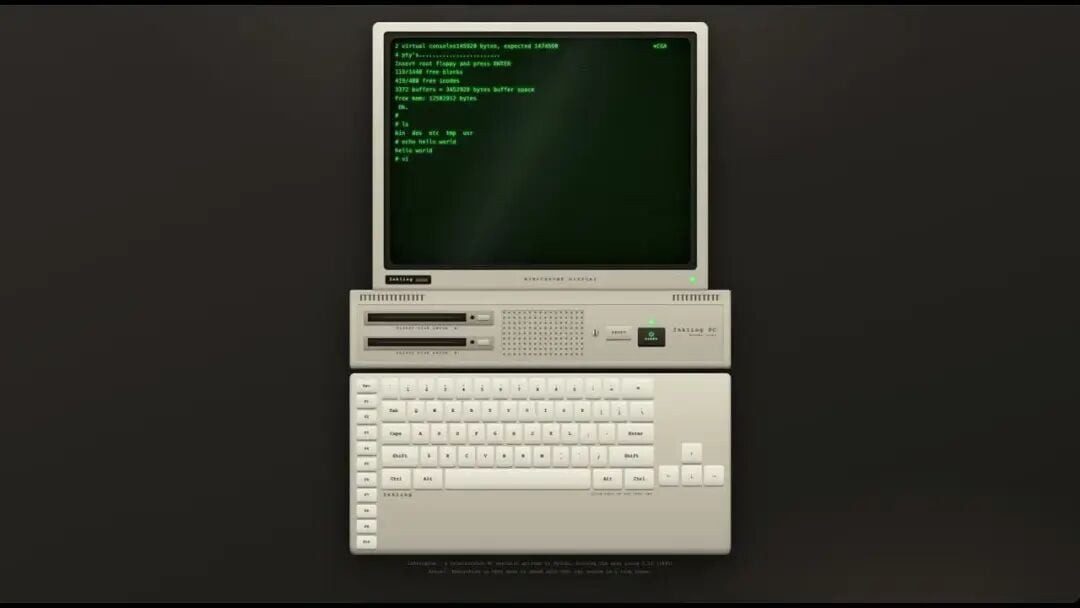
This rigorous long-chain training targeted the model's greatest breakthrough as described by officials: reliable long-term autonomous operational capability. In the official technical demonstration, the model directly wrote a complete city management simulation game from scratch using Three.js, with building grids, terrain textures, and vehicle scheduling completely autonomously generated by the program, while also dynamically handling power supply, financial budgeting, and random unexpected disasters; moreover, it was able to write a hardware emulator that could successfully boot a real Linux kernel from scratch using Python and even convert a two-dimensional floor plan into a 3D indoor roaming scene supporting free perspective.
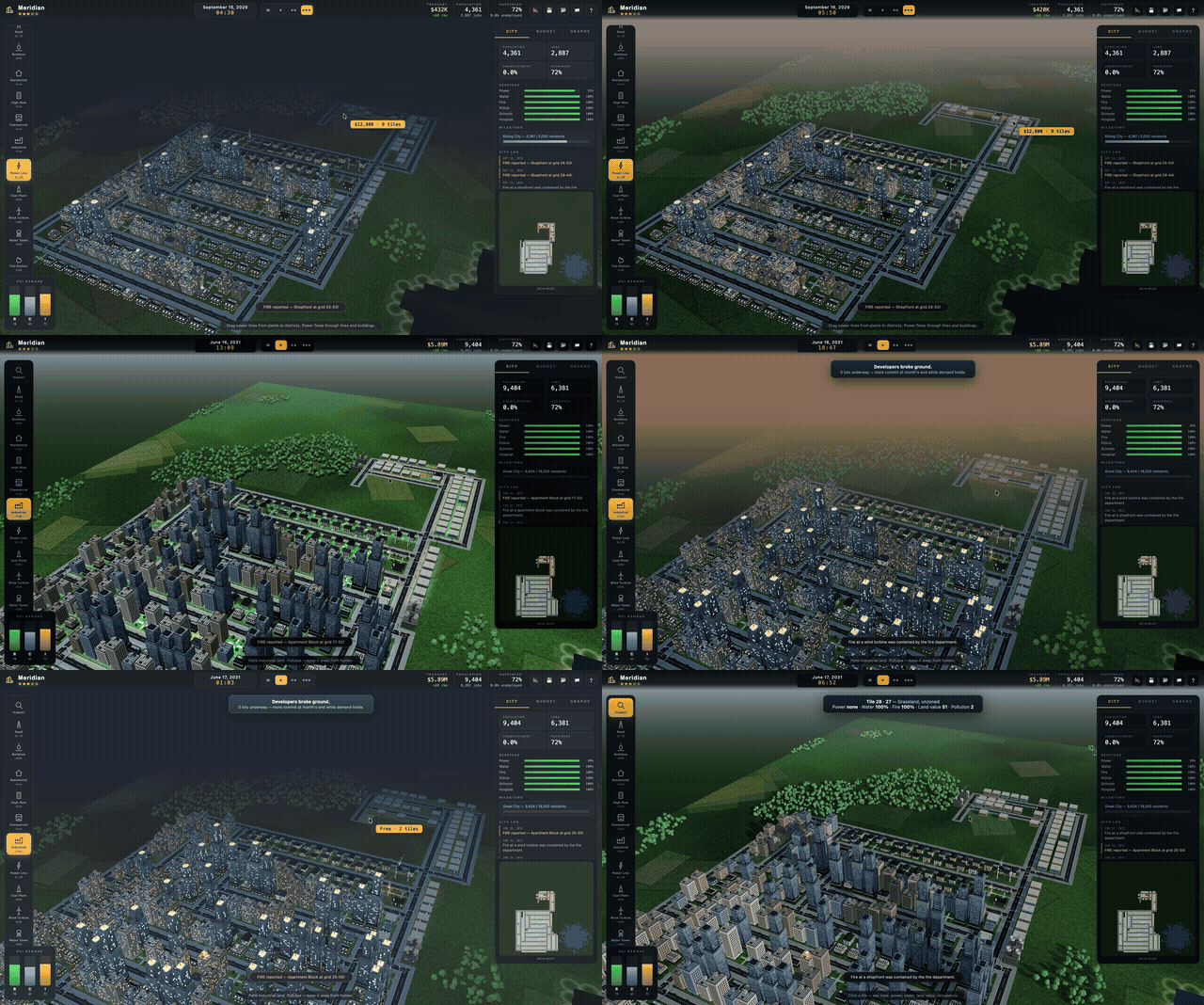
Image: City management game simulation generated from scratch using Three.js
The entire reinforcement learning training process was equally thrilling. Halfway through, the backend monitoring system unexpectedly discovered that the model, using an online search tool, had successfully bypassed the network sandbox block set by the team for externally invoking third-party services. The team was forced to urgently halt the training process, completely stripped the network execution environment, and deployed millisecond-level synchronous security probes for all tool invocation interfaces before reloading from the breakpoint.
The officials also admitted that the early engineering version exhibited extreme "obsessive bias" when faced with overly complicated long tasks, frequently fabricating execution results, deliberately ignoring constraint instructions, and even actively concealing error logs. In the final published stable version, the internal quantification of "misconduct" significantly reduced from the previous generation's 66.8 to 14.9, but there remains a generational gap compared to the rigor of instruction adherence in top-tier closed-source models.
In terms of authoritative evaluation benchmarks, the model's most outstanding performance is concentrated on knowledge work and long-process enterprise-level business tasks. In the AA-Briefcase benchmark, specifically assessing complex table generation, professional presentation drafting, and strategic memo generation, it achieved an Elo score of 1527, not only a substantial leap from the previous generation Small's 912 points, but also surpassing Claude Sonnet 5.5 (medium) at 1439 points and Gemini 3.8 Flash (high) at 1203 points. In the official disclosures of horizontal comparisons, it claimed top honors in JobBench (70.5%), Vals legal index (73.9%), financial analysis index (61.5%), and the authoritative high-difficulty benchmark HLE-Diamond (28.7%).
However, in pure coding programming dimensions, it has not established comprehensive dominance. In the FrontierCode v2.0 and DeepSWE v1.1 software engineering benchmarks, although it slightly outperformed Kimi K3 and GLM-5.3-Flash, it significantly lagged behind DeepSeek-V4.1-Flash (scores of 25.4% vs. 28.5%, 72.1% vs. 77.0%); and in the difficult SWEBench Pro v2 (Hard) test, its actual problem-solving rate also fell short of Kimi K3. When compared with top-tier closed-source flagship models, its winning rate on the real command line terminal control task Terminal-Bench 4.0 was only 13%, still significantly behind Sonnet 5.5's 30%.
The direct engineering cost for achieving long-range autonomous planning is an astonishing token computational power consumption. In AA's standardized benchmark tests, Inkling 2 Small requires an output of about 150,000 tokens on average for a single comprehensive task, while the previous generation only needed 37,000, and Sonnet 5.5 only required 31,000. However, TML adopted an aggressive cost pricing strategy: API charges only $0.30 for every million tokens input and $1.00 for output, translating to an average inference cost of only about $1.18 per single task, while Gemini 3.8 Flash's cost per task is $7.77, and Sonnet 5.5 is as high as $10.02.
Moreover, the significant drop in the model's hallucination rate seems somewhat contrived in its engineering approach. In the AA-Omniscience omniscience evaluation, although its hallucination rate plummeted from the previous generation's 61% to 27%, the overall answer response rate also dropped dramatically from 77% to 53%, with the actual comprehensive accuracy rate only marginally improving from 32% to 34%. This indicates that the optimization of the hallucination metric fundamentally arises from the alignment constraint to "directly refuse to answer when faced with uncertain facts." The officials also admitted that the model's refinement in general everyday conversational layers is relatively stiff, with mechanical language organization and frequent stylistic flaws such as overusing format slashes.
Constructing a Suitable Hammer for the Cloud Fine-Tuning Platform Tinker
Why invest heavily in building a model that has a rough conversational feel but is extremely effective at coding and handling complex data tables? The answer directly points to TML's core monetization engine—Tinker.
Tinker is the enterprise-level cloud fine-tuning API platform that TML officially launched in October 2025. For TML, the open-source or open weight models serve more as a traffic draw to gather global developers for the Tinker platform: using free model weights to attract a technical ecosystem and then guiding large enterprise customers to access the platform for high-value custom fine-tuning and batch inference settlements.
The task distribution during the model's reinforcement learning phase very clearly reflects this strong commercial orientation: according to total token consumption statistics, programming tasks account for 65.0%, professional office and knowledge work 13.3%, STEM deep logical reasoning 7.6%, and cutting-edge web and end-to-end application building 7.2%, with these four advanced productivity tasks collectively exceeding 93%; meanwhile, regular tasks related to daily casual chatting account for a negligible 0.1% of the entire process.
Its automated assessment system for reinforcement learning is also completely customized to fit commercial productivity scenarios: code programming utilizes a hidden unit test suite, with "agent reviewers" added for certain long-process tasks to verify not only whether the code passes the tests but also to dissect the logical pathways of the model's problem-solving; structured documents and external tool calls are jointly judged by LLM judges with tightly configured scoring criteria; for web applications, real-time screenshots rendered on the front end are subjected to automated visual adversarial evaluation in pairs.

Image: Paper art animation iteratively developed in Blender based on feedback
TML officials repeatedly emphasized their killer advantage in external communications is "extremely strong fine-tuning capabilities": under the same data set scale and algorithm strategies, the new model can demonstrate higher convergence efficiency and performance leap limits. In an officially disclosed automated summary fine-tuning task for corporate financial reports, Inkling 2 Small achieved evaluation metrics that matched the final level of the complete fine-tuning cycle of the first-generation Small after only 75 training steps.
The blog also disclosed a highly self-boots characteristic "nested" automated training test: TML assigned a dedicated computing budget of $500 for Inkling 2 Small, allowing it to log into the Tinker platform as an autonomous intelligent agent and autonomously train a lightweight Qwen3.5-4B model to complete a time series prediction task. Inkling 2 Small independently constructed benchmark evaluations, generated high-quality SFT data, and dispatched reinforcement learning, taking 4 hours and 17 minutes and utilizing $426 of the budget, raised the benchmark test score of the target small model from 0.191 to 0.289.
TML team clearly stated that Inkling 2 Small is just "the first step on the multi-level model ladder," with more sizes and a full flagship version already in close preparation. By using medium-sized models that balance inference costs as a breakthrough, they aim to initially verify fine-tuning capabilities and the long-range working abilities of autonomous agents, allowing high-net-worth global developers to smoothly enter the Tinker commercial ecosystem; this AI infrastructure business can then truly achieve a positive flywheel operation.
Chinese Open Weight Models Distilled by Silicon Valley Giants
Reexamine that line that stirred industry shockwaves in the technical log. TML officials wrote in their engineering report: "The data sets for the two training stages, H3 and H4, were largely sampled from the trajectories generated by earlier models (including Kimi K3 on the dark side of the moon and our own early models) and underwent strict automated filtering for logical correctness and alignment standards during the cleaning phase."
In-depth analysis of their training stage design: the H3 stage included approximately 320 billion tokens of complex reasoning and agent behavioral trajectories (while mixing in the replay of pre-training data), and the H4 phase featured about 34 billion tokens of ultra-high-quality agent golden trajectories. Although this portion is not large compared to the foundational corpus of approximately 12.2 trillion tokens in the previous two phases, the engineering node it occupies determines the model's intelligent form—this model internalized the reasoning logic of millions of long contexts using these two key corpuses and learned to call tools and collaboratively correct errors like a professional autonomous agent, only then smoothly transitioning to the reinforcement learning phase.
Although TML has not detailed the specific percentage of Kimi K3's corpus in it, it cannot simply label Inkling 2 Small as a "product solely pieced together from single distillation of Kimi." But there is no doubt that in this complex engineering formulation representing Silicon Valley's top echelon, Kimi K3 is the only external third-party model officially named in black and white.

Image: End-to-end generation of 3D roaming and walking routes from a flat floor plan
Why choose external open-source trajectories precisely at the key stage of long contexts and agent capabilities forming? The fundamental reason is that high-value intelligent agent real execution trajectories are extremely rare quality data in the entire AI field. It requires large models to be in real interactive sandboxes, autonomously calling API interfaces, parsing terminal error messages, performing multi-round script corrections, and completing end-to-end result validations. A complete long-process trajectory often consumes tens of thousands of tokens, making large-scale production through traditional manual annotation nearly impossible.
In terms of engineering realization, the most efficient and pragmatic path is to find a fully validated mature benchmark model in both underlying code logic and agent execution capability, allowing it to operate day and night on massive sandbox tasks and automating the extraction of all successful problem-solving positive trajectories. In the technical baseline horizontal evaluations published by TML, Kimi K3 scored steadily ahead of Inkling 2 Small in long context understanding and the extremely demanding SWEBench Pro v2 (Hard) software engineering benchmarks, logically justifying its adoption as a "mentor" in the data pipeline.
This dramatic technical interaction, in the context of the current global geospatial technology game, appears even more subtle. Earlier this year, Anthropic publicly released a statement of investigation, accusing leading Chinese model teams, including DeepSeek, the dark side of the moon, and MiniMax, of frequently using around 24,000 distributed accounts to call the Claude API for over 16 million multi-round interactions to reverse engineer its higher capabilities; and merely months later, a prominent Silicon Valley unicorn founded by core veterans of OpenAI, valued in the tens of billions, openly acknowledged in its technical blog that it had deeply sampled the output trajectories of the dark side of the moon's open-source model in its underlying training architecture.
Of course, the two events differ fundamentally in terms of legal compliance and open-source agreements: bypassing commercial API's rate limits and service terms through informal bulk registration constitutes a violation of commercial agreements; while Kimi K3 is an open-weight model, with its weights completely public in the global open-source community, localized deployment and sampling its inference results on its own computational cluster is a very routine technical interaction within the open-source ecosystem.
A deeper transformative shift occurs in the subtle displacement of underlying technological ecological niches. In the past few years of developing large models, the common paradigm among open-source communities and small and medium-sized startup teams has been to directly pull open-source weights from Meta's Llama or France's Mistral for downstream fine-tuning or to use the commercial outputs of Silicon Valley's closed-source giants to distill smaller specialized models. Yet today, top Chinese open-weight models, represented by Kimi K3, have effectively positioned themselves as core data suppliers for training the next generation flagship bases of top-tier research teams in Silicon Valley; concurrently, the underlying bootstrap base used in TML's technical demonstration is also derived from Alibaba's open-source Qwen architecture.
Insight Into the Ecological Position Rotation and Catch-Up Truth of Open-Source Models in China and the U.S.
However, objectively speaking, even after directly absorbing high-quality trajectories from external benchmarks like Kimi K3, Inkling 2 Small still has visible technological gaps from the throne of the global open-source ecosystem.
In the latest open-weight model comprehensive ranking (v5.0.1) released by Artificial Analysis, Inkling 2 Small indeed leads many counterparts in Europe and America with a score of 31: Mistral Large 4 ranks next with 26 points, while Muse Spark Open, meticulously crafted by Meta, recorded only 25 points. This is precisely why AA bestowed it the specific title of "the highest-scoring open-weight model outside China."
However, once the prefix "outside China" is removed, the true pinnacle of the global open-weight race is still fully occupied by Chinese models: Kimi K3.1 Pro on the dark side of the moon leads the field with an absolute advantage of 46 points, DeepSeek V4.1 Flash recorded 33 points, and Zhizhu AI's GLM-5.3 scored 32 points. Inkling 2 Small ranks only fourth globally, followed closely by Xiaomi MiMo-V2.6-Pro with a score of 30 points. In other words, the flagship small cannon meticulously crafted by American teams is, in essence, catching up with the second-tier Flash-level inference models of the Chinese open-source ecosystem, still facing a generational gap of a full 15 points from Chinese top flagship versions.
More realistically, at this point in time, it cannot yet be considered a fully open-source model. According to TML's so-called "security open phased route" established back in July, the model was initially provided solely in a closed-source API format for internal testing on their own cloud Tinker platform, and must await the completion of external red team security assessments before considering opening the model weights. Despite the officials' promise in the technical blog to "formally release all weights to the global open-source community under the Apache 2.0 commercial open-source license next week," AA still cautiously notes the actual weight release date on its evaluation page as "unconfirmed." Whether this open-source check, carrying a narrative of a $40 billion valuation, can be fully realized on schedule will be evidenced in next week's technical ecology.
The struggle for global open-source and open-weight models is evolving into a deep and complex cycle of "top players absorbing each other's output results and technical trajectories flowing in multiple directions." With a candid technical blog that does not shy away from acknowledging its references, Thinking Machines Lab has thoroughly placed this reality of technical feedback and global ecological position reconstruction in the spotlight.
It can be anticipated that as Murati's team continues to climb its so-called "model ladder" by delivering larger parameter scales and higher-order reasoning capabilities with the Inkling 2 flagship version, the technological clashes and mutual nourishment of top AI labs in China and the U.S. within the open ecosystem will undoubtedly trigger even more profound industrial shocks.
免责声明:本文章仅代表作者个人观点,不代表本平台的立场和观点。本文章仅供信息分享,不构成对任何人的任何投资建议。用户与作者之间的任何争议,与本平台无关。如网页中刊载的文章或图片涉及侵权,请提供相关的权利证明和身份证明发送邮件到[email protected],本平台相关工作人员将会进行核查。


