Author: Zuo Ye, Crooked Neck Mountain

A red wind of MAGA over a cup of tea, ten years of blue night rain in Texas.
With the midterm elections concluded, Trump enters a lame duck phase ahead of schedule.
Republicans always emerge as rebels, yet the outcome consistently sees them co-opted by the system, just like the Tea Party in 2010 and today’s MAGA. What was promised then was a fierce fight against the deep state; now, the goal is to collaborate with Democrats in grand ventures, as Trump officially enters garbage time.
The Democrats are sharpening their knives: Warren aims to re-examine the special pardon process for CZ, and the Trump family's WLFI is also on the list; while Coinbase, a player within the crypto circle, has dragged its feet on crypto legislation. Those who bet on compliance over the past year now face ridicule from the wild financial sector.
The bull market that began on August 20 peaked with Robinhood's memes and ended with the Binance hack, creating a final window for compliant entry into the U.S. The political winds have suddenly stopped.
How long can the red flags continue to fly? Where will the cryptocurrency world go after Trump?
Binance Time: Monopoly as a State of Affairs
"In the endless distance, countless people are all related to me."
Sometimes, the dead can be more useful than the living.
After the sudden death in July of Lindsey Graham, an extreme supporter of Ukraine and Israel, his sister Darlene took over the remaining Senate term and received strong backing from Trump in this midterm election. Trump played a card: urging the Senate to pass the Clear Act "in memory of Lindsey."
This is actually quite magical; Lindsey was not even a member of the Senate Banking or Agriculture Committees and had teamed up with the anti-crypto banner-waver Warren in 2023 to call for tighter regulations, using a dead anti-crypto figure to push a pro-crypto bill.
Then the card was lost. Darlene lost in South Carolina, a Republican stronghold for 30 years, and Trump’s endorsement has lost its value; the Democrats quickly responded, targeting CZ, focusing on whether the pardon procedures were appropriate.
Binance, situated between China and the U.S., with CZ navigating between the two parties, will always face continuous pressure for alignment of positions. Is it possible that Sun Ge truly is a genius, having seen Trump's decline ahead of time?
In the larger political climate, whether $6 billion is stolen or $5 billion flows out in a single day, both are merely small numbers relative to $170 billion in assets. The big question is, how much longer can Binance dominate the crypto world?
Monopoly is not evil; it is more like a marker of an industry reaching maturity. Everyone's methods are identical, and strategies are highly similar across VCs, exchanges, and project teams, offering nothing but categories like Perp, prediction markets, memes, and stablecoins, leading to point competitions until TGE, after which project teams rug pull, and retail investors forget everything.
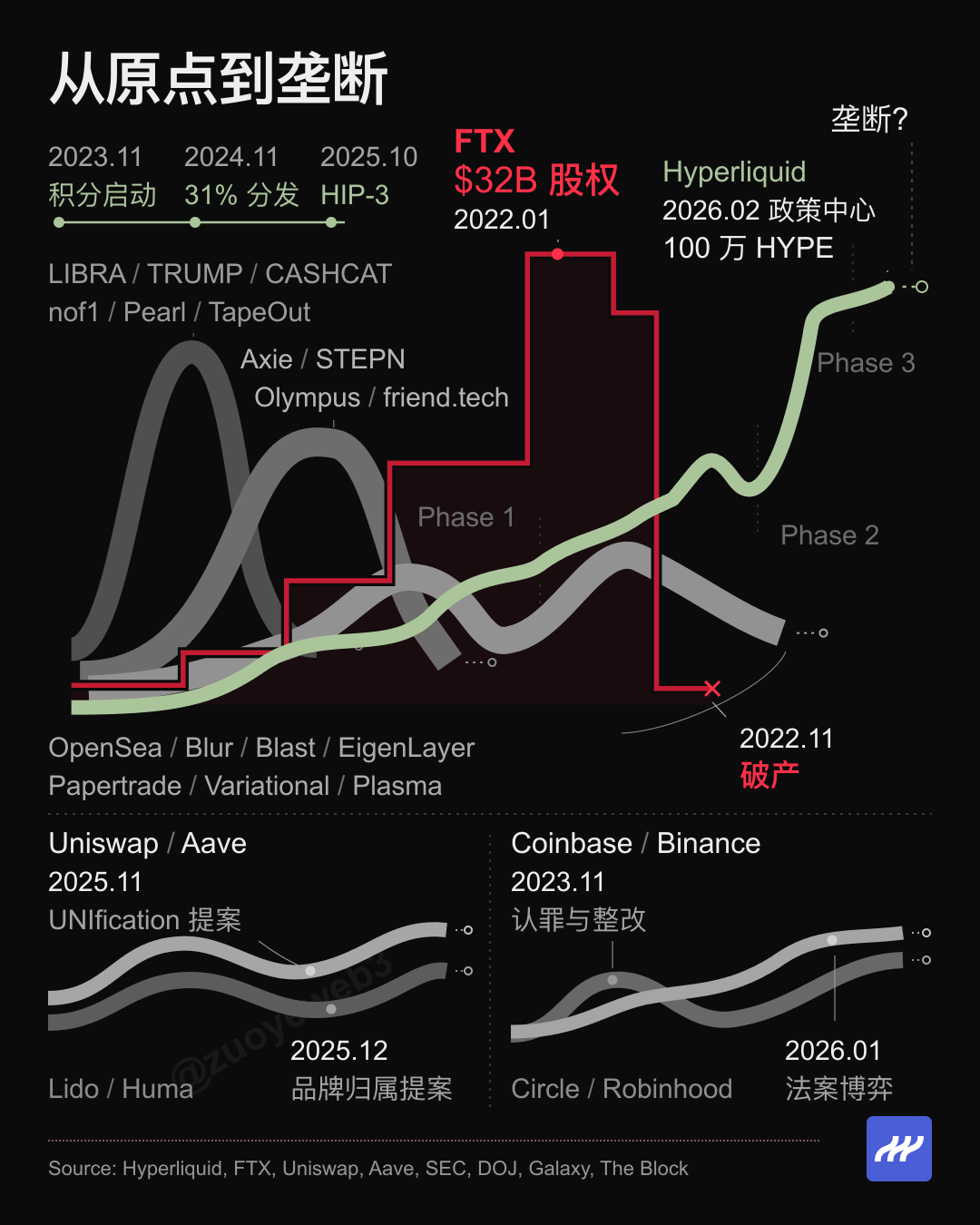
Image: Monopoly is a state of affairs
Since the approval of the Bitcoin spot ETF in January 2024, the logic in the crypto space has quickly homogenized; there will be no more distinction in tracks, only unfinished gaps remain.
If we sketch its basic portrait, it can generally be divided into four phases:
Phase 0: Ignite project-level hotspots to attract funding for trading or investment, such as in October 2025, when nof1 starts six AI large models trading real contracts on HL, or the PaperTrade loss-exchange debacle in October 2026;
Phase 1: If the project ignites market sentiment, it must enter the actual operation phase. Generally, after entering Phase 1, marketing strategies like point competitions are needed to attract funds with potential token airdrops;
Phase 2: If it can withstand the capital fluctuations post-token issuance, it may become a key player in a certain track in the crypto industry. At this time, it is necessary to coordinate the interests of the protocol itself, management team, and token holders through mechanisms like HYPE's continuous buybacks and self-token locking; conversely, there have been ongoing conflicts with Aave Lab and DAO;
Phase 3: If it can successfully coordinate the interests of all parties involved with the tokens, it must then face the final challenge: regulation, exemplified notoriously by Binance's CZ serving a sentence and paying huge fines. If successful, it can essentially enjoy monopoly profits.
All types of products differ only in consumer capacity; Sha County and Starbucks differ only in price, not in products and images: PumpFun and GMGN both create cross-chain bridges, Uniswap merges with Curve, 1inch for liquidity, the socialization trend ignited by Fomo, and CEXs speed towards uniformity.
These are all opportunities in the gaps, and no new assets are being created, no new asset issuance methods, only product shelf combinations.
Summer of Security: The High Cost of Abandoning True Innovation
Abandoning true innovation carries an extraordinarily high cost.
Aug 20 not only marks the starting point of this minor bull market but also the origin of frequent security incidents like cold wallet thefts and exchange breaches. As the industry structure becomes increasingly solidified, hackers, backed by AI, can create wealth opportunities more quickly and in larger batches.
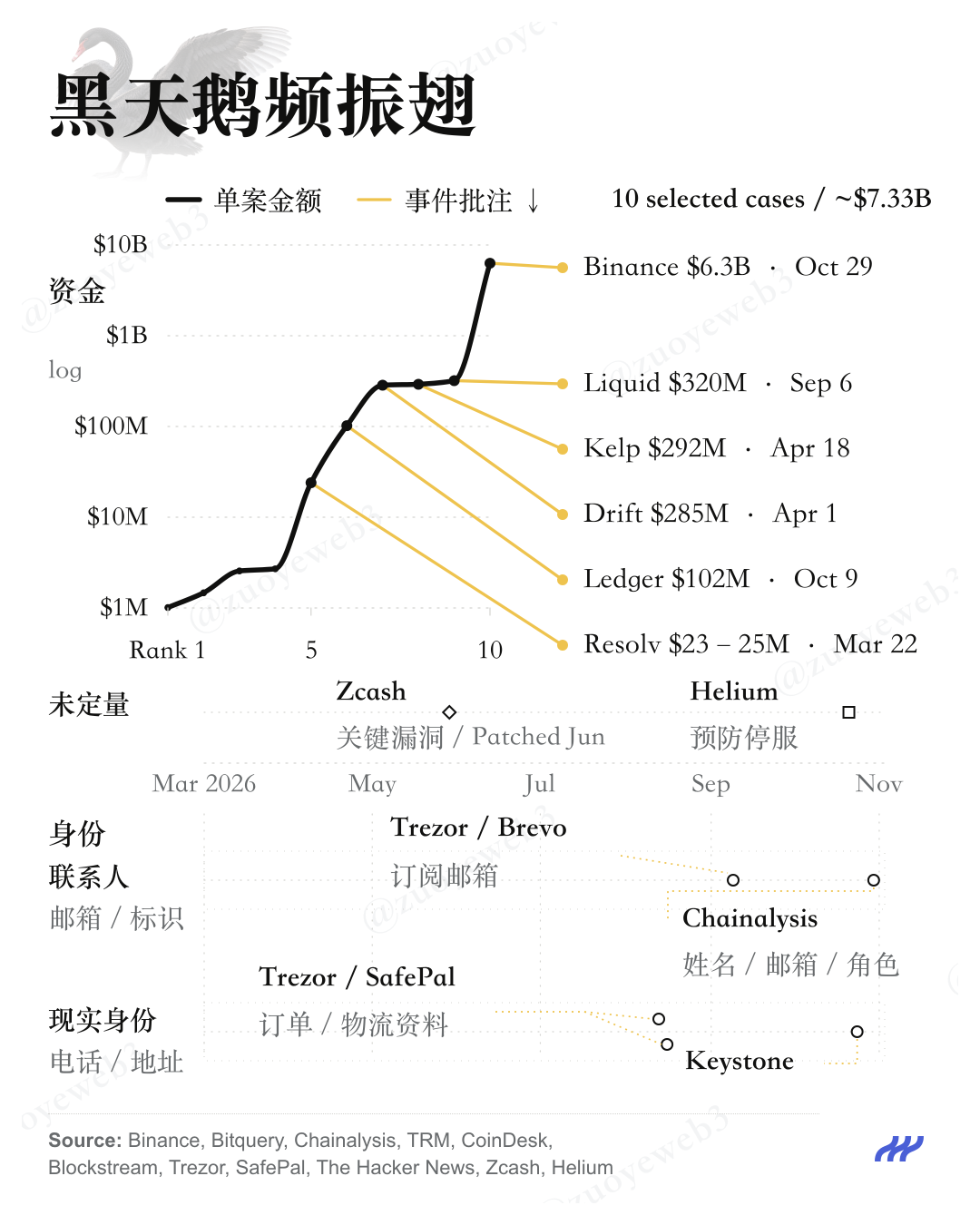
Image: Security issues from August onwards
In times of high-frequency innovation, users can tolerate short-term discomfort, but during the industry's maturation phase, if safety standards cannot match those of TradFi, any extra profits cannot cover potential risks.
It can be predicted that from now until 2028, crypto users will continue to diminish, and existing funds in the crypto circle will reassess various crypto assets.
After Binance resumed withdrawals, it initiated high-interest deposit activities to restore the asset cover disrupted by hackers. This is essentially an alternative expression of socialized losses, but Binance’s dominant position allows it to quickly recover, making it challenging to attract external funds.
This means Binance is competing for the existing users among CEXs, and this struggle is an extreme form of internal competition, unlikely to lead us to the future we desire.
TikTok time instills fear in ByteDance, while Binance time leads to the loss of control in crypto; in which manner will decentralization become a reality? Or more seriously, we must ask ourselves, if Binance falls, will we witness a renaissance on-chain or will we sink into a dead silence akin to collectors of postal and currency cards?
Politics is an eternal perpetual contract; the Republicans will strategize around Vance, while the Democrats sharpen their knives against the rich. Peter Thiel predicted the trajectory correctly and moved early towards Latin America (as a reserve for spiritual whites), while Musk paid $400 million but ultimately achieved nothing, yet they still have a future.
Meanwhile, crypto now has to pay the price for Binance.
The U.S. Regulatory Framework: Who Will Pay for Institutional Cooptation
"That seasonal wind blew so empty, as if everything in the world would also vanish without a trace."
The distance between the crypto circle and the center of the era is becoming increasingly close. Although it is not like AI has become the absolute center of this election: data centers competing for water and electricity, with AI causing waves of unemployment, crypto, as the future of finance, has firmly taken root in the world.
Prior to the release of midterm election results, perpetual contracts are compliant in the U.S., and on a larger scale, America has nearly built a complete regulatory framework. In the next two years, compliant enterprises will employ a "hop on, close the door" market strategy because I am compliant, therefore you will utilize my services.
This essentially constitutes a restriction on market entry, which will hardly become a coveted place for free men. We are focusing on new opportunities within the gaps, better to be a meme than to be Goldman Sachs.
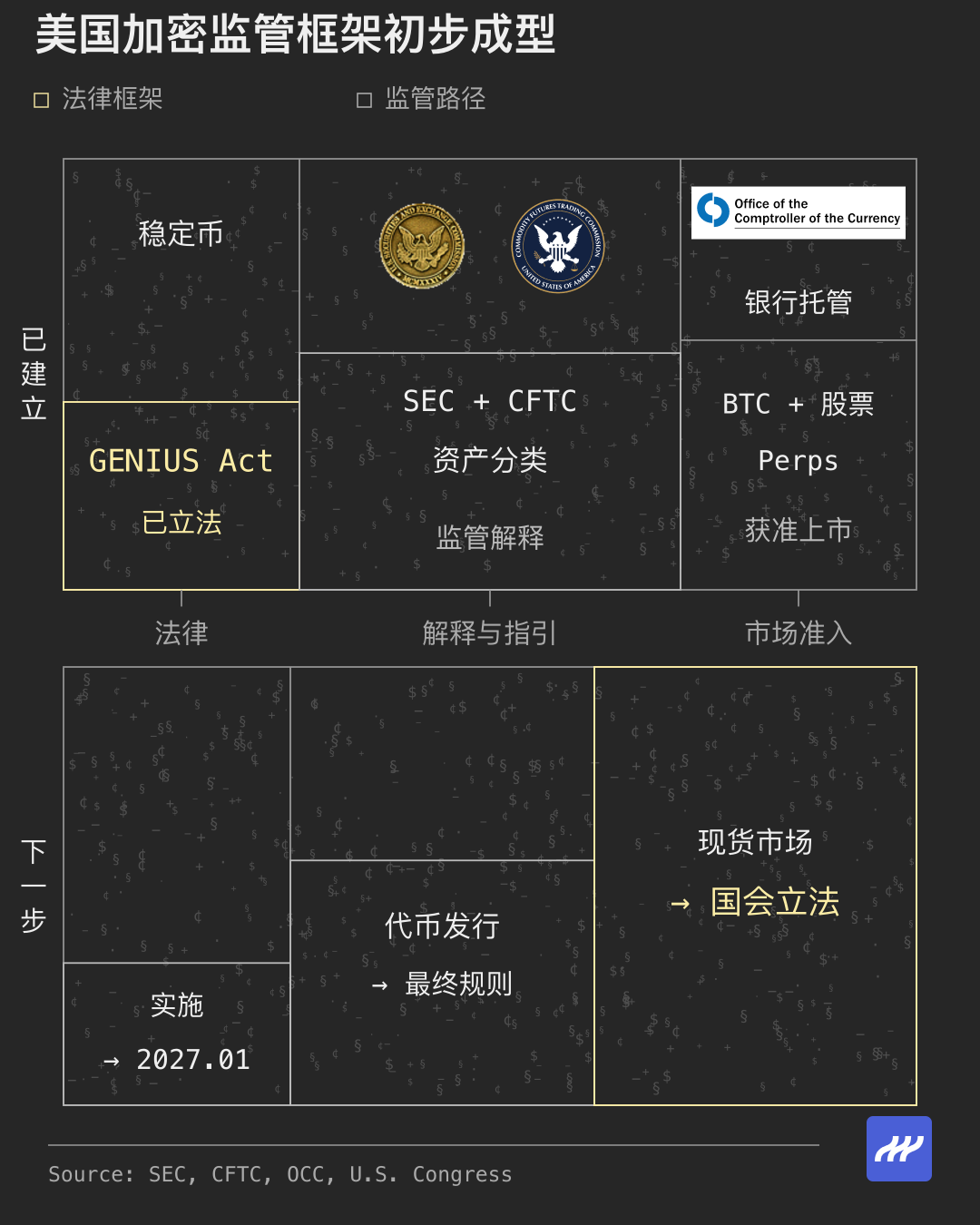
Image: U.S. regulatory framework
One can feel the anxiety of the masses in advance, from KOLs complaining about declining traffic to the fierce competition in exchanges over user acquisition, all indicating that the CEX-dominated era is rapidly collapsing. Although American exchanges may lack in technology, service, and products, they excel in compliance; countless law firms and hungry former officials in the revolving door are ready to consume the new funds.
"Items are no longer direct products of labor; people no longer understand the production environment and process of these items. The commodities presented before people are increasingly strange and magical, which is also a process of society becoming more fetishistic."
But retail investors cannot refuse; people have already drifted away from the internal links of project production. As public chains, token economics, and project parties have increasingly complex technologies and multiplied personnel, it is impossible for people to understand everything through in-depth details, even with AI. We must ask ourselves: have we enhanced information transparency or merely enriched the materials filled in, ultimately approving everything and pretending to comprehend it all?
Accepting reality, it is now basically impossible to accompany a project for ten years like waiting for BTC; you must act quickly and choose your investment amounts, otherwise, you will be shorted by the market.
Coming like wind and rain, departing like fine dust.
Post-Trump Era: The Main Line of the Cryptocurrency Market Shifts
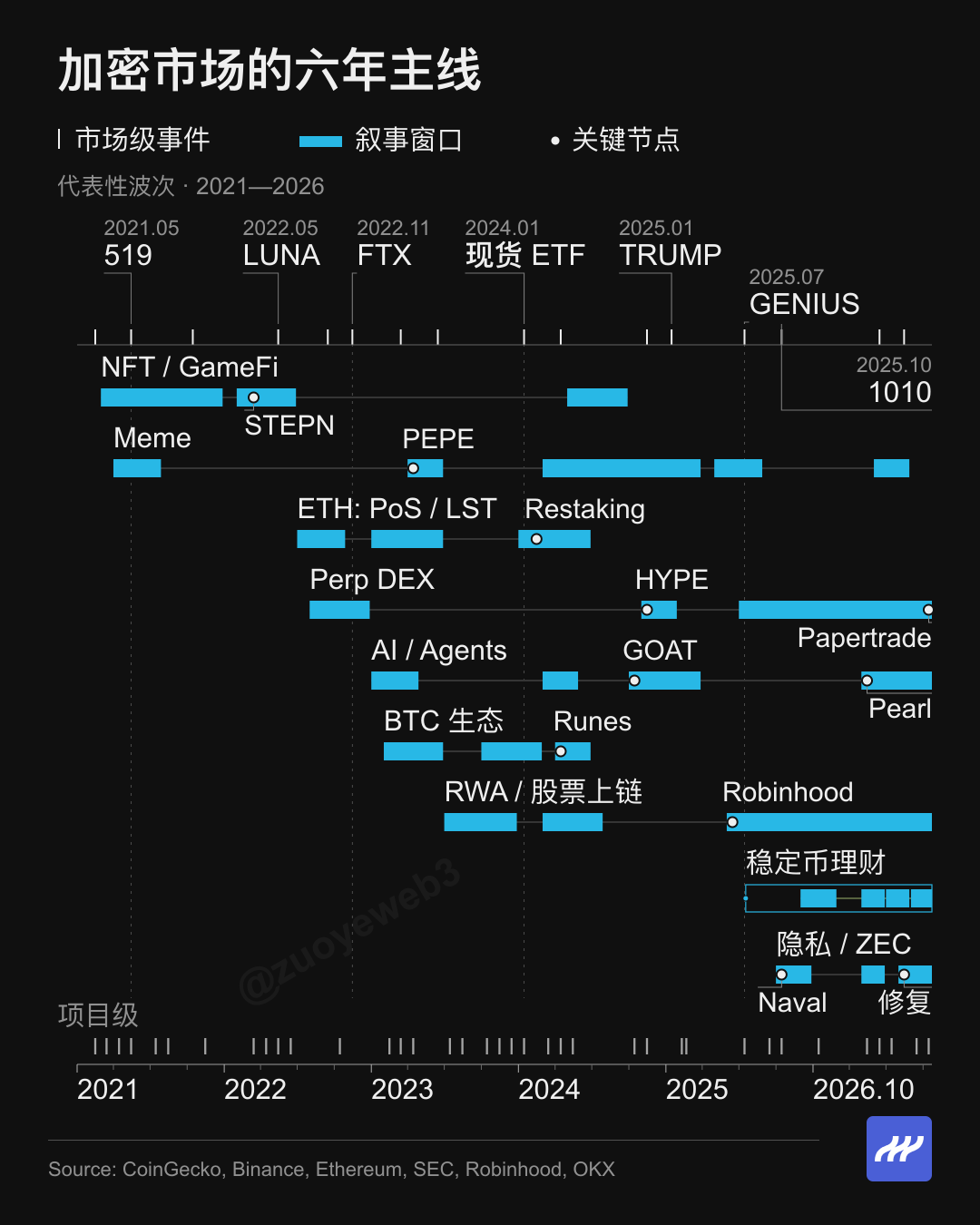
Image: Main lines of the cryptocurrency market
Starting from the last recognized most explosive bull market, since 2021, the crypto industry experiences 2 to 3 major market fluctuations each year, 5 to 7 track-level fluctuations, and around 10 project-level hotspots.
However, it must be admitted that this technological cycle, starting from the Ethereum shift to PoS as a market hotspot, has given rise to several tracks such as ZK, L2, LST/LRT, absorbing VC funds amounting to hundreds of millions like a16z, and spawning hundreds of projects, leading to a climax in 2024, while we are still in its tail stage.
Additionally, since the Bitcoin spot ETF in 2024, the super long cycle and plethora of original plays in the crypto world have increasingly made way for rapid three-in-one projects like $TRUMP: market-wide hotspots, meme tracks, and individual projects.
Since 2025, only the stablecoin track after the genius bill has attracted fintech funds, while privacy narratives such as Zcash/Zama popular in the West have consistently failed to convince the Asian market to invest.
Ultimately, in 2026 there will be no market-level, all-industry, cross-over hotspots; only Robinhood capturing the meme and the crypto circle's leeks hoping for fantasy gains with stock pairing.
With Trump becoming a lame president, the favorable policy phase for crypto has momentarily stalled. From the perspective of wild finance, the sovereign narrative also comes to an end; we must return to the essence of innovation, how to replace fiat currency with cryptocurrencies and connect the world.
The future that Crypto desires cannot be provided by either the red or blue government.
Concluding Thoughts: The Future of Crypto Cannot Be Provided by the Red or Blue Governments
"The origin of money lies in social relations, and politics is the representative of social violence."
From the lament of the rural people to the MAGA wave sweeping the deep state, Trump finally completed his institutionalization in his second term, while the most peripheral innovation in cryptocurrency, meme culture, surprisingly allowed the Trump family to earn wealth they had never even dreamed of.
Globally, the climate is the same; the ability of crypto to witness the entire ebb and flow of the most fervent political forces alongside AI is the best demonstration of its vitality. Under the dual blows of Binance's theft and Trump's lame duck status, the tail end of 2026 may still conceal a sector-level or even market-level opportunity.
This reflects a kind of blade-seeking in the boat and bottom-fishing mindset; Peter Thiel fled before the midterm elections, whereas in 2016, he chose to leap into Washington.
免责声明:本文章仅代表作者个人观点,不代表本平台的立场和观点。本文章仅供信息分享,不构成对任何人的任何投资建议。用户与作者之间的任何争议,与本平台无关。如网页中刊载的文章或图片涉及侵权,请提供相关的权利证明和身份证明发送邮件到[email protected],本平台相关工作人员将会进行核查。


