
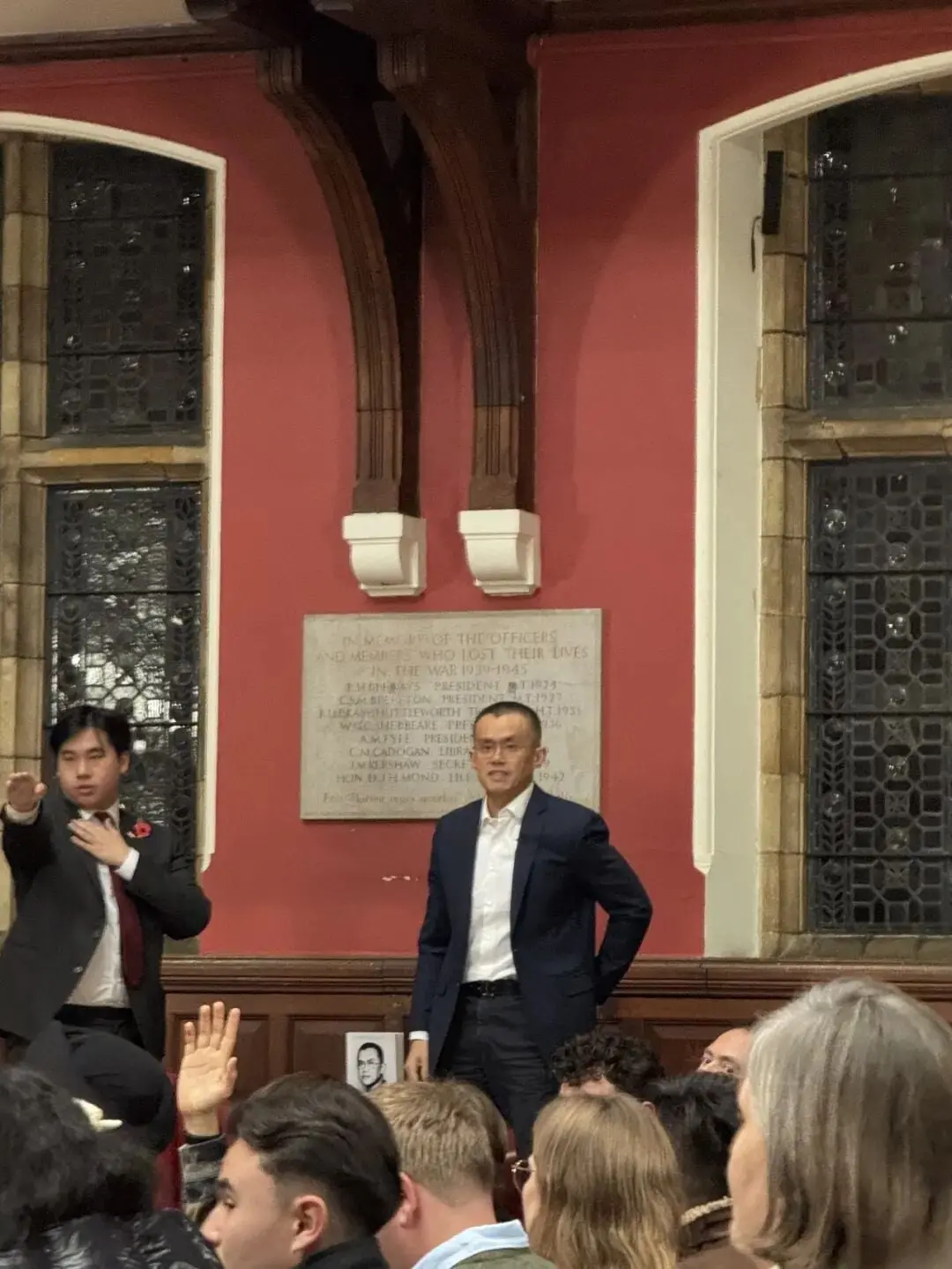
On November 3, the wind in Oxford was strong. Around 5 PM that day, a long line formed outside the Oxford Union, and at 6 PM sharp, Zhao Changpeng stepped into the debate hall, where hundreds of waiting attendees were already seated. Five days earlier, Binance had just experienced a major cybersecurity incident - according to the investigation update released by Binance on November 3, the incident involved approximately $6.34 billion in digital assets, of which about $2.85 billion related assets were frozen or intercepted by the time of the disclosure. Binance stated that it had set aside sufficient funds to cover the losses and was gradually replenishing the affected assets.
This meant that the interview themed around CZ's new book "Freedom of Money" was likely his first candid engagement with a public audience after this incident. The host dove straight into the topic at the start: after such a monumental mistake, why should users still trust this platform?
From cybersecurity to entrepreneurial missions, from stablecoins to artificial intelligence, from quantum computing to marriage choices, the nearly hour-long dialogue with 19 questions from the audience contained a wealth of information that far exceeded the interview in Hong Kong in August 2026. For an entire industry caught in the whirlwind of "platform trust" discussions, the significance of this dialogue surpassed that of a typical book sharing.
Why Oxford
CZ provided his answer: he believes the Oxford Union genuinely embodies the spirit of Freedom of Speech, while Binance's focus is on another type of freedom - Freedom of Money, which is also the title of his new book.
He further articulated a continuous line of evolution for the concept of "freedom" throughout human civilization: from personal freedom by abolishing slavery, to freedom of expression, freedom of the press, and freedom of information. Today, he believes the industry is entering a new phase - Freedom of Intelligence. In his view, this is not just a possibility, but a direction that "will inevitably happen."
This expression is clearly a designed narrative, but it highlights the subtlety of this dialogue: a founder of a platform that has just faced the largest theft in history stands in a debate hall with a history of 200 years, discussing grand themes such as freedom, trust, and technological evolution. Beneath the surface of crisis management lies a public defense of the industry's legitimacy and long-term value.
The Four Intertwined Themes Behind the 19 Questions
Breaking down the 19 questions reveals four intertwining themes.
The first theme is security and trust, which is also the core issue of the entire dialogue. CZ did not shy away from responsibility; he acknowledged the attack revealed clear shortcomings in Binance's security and operational aspects, and explicitly stated that he could not dismiss the platform's responsibility by claiming "the attack was too advanced." However, he emphasized two points in the aftermath: first, quick communication of developments to the outside world after the incident, and second, the platform's commitment to bear the losses of user assets. He repeatedly returned to the principles established when he founded Binance - centralized exchanges must ensure user assets are protected during crises and cannot make users pay for internal platform vulnerabilities.
Interestingly, he refused to give a "never again" commitment. In his view, any claim that complex information systems can be forever immune to attacks is unrealistic. He revealed that attackers might have spent about five to six months preparing, first approaching the enterprise through traditional methods like fake recruitment and social engineering, before using AI to accelerate their understanding of systems. Certain fundamental security protocols for Binance were not rigorously enforced, an issue that should not appear on a major trading platform. He cited a fundamental judgment in the security industry: attackers only need to find one entry point, whereas defenders must secure all entry points—this asymmetry is further amplified in the AI era. Therefore, his conclusion was not "this will not happen again" but rather to shift the industry from passive remediation to proactive defense.
The second theme is the underlying reason for the existence of cryptocurrencies. When asked "Why does the world still need cryptocurrencies?" CZ's answer revolved around several real pain points: difficulties in account opening and cross-border payments in certain regions, the need for tools to protect purchasing power in high-inflation environments, the ongoing frictions between financial systems of different countries, and the technical potential for on-chain payments and transactions to operate around the clock. He also maintained a certain level of nuance, acknowledging that this was a statement about technological potential rather than that all crypto financial services have been proven superior to banks; actual applications still need to address issues like fees, compliance, custody, and consumer protection.
The third theme is the dual reinterpretation of the industry by AI. CZ revealed that he also uses natural language-driven AI programming tools, believing that as coding barriers lower, competitive advantages will shift towards the ability to design products and solve problems. However, a more forward-looking judgment lies in the demand side: as AI agents automatically match services, assess results, and settle payments on behalf of users, there will be a massive demand for small payments between machines, which represents an opportunity for low-cost, digitally native payment infrastructure. Of course, he also acknowledged the short-term double-edged effect of AI - attackers are also using it to enhance efficiency.
The fourth theme is the collision of technology and systems. Regarding the relationship between CBDCs, stablecoins, and Bitcoin, his response was "different tools satisfy different needs": stablecoins are preferred for payments, while investments in the long-term development of industries look to native assets. When discussing China, he described Hong Kong as a "testing ground" for observing digital asset innovation, while also cautioning the market against overinterpreting individual supportive statements for financial innovation as signals of full openness. On the issue of quantum computing, he admitted a lack of expertise and avoided making absolute judgments but believed that research into post-quantum cryptography will advance synchronously with quantum capabilities. The most tension-filled response appeared regarding the issue of law enforcement freezing: the ability to transfer on-chain and whether funds are processed through centralized custodial platforms are two issues that need to be discussed separately—having the ability for on-chain transfers does not mean that real-world transaction paths are free from judicial jurisdiction.
The True Industry Significance of This Dialogue
Returning to the incident itself, the industry signals revealed by this interview may be more important than the 19 answers themselves.
First, "platform responsibility" is becoming the default paradigm for crisis management. Binance's operations during this incident—rapid disclosures, freezing and interception, utilizing the SAFU user asset security fund (which he mentioned on-site is approximately $1 billion in scale), insurance funds, and the company's own capital to replenish user assets—actually set a reference model for the industry. It should be noted that some funding details come from CZ's on-site estimations and are not precisely audited data; however, the public declaration of the principle "losses are borne by the platform" itself will influence user expectations in future crises.
Second, transparency is evolving from a slogan into a competitive dimension. CZ compared on-chain verifiability with information disclosure of traditional financial institutions, noting that third-party analytical firms sometimes identify anomalies even before the platform does. While this transparency amplifies the immediate impacts of a crisis, it also enables the system to accept public oversight. For the industry, this presents a rather enlightening perspective - in an era where AI makes attacks more efficient, "external verifiability" may be more convincing than "claims of safety."
Third, AI is simultaneously raising the thresholds for both offense and defense. From North Korean hackers using generative AI to forge recruitment companies and interview scripts, to the defenders needing to introduce AI companies, cybersecurity experts, regulators, and law enforcement for multi-party collaboration, security has evolved from a singular platform issue to a cross-institutional collaborative issue. The "positive changes" in cross-institutional collaboration that CZ mentioned should be observed for their potential to transition into normalized defense mechanisms.
Fourth, the object of trust is shifting from individuals to institutions. One audience member directly questioned: do users trust the Binance platform or the founder personally? CZ's response was quite candid - the principle of protecting user assets should not rely on whether a particular founder is in power but should become the system and behavior of the platform itself. Considering that he no longer serves as CEO, this response is, in a sense, a public endorsement of Binance's depersonalized governance. His sincere response about marriage and life partners having "no standard answer" became the most authentic moment of the evening - no matter how grand the narrative, acknowledging one's own ignorance is, in itself, a form of credibility.
Conclusion: A Delayed Coming of Age Ceremony
This dialogue at the Oxford Union did not provide a timetable for when cryptocurrencies will enter the mainstream, nor did it eliminate any technical or security risks. The rough estimate of "initial widespread adoption needing five to ten years" on the S-curve is neither a prediction nor a promise.
However, its significance lies in: a platform that has just suffered a loss of $6.34 billion choosing to accept the sharpest questions on the oldest public debate stage. From the marginalization of the industry during the Sony incident era to the present being on the debate stage in Oxford, the crypto industry is being forced to learn one thing - the way to earn trust is not by claiming to be infallible but by how to take responsibility, rectify systems, and continue operations after making mistakes. This may not be the answer users want to hear, but it could be the necessary coming-of-age ceremony for this industry on its path to maturity.
免责声明:本文章仅代表作者个人观点,不代表本平台的立场和观点。本文章仅供信息分享,不构成对任何人的任何投资建议。用户与作者之间的任何争议,与本平台无关。如网页中刊载的文章或图片涉及侵权,请提供相关的权利证明和身份证明发送邮件到[email protected],本平台相关工作人员将会进行核查。


