

Every Monday, Wednesday, and Friday, focusing on the cryptocurrency market, Japan, South Korea, the A-share market, and Hong Kong stocks, reviewing the market with data, seizing opportunities with trends, produced by PANews.
Bitcoin drops nearly 6% in a single day, falling below $76,000, technology stock sell-off transmits to the cryptocurrency market
Last night, Bitcoin followed the plunge of U.S. technology stocks. The cryptocurrency market saw widespread declines, with BTC market capitalization falling to $1.52 trillion. As of the time of this report, BTC is priced at $75,721, down 5.9% in 24 hours, down 3.4% over 7 days, and down 9.9% over 30 days. Following the Binance theft incident, BTC had briefly rebounded to $81,200, but this round of declines has erased all gains from that rebound.
Institutional funds are turning into outflows during the decline. According to SoSoValue data, on November 5th Eastern Time, the total net outflow from Bitcoin spot ETFs was $430 million, while the previous day saw net inflows of $74.567 million. Fidelity's FBTC had the highest net outflow of $200 million in a single day, while BlackRock's IBIT saw a net outflow of $105 million.
The derivatives market is de-leveraging in the decline, with options expiry further amplifying volatility. Deribit has approximately $2.64 billion in BTC options expiring today at 16:00, with a put/call ratio of 0.38 and a maximum pain point at $79,000; positions are concentrated in $82,000 and $85,000 call options, while the current price is far below the strike prices.
The source of the decline lies in U.S. stocks. CryptoQuant analyst Axel Adler Jr. points out that technology stocks faced the largest single-day decline since the COVID-19 pandemic. Democrats, victorious in the gubernatorial elections in Texas, Ohio, and Georgia, have pledged to pause the construction of new data centers, raising market concerns about a slowdown in AI infrastructure expansion. He believes that as long as the stock market sell-off continues, further risk of reduction in the cryptocurrency market still exists. Another CryptoQuant analyst, Darkfost, shows that the correlation indicator between BTC and the S&P 500 has surged above zero for the first time since 2015, indicating that BTC prices are increasingly following stock market fluctuations. The policy environment is also weakening: according to CNBC, Democrats achieved significant victories in the midterm elections, and the CLARITY Act may be shelved until 2028; the Wall Street Journal states that long-time crypto industry critic Senator Elizabeth Warren is expected to lead the Senate Banking Committee. Going forward, whether U.S. technology stocks can stop falling is the biggest variable for Bitcoin's short-term trend.
BTC is under pressure from the significant correction of U.S. technology stocks, with prices fluctuating around the $75,000–$76,000 range and showing signs of sweeping towards near $75,000. Major traders generally hold a cautious wait-and-see attitude or are looking to buy on dips. Michaël van de Poppe notes that Bitcoin is relatively more resistant to declines compared to the Nasdaq on that day (similar to the situation in March 2020), predicting that the Nasdaq may bottom tomorrow, and Bitcoin may also stabilize after sweeping $75,000; current high volatility is seen as an ultimate accumulation opportunity. Crypto Tony clearly stated he is waiting for a test of the lows, confirming stability before seeking long opportunities, and is currently not entering the market. Rekt Capital suggests that Bitcoin has hit the right shoulder support of a cycle similar to the 2023 cycle and is currently diverging downward, having retraced about 13% from its previous high, still a significant distance from the all-time high, with short-term weakness not fully alleviated.
Ethereum drops nearly 8% falling below $2,300, divergence between whales increases
Ethereum's decline is more severe, currently priced at $2,230, down 7.9% in 24 hours, with market capitalization falling back to $272.4 billion. The U.S. Ethereum spot ETF experienced a total net outflow of $99.9677 million on November 5th (Eastern Time), with BlackRock's ETHA leading the net outflows at $75.203 million, and ETHB seeing a net outflow of $21.9878 million; the previous day, the ETF had just ended a five-day consecutive net outflow and shifted to a net inflow of $53.02 million, and the fund situation has deteriorated again after only briefly turning positive for one trading day following five consecutive days of net outflow.
The derivatives market is also cooling down. The ETH perpetual funding rate has turned to -0.0004%, with open interest dropping from $2.004 billion on November 5th to $1.708 billion, while the long-short ratio increased from 2.6 to 3.36. Today's expiring Deribit ETH options have a nominal value of about $224.5 million, with a put/call ratio of 1.27, indicating significantly more put options than call options, and the maximum pain point is located at $2,350, with significant positions also around $2,100.
ETH follows the risk asset correction, with prices falling to around $2,200–$2,230, experiencing greater volatility compared to BTC. Daan Crypto Trades (@DaanCrypto) believes that after a previous rebound, ETH has faced significant selling pressure, showing weak price performance in the short term. However, from a larger cycle perspective, $2,100 and $2,800 constitute important lower support and upper target areas, respectively; if $2,100 is lost, the mid-term bullish structure will face more severe challenges. Atrades points out that ETH's weekly chart has returned to the range, currently leaning bearish unless it breaks $2,464; Minga has moved the stop loss of ETH positions to $2,050, and Crypto Tony is also waiting for the lows to be tested, considering re-entering for longs upon confirmation.
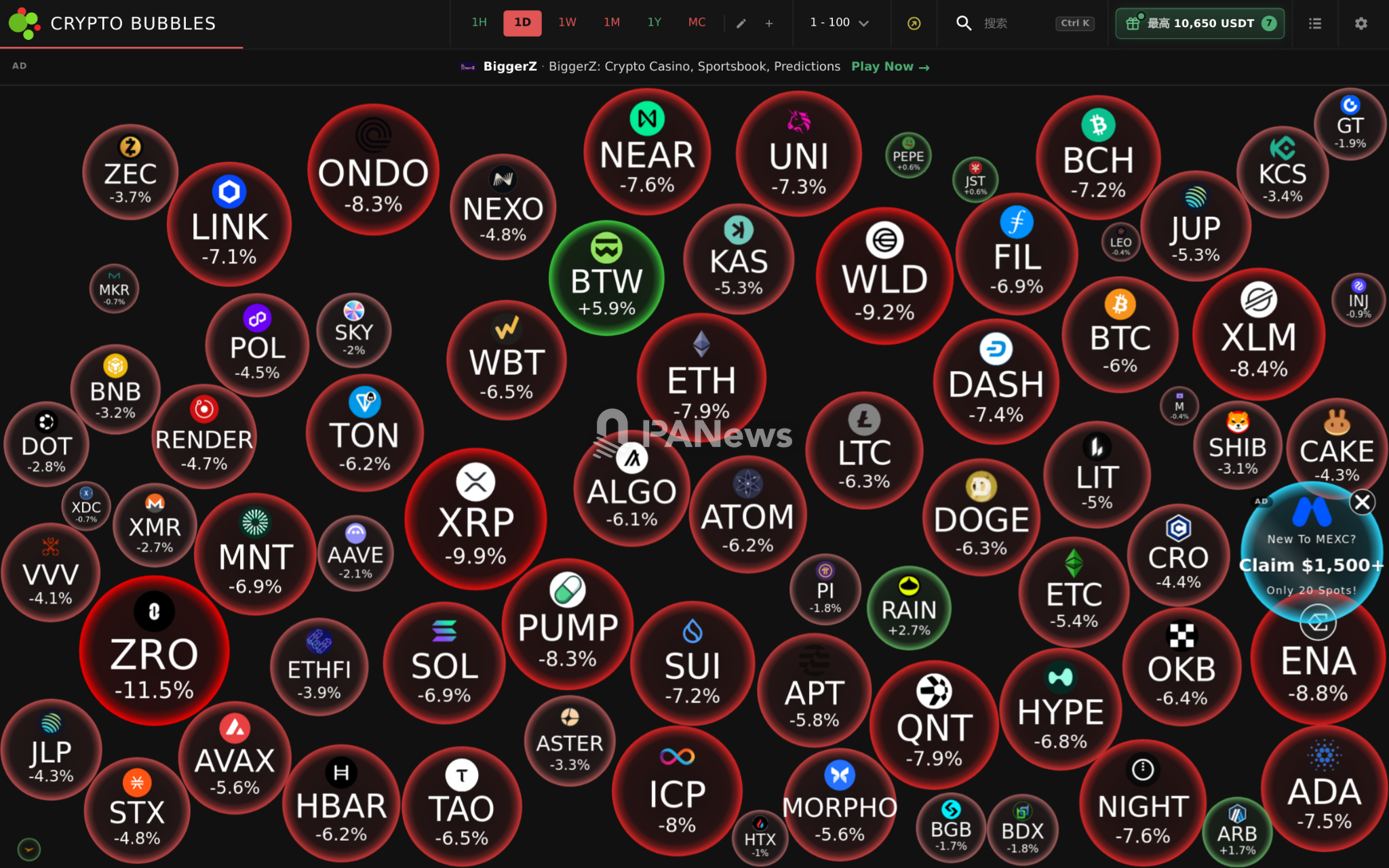
Other major coins have deeper declines, with XRP down 9.8% in 24 hours, SOL down 6.9%, and ZRO down 11.4% leading the declines among the top 100 by market capitalization. The aftershocks of the Binance hacking incident are still being addressed: Binance announced that from 12:00 on November 6th, additional asset withdrawals will be opened in batches and has applied to ArbitrumDAO to return the frozen 8,425.997 ETH and approximately 74.56 million ARB, with the entire governance process expected to take about 49 days.
Key points for today:
- Monochrome Exchange launches platform token MCR, on-chain withdrawals open today
- Upbit 24-hour trading volume rankings: XRP, BTC, ETH, CARDS, SOL
- Total net outflow from Bitcoin spot ETF yesterday was $430 million
- Total net outflow from Ethereum spot ETF yesterday was $99.9677 million
Today's top gainers among the top 100 by market capitalization: BTW up 6.3%, RAIN up 2.9%, ARB up 1.7%, CC up 0.7%, JST up 0.6%.
Overnight chip stocks crash sentiment sweeps Asia-Pacific, South Korean stocks circuit breaker, Nikkei enters bear market
The overnight plunge in U.S. technology stocks and the Philadelphia Semiconductor Index has transmitted fully to the Asia-Pacific market, with concerns about a slowdown in AI infrastructure expansion causing severe damage to the chip, memory, and computing power supply chains.
The South Korean stock market triggered a circuit breaker at one point in the morning session. The KOSPI index closed down 6.02% at 5,059.69 points, and the KOSDAQ index fell 5.03%. Major stocks broadly declined, with SK Hynix down 10.44%, SK Square down 10.51%, Samsung Electronics down 6.35%, and Samsung SDI down 8.06%. Among the top decliners, Kumho Petrochemical and Korea Investment Holdings both fell 17.34%, and Hanwha Aerospace dropped 14.26%. Stocks that rose against the trend include NHN up 15.63%, Lotte Rental up 10.40%, and GS Construction up 6.44%. Bloomberg previously reported that Korea's KOSPI 200 futures fell 7.9% overnight, with Samsung Electronics and SK Hynix dropping over 10% in pre-market trading.
The Japanese stock market also entered a technical bear market. The Nikkei 225 index closed down 5.96% at 57,434.70 points, a cumulative drop of 20% from the June peak; the TOPIX index fell 5.90%. SoftBank Group plunged 10.83%, Japan Tobacco dropped 19.31%, ROHM fell 15.00%, Ajinomoto down 12.40%, Tokyo Electron down 5.60%, and Advantest down 4.99%. A few stocks managed to close in the green, including Sysmex up 2.40% and Daikin Industries up 1.51%.
Hong Kong stocks declined more moderately, but significant structural differentiation was evident. The Hang Seng Index closed down 1.27%, and the Hang Seng Technology Index fell 1.83%. Tencent dropped 2.46%, Xiaomi down 2.94%, and SMIC fell 4.04%. Some individual stocks in the AI computing and semiconductor supply chain saw steeper declines, with FIT Hon Teng down 14.16%, GDS down 10.61%, and Shanghai Suiryan Technology down 11.67%. Defensive and consumer stocks performed relatively well, with Li Ning up 5.16%, Budweiser APAC up 2.57%, and Guangzhou Rural Commercial Bank up 8.30%.
China's three major indices closed collectively down, with the Shanghai Composite Index down 1.10%, the Shenzhen Component Index down 2.57%, and the ChiNext Index down 3.96%. Over 4,700 stocks in the entire market declined, and the trading volume in both markets reached 1.66 trillion yuan, reducing by 460.2 billion yuan compared to the previous trading day. The semiconductor and AI hardware sectors led the declines, with Dongshan Precision and Jerry Holding hitting the daily limit down while Huadian Technology fell 9.62%, Zhongji Xuchuang down 9.19%, and Zhaoyi Innovation down 8.99%. Defensive sectors were active against the trend, with banks, power, and telecommunications strengthening, as China Construction Bank rose 2.14%, China Mobile up 3.24%, China Telecom up 4.22%, and Hua Hong Semiconductor up 6.86%.
免责声明:本文章仅代表作者个人观点,不代表本平台的立场和观点。本文章仅供信息分享,不构成对任何人的任何投资建议。用户与作者之间的任何争议,与本平台无关。如网页中刊载的文章或图片涉及侵权,请提供相关的权利证明和身份证明发送邮件到[email protected],本平台相关工作人员将会进行核查。


