Author: Nancy, PANews
Hyperliquid is one of the recent hot topics that has emerged in the cryptocurrency market. From ICE extending a collaboration olive branch to the legendary Wall Street investor Stanley Druckenmiller entering the scene, Hyperliquid is accelerating its move towards the stage of U.S. institutional-level financial infrastructure, also leading the market to have more imagination about this leading Perp DEX.
Driven by a series of positive news, HYPE once surged strongly, approaching its historical high. However, the short-lived upward trend did not continue, and HYPE subsequently turned around and continued to decline. In addition to the overall weakness of the cryptocurrency market, other significant factors driving its price adjustment include the realization of previous positive news, profit-taking by large holders, market competition pressure, and concerns about selling pressure from token unlocks for the team.
Founder Jeff in a Suit, Hyperliquid Encounters Wall Street
Recently, when Hyperliquid founder Jeff visited Washington, D.C. to meet policymakers, he wore a dark suit and tie to conform to the dress code of this political center. This low-profile cryptocurrency tycoon usually opts for a casual attire of t-shirts, hoodies, and shorts. Colossus previously disclosed in an in-depth report the minimalist aspects of Jeff’s life, stating that he owns 15 Lululemon shorts and 10 t-shirts, and typically rotates through three colors.

The change from casual t-shirts and shorts to a formal suit and tie reflects not only a shift in Jeff’s dressing style but also the transformation of Hyperliquid itself. Once challenging Wall Street as a crypto-native platform, it is now gradually stepping into the field of traditional finance, even beginning to attract attention and acceptance from former competitors.
At the beginning of this year, Hyperliquid broke the trading barriers of traditional financial markets with on-chain perpetual contract trading, challenging long-standing trading rules and industry moats of Wall Street, which triggered dissatisfaction and resistance from traditional financial forces. However, within just a few months, the situation began to reverse.
In recent months, Hyperliquid has gradually transitioned from a star project within the cryptocurrency circle to a broader mainstream financial stage. From Trump publicly naming it in the White House, to Stanley Druckenmiller posting his first-ever tweet supporting it, to Musk retweeting related news, and traditional financial giant ICE investing in its ecological project Trade.xyz.
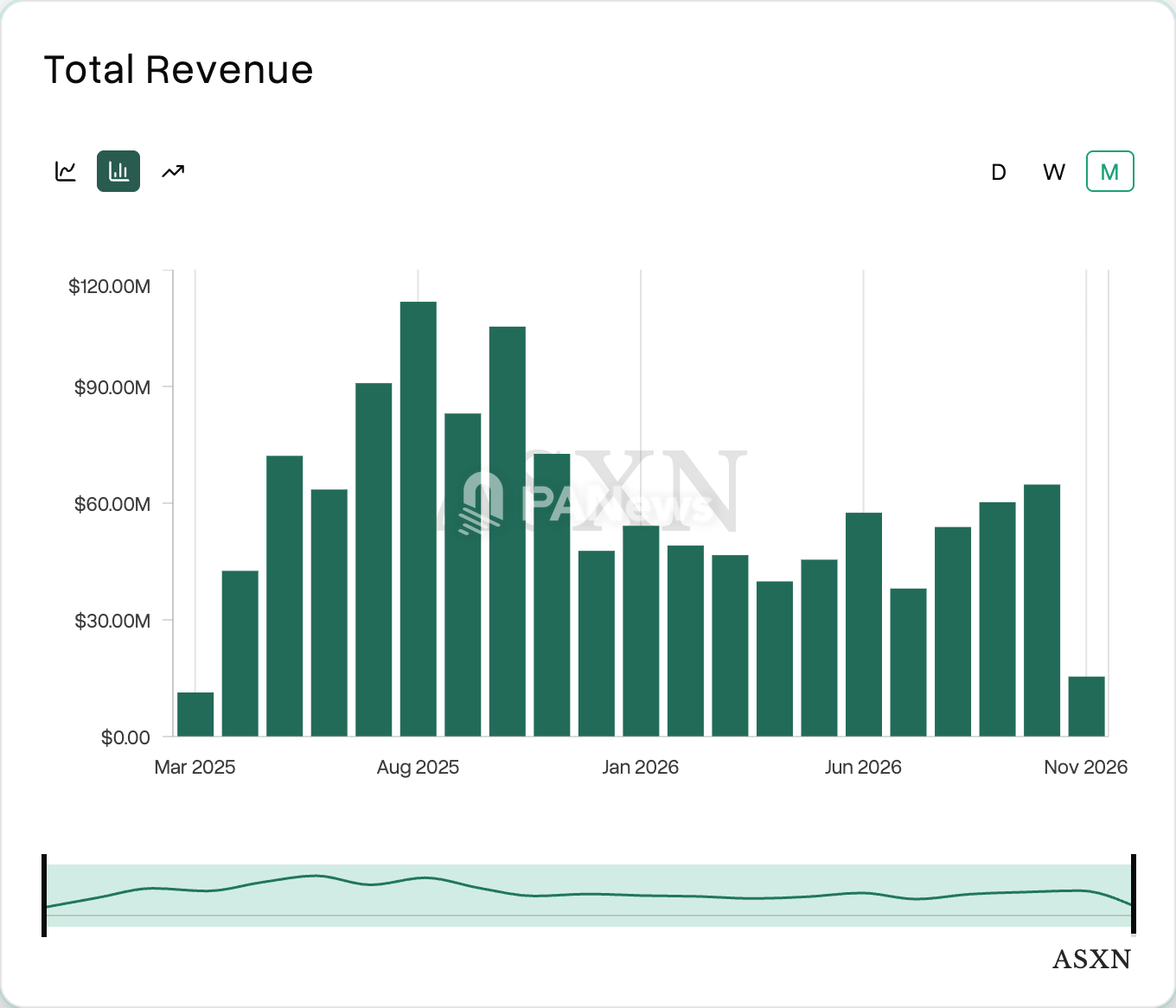
Meanwhile, in the noisy and speculative cryptocurrency market, this small team of 11 has already established a quite scalable commercialization path, supporting token buyback with real protocol revenue.
According to Hyper Screener data, as of November 6, Hyperliquid's cumulative protocol revenue has surpassed $1.23 billion, with approximately $1.2 billion used for token buybacks, accounting for as much as 97.5%. Recent performance indicates that its profitability cannot be underestimated either. Data from DeFiLlama shows that in the past 30 days, Hyperliquid’s revenue reached $6.888 million, ranking it third across the network, just behind the two major stablecoin issuers Tether and Circle.
The imaginative space brought by Wall Street, combined with the continuously generated protocol revenue and substantial token buybacks, has collectively heightened market optimism towards Hyperliquid, and HYPE has subsequently entered a strong trading scenario.
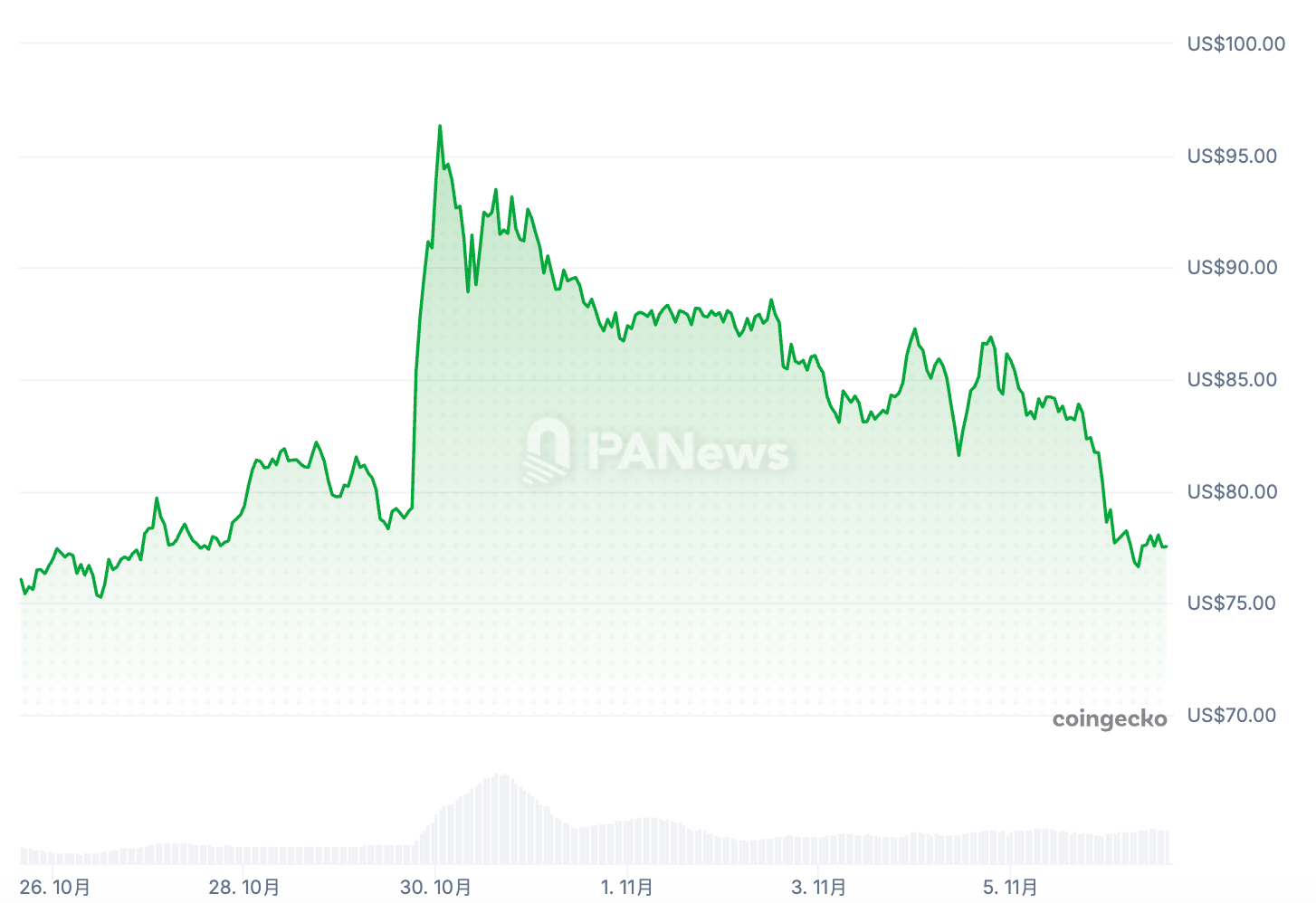
In late September this year, HYPE once touched $97.9, setting a historical high. Though it experienced a pullback afterward, it surged strongly again at the end of October, with prices approaching $97, just a step away from the previous high. Even without the support of a bull market, HYPE has repeatedly attempted to break historical highs, becoming one of the few cryptocurrency projects that can move independently.
Buybacks Cannot Halt Selling Pressure, Why is HYPE Stagnant?
The improvement of the regulatory environment in the U.S., coupled with Wall Street's proactive embrace and strong profitability, should have provided continuous upward momentum for HYPE. However, since briefly peaking at the end of last month, HYPE has turned around and continued to decline. CoinGecko data shows that since the high on October 30, HYPE has dropped by 19.6%.
Putting aside external shocks like the Binance hacking event and the blue wave caused by the U.S. midterm elections triggering a mass sell-off of AI stocks, HYPE is currently facing multiple pressures from within.
· Positive News Realized, Large Holders and Whales Seize Profits
As the price of HYPE approached historical highs, some funds began to choose to cash out, especially early investors and whales.
Santiment data indicates that on October 30, four whale wallets completely closed their long positions in HYPE, collectively making about $5 million in profits. Among them, the largest wallet had been accumulating HYPE since late May; Lookonchain monitoring revealed that on October 31, two addresses collectively sold about 1.21 million HYPE, realizing profits exceeding $26.5 million; whale Yeti0x also recently exchanged $2.49 million worth of KHYPE for HYPE, then began selling.
Meanwhile, significant movements in HYPE by multiple institutions have also raised market concerns. According to on-chain analyst Ai Yi, since October 30, a16z has transferred a total of 233,000 HYPE, worth over $20.6 million; Onchain Lens monitored that FalconX transferred 350,000 HYPE to Coinbase within three days, worth about $30.57 million; on-chain analyst MLM monitored that Paradigm recently unstaked 2.55 million HYPE through 15 different wallets, worth about $224 million, but considering that Paradigm had also conducted similar large-scale unstaking operations weeks ago, this move might just be a tidy-up of wallets; Galaxy Digital’s OTC department recently deposited 47,000 HYPE into OKX, worth about $4.06 million, potentially indicating a sale.
Additionally, HYPE spot ETFs in the U.S. have been experiencing ongoing net outflows. SoSoValue data shows that from October this year to date, net outflows from HYPE spot ETFs have reached $42.14 million.
· Team Token Allocation Raises Concerns About Potential Supply Pressure
In addition to the short-term selling pressure brought by profit-taking, team token allocation is also a focus of market attention. Last month, Hyperliquid officially announced the unlocking of 180,000 HYPE and plans to formally allocate them to team members on November 6, 2026. This arrangement has raised market concerns about potential new supply.
However, in terms of scale, the 180,000 HYPE allocated this time only accounts for 0.075% of the current circulating supply of about 239 million HYPE, and the proportion is relatively limited. Additionally, the team’s OTC (over-the-counter) directed sales to specific institutions have avoided direct selling pressure and price slippage on the public order book.
· Collaborative Benefits Not Yet Realized, Institutional Narrative Faces Implementation Tests
The uncertainty surrounding external collaborative progress has somewhat weakened market expectations.
Shortly after ICE announced its collaboration with Trade.xyz to introduce perpetual contracts based on Hyperliquid to the U.S. market, the institution deleted the relevant collaboration announcement, raising market speculation about potential changes in the cooperation, which brought temporary panic. Subsequently, ICE reissued the announcement, modifying the wording, emphasizing that this collaboration is “planned to introduce” and is “subject to regulatory approval.”
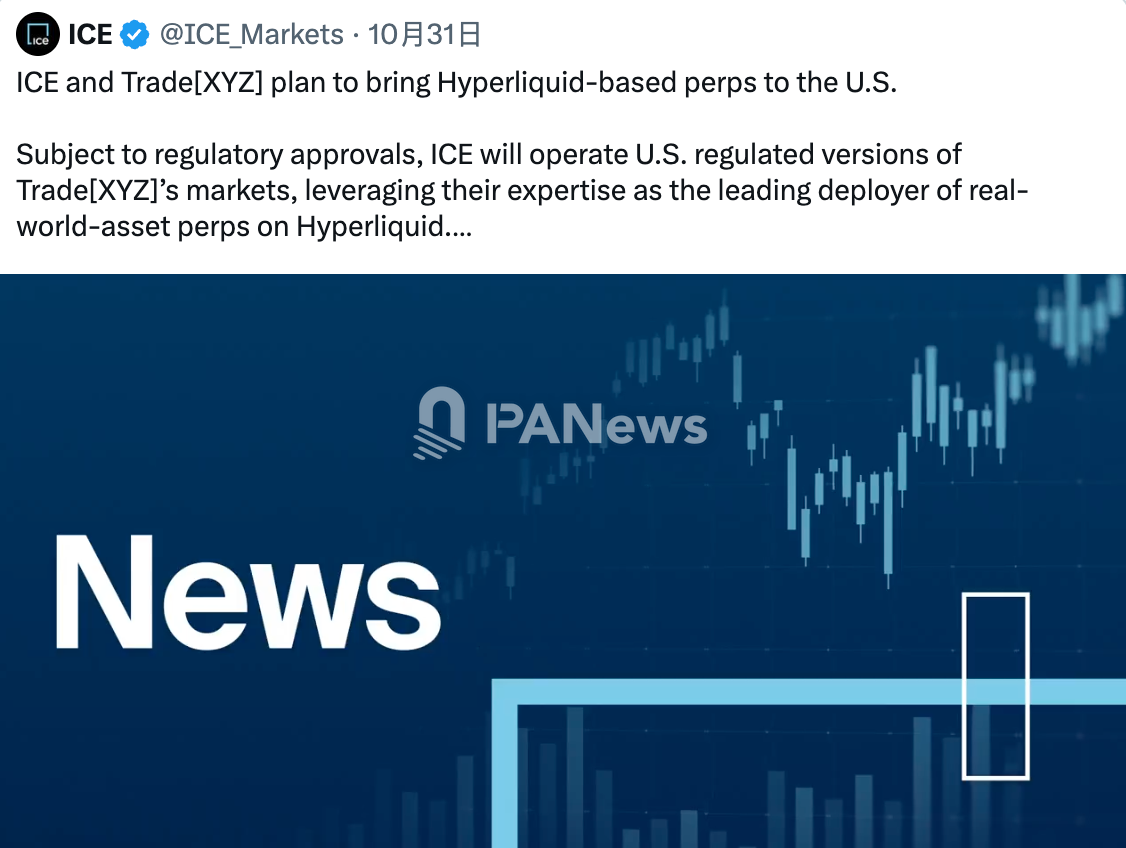
Therefore, whether Hyperliquid can truly open up the U.S. market story still depends on the approval progress of the CFTC, which cannot be converted into actual user growth and revenue increment in the short term.
· More Players “Licensed” to Enter, Hyperliquid Faces New Competition
The improvement of the regulatory environment in the U.S. does not mean that Hyperliquid can monopolize market dividends. As the regulatory framework gradually clarifies, more trading platforms are beginning to accelerate their layouts.
Recently, the CFTC announced approving individual stock perpetual futures trading in the U.S., and Kalshi, Coinbase Derivatives, Kraken, and Crypto.com were among the first to enter the list. This means that Hyperliquid may face more direct competition in the U.S. market in the future.
It is worth noting that while competitors are entering, the Hyperliquid ecosystem is also actively seeking compliance access to the U.S. market. Hyperliquid Strategies, a subsidiary of HYPE Treasury Company, recently revealed that it has applied for registration as a CFTC futures commission merchant (FCM). If approved, this FCM will be able to accept U.S. client accounts for a licensed market deployed under the HIP-3 framework, helping the Hyperliquid ecosystem provide perpetual contract trading services to U.S. clients within a regulated framework.
· Political Support Uncertainty After the Midterm Elections
Jeff's recent trip to Washington aims to push Hyperliquid into the U.S. market, while the change in Washington's political wind may become an uncertain factor in Hyperliquid's expansion into the U.S. market.
Before the midterm elections, friendly signals regarding cryptocurrency policy from the Trump administration, the CFTC's openness to the trading framework for perpetual contracts, and ICE’s collaboration plans with Trade.xyz generated high expectations in the market for Hyperliquid's entry into the U.S. market. Jeff’s personal visit to Washington at this time is also seen as a signal that the project is attempting to further strengthen policy communication.
However, from a timing perspective, this trip coincidentally coincides with changes in the political landscape following the U.S. midterm elections. In the midterm elections held on November 3, the Democratic Party won control of both chambers of Congress, while the Republican Party lost its majority in both houses. With the control of Congress flipping, the pace of advancing related cryptocurrency legislation and regulatory frameworks, as well as Congress's focus on DeFi, high-leverage derivatives, and investor protection issues, may all face new variables. Although Trump will continue to be in office, he will face a Congress led by the Democrats in the next two years, which may restrict the legislative agenda and policy promotion space. For Hyperliquid, this change could influence the market's judgment on its prospects for expansion into the U.S.
However, it is noteworthy that in a Bloomberg report, Jeff emphasized that Hyperliquid is more like the Internet or Linux, importantly providing a set of neutral underlying infrastructure. The report also disclosed a significant detail that during the filming, the Hyperliquid team specifically requested that no current or former U.S. presidential portraits appear in the interview background. Perhaps, Hyperliquid hopes to convey a message to the outside world that it seeks not the political endorsement of any particular administration, but a foundational infrastructure status that can operate under different political environments.
In Jeff’s view, Hyperliquid has never been about merely building a more efficient trading platform but aims to construct a network that can underpin the entire financial system, allowing stocks, derivatives, and even more financial activities to operate on this network.
“We don’t see this as building a trading platform, but rather as creating an entire network,” Jeff explained Hyperliquid's vision in a recent interview. They previously explored existing blockchains but found that none could meet the throughput and latency demands of the global financial market without making significant compromises.
Now, from emerging as a prominent player in on-chain perpetual contract trading to gaining attention from Wall Street institutions, and attempting to connect with traditional financial infrastructure, Hyperliquid is step by step moving out of the boundaries of the crypto-native market. However, truly transitioning from a trading platform to financial infrastructure, entering Wall Street might just be the beginning.
免责声明:本文章仅代表作者个人观点,不代表本平台的立场和观点。本文章仅供信息分享,不构成对任何人的任何投资建议。用户与作者之间的任何争议,与本平台无关。如网页中刊载的文章或图片涉及侵权,请提供相关的权利证明和身份证明发送邮件到[email protected],本平台相关工作人员将会进行核查。


