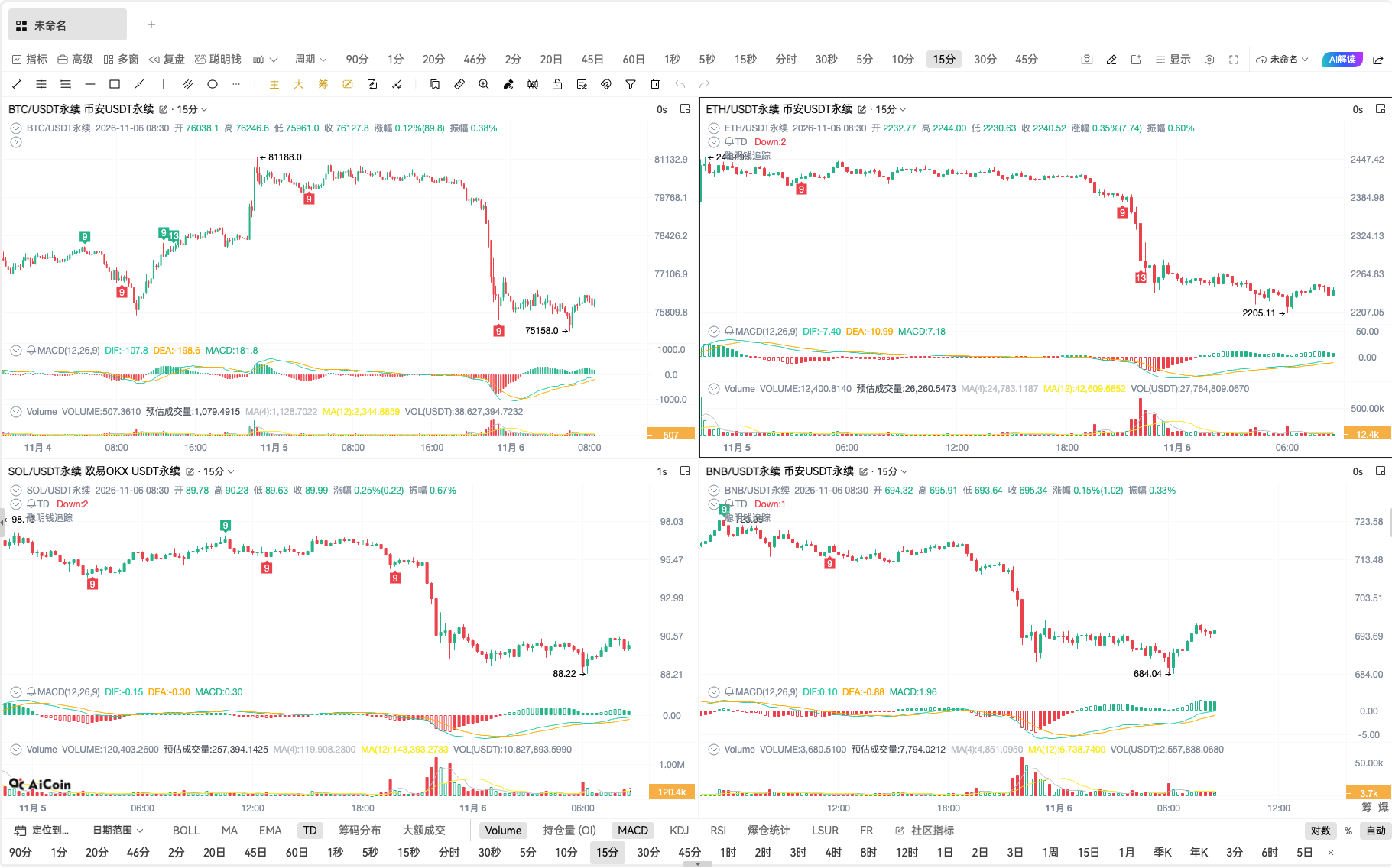
Recently, within a single trading day, global multi-asset markets seemed to have simultaneously pressed the sell button, with risk assets plunging from U.S. stocks to Korean stocks to cryptocurrencies. This was described by many traders as a rare significant drop in a single day. In the Korean market, the KOSPI index fell by over 8% at one point during the trading session, triggering a circuit breaker mechanism that forced a pause in trading for about 20 minutes. The on-chain world was also affected; the cryptocurrency fear and greed index dropped from 50 the previous day to 28, with sentiment plunging from neutral into the panic zone, as funds moved to safer holdings and instinctively reduced positions. A more specific impact was seen in the marginal realm of asset tokenization: Samsung Electronics' tokenized shares on the Gate trading platform fell by about 11% within 24 hours, burdened along with offline stock prices. However, against the backdrop of circuit breakers and emotional sell-offs, another force was quietly pushing against the trend — Kraken announced it would launch tokenized products related to the Anthropic IPO, linking the allocation outcomes of traditional equity offerings with on-chain assets. Around the same time, Lombard Systems, focused on tokenized securities financing infrastructure, completed a $4 million seed round, with institutional funds choosing to increase their stakes in foundational facilities amid high volatility. This global plunge and the emergence of new forces in tokenization are reshaping the narrative boundaries of risk assets.
The Panic Day of Musk's Plummet and Korean Stock Circuit Breakers
In the same wave of volatility that was intensifying the tokenization narrative, U.S. stocks presented a completely opposite picture: Tesla dropped about 10.77% in a single day, while SpaceX fell around 9.05%, as both star assets closely tied to Musk came to a halt. According to estimates from Forbes and Bloomberg's billionaires list, Musk's personal wealth dipped to around $785 billion to $789.5 billion, losing about $79.3 billion to $79.7 billion in a single day, sketching the outline of this round of U.S. stock market risk aversion. On the other side, the Nasdaq index futures initially dropped over 1% before turning positive, with sharp tussles between bulls and bears as the market was reluctant to easily concede defeat, and no one dared to claim they had truly 'caught the bottom.'
Further afield in Seoul, this sentiment amplified into institutional-level standstill: the KOSPI index's drop exceeded 8%, triggering a circuit breaker; trading was paused for about 20 minutes before resuming, and panic was reflected in the index's intraday chart. Correspondingly, Samsung Electronics' tokenized shares on the Gate trading platform fell about 11% in 24 hours, with quotes dropping to approximately 137.69 USDT, as the volatility of traditional giants' stock prices quickly projected onto the on-chain 'mirror assets.' The cryptocurrency market itself also experienced a rapid cooling in sentiment, with the fear and greed index plummeting from 50 to 28, slipping from neutral into panic. On this day, from Musk's wealth to the Korean stock circuit breaker to the shift in on-chain sentiment, various global risk assets seemed to be uniformly adjusted downwards in risk preference.
Trump Blames Democrats, Igniting a War of Emotions
At the very moment when various risk assets were being universally adjusted down in risk preference, former U.S. President Trump chose to rewrite this market upheaval into a political narrative. He publicly stated that the stock market experienced 'one of the worst trading days in history' due to the election results without providing any specific data but directly tying the blood-red figures on the screen to the election results he did not endorse. In his narrative, this was not a cross-market chain sell-off, but rather 'retribution' following the ballot counting, with the protagonists swiftly changing from Tesla, Korean stocks, and tokenized shares, to the bipartisan battles outside the White House.
To make this political attribution more impactful, Trump deliberately singled out the 401(k) retirement accounts of the American people, claiming these accounts were shrinking and attributing all the blame to what he termed 'stupid Democrats.' The 401(k) accounts were originally long-term savings tools for countless middle-class and retail investors, but once they were brought into the narrative as 'victims,' the declines on the screen transformed from abstract percentages into direct losses of voters' retirement funds. For ordinary investors already frightened by volatility, this narrative provided an emotional outlet — they were not losing due to risk, but because of 'their' governance. Thus, market panic and political opposition began to amplify each other: fearful retail investors were more willing to explain prices with political labels, while politicians leveraged price fluctuations to bolster their own arguments, ultimately layering a level of political uncertainty that was difficult to quantify but sufficient to influence expectations onto this already highly sensitive decline. In this narrative, price volatility was no longer just a trading outcome but had been thrust into the front lines of political struggle.
In the Shockwave, Kraken Throws Out Anthropic
When market emotions were being torn apart by political rhetoric and fear indicators, Kraken chose this moment to announce a distinctly different message: it previewed the launch of a tokenized product related to the Anthropic IPO. While prices were plummeting and accusations were exchanged, Kraken was telling another story — not about who caused the drop, but where the next round of capital could flow. It aimed to slice up the IPO allocation that originally existed only in investment banking books and roadshow PPTs into a tradable exposure on-chain, providing crypto funds, which were focused on market fluctuations, with an unexpected 'side door' to 'participate in traditional IPOs.'
Structurally, this was not a simple 'shadow stock,' but an attempt at tokenizing the actual allocation of the Anthropic IPO. Kraken repeatedly emphasized a key signal in its announcement: the final allocation of IPO shares would not be determined by the platform; investors could receive all, part, or none of the allocation, and funds not allocated would be refunded. This cold, upfront warning, along with the redline statement that 'the product is not available to persons in the U.S. and certain jurisdictions,' not only clearly delineated regulatory and compliance boundaries but essentially informed the market — at a time when global multi-asset markets were in turmoil and risk preferences were contracting, the rules of traditional equity financing would not bend for on-chain investors, but someone had already begun bridging the gap, allowing funds accustomed to seeking volatility on-chain an opportunity to reach out and touch an IPO game that originally belonged only to offline books and institutional allocation lists.
Lombard Systems Secures Funding to Build New Rails
As global multi-asset markets experienced severe turbulence and fear indicators were on the decline, a seemingly 'counter-trend' sum of money quietly landed — Lombard Systems, focused on tokenized securities financing infrastructure, completed a $4 million seed round, led by Ethereal Ventures, with participation from institutions such as ALPS Capital, First Commit, Veris Ventures, and ATKA. Compared to Kraken's approach in the previous section, which focused on packaging traditional IPOs' one-time opportunities into tradable products on-chain, Lombard Systems seemed to be working on the other end: it was not merely opening another subscription window for you but attempting to rewrite the underlying technology and processes of tokenized securities and financing, paving the way for more similar products to operate in the future.
From the forms of funding and the list of participating institutions, this investment wasn't chasing the volatility of a short-term trend but was a typical early-stage equity capital bet: during this 'recent' phase when the U.S. stocks, Korean stocks, and on-chain risk assets were generally under pressure, these institutions were still willing to take on chips in the seed round, logic akin to 'buying infrastructure rather than betting on the next candlestick.' For them, Kraken-like products make the current volatility more narratable, while infrastructures like Lombard Systems are related to pricing power and discourse rights in the next round of asset tokenization cycles — the market may panic, valuations may retreat, but who can master the core processes of moving securities on-chain and completing financing is one of the few key variables that are being quietly enhanced in this context of volatility.
Where Will Funds Flow Between Panic and Innovation
In the same time frame of 'stock market crash — Korean stock circuit breaker — cryptocurrency sentiment dropped from 50 to 28,' the preview of tokenized products related to the Anthropic IPO by Kraken and Lombard Systems securing $4 million in seed funding seem like two separate curves: one side is the risk assets passively enduring sell-offs, while the other is institutional funds still increasing their stakes in foundational facilities. However, when you stretch the timeline, you'll find they are actually on the same migration path: when risk preferences contract, the narrative around tokenization can easily be packaged as a short-term refuge of 'participating in IPOs without being fully exposed to stock market fluctuations,' but Kraken must emphasize that the allocation results are not determined by the platform, that unallocated funds will be refunded, and that the product is closed to U.S. persons and certain jurisdictions. These details indicate that it remains firmly locked within the existing regulatory and market structure, far from being a frictionless alternative. Conversely, the $4 million seed capital that Lombard Systems secured at this time seems more like a bet against the long-term institutional migration of 'how securities are financed and pledged on-chain' amid high volatility — funds are not making an either-or choice between panic and innovation, but are pivoting between the surface of high-frequency swings in sentiment and the deep, slow reconstruction of infrastructure. What can genuinely navigate this round of great shocks are often those assets and platforms that can withstand regulatory constraints while continuously solidifying their tokenization capabilities in terms of technology and processes.
Join our community to discuss and grow stronger together!
AiCoin's exclusive Hyperliquid benefits: https://app.hyperliquid.xyz/join/AICOIN88
AiCoin's exclusive Aster benefits: https://www.asterdex.com/zh-CN/referral/9C50e2
On-chain Telegram community: https://t.me/AiCoinWhaleData
On-chain community: https://www.aicoin.com/link/chat?cid=N6OVMor5g
AiCoin on-chain Twitter: https://x.com/aicoinwhaledata
免责声明:本文章仅代表作者个人观点,不代表本平台的立场和观点。本文章仅供信息分享,不构成对任何人的任何投资建议。用户与作者之间的任何争议,与本平台无关。如网页中刊载的文章或图片涉及侵权,请提供相关的权利证明和身份证明发送邮件到[email protected],本平台相关工作人员将会进行核查。