Original | Odaily Planet Daily (@OdailyChina)
Author | jk
On November 5th (Thursday) Eastern Time, U.S. stocks plunged across the board, with the AI and chip sectors being hit the hardest, the rebound on Wednesday due to midterm election results was completely erased. By the end of the trading session, the Dow Jones fell about 3%, over 1,600 points; the S&P 500 was down nearly 4%; the Nasdaq dropped over 5%, entering a technical correction; the Philadelphia Semiconductor Index fell nearly 10%.
From "Uncertainty Settled" to "Regulatory Expectations Rising"
On Wednesday, the Democrats secured both the Senate and House, and Trump stated he accepted the results, causing the market to rise temporarily due to the "disappearance of political uncertainty," with the Dow soaring over 1,500 points in one day. However, a day later, the logic reversed.
After the midterm elections, the Democrats took both the Senate and House, as well as a large-scale turnover at the gubernatorial and state legislature levels; the Republican Party did not flip a single Democratic seat at any level. Before the election, the Republicans controlled 53 seats in the Senate and about 218 seats in the House compared to 213 to 214 seats for the Democrats.
In the Senate, the Democrats currently have 54 seats, the Republicans 44 seats, with the Democrats flipping 7 seats, while the two seats in Alaska and Mississippi have yet to be announced. In the House, the vote count on the afternoon of November 4 showed 251 seats for the Democrats and 155 for the Republicans, well exceeding the majority requirement of 218 seats; at the state level, the Democrats flipped 5 gubernatorial seats, including defeating three-term Governor Abbott in Texas; up to 12 state legislative chambers switched hands, with the Pennsylvania Senate changing for the first time since 1994 and preliminary results in Arizona also indicating a flip. The flipped Senate seats include Texas, North Carolina, Iowa, South Carolina, Ohio, and Maine.
The new concern arising from the elections is the policy environment for the AI industry: investors are beginning to reassess the speed of data center construction, expansion of computing power, and whether these investments can yield sufficient returns.
The rise on Wednesday reflected the easing of political uncertainty: after Trump acknowledged the results, the market no longer needed to price in electoral disputes. The decline on Thursday reflected another layer of concern: that the new Congress might alter the environment on which the AI industry relies for expansion, particularly regarding data center construction. TipRanks listed this as one of the reasons for Thursday's sell-off, alongside the sharp drop in semiconductor stocks and the uncertain interest rate outlook.
These concerns have been amplified because some members within the Democratic Party have already put forward specific legislation to restrict AI.
A Post That Became an Amplifier of Sentiment
On November 4, Arizona Democratic Representative Yassamin Ansari posted that the Democrats need to pause the development of advanced AI, regulate the out-of-control industry, and ban artificial superintelligence at the top of their first day's agenda. The next morning, Musk retweeted and responded: “It's a Brave New World,” borrowing the title from Huxley's dystopian novel, clearly sarcastic. Earlier, he had also posted that “space data centers now look very appealing.” Reportedly, Musk invested around $474 million in Republican-affiliated political groups in this election cycle.

Original post by Ansari, source: X
It should be noted that Ansari's remarks are just her personal statement and not the official position of the Democratic Party. Senator Sanders and Representative Casar introduced the "Artificial Superintelligence Ban Act" in September, advocating for a permanent ban on superintelligence and a pause on advanced AI development, but that bill has not yet become law, and "superintelligence" does not have an accepted technological definition, making enforcement very challenging.
U.S. Stocks in Hard Hit Zone
According to msx.com data, AMD fell 17.55%, Micron fell 16.8%, Intel fell 11%, TSMC's American Depositary Receipts fell 10%, Marvell fell 16.3%, and SanDisk fell 22%. Nvidia's intraday decline ranged from 6% to 9%, marking its largest intraday drop since April 2025; according to Yahoo Finance, since reaching an all-time high in October, Nvidia has seen its market value evaporate by nearly $1.4 trillion.
Data center and new cloud vendors are the most sensitive to added computing power and financing, leading the declines. CoreWeave fell about 11%, Nebius fell about 14% to 15%, IREN fell about 15%, and Vertiv, which provides power and liquid cooling equipment to data centers, fell about 14%, while Oracle fell about 7%. Oracle recently priced a bond offering totaling about $20 billion, and financing needs are also a market focus. In comparison, larger cloud vendors like Amazon, Google, and Microsoft had much smaller overall declines, with Amazon dropping about 3% intraday.
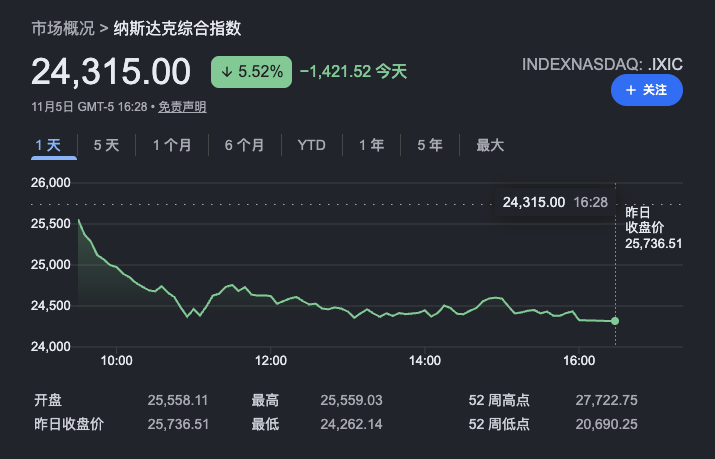
Source: Google
Musk's companies were also under pressure, with Tesla down about 11% and SpaceX down about 9%, with CNBC linking this pressure to his $474 million election investment being in vain.
In the realm of crypto stocks, Coinbase fell about 10%, Circle fell about 8% to 12%, Strategy fell about 10%, and crypto mining stocks fell 15% to 20%. The declines in major cryptocurrencies themselves (Bitcoin around 5%) were smaller than those of related stocks.
Risk Assets Drop in Tandem
The crypto market faced pressure simultaneously. Bitcoin temporarily fell below $76,000, then stabilized above that level, touching about a three-month low; altcoins' weekly gains were mostly erased. FXStreet dubbed this "one of the most synchronized risk-off movements of the year."
Earlier on Thursday, Bitcoin surged above $80,000 due to ETF fund inflows and short squeezes, but then dropped from $78,767 to $75,986 within an hour. Ethereum fell about 7%, priced at about $2,248; XRP and Solana saw declines between 4% and 7%. The total market cap of cryptocurrencies shrank by about 5%, dropping to about $2.6 trillion. According to CoinGlass data, the amount of liquidations in the last 24 hours was about $1.12 billion, with about $990 million being long positions, more than 210,000 traders were liquidated. The Bitcoin spot ETF still recorded about $148 million in net inflows on Thursday, while Coinbase and mining stocks were down in sync with tech stocks.
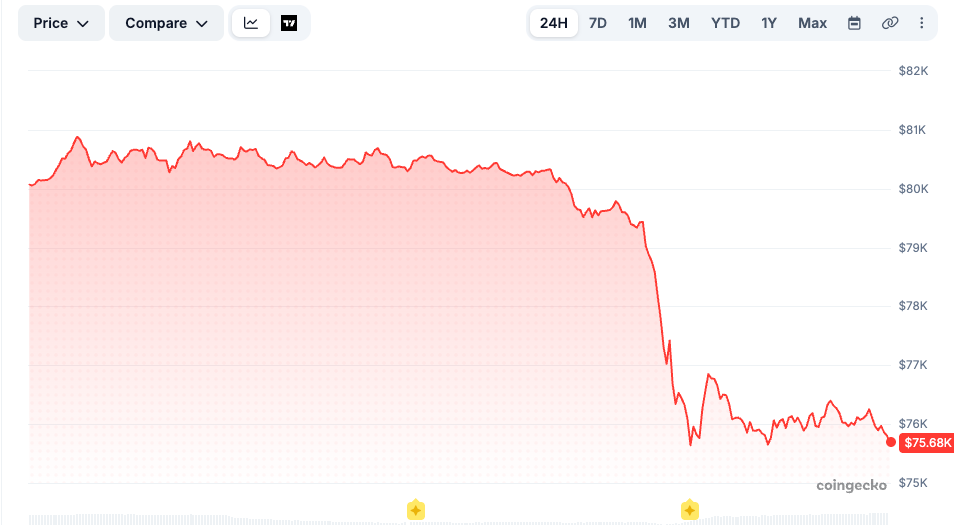
Bitcoin Trend, Source: Coingecko
The dollar index was around 101.4, further declining from 101.51 on Wednesday, approaching a one-month low. The yield on the 10-year U.S. Treasury bond was about 4.9%, dropping to 4.894% on Wednesday (down from 4.952% the previous day), returning below 5%. The market is pricing in about a 67% chance of a rate hike from the Federal Reserve in December, with Friday's non-farm payroll report being the next key data point.
Crude oil plummeted over 8% on Wednesday but rebounded slightly on Thursday.
What to Watch in the Future?
From the policy signal perspective, attention should be paid to whether the new Congress from the Democratic Party will actually put AI pauses or bans on superintelligence on the early agenda, or if it remains merely a personal expression. From a technical perspective, after the Nasdaq fell below the 200-day moving average, strategists expect increased volatility. Regarding the correlation with the crypto space, the risk preferences of AI/tech stocks are highly linked to crypto assets, and whether U.S. tech stocks can stabilize will directly impact Bitcoin's short-term trends.
免责声明:本文章仅代表作者个人观点,不代表本平台的立场和观点。本文章仅供信息分享,不构成对任何人的任何投资建议。用户与作者之间的任何争议,与本平台无关。如网页中刊载的文章或图片涉及侵权,请提供相关的权利证明和身份证明发送邮件到[email protected],本平台相关工作人员将会进行核查。


