Author: stein (Independent RWA and Tokenization Researcher)
Translated by: Deep Tide TechFlow
Deep Tide Introduction: In modern financial markets, investors can click “buy” on stocks in a broker's account or crypto wallet in just milliseconds, but very few truly delve into: whose name is actually written on the underlying statutory shareholder registry of a listed company?
Independent RWA and tokenization researcher stein systematically reviews the century-long evolution of stock ownership from paper certificates to blockchain tokens in this penetrating long article. The article analyzes layer by layer the Direct Registration System (DRS), Direct Stock Purchase Plans (DSPP), the brokerage street holding system monopolized by Cede & Co., as well as the wrapped tokens issued by SPVs and issuer-sponsored tokens (IST) that have truly received transfer agent support in the current crypto market.
By contrasting cutting-edge real-world cases from Galaxy Digital, Superstate, Securitize, and Canton Network, this article clearly points out the deep waters of tokenization in American stocks: while codes and tokens bestow assets with 24/7 circulation and composability, only a technical paradigm that directly addresses the obligations of transfer agents and the statutory shareholder register can truly reconstruct the underlying clearing rules of the global securities market.
In today's era, almost everyone knows how to buy a stock, and many are aware of the shareholder rights accompanying stocks. However, the vast majority of investors may have never seriously considered a fundamental question: whose name is actually written on the official ownership registry of a listed company?
Every publicly listed company maintains an official shareholder register (Register) that has legal effect. This register is maintained by a licensed professional institution known as the “Transfer Agent.”
This register is the sole legal basis that determines all core rights: it officially acknowledges who the shareholders are, to whom dividend checks are sent, who has voting rights at shareholder meetings, and who has the right to participate in asset distribution when the company faces liquidation; the register’s answers are the final standard.
In this article, I will explore six different ways of holding stocks in depth. These six models span a long evolution from a yellowed paper stock certificate to an on-chain digital token stored in a crypto wallet.
Although they vary greatly in surface form, the measure determining their essential attributes is always the same: how far your true name is from the official shareholder register maintained by the transfer agent?
Paper Certificate Stocks: Physical Barriers and High Friction Costs
The ownership of stocks originally sprouted from this form. In the initial model, after purchasing stocks, you would receive a paper physical certificate printed with your legal name.
As a holder, your name would be directly registered on the company’s shareholder list. Each time the public company distributed dividends and disclosed financial reports, dividend checks and earnings reports would be directly mailed to your private address through paper letters.
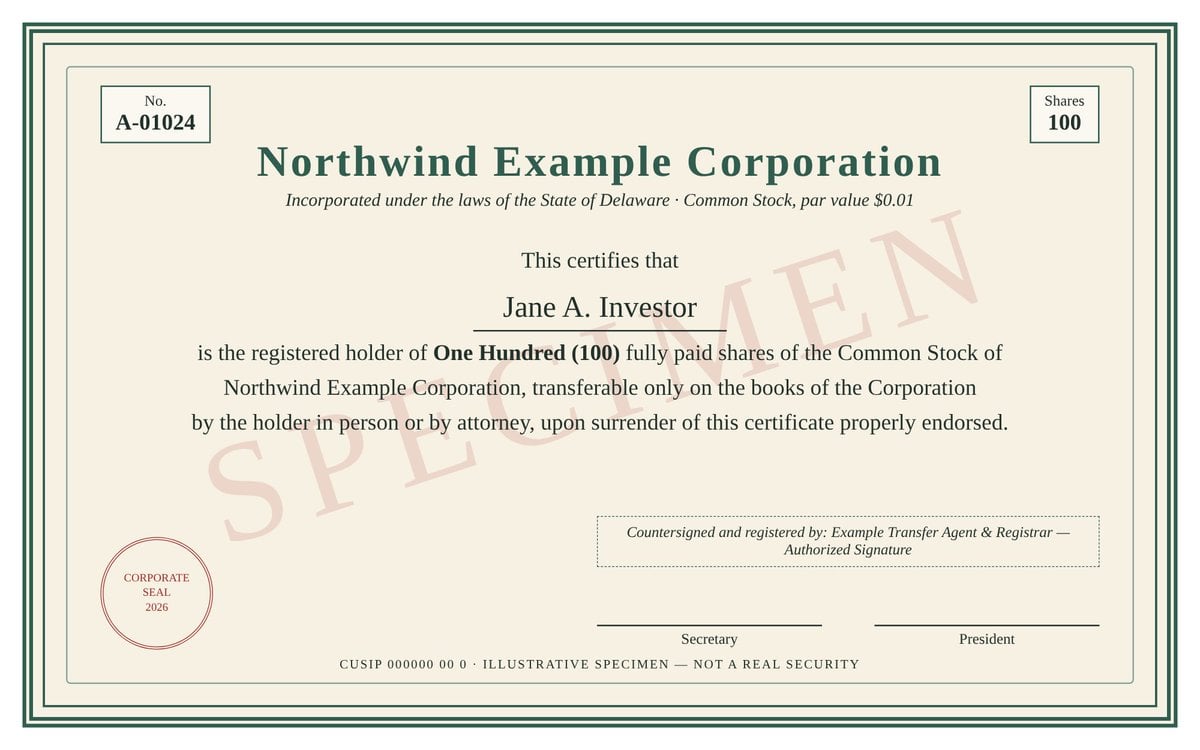
Figure: Illustration of a physical paper stock certificate, indicating the holder's name, number of shares, and the Transfer Agent's counter-signed seal
In a sense, this model sounds nearly perfect. Because there are no financial intermediaries between your name and the listed company, and no one can arbitrarily lend your stocks to short sellers.
However, the real flaws brought about by the paper medium are evident. If you want to sell stocks, you must send the physical certificate by registered mail, making the trading process extremely slow and cumbersome.
For this reason, most listed companies have long ceased to issue paper certificates. Worse still, if you lose this paper certificate, the process of reissuing is not only exhausting but also extremely costly.
During the reissue process, you must sign a legal affidavit and purchase an indemnity bond from an insurance company. The cost of this bond typically reaches 2% to 3% of the stock's market value.
Large transfer agency Continental Stock Transfer charges a 3% bond fee for U.S. residents and up to 5% for overseas investors. In other words, if you accidentally lose a paper certificate worth $50,000, just to reissue that piece of paper, you may need to cough up between $1,500 and $2,500 in real money.
Faced with this physical friction, the financial industry subsequently took a step toward self-innovation and proposed a core idea: "What if we keep your name on the shareholder register but completely throw away that fragile paper?"
Direct Registration System (DRS): Bidding Farewell to Paper Medium with Electronic Direct Registration
The technical answer to the pain points of physical paper stocks is the Direct Registration System (DRS).
Under the DRS system, your legal name is still fully registered in the company’s official register, but the record form changes to an electronic ledger maintained by the transfer agent, thus eliminating the risk of suffering severe losses due to the loss of certificates.
Investors holding DRS stocks can receive stock statements, dividend payments, and shareholder voting documents directly from the company’s transfer agent, and maintaining this holding arrangement is usually completely free for individuals.
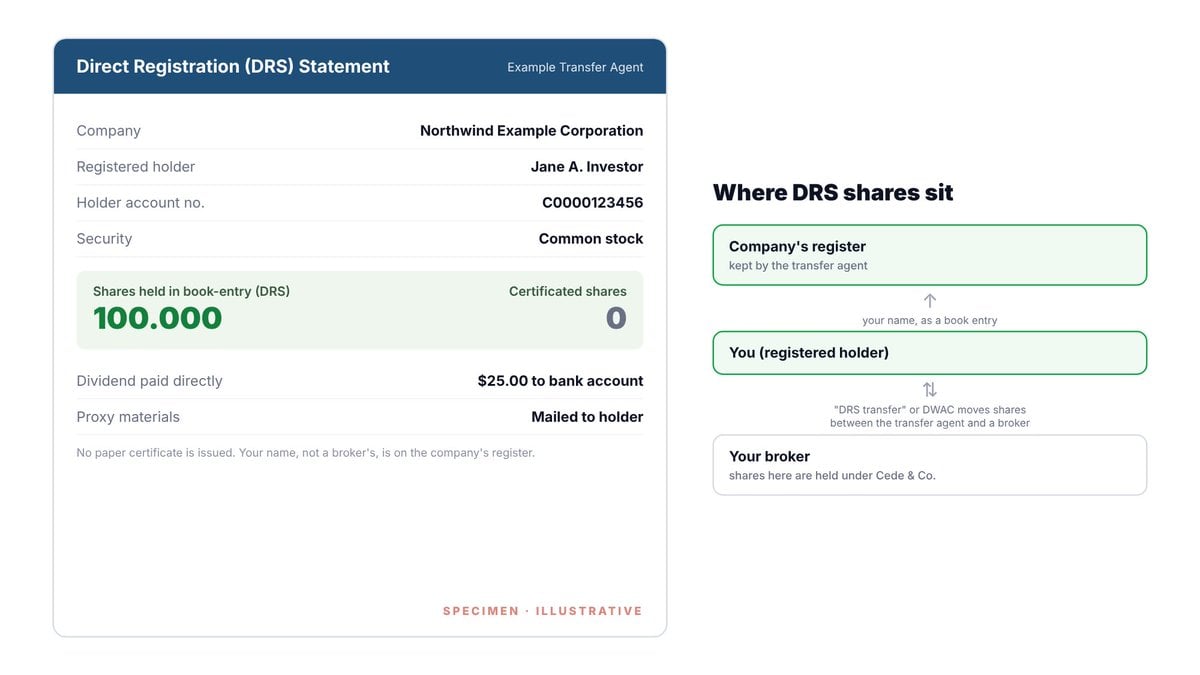
Figure: Electronic stock statement issued by transfer agent Computershare under the Direct Registration System (DRS)
The transfer agent institutions active in this field are all well-known titans on Wall Street. For instance, Computershare maintains the official shareholder registers for 58% of listed companies in the S&P 500 index and manages about 35 million independent shareholder accounts; another well-known firm, Equiniti, is responsible for overseeing data for about 20 million shareholders.
The retail investor community of GameStop brought DRS into the spotlight. During the shocking short squeeze battle of retail investors that stunned the world, they proactively launched a movement to transfer stocks from brokerage accounts to DRS systems, registering them directly in personal names to prevent brokers from lending out their stocks to short sellers.
As of March 2023, approximately 76 million shares of GameStop (about one-quarter of the company's total shares) were held in full through direct registration via DRS by retail investors.
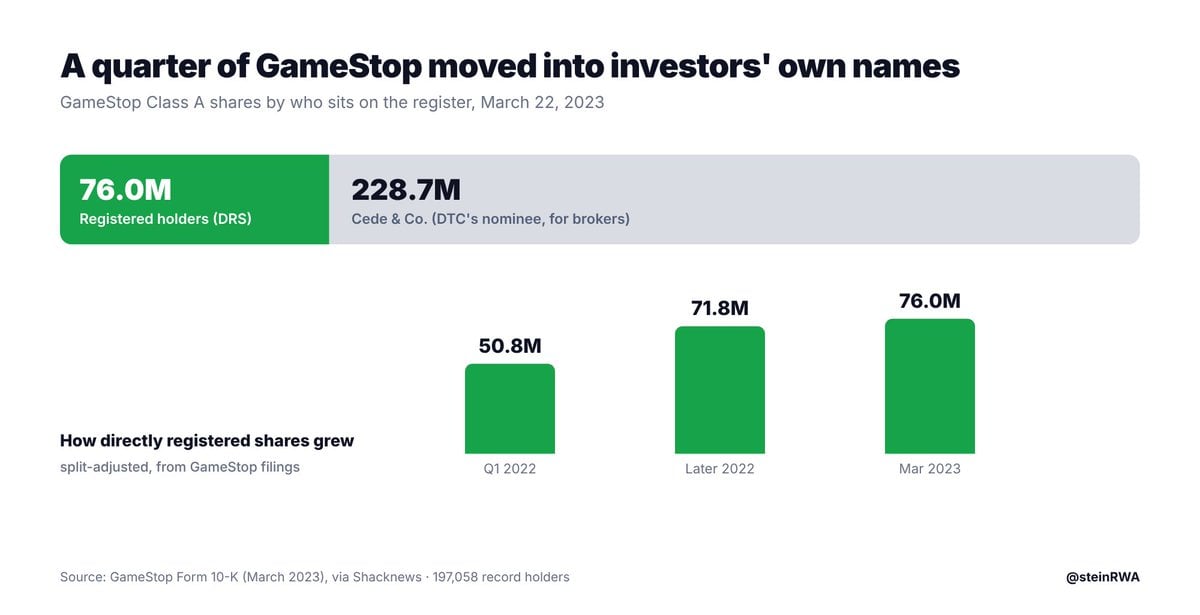
Figure: GameStop’s annual report disclosing that retail investors directly held 76 million shares through DRS (Source: SEC Form 10-K)
However, transfer agents are by no means securities brokers. In a DRS account, you cannot place limit orders for quick trading, nor can you use the stocks for margin financing.
If you want to sell stocks held through DRS, you generally must participate in periodic bulk sale transactions organized by the transfer agent or must first transfer the stocks back to a traditional brokerage account to list them for trading.
Securitize's Hybrid Architecture: Mapping DRS Logic On-Chain
In the exploration of tokenization, the issuer-sponsored tokens (e.g., $SECZ) launched by Securitize are mechanism-wise very similar to an on-chain version of DRS, but this model only applies to the specific shares clearly tokenized.
For the tokenized portion of the shares, the system will whitelist each audited on-chain wallet and deeply bind it with the investor's true identity (KYC), completely removing intermediaries from the entire chain. The well-known industry research firm Ledger Insights accurately characterizes it as "an add-on to the direct registration system."
However, this does not mean Securitize can know the true identity of every SECZ token holder. Most SECZ common stock still publicly trades on the New York Stock Exchange through traditional brokers, under the name of Cede & Co.
Securitize's understanding of this portion of traditional floating stocks, like any other public company, can only be through the aggregate lists provided by brokers. The only investors Securitize can deeply understand are those who hold tokenized SECZ on their dedicated platform.
The same logic applies to Exodus (EXOD). In Exodus's public offering in 2021, they hired Securitize as the transfer agent, and only investors holding tokenized shares are directly recorded in Securitize's primary register.
With the strategic cooperation with the world's largest transfer agent, Computershare, other listed companies can now flexibly mount this tokenization expansion option while maintaining the original Computershare DRS register.
Fairmint's On-Chain Practice: Directly Deploying the Master Shareholder Register on Blockchain
Imagine this extreme form: what if the shareholder register relied upon by the DRS system were directly deployed and operated on the blockchain?
This is precisely the technical solution officially delivered by Fairmint on October 28, 2026. Its subsidiary Fairmint TA LLC is a registered transfer agent with the U.S. SEC (SEC Registration Number: 084-06901).
When a company designates it as a transfer agent, Fairmint will fully migrate the company’s master shareholder files onto the blockchain, making them the only legally valid official record.
Every time stocks are newly issued, transferred, or repurchased, they will be directly written into the Canton Network’s native chain according to the Open Cap Table Protocol. Fairmint will be responsible for reconciling and matching old paper or centralized system registries, completing the legal and technical transition between two generations of transfer agents.
The first company to publicly implement this solution is Nasdaq-listed Canton Strategic Holdings (stock code: CNTN). Its tokenized stock is scheduled to officially launch trading on the tokenized trading venue on November 2, 2026, with the on-chain holders enjoying equivalent legal shareholder rights to those purchasing stocks on Nasdaq.
Compared to traditional registers, what revolutionary advantages can a purely on-chain deployed shareholder register bring? The core is reflected in the following six dimensions:
Instant Status Updates: Traditional shareholder registers typically take periodic batch bookkeeping. In Galaxy Digital’s tokenized stock practice, on-chain transfer agent Superstate records ownership on the Solana public chain, and whenever tokens are transferred, Galaxy's registered shareholder list updates in real-time at the millisecond level.
24/7 Operation: Stocks can be instantly transferred 24/7 between accredited compliant wallets, breaking the limitations of traditional finance that only operates during business hours on weekdays.
Asset Productivity: Investors can directly use their registered stocks for collateral borrowing. For example, tokenized stocks of Forward Industries can be directly pledged into the Kamino lending protocol on Solana to obtain liquidity in stablecoins, something traditional DRS holders cannot do.
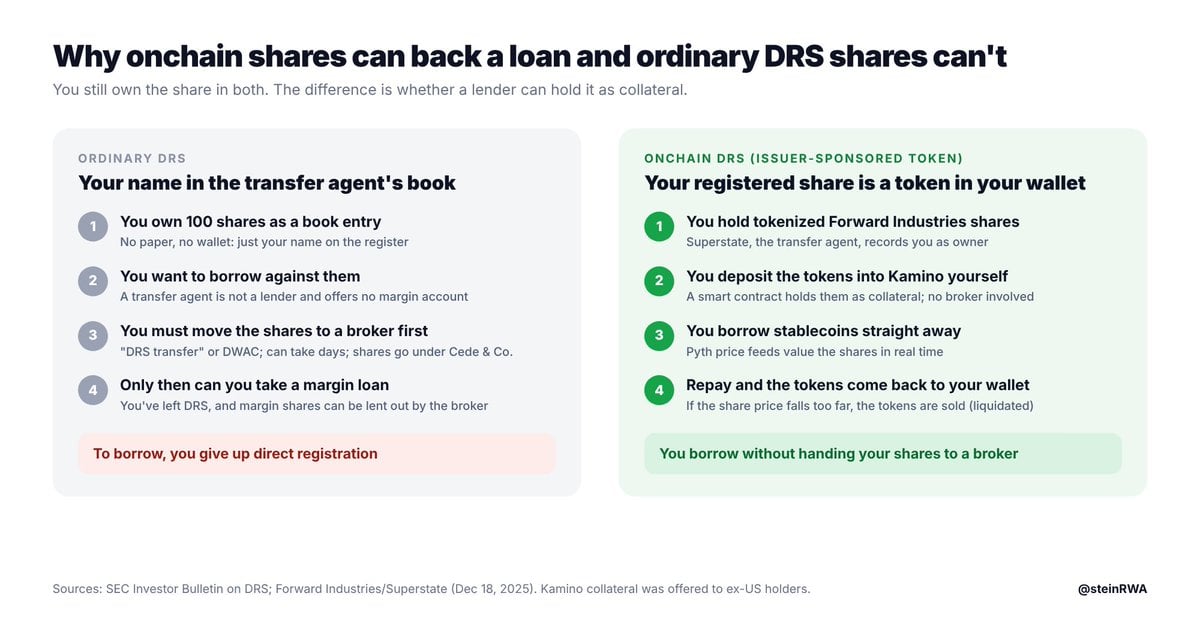
Figure: Forward Industries' on-chain stock tokens pledged in the Solana Kamino lending protocol as collateral to obtain stablecoins
Automated Company Actions: Dividend distributions and voting can be fully automated through smart contracts. Galaxy previously successfully organized on-chain shareholder voting in collaboration with traditional financial infrastructure giant Broadridge.
Compliance Rules Built-In: Any attempt to transfer to unqualified illegal wallets will be natively intercepted and executed failure at the smart contract code level.
Faster Issuer Payment Collection: Superstate pointed out that companies financing through this model can receive stablecoin funds instantly at the moment of subscription approval, completely eliminating days of settlement waiting periods.
It's important to emphasize that for on-chain DRS, investors must be extremely careful in safeguarding their wallet private keys. Furthermore, the transfer agent still maintains an off-chain reconciliation sheet that tightly corresponds the on-chain wallet addresses with the investors' legal true identities.
Direct Stock Purchase Plan (DSPP): Skipping Brokers but Not Eliminating Intermediaries
This raises another classic question in the market: can publicly listed companies sell stocks directly to individual investors, completely bypassing broker rip-offs?
The answer is absolutely yes, and many multinational blue-chip companies are still executing this. The Direct Stock Purchase Plan (DSPP) allows investors to participate directly in official investment plans operated by transfer agents, purchasing stocks directly from listed companies.
Giants like IBM, Union Pacific, and Texas Instruments provide such plans to the public through Computershare. Investors can start with an ultra-low threshold of a few hundred dollars (Union Pacific at $250, IBM at $500) and then invest $50 in each subsequent purchase, also allowing each dividend payment to be automatically reinvested into more shares or even fractional shares.
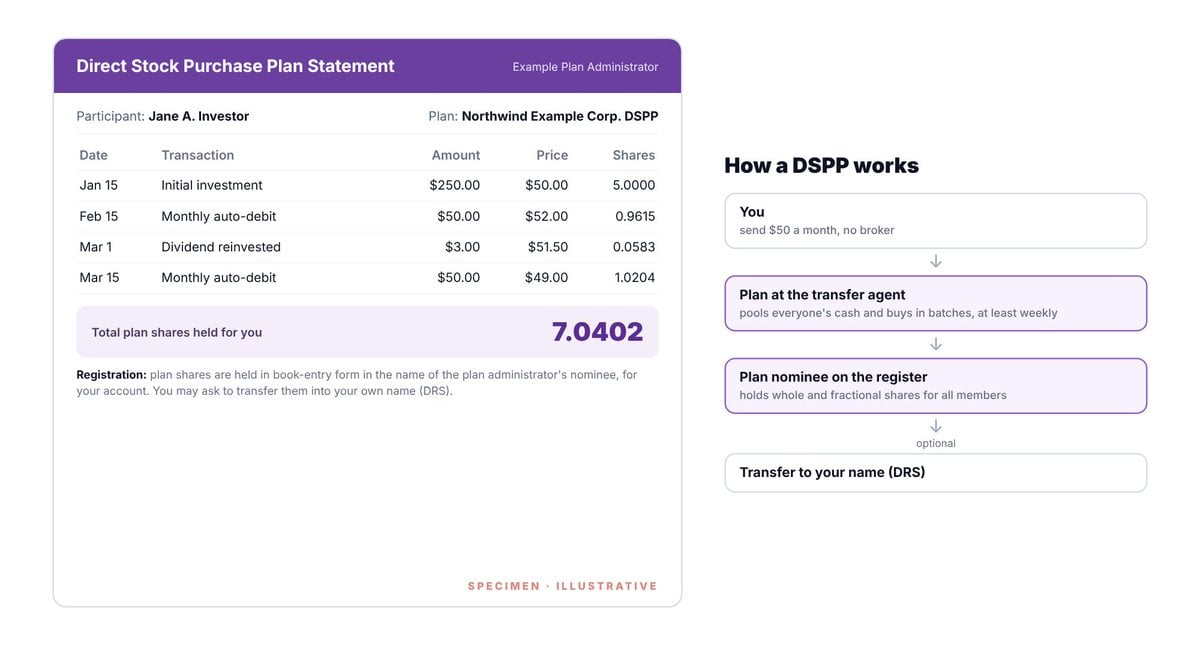
Figure: The Direct Stock Purchase Plan (DSPP) structured as an indirect registration held by the transfer agent’s nominee
However, the vast majority of investors overlook a deeply ironic institutional reversal: in DSPP schemes, these stocks are often not registered in your personal name at all.
In the case of Union Pacific's plan, Computershare explicitly states that stocks bought or deposited by all plan participants will be held under the name of its designated nominee.
The so-called nominee essentially acts as a legal stand-in for all plan participants, holding stocks on the shareholder register. While the internal ledger of the plan knows the shares you own, the actual statutory shareholder register shows only this nominee.
Of course, you can proactively apply to officially separate the stocks within the plan and transfer them to your personal name, thus converting them into true DRS stocks. But until then, although you've bypassed the broker, you still haven’t bypassed the intermediary holding structure.
Furthermore, traditional DSPPs also entail unique cost frictions. In Union Pacific, the purchase fee is borne by the company, but each time you sell stocks, you must pay a fixed fee of $15 plus a commission of 12 cents per share; since funds are summarized and batch transferred weekly, you cannot independently decide the exact timing and price of transactions; IBM also charges a $5 fee for each check deposit and a $1 facilitation fee for each automatic deduction.
Constructors of On-Chain DSPP: Native Issuance and Direct Connection to Investors
The next-generation on-chain DSPP built on blockchain technology perfectly retains the essence of "buying directly from the listed company," while thoroughly eliminating all stubborn maladies of the traditional system:
Superstate announced its Direct Issuance Programs on December 10, 2025. This mechanism allows listed companies to sell newly issued tokenized stocks directly to verified compliant investors, who then make payments using stablecoins, with stocks being delivered in token form directly to their wallets at the moment of transaction. The entire process requires no underwriters; companies only need to submit the usual S-3 registration documents, fully supporting Ethereum and Solana networks.
Securitize had previously made early attempts in 2021. At that time, the crypto wallet developer Exodus raised about $75 million directly from individual investors under Regulation A, with Securitize serving as its blockchain transfer agent.
Additionally, global transfer agent Equiniti also launched the Shareholder Central portal for crypto institution Bullish, allowing registered holders to freely switch between traditional book-entry stocks and on-chain tokenized stocks.
The most essential difference from traditional DSPPs is that these new on-chain mechanisms directly register stocks in the true personal names of investors, completely abandoning the centralized holding nominee mechanism.
Street Name Registration: The Modern Brokerage Custody System Dominated by Cede & Co. and DTC
If you purchased stocks through Robinhood, Fidelity, Charles Schwab, or nearly any other common brokerage, your name will also definitely not appear on the company’s shareholder register.
What is clearly written on the register is the name Cede & Co. It is a nominal partner of the Depository Trust Company (DTC), which is an enormous custody settlement giant representing nearly every brokerage in the U.S. by collectively holding stocks for the entire market. In the 2023 GameStop equity structure, Cede & Co. alone held up to 75% of the company's shares.
Your broker will maintain an internal private ledger that records which part of these massively concentrated held stocks belongs to you. Legally, what you own is merely a statutory claim known as "Security Entitlement," which grants you an indirect creditor claim against the broker, rather than direct equity ownership in the listed company. In the financial world, this model is referred to as "Street Name Registration."
The dominance of street name holding in the global financial market for decades is attributed to its unparalleled transactional convenience. You can complete stock transactions in milliseconds, flexibly place limit orders, use margin leverage financing, and if unfortunate events lead to broker bankruptcy, the Securities Investor Protection Corporation (SIPC) will provide statutory insurance coverage up to $500,000.
However, this extreme convenience has its hidden costs. If you use a margin account, the broker has the right to lend your stocks to short sellers to earn interest without your consent.
When your stocks are lent out for shorting, you may temporarily lose your voting rights at shareholder meetings; even dividends distributed by the listed company may be converted by the broker into so-called "Cash-in-Lieu" payouts, which may impose entirely different and harsher tax penalties on you.
Even in full-payment lend programs offered by firms like Fidelity, while you can receive interest share from lent securities daily, you still lose voting rights during the lending period, and receive only alternative cash, and the lent stocks will no longer be protected by SIPC’s bankruptcy insurance, leaving your only safety cushion dependent on the quality of collateral pledged by the borrower in the custodial bank.
For decades, global capital markets have had almost no alternative to centralized holding structures. It was not until blockchain technology was introduced into the securities field that a new possibility emerged: to treat stocks as digital tokens and hold them directly in your crypto wallet.
But this immediately raises a vital question: converting stocks into on-chain tokens, does it bring you closer to the statutory shareholder register or push you further away from it?
Wrapped Tokens: The Debt Certificates Furthest from the Real Shareholder Register
For the vast majority of "tokenized stocks" circulating in the current crypto market, the harsh reality is that tokens in fact push investors farthest away from the official shareholder register.
The most popular tokenized U.S. stock products on the market are almost all so-called "wrapped tokens." Third-party intermediaries buy real U.S. stocks off-chain, entrust them to custodians, and then mint and issue tokens on the blockchain tracking the stock price fluctuations.
These tokens offer a trading experience almost indistinguishable from real stocks, but in legal essence, they are merely a unilateral repayment promise from the issuing institution to the investors.
Take xStocks, widely traded in the Kraken and Solana ecosystems, as an example: each xStocks token is issued by Backed Assets (JE) Limited, registered in Jersey, UK. Legally, it is a financial instrument known as a "Tracker Certificate," which is an unregistered debt instrument.
Although it claims to have 1:1 underlying real stock reserves as collateral backing, and has set up independent agents with the rights to dispose of stock compensation holders in the event of bankruptcy, it does not grant you any statutory voting rights. More critically, the tracked listed company does not even know of your existence.
Robinhood's recently launched U.S. stock tokens similarly follow a similar path; their essence is also debt securities tokenized in Jersey; the tokenized stock products offered by Ondo can automatically reinvest underlying dividends into the token's net value, but still cannot grant holders true legal shareholder ownership.
To grasp just how far wrapped tokens are from the shareholder register, one only needs to count the complicated levels in between: at the top is the official register showing Cede & Co.; below that is the custodian or traditional brokerage; further down is the issuer of the offshore wrapped tokens; and at the very bottom are the on-chain investors holding tokens who only have creditor claims against the issuing institution.
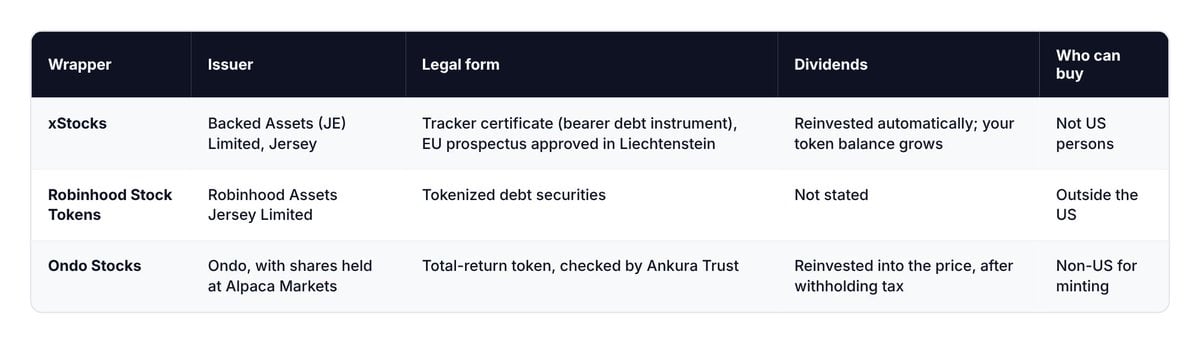
Figure: The multi-layer debt structure of wrapped tokens (Wrappers) based on offshore special purpose vehicles (SPV) and Tracker Certificates
Whether debt notes or tracker certificates, they are not equity legally. Debt notes are contractual agreements in which the issuer pays you the value of the underlying asset; tracker certificates are special debts pegged to the price fluctuations of a single asset. In either structure, the issuer is indebted to you, and you are not a shareholder of the listed company; the ultimate security of the assets relies entirely on the underlying collateral liquidation and the bankruptcy isolation legal framework.
U.S. SEC regulators classify these products as "Synthetic Tokenized Securities." They typically exist in the form of security-backed notes or securities-based swap contracts (SBS), which legally "shall not transfer any equity, voting rights, information rights, or any other legitimate rights to the holder," and are usually subject to extremely stringent regulatory entry limits.
So, since wrapped tokens have such a significant legal gap in terms of rights, why do they still thrive in the crypto market?
The reason is very pragmatic: the issuers of wrapped tokens do not need to knock on the door of the listed companies for consent when launching any stock; they can achieve 24/7 global liquidity by virtue of their unregulated nature, seamlessly integrating into various DeFi protocols as collateral. They currently dominate a $4.64 billion market size of tokenized U.S. stocks globally.
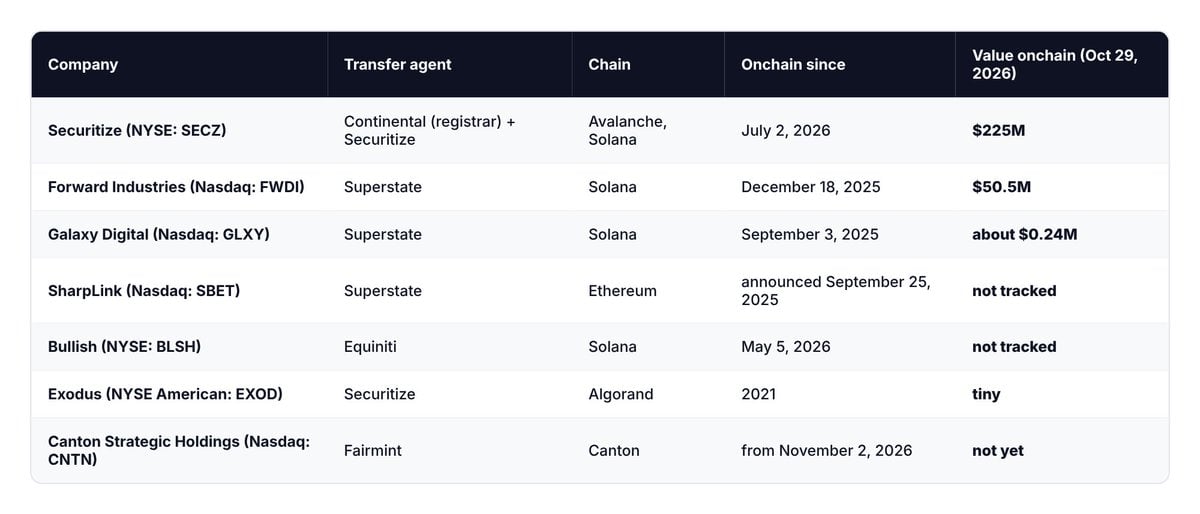
Figure: Market size trend and protocol distribution of tokenized U.S. stocks (Source: Token Terminal)
This naturally leads us to the ultimate technical breakthrough in the whole field of tokenized securities: what if listed companies themselves actively step in to deploy real official stocks on-chain?
Issuer-Sponsored Tokens (IST): The Ultimate Solution Combining Registered Shareholder Rights and Instant Settlement
This is the Issuer-Sponsored Token (IST).
In this model, publicly listed companies directly commission and instruct their official transfer agents to establish and maintain a portion of the statutory shareholder register directly on the blockchain. Whenever tokens are transferred between compliant wallets on-chain, the legal equity records on the transfer agent's register will also update simultaneously.
As U.S. SEC regulators have pointed out, “the technological format will not change the statutory applicability of federal securities law”: as long as the registration is complete, regardless of the technical carrier presented, real stocks remain legal stocks.
IST is currently the only token form designed from the underlying legal framework to make holders “statutory registered shareholders.” The largest transfer agent, Computershare, explicitly defines IST holders as “statutory registered shareholders with the same rights as any other formally registered shareholder.” In other words, IST is essentially a modernized DRS with superpowers.
These superpowers granted by the blockchain are not mere illusions: stocks can be transferred around the clock between compliant wallets; Galaxy Digital’s registered shareholder lists can synchronize at the moment tokens change hands; on-chain stocks of Forward Industries can be used as underlying assets for collateral on Kamino; Galaxy has even officially recorded the 2026 annual shareholder meeting vote directly on the public chain.
Currently, several pioneering companies have taken substantial steps: Galaxy Digital, SharpLink, and Forward Industries have chosen Superstate; Bullish has partnered with Equiniti; Exodus and Securitize have adopted the Securitize platform; and Canton Strategic Holdings has begun a new experiment through Fairmint.
Exploration of Superstate: Founded by Robert Leshner, the well-known DeFi lending protocol Compound, Superstate is a formally registered transfer agent with the U.S. SEC. Its Opening Bell platform is dedicated to directly bringing SEC-registered stocks onto the blockchain and firmly preventing any synthetic or wrapped versions. Traditional shareholders only need to complete compliant account opening to smoothly convert circulating shares from U.S. brokerage accounts to verified wallets.
Its most notable benchmark case is Nasdaq-listed Forward Industries. The on-chain circulating share volume rapidly expanded nearly sixfold in just a few months, surging from $9.8 million at the end of December 2025 to $56.8 million by the end of September 2026. Non-U.S. investors have always been able to use it as collateral in the Kamino lending protocol, with real-time pricing provided by the decentralized oracle Pyth.
Securitize's Competitive Edge: Securitize is the early mover and has the most profound roots in this space. Back in 2021, it acted as the blockchain transfer agent for Exodus’s direct public offering, raising as much as $75 million. In April 2026, the largest transfer agent, Computershare, officially selected Securitize as its technology strategic partner, empowering its clients to issue IST; in June of the same year, Continental Stock Transfer also designated it as a preferred tokenization partner.
More significantly, on July 2, 2026, Securitize officially landed on the New York Stock Exchange, listing its shares and synchronizing its own ordinary shares on-chain on the first day of listing. Currently, it underpins approximately $5 billion in tokenized fund assets, attracting top global asset management giants like BlackRock, Apollo, and KKR; its trading volume surged 147% in the second quarter of 2026, reaching $5.3 billion.
Transitional Bridge: Convertible Entitlement Tokens (CET) as a Progressive Pathway
However, the native IST model has a fatal practical bottleneck: it must obtain authorization from each company's board of directors, and the business development and legal entry processes are extremely lengthy.
To break this deadlock, Securitize launched a smart technical compromise bridge in October 2026: Securitize Stocks. This platform introduces so-called “Convertible Entitlement Tokens (CET),” covering twelve core U.S. stocks such as Apple, NVIDIA, and Tesla for the first time.
The CET is essentially “Street Name” that has been migrated onto the blockchain. Investors hold security entitlements through compliant brokers affiliated with Securitize, and each on-chain token is strictly backed with a one-to-one pledge of real ordinary shares, with Securitize legally making a rigid commitment not to lend this portion of stock without permission.
Before conversion occurs, investors might not be directly registered on the listed company’s shareholder register, but the mechanism fully preserves all details: covering giants like Microsoft, Google, Meta, Amazon, Netflix, Circle, MicroStrategy, and Palantir; operating on the Solana network and settling in USDC instantly, with top market makers like Jump Trading providing liquidity; investors fully enjoy dividends and voting rights distributed by the listed companies, while planning for future seamless integration into lending markets like Aave as collateral assets.
The brilliant design feature is its "Convertible" characteristic in the name: once the underlying listed company formally approves and activates the native IST system in the future, CET token holders can directly convert their tokens into true legally registered shares without having to sell their assets. This allows the issuing institution to directly list any popular U.S. stock assets at present while sequentially upgrading investors to legitimate registered shareholders in the future.
Focusing on the SECZ Case: Whose Name is on the Register Based on Different Buying Channels?
All these intricate paths of stock holding and legal design come to a powerful practical test with Securitize’s own listed stock, SECZ.
On July 2, 2026, Securitize rang the bell on the NYSE, simultaneously deploying its stock on-chain. So if you passed compliance KYC and purchased SECZ stock in the market, whose name is actually on the register?
The answer entirely depends on your specific buying channel:
If you bought it through a regular traditional broker on the NYSE, then the name still written on the official register is Cede & Co., and legally you are just an ordinary beneficial owner.
However, if you purchased tokenized SECZ shares directly on Securitize's official platform, all statutory evidence directs to direct ownership. Securitize explicitly states in its S-1 listing registration documents submitted to the SEC that it maintains corresponding equity ownership records in its official capacity as a licensed transfer agent, enabling seamless reconciliation and merging of tokenized stocks with traditional circulating shares in the same underlying master register.
The Core Responsibilities of Transfer Agents: Accounting Boundaries Under Different Holding Models
Looking at the hundred-year evolution of stock holding methods, transfer agents have always been the only gatekeepers of this sacred register. The profound changes that occurred were merely in what names were written on the register and what functions they served in the chain for you.
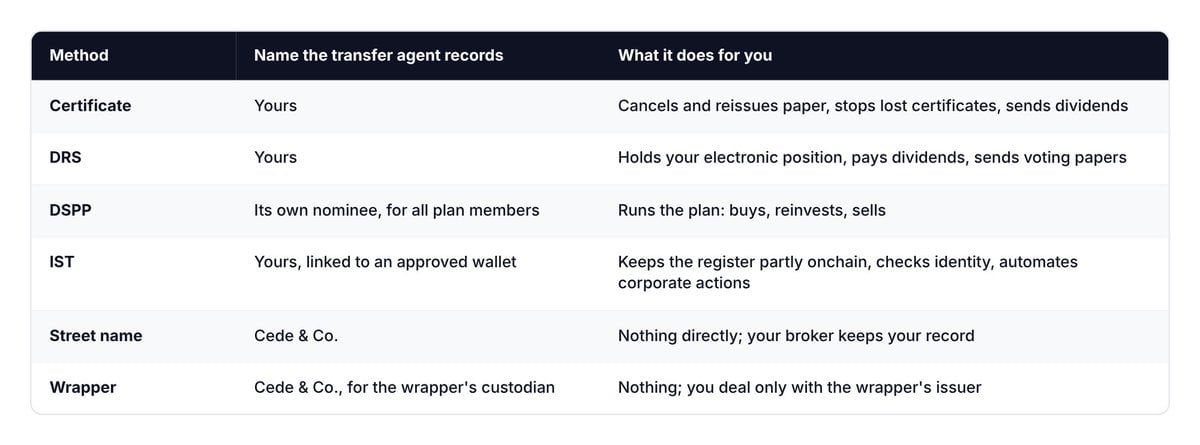
Figure: Comparison of the accounting roles and legal responsibilities of Transfer Agents across six stock holding models
Cash Flow and Equity Play: Dividends, Lending Frictions, and Borrowing Income
In the real financial world, a law always holds: the closer your name is to the underlying official register, the purer and safer your fund flow and ownership rights.
Cash Dividends: Holders of paper certificates, DRS, and native IST are directly issued dividend payments by the transfer agent; DSPP participants can achieve automatic reinvestment of funds; while street name holders must navigate intermediaries to access dividends and may be forced to accept alternative cash compensation with potentially adverse tax consequences if their stocks are lent out; wrapped token holders usually only can reinvest after-tax dividend energy to boost token net value.
Friction Costs: Replacing lost paper certificates incurs high bond issuance costs of 2% to 5% of the total stock value; maintaining DRS accounts is typically free for individual investors; traditional DSPPs are subject to fixed trading commissions and batch processing friction fees; whereas the minting and trading wear of wrapped tokens often quietly scattered across liquidity spreads and protocol governance fees.
Interest Share from Borrowing Stocks: Only investors with street name registration can actively earn interest share through full borrowing programs; however, if using a margin account, your stocks may be loaned to short sellers without notifying you, even removing the protection of SIPC from bankruptcy.
Collateral Financing Capability: Street name stocks naturally fit the centralized broker's margin lending system; native IST holders unlock the right to place real registered stocks directly into DeFi smart contracts as underlying collateral for the first time in blockchain history; while wrapped tokens may be most used in DeFi currently, investors must be aware that they are merely pledging a legal payment promise from an offshore intermediary.
Comprehensive Comparison of Six Holding Models
To help investors and institutional practitioners clearly see the fundamental differences from paper certificates to on-chain IST, we have deeply summarized and compared the six core models across key dimensions of legal qualification, register registration entities, voting rights, borrowing risks, and liquidation protections:
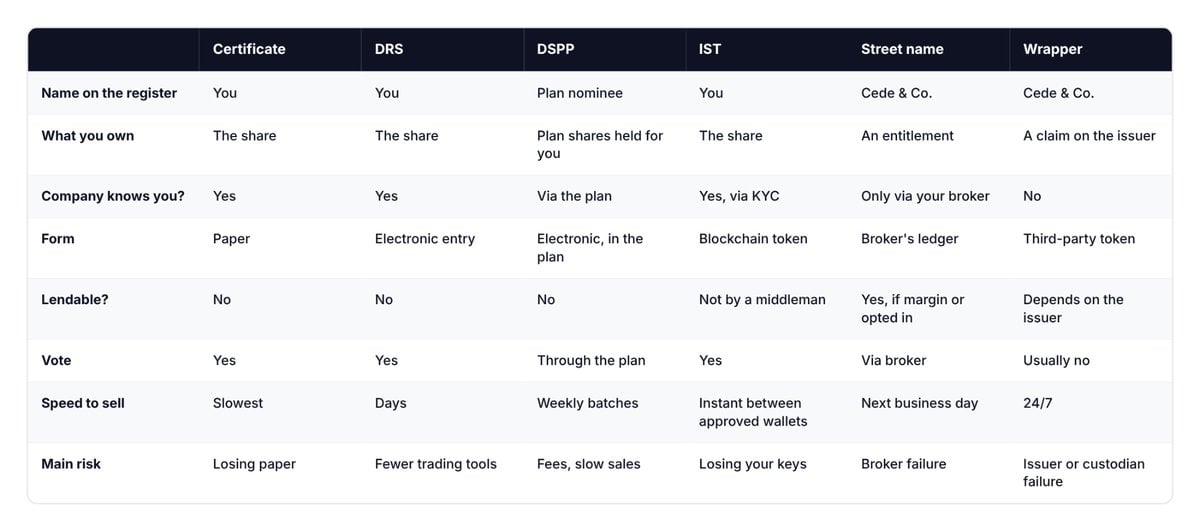
Figure: Comprehensive comparative matrix of six core dimensions of stock holding methods from paper certificates to on-chain IST
Five Core Questions to Ask Before Buying Any Stock Asset
Regardless of how you choose to hold a company's stock assets, before hitting the buy confirmation button, simply ask yourself the following five penetrating soul-searching questions to immediately see what you truly own:
First Question: Whose name is actually written on the legal official shareholder registry of the listed company? Is it your true name, the name of a nominee holder from some plan, or the name of Cede & Co.?
Second Question: What are you legally entitled to hold? Is it the company's equity asset itself, indirect securities entitlement against the broker's internal ledger, or merely a unilateral repayment promise debt issued by some wrapping institution?
Third Question: Is there any institution that can arbitrarily lend your stocks to shorting institutions? Only brokers may lend your stocks under specific account conditions, but you must be clear if you are exposed to this.
Fourth Question: Are you guaranteed 100% to receive legal dividends and voting rights? Legally registered shareholders always retain full voting and dividend rights, while most holders of wrapped tokens are completely stripped of governance voting ability at the underlying level.
Fifth Question: If the financial intermediary standing between you and the listed company encounters a run or bankruptcy, what legal tools can protect you? Is it SIPC's statutory compensation, rigorously legally isolated off-chain pledges, or simply nothing in a legal vacuum?
Conclusion: A Century-Long Cycle of Ownership from Paper to Tokens
Reflecting on the century-long evolution of stock ownership from paper certificates to digital tokens, the underlying logic of the financial world seems to complete a profound cycle of destiny.
One hundred years ago, paper certificates solemnly inscribed your true name on the company's official registry, yet the heavy chains of the physical medium made you slow and faltering in action;
The later Wall Street brokerage system, by virtue of centralized street name holdings and electronic matchmaking, granted you lightning-fast transaction speeds but silently erased your name from the company's register;
The initial exploration of the crypto world with offshore wrapped tokens gave assets 24/7 circulation and global accessibility but turned investors into fragile creditors holding merely a promise of repayment beneath the complex token shell;
Yet today, the issuer-sponsored tokens (IST) gradually ascending the historical stage represent the first great experimental endeavor in human financial history to attempt to combine the fish and the bear's paw: it aims to firmly engrave your true name on the official underlying register of the company while allowing you to enjoy the instant clearing speed brought by the entire modern internet and blockchain.
Although this new paradigm is still in its infancy within the massive scale of the global capital market, the next time you prepare to buy any stock on your screen, whether in the traditional Nasdaq matching market or on-chain aggregators, it’s worth re-asking yourself this oldest yet most fatal ultimate question in the investment world:
Behind this stock, whose name is actually written?
免责声明:本文章仅代表作者个人观点,不代表本平台的立场和观点。本文章仅供信息分享,不构成对任何人的任何投资建议。用户与作者之间的任何争议,与本平台无关。如网页中刊载的文章或图片涉及侵权,请提供相关的权利证明和身份证明发送邮件到[email protected],本平台相关工作人员将会进行核查。


