The underlying operation of prediction markets and perpetual futures does not require blockchain.
Written by: 100y
Translated by: Chopper, Foresight News
The crypto industry received significant news today: the U.S. Commodity Futures Trading Commission (CFTC) has approved stock perpetual contract trading. This is not just a regulatory announcement; Kalshi launched the real trading of this product on the very same day it was officially announced.
But there is one question: is this really crypto industry news?
Understanding Kalshi
As most people know, Kalshi is a centralized derivatives exchange regulated by the CFTC in the United States, focusing on prediction markets and perpetual futures. It is commonly believed that Kalshi is deeply intertwined with the blockchain industry, but the reality is: the connection between Kalshi and blockchain is quite limited.
Kalshi's core products, including prediction markets and perpetual futures, do not rely on blockchain for operation. Orders are matched off-chain through a self-developed matching engine, and clearing and settlement are handled by its CFTC-regulated derivatives clearing organization, Kalshi Klear.
The only intersection between Kalshi and blockchain is that users can deposit and withdraw funds using stablecoins, and its prediction market positions can be tokenized and accessed for trading through the Solana ecosystem platform DFlow and Jupiter.
So why do people instinctively associate Kalshi with blockchain? I believe there are several reasons:
- Benchmarking Polymarket: When Polymarket launched its prediction markets for users outside the U.S. in the early days, it relied on the Polygon network and UMA oracle for result determination and trade settlement, which led to an inherent impression in the market that prediction markets themselves are products of the blockchain sector. Even Polymarket US, which is regulated by the CFTC and targets the U.S. market, has a very low reliance on blockchain, similar to Kalshi.
- John Wang joined Kalshi: In August 2025, John Wang joined Kalshi as the head of crypto business; he was previously a researcher at Paradigm (a leading venture capital firm in crypto).
- Perpetual futures products: Perpetual futures are another type of financial-native product that people default to associating with blockchain. This association is not unfounded, as perpetual contracts originated in crypto exchanges, and the 24/7 trading nature of the crypto market is naturally suited for perpetual contracts. Moreover, the industry has platforms like Hyperliquid and Lighter_xyz specializing in native on-chain perpetual contracts. Although perpetual contracts are indeed rooted in the crypto market, from a technical perspective, conducting perpetual futures business does not necessarily require blockchain. U.S.-licensed exchanges like Kalshi and Coinbase do not use blockchain for executing and clearing perpetual contract trades.
The conclusion is simple: both prediction markets and perpetual futures are trading categories deeply bound to the crypto industry, but neither of them requires blockchain to operate.
Blockchain, just a financial channel
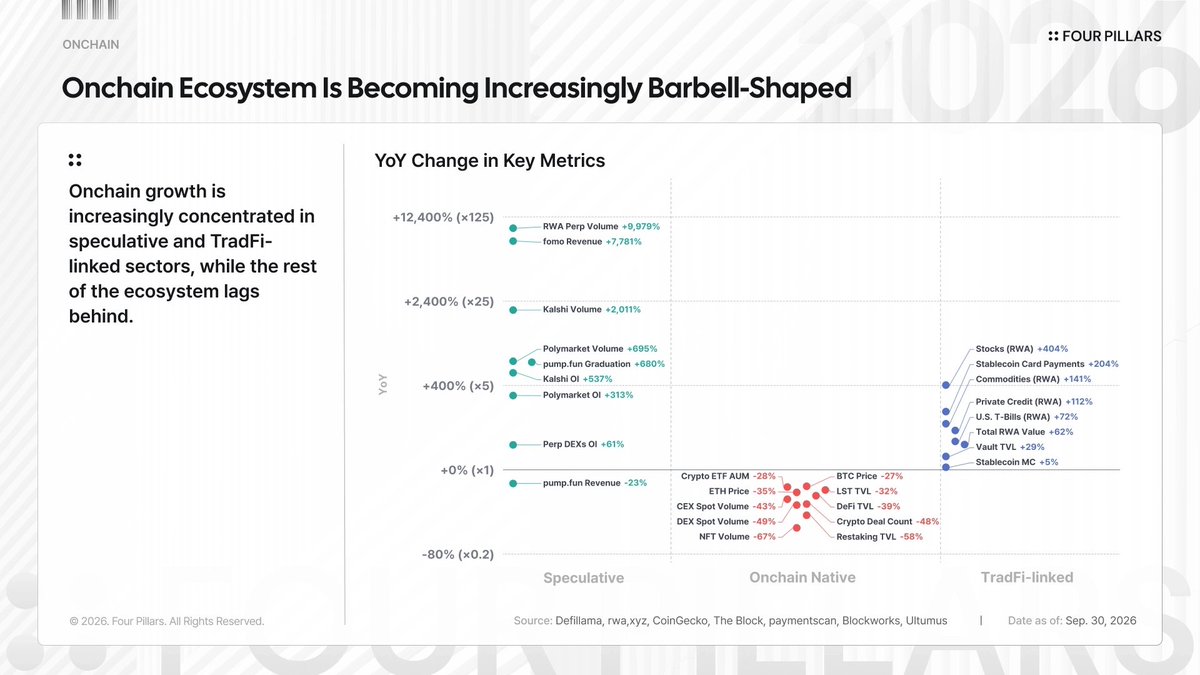
In my previous article, I mentioned that on-chain ecosystems are heading towards polarization.
Looking back at the performance of various sectors in 2026, the trends are very clear. Native on-chain sectors like DeFi performed poorly, while sectors achieving significant growth are largely divided into two ends.
One end is speculative sectors: prediction markets, perpetual futures, MEME coins; the other end is sectors connected to traditional finance: stablecoins, real asset tokenization (RWA), treasury funds.
2026 was itself a year of extremely poor performance for the crypto industry, and yet these sectors still achieved substantial growth, indicating that they have at least found some degree of product-market fit.
At first glance, these two types of sectors seem worlds apart, but they have one commonality: most just treat blockchain as a financial transmission channel.
As mentioned earlier, the underlying operation of prediction markets and perpetual futures does not require blockchain. The role of blockchain is concentrated in the areas of deposits and withdrawals, asset tokenization, and free trading. The same goes for MEME coins: blockchain enables anyone to issue tokens and trade freely, which is almost its entire value.
On the other side, stablecoins and RWAs primarily use blockchain as a next-generation financial channel, replacing outdated backend infrastructure in traditional finance.
Of course, I'm not saying that financial channels have no value; quite the opposite. A system that allows anyone to trade anytime and access various assets represents a huge upgrade compared to traditional financial infrastructure. Just this point creates a differentiated advantage.
However, I think it's worth reflecting on the fact that in those sectors where blockchain has truly found product-market fit, blockchain itself is rarely the core of the business. The core logic lies elsewhere; the true business essence has another carrier, and blockchain merely makes the operations more efficient, faster, and with lower entry barriers.
Where is the blockchain industry heading?
A recent article circulating in San Francisco presents an interesting viewpoint: in the long run, value may not necessarily settle where the technology was born, but rather at the stages of technology distribution and implementation. The article suggests that the AI sector will follow this pattern.
In my view, this pattern is already being played out in the crypto industry. Blockchain has found its product-market fit, but value has not flowed back to the on-chain ecosystem itself, nor to the underlying public chain infrastructure. The vast majority of value has been captured by platforms that hold user relationships. For these platforms, blockchain is not the core logic of the business; it is merely one of the capabilities within the product feature set.
So what should the blockchain industry do next? At present, blockchain has proven to be feasible as a financial channel and has demonstrated product-market fit. However, I believe we cannot stop here; we need more such businesses: where blockchain is an irreplaceable infrastructure, not just an auxiliary tool, but deeply rooted in the core logic of the business.
Of course, we have seen numerous similar attempts. Many projects initially held this goal: to create products that can only operate on the blockchain and have fundamentally different characteristics from all previous things. However, the vast majority of these projects have not survived to today. Even so, we must continue to explore in this direction.
If the role of blockchain is forever limited to being a next-generation financial channel, then in a highly financialized era, the blockchain industry may ultimately be reduced to one among many suppliers of financial infrastructure. Objectively speaking, this outcome may not be a bad thing. But if we want the blockchain ecosystem to grow into something far beyond its current state, we must find new answers.
Perhaps in the future, a completely new type of native on-chain application that no one ever anticipated will emerge to break this deadlock. Maybe the catalyst for breaking this deadlock will not be technology at all, but rather political and social changes that thoroughly alter the public's perception of blockchain, granting existing applications renewed attention.
I do not know which path will become reality. But this is precisely the direction we should continue to observe.
免责声明:本文章仅代表作者个人观点,不代表本平台的立场和观点。本文章仅供信息分享,不构成对任何人的任何投资建议。用户与作者之间的任何争议,与本平台无关。如网页中刊载的文章或图片涉及侵权,请提供相关的权利证明和身份证明发送邮件到[email protected],本平台相关工作人员将会进行核查。


