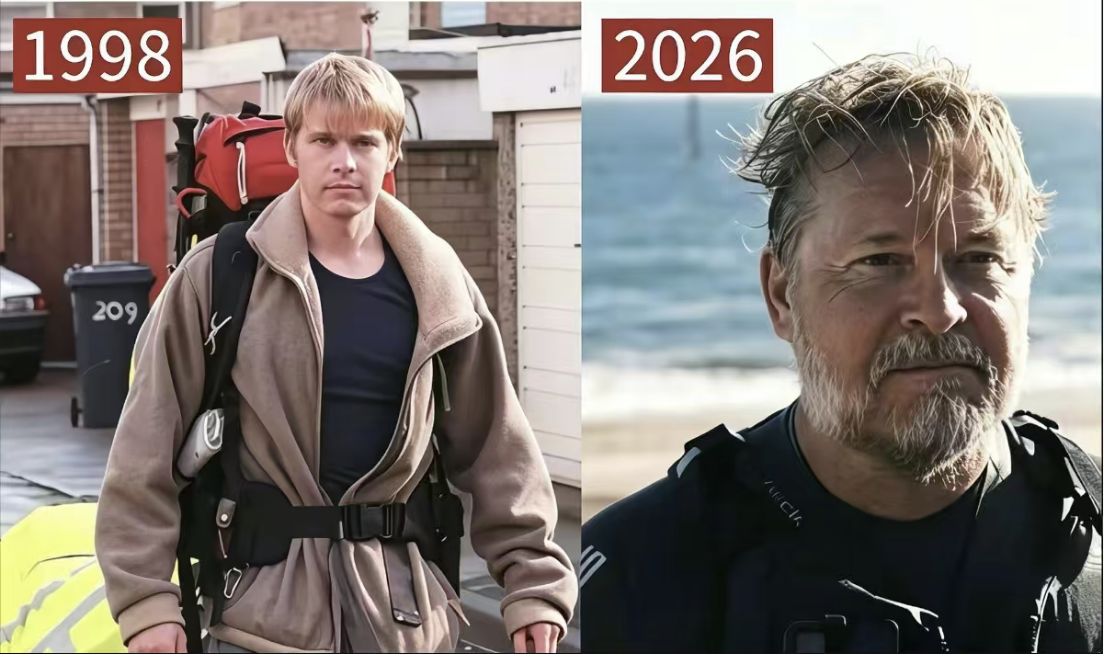
On November 1, 1998, 29-year-old Karl Bushby set out from the southern tip of Chile, preparing to walk all the way back to England.
On November 2, 2026, at the age of 57, he pushed a cart loaded with luggage and finally returned to his hometown of Hull. A banner was hanging at the door welcoming him home, and his mother embraced him, shedding tears.
This journey, spanning four continents, 30 countries, and approximately 50,000 kilometers, took 28 years.
When he set out, mobile communication was still in the 2G era. By the time he walked back to his hometown, people had become accustomed to video calls at any time, and AI had begun to participate in daily work.
The changes in technology are easy to identify, but the changes in family give those 28 years a different weight. His son is now 36 years old, and his 12-year-old granddaughter met her grandfather for the first time during this return. For Bushby, 28 years was a path walked step by step; for his family, those years also included many days spent apart.
He walked 50,000 kilometers while the world went through twenty-eight years
While 50,000 kilometers can at least be traced on a map, 28 years is much harder to capture. It requires reopening those years that have already passed to realize just how long he has walked.
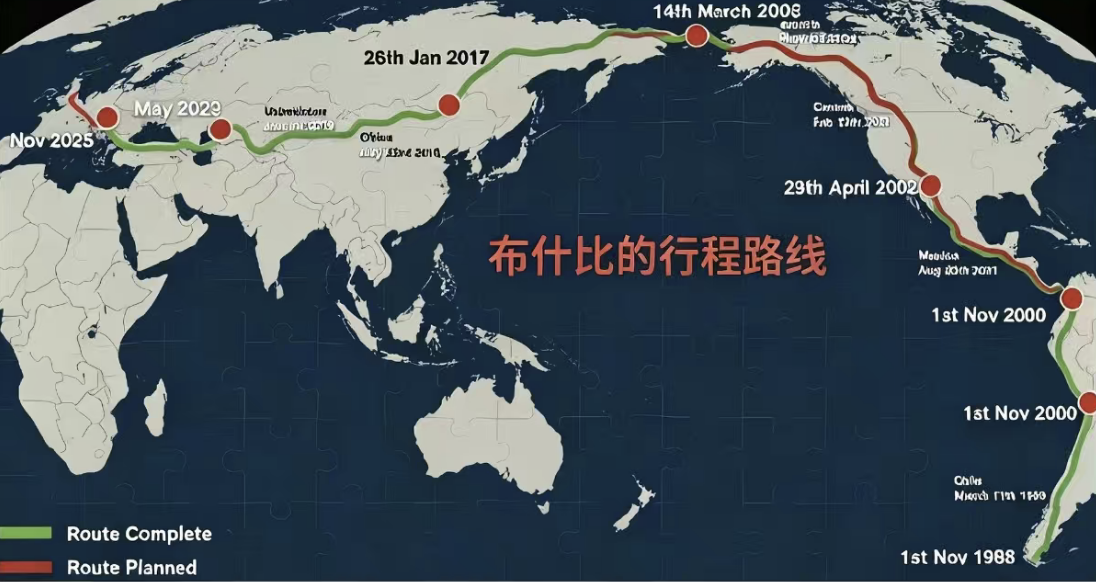
In 2001, he crossed the Darién Gap that connects South America to Central America. There were impenetrable jungles and the dangers of armed conflict. After entering Panama, he was detained for 18 days for crossing restricted border areas.
In 2006, he and a companion attempted to cross the Bering Strait. They were once rescued along the way and then set off again, only to face the peril of falling into the icy waters, with their sled carrying supplies almost sinking. After crossing, they faced delays due to immigration procedures. At that time, he had been away from Chile for over seven years.
The following year, in 2007, the first generation iPhone was released. People began to browse the web and check maps on a small touch screen, and later moved more and more of their lives into it. Looking back today, that phone has become an antique in the history of technology; for Karl, its launch was even partway through his journey.
In 2008, Lehman Brothers filed for bankruptcy, and the financial crisis swept the globe. Unemployment in office buildings and losses in accounts seemed far removed from a hiker, but ultimately affected his sponsorship funds.
He could traverse mountains on foot, but the next leg of the journey still required financial support. The tremors in the financial markets thus influenced his itinerary.
Longer than danger is waiting. The Russian segment took him nearly ten years due to visa and weather restrictions. Suitable travel periods only lasted a few months each year, and if paperwork was delayed, the journey had to stop. On the map, he seemed to remain still, but age continued to increase.
By 2020, the World Health Organization classified the COVID-19 pandemic as a pandemic. Many people's travel plans were disrupted, and Karl's expedition was also affected. That year, he had been away from Chile for over twenty-one years.
In November 2022, ChatGPT was released. Since then, talking to machines and having AI assist with writing and work gradually became everyday topics. It had been 24 years since Karl set out.
Connecting these years, 28 years gradually revealed its length. News that once shocked the world later became history; technologies that changed daily life moved from emergence to ubiquity, followed by new alternatives. Karl's destination remained the same: Hull, England, his mother's home.
Along the way, others offered him places to rest. In Peru, when he fell severely ill, a doctor's family took care of him until he recovered; some who welcomed him were not well off but still willing to share their food. Long-distance trekking exposed him to dangers but also helped him remember many who once helped him.
Within the 50,000 kilometers, there were paths he walked on his own and hardships he overcame with the help of others.
When on the road, after completing a day, home still felt far away. Sometimes he had to backtrack, detour, and wait until he could pass again. It was not until he finally arrived that he could look back and see how those daily walks had formed a distance that crossed continents.
Our perception of time is often similar. A day, a week, it is hard to see changes in life. But when we place 1998 alongside 2026, from communication methods to the faces of family members, traces of time can be found almost everywhere.
What would be left if we put these 28 years into an ordinary person's account?
Saving a little money every month may seem insignificant at first. Over several years, the principal gradually gains weight. If investments yield returns, and those returns continue to be reinvested, there is an opportunity to participate in the next stage of growth. The effect of compound interest becomes evident through this repeated cycle.
Looking at just one year, the differences may be limited; stretched over twenty years, the amounts invested continuously, actual returns achieved, and whether the returns are reinvested can lead to a widening gap in the final results.
But such a long period carries real life within it.
The amount of money that can be left untouched at age 29 may need to be used for housing or children's expenses by age 35. Plans that were originally meant for continuous investment may encounter unemployment. When markets decline, there may coincidentally be an expense that must be paid. A calculator can project future returns based on expected yields, but it cannot help us cope with these changes.
Thus, before asking "how much can be accumulated in 28 years," we must first clarify: which money will be needed soon, which can be kept longer, and what will sustain our lives when income is interrupted.
Set aside an accessible amount for unexpected expenses, arrange the funds needed for the short term, and then plan long-term investments based on target deadlines and risk tolerance to reduce the likelihood of being forced to sell during a cash crunch. As income and family responsibilities change, the original arrangements should be re-evaluated.
Investments can incur losses, and expenses also affect returns. Lengthening time does not guarantee that every asset will profit. What is called long-term needs to be implemented in a way that one can manage and adjust with life.
These actions often feel very mundane. Setting aside money each month may initially show no significant difference, and unexpected expenses can reverse some of the accumulation. But after several years, it could allow someone to leave an unsuitable job or share some costs when a family member falls ill. Moving forward, it leads to retirement and longer-term plans.
The numbers in an account only become practically useful at these moments. What is gained from years of accumulation may simply provide extra options at decision-making times.
Karl's story also contains time that accounts cannot record.
When he arrived, his son had been an adult for many years, and his granddaughter was already 12. Of course, accumulating for the future is worthwhile, but the time spent with family also has its own limits. When making arrangements for twenty years down the line, the present years also need to be taken seriously.
When Karl set out in 1998, he could not have imagined the world 28 years later. Today, we cannot accurately describe the daily lives of over twenty years from now either. What we can do is start now, leaving some accumulation for the life we want and also providing time for those we live with.
On November 2, 2026, Karl walked the last stretch of road, and his mother was right at the doorstep.
The 50,000 kilometers on the map finally reached an endpoint. The person who set out at 29 is now 57. He put down his luggage and returned to his mother's embrace.

Bitget Wealth Management | Leave time for accumulation, and tranquility for life
The temporarily idle digital assets in hand can also have arrangements. Bitget's "Easy Earn" savings accounts offer an annual percentage rate (APR) of 12% for USDC subscription amounts within 300,000.
https://www.bitget.com/zh-CN/finance?vipCode=hktb3191
Specific interest rates, applicable limits, and withdrawal rules are subject to the subscription page.
免责声明:本文章仅代表作者个人观点,不代表本平台的立场和观点。本文章仅供信息分享,不构成对任何人的任何投资建议。用户与作者之间的任何争议,与本平台无关。如网页中刊载的文章或图片涉及侵权,请提供相关的权利证明和身份证明发送邮件到[email protected],本平台相关工作人员将会进行核查。