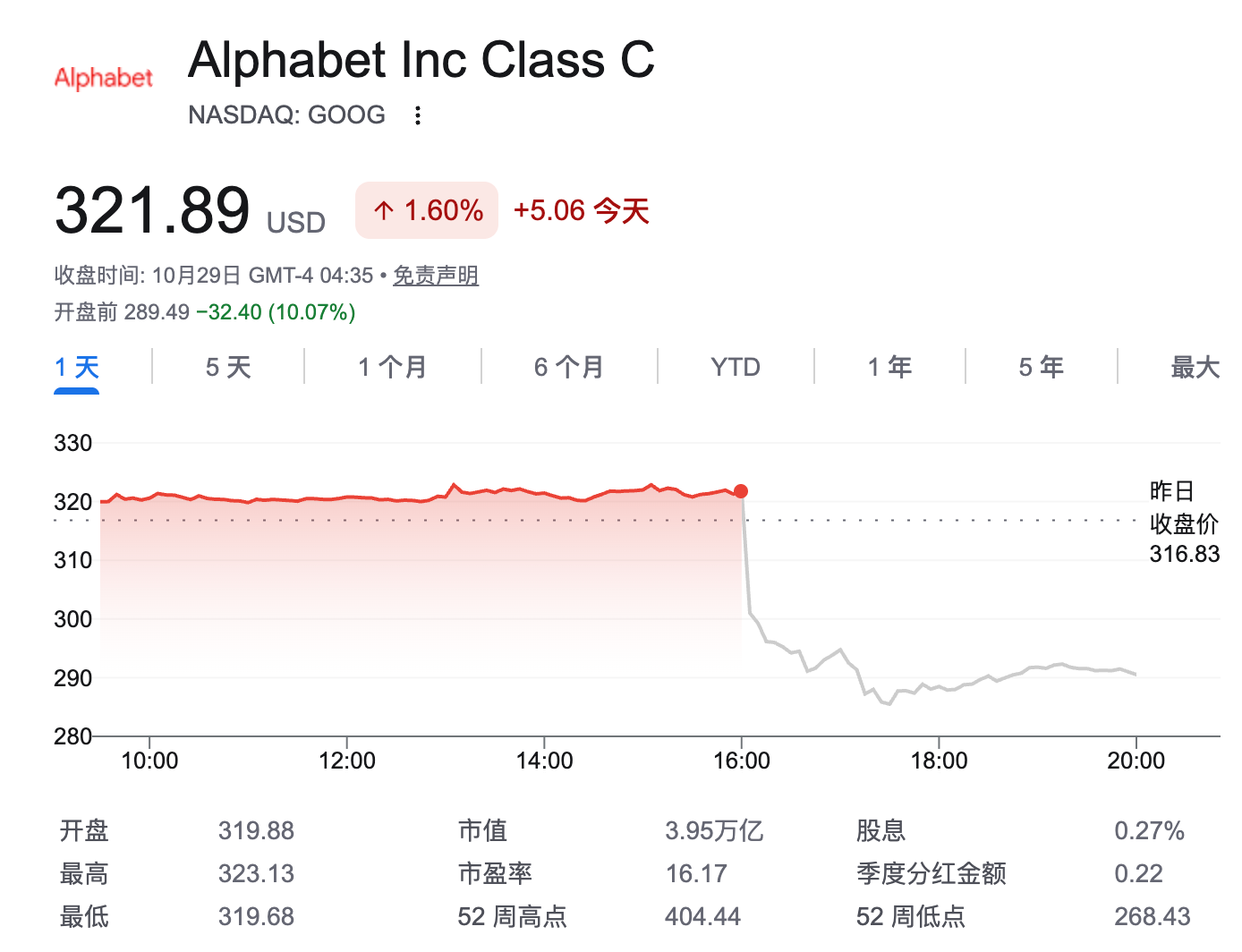
After hours on October 28, Eastern Time (in the early morning of the 29th Singapore Time), Google's parent company Alphabet released its third-quarter results: revenue and earnings per share both fell short of expectations, with after-hours stock prices plunging nearly 10% at one point (to $292.82), resulting in a single-day market value evaporation of over $300 billion. The core issue of this "surprise" financial report lies not in the declining revenue but in "money can be made, but profits cannot be kept" — massive capital expenditure on AI is quickly eroding free cash flow.
Key Data: Record Revenue, Yet No Profit
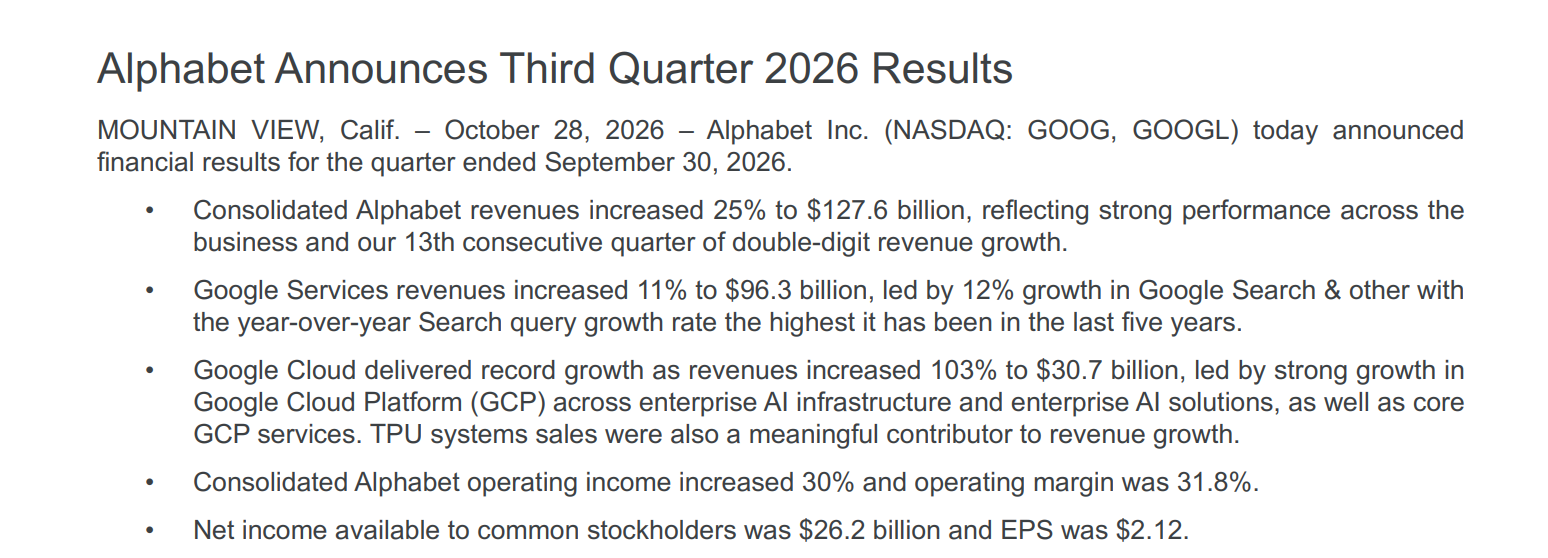
This quarter, Alphabet's revenue reached $127.58 billion, setting a new record, yet still below Wall Street's consensus expectations; earnings per share also failed to meet the target. Even more striking is the shift to negative free cash flow — reporting approximately -$9 billion for the quarter, which is extremely rare for a company known for being a "cash cow" like Google. Capital expenditure soared to $51.4 billion (for the quarter), setting a new record. The market's prior concerns about an "AI money-burning black hole" have now been laid out in such a blatant manner for the first time.
One bright spot comes from the cloud business: Google Cloud's revenue for the quarter was about $30.7 billion, up 103% year-on-year, clearly proving that AI demand driven by Gemini is beginning to materialize. However, the "doubling" growth rate of the cloud could not offset the weakness in search and YouTube advertising, nor the cash flow pressure from AI investments.
Deep Concerns: AI Backlash on Search Fundamentals
Google's real trouble lies within its most profitable search advertising. Since the beginning of this year, AI chat and multimodal large models have continuously siphoned off traditional search share, leading to accusations that Google is trying to mask the slowing growth of search revenue by "loosening keyword matching and effectively increasing advertiser costs" — complaints from advertisers about being charged for closely related terms like "tennis rackets" when searching for "rackets" are becoming increasingly pronounced. This short-term revenue increase at the expense of the advertising ecosystem is seen by the market as an early warning signal of pressure on the search business. This quarter, the growth rates of both search and YouTube advertising revenues weakened, confirming this deep concern. In addition, the financial report also included the book loss from SPCX, further dragging down apparent profits.
A Tale of Two Extremes: Microsoft as the Control Group
Microsoft's financial report released the same night was much more stable: revenue reached $92.3 billion, a record high, with Azure revealing quarterly revenue of $33.2 billion for the first time, growing 48% year-on-year. After-hours stock prices rose about 6%, nearing a 52-week high. Microsoft, unlike Google, has not made aggressive bets on AI but continues to monetize through Azure, Copilot, and a backlog of commercial orders (which reached $677 billion, up 73% year-on-year). In comparison, the market sends a clear signal: it’s not about who invests the most now, but who can turn AI investments into profit and cash flow first.
Market and Crypto Transmission
After the financial report, 19 accounts on Hyperliquid paradoxically added approximately $20.56 million in long positions on Google, betting on a "bounce back" after the selloff; the crypto market remained relatively resilient, with BTC stabilizing around $80,000 and spot buying showing some uptick. However, the continued drop in tech stocks is still dragging down risk sentiment; if the valuation reassessment triggered by Google spreads, it will still suppress crypto assets in the short term.
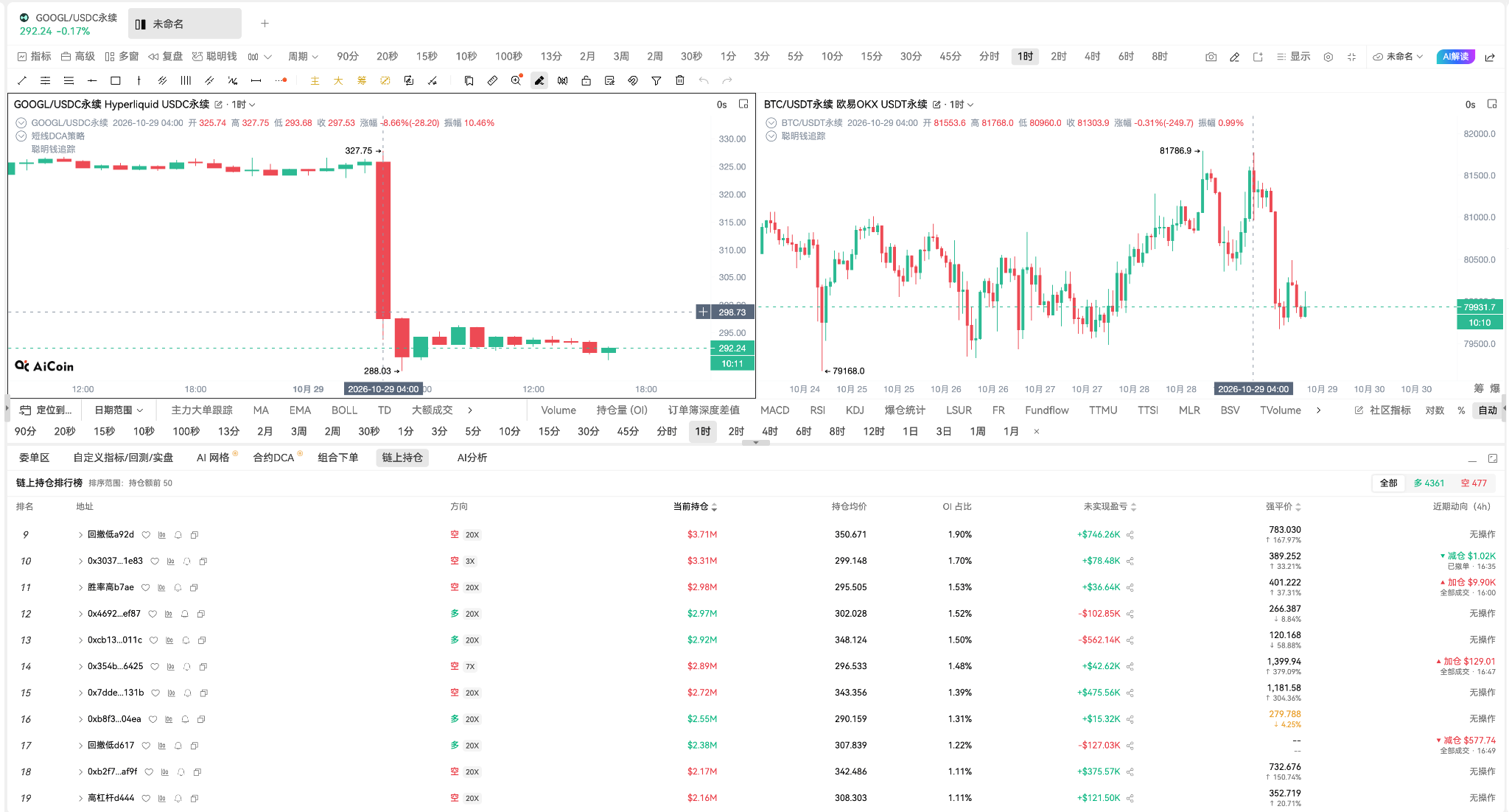
Google's decline this time is fundamentally a concentrated pricing on the market's assessment of whether "AI capital expenditures can translate into profits." The Gemini 4 Carbon has rolled out in two weeks, securing 15 out of 17 benchmarks, indicating that from a technical perspective, it is not lagging; what’s lacking is the time to convert its leading advantage into free cash flow. For investors, the gains or losses around the $290–300 mark will determine whether this is a "buying opportunity after a selloff" or the beginning of a "shift in valuation center."
免责声明:本文章仅代表作者个人观点,不代表本平台的立场和观点。本文章仅供信息分享,不构成对任何人的任何投资建议。用户与作者之间的任何争议,与本平台无关。如网页中刊载的文章或图片涉及侵权,请提供相关的权利证明和身份证明发送邮件到[email protected],本平台相关工作人员将会进行核查。