Author: AiPlot Research Institute
Focus: RWA / Digital Assets / In-depth Analysis of Financial Infrastructure
Website: https://aiplot.com/?utm_source=aicoin
BNB Standard Corporation (Nasdaq: BNC) ringing the bell on Nasdaq has drawn market attention not just because of a corporate name change or a capital market ceremony. Its more significant meaning lies in the fact that BNB has finally provided a relatively direct listing company exposure for US stock accounts.
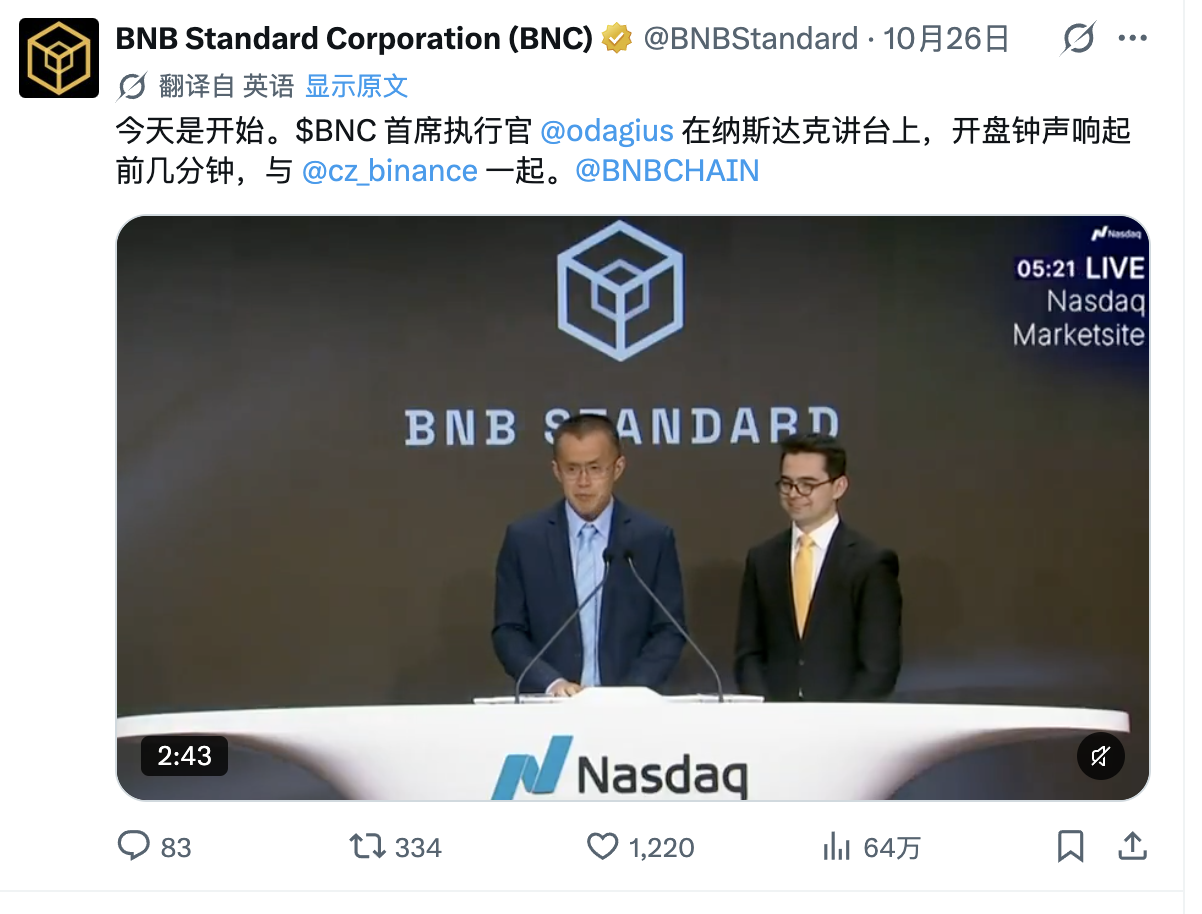
BNC was previously known as CEA Industries and gradually shifted towards a corporate-level BNB treasury strategy after a PIPE financing of about $500 million in 2025. The company officially changed its name to BNB Standard Corporation on September 29, 2026, but its common stock continues to trade under the BNC ticker on the Nasdaq Capital Market.
This needs to be accurately understood: BNC is not Binance's listing, nor is it BNB itself, and holding BNC does not equate to directly holding BNB. It is a publicly listed company that combines corporate balance sheets, public market financing, and BNB asset exposure.
This is exactly where it relates to RWA. It is not a typical "on-chain real asset," but it packages BNB exposure, which could previously only be accessed through crypto wallets, into publicly traded company equity that can be traded through securities accounts. For some funds, this serves as an indirect channel from traditional capital markets into crypto assets.
1. RWA Market from AiPlot's Perspective
AiPlot's current RWA market page shows that, by asset class, the top ten asset categories total approximately $38.05 billion. Among these, US Treasury assets amount to about $14.6 billion, accounting for roughly 38.4% of the top ten, significantly higher than the second-ranked commodities at $5.15 billion and the third-ranked active strategies at $4.34 billion.
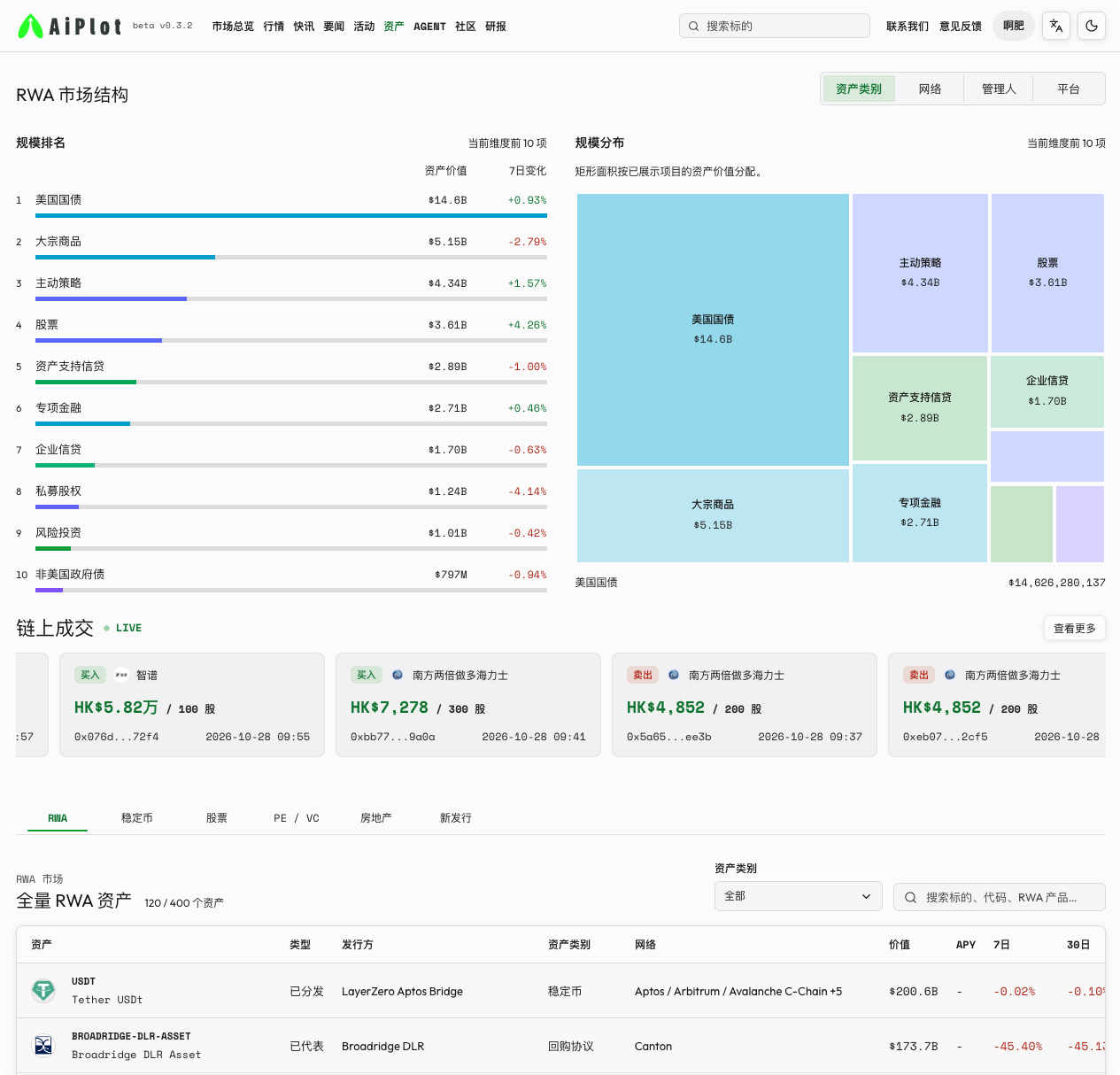
The leading asset classes and their 7-day changes are as follows:
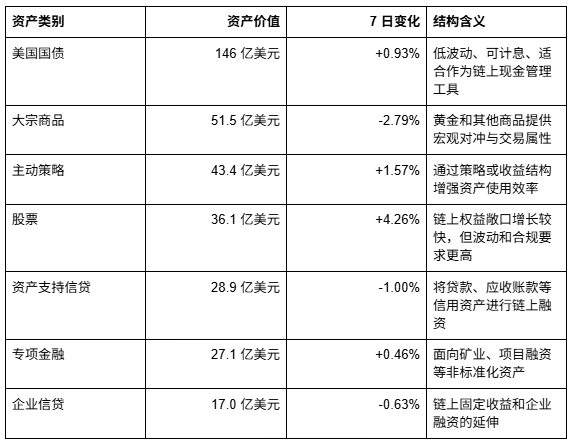
US Treasury bonds account for about 62% of the combined scale of the other nine asset classes. This proportion indicates that the largest successful scenario for RWA currently is not high-risk stocks or real estate, but rather bringing short-duration dollar assets, treasury bond funds, and cash management tools on-chain.
The reason is quite practical. Treasury bonds have a clear valuation system, a mature custody mechanism, stable income sources, and widespread institutional demand. In contrast, stock tokens must address issues such as issuer rights, trading times, geographical restrictions, and securities regulation; real estate and private equity face challenges such as low valuation frequency, strong transfer restrictions, and insufficient liquidity.
Therefore, the first stage of RWA is not to tokenize all assets but to prioritize the dollar assets that are easiest to standardize, easiest to value, and most easily accepted by institutions onto the blockchain.
2. Why US Treasury Bonds Are the Ballast of RWA
AiPlot's specific asset list further shows that the current large-scale RWA assets include USDT, USDC, Figure HELOC Token, USYC, Ondo USDY, BlackRock BUIDL, eurSAFO, iBENJI, and USDG, among others.
It is essential to distinguish between "asset class scale" and "individual asset scale." Stablecoins often have a larger total issuance, but they primarily serve functions of payment, settlement, and liquidity mediation; US Treasury token-type assets are closer to interest-bearing on-chain cash management products.
For instance, AiPlot's page shows that Circle USYC is about $2.37 billion, Ondo USDY is around $2.36 billion, BlackRock BUIDL is approximately $2.16 billion, and Franklin Templeton's iBENJI is about $1.71 billion.
The common feature of these products is that their underlying assets are relatively transparent, the sources of returns can be explained, price volatility is generally lower than that of stocks and crypto assets, and they can be used in conjunction with stablecoins, lending protocols, and on-chain settlements.
This explains why the RWA market presents an important structure:
stablecoins provide liquidity, treasury tokens provide yields, public chains provide settlement, and trading platforms provide distribution.
The emergence of BNC corresponds to another direction: traditional securities accounts providing exposure to crypto assets.
It is not about bringing treasury yields on-chain but about transferring BNB asset risk to a publicly traded company's balance sheet and stock market. Both are doing asset connection, but in opposing directions: treasury tokens represent TradFi assets entering on-chain, whereas BNC is exposure to crypto assets entering the TradFi market.
3. The Essence of BNC: A Company, A Stock, and A BNB Treasury
The announcement from Nasdaq regarding BNC shows that its predecessor, CEA Industries, advanced the BNB treasury strategy through $500 million in private placement financing and announced the purchase of 200,000 BNB. At that time, the company clearly stated that BNB would be a primary reserve asset and planned to continue increasing its holdings.
The core logic of such companies is similar to other digital asset treasury companies:
The company finances by issuing stock or other securities, and then allocates the funds to a particular digital asset. Investors do not need to manage wallets, private keys, or on-chain transactions themselves, but gain indirect exposure to the asset through publicly traded shares.
However, this structure simultaneously introduces the complexity of traditional publicly listed companies. Shareholders hold company equity, not direct ownership of the BNB held by the company. The stock price may be higher or lower than the net value of the assets held, with the difference depending on market expectations regarding management capability, financing ability, asset appreciation potential, and future expansion.
Therefore, assessing whether BNC is attractive cannot be based solely on the price of BNB or the number of BNB the company holds; at least four indicators must be considered:
- The number of BNB held by the company and other balance sheet items such as cash and debt;
- Adjusted Net Asset Value (Adjusted NAV) and per-share Adjusted NAV;
- The premium or discount of the market capitalization relative to the net assets of BNB;
- The dilution effect on per-share BNB exposure due to new share issuance, warrants, and financing activities.
BNC's SEC disclosure in September 2026 clearly indicates that the company's risks include BNB price volatility, concentration of holdings and custody arrangements within the Binance ecosystem, loan collateral and repayment obligations, weaknesses in internal controls, regulatory changes, and the ability to continue financing and increasing BNB holdings.
This risk list is significant. It shows that BNC is not a simple "BNB ETF substitute." It includes additional risks related to corporate governance, financing, custody, debt, and regulation.
4. BNC Is Not Just About "Buying Cheap Coins"
Before ringing the bell, BNC's per-share NAV was about $7, and it was believed that if the market price fell below this level, investors would effectively gain a discounted channel into BNB exposure. This thinking has some rationality, but it is essential to distinguish three concepts: asset net value, stock price, and future financing ability.
If the company's adjusted per-share NAV is $7 and the stock is trading at $6, then the discount relative to NAV is about 14.3%. This indicates that the market price is below the per-share value of the assets held, according to disclosure standards.
However, a discount does not necessarily represent underestimation. The market may be reflecting the following risks within the discount:
- BNB price may drop rapidly;
- Company may need to issue stock at low prices for financing;
- Debt or warrants may lead to future dilution;
- Custody and asset allocation concentrated in a single ecosystem;
- Uncertainty about whether management can continue to increase per-share BNB exposure;
- Stock trading times for the publicly listed company may not align with BNB's 24/7 trading.
Conversely, if BNC's stock price is significantly higher than per-share NAV, then the market is paying not just for the BNB assets themselves but also for expectations regarding management's financing capabilities, asset growth rates, and the continued increase of "per-share BNB amounts."
Thus, what investors should genuinely track is not whether "BNC's stock price can rise," but rather:
Is the number of BNB behind each BNC stock continuously increasing? Can the stock premium convert into more BNB, rather than just capital expansion?
This is also the key distinction between digital asset treasury companies and traditional ETFs. ETFs typically aim to closely track net asset values, while treasury companies may exhibit significant premiums, discounts, and financing-driven valuation changes.
5. The Relationship Between BNC and RWA: It Is a Capital Market Entry for "Reverse Tokenization"
Defining it strictly, BNC stock itself is not an RWA token. It represents equity in a publicly listed company within the traditional securities market, with underlying company assets that include BNB, and not a particular tangible asset or stream of cash flow.
However, from the perspective of asset connection, BNC represents a pathway opposite to RWA.
The traditional RWA pathway is:
Treasuries, funds, credit, stocks, and other traditional assets → Tokenization → Public chain settlement → On-chain trading and portfolios.
BNC's pathway is:
BNB digital assets → Corporate treasury holdings → Publicly listed company equity → Trading through Nasdaq securities accounts.
The former is "real assets on-chain," while the latter is "digital assets listed." Both share the common goal of lowering the barriers to cross-market asset flow, but the legal and economic risks they bear are entirely different.
Within this data structure, BNC-related assets, on-chain stock products in the BNB ecosystem, and RWA issuance conditions in BNB Chain can be compared within the same market framework. Researchers can further observe:
- Whether treasury, stablecoin, and stock tokens on BNB Chain are growing;
- Whether RWA assets in the BNB ecosystem are experiencing continuous on-chain trading;
- Whether the premium or discount of BNC's stock price relative to NAV is changing;
- Whether when BNB prices rise, BNC's stock generates additional treasury premiums;
- Whether when BNB prices decline, the structure of the publicly listed company exacerbates downward pressure.
This is more accurate than simply calling BNC the "US stock version of BNB." It is actually an experimental sample observing how digital assets enter traditional capital markets.
6. BNB Chain's Infrastructure: Why It Decides Whether BNC's Narrative Can Continue
The asset value of BNC ultimately relies on BNB, and the long-term fundamentals of BNB are related to the usage, liquidity, and application ecosystem of BNB Chain.
BNB Chain's official roadmap shows that by 2025, the network achieved a block time of approximately 0.45 seconds and a final confirmation time of about 1.125 seconds, listing stablecoins and real assets as major application directions.
The official disclosure also revealed that in 2025, the market value of stablecoins on BNB Chain reached about $14 billion at one point, with RWA market value exceeding $1.8 billion, and mentioned institutional products like USYC, BlackRock BUIDL, Franklin Templeton BENJI, and VanEck VBILL.
These figures belong to the disclosure standards of the BNB Chain ecosystem and do not equate to independent audited full market data, but they can indicate an important issue: the long-term narrative of BNC cannot rely solely on "limited BNB supply" or "rising BNB prices"; it must also depend on BNB Chain continuously generating demand for transactions, payments, stablecoins, and RWAs.
In 2025, BNB Chain also launched a special incentive program for RWA projects, including technical and compliance support, liquidity initiation, TVL incentives, growth funding, and expansion route design.
The significance of these incentives lies in BNB Chain's attempt to advance the development of RWA from merely asset issuance to project migration, liquidity building, and user growth. For BNC, the more ecosystem applications there are, the richer the use cases for BNB as transaction fees, staking, governance, or liquidity assets, making the corporate treasury logic easier to support fundamentally.
However, a boundary exists here: active on-chain trading does not automatically equal BNB value capture. It requires ongoing observation of the actual demand for BNB usage, fee income, validator economics, ecosystem incentive costs, and whether application growth can transform into long-term holding demand.
7. The Three Most Noteworthy Scenarios for BNC Currently
Scenario One: BNB Rises, BNC Forms Positive Treasury Premium
If BNB's price rises while BNC can continue to finance and increase per-share BNB exposure, the market may grant the stock a premium above NAV. At this point, the price increase of BNC's stock may exceed that of BNB, but the rise is not solely from asset appreciation; it also includes a repricing of market expectations regarding the company's expansion capabilities.
Scenario Two: BNB Flatlines, BNC Returns to Net Asset Discount
If BNB's price does not increase and the company does not noticeably increase the number of BNB per share, the market may gradually lower expectations for treasury growth, causing the stock price to converge toward NAV or discount levels.
This scenario illustrates that BNC is not suitable for valuation solely using static price-to-earnings ratios. It is more like a structured asset that reflects "digital asset net value plus capital market premium."
Scenario Three: BNB Declines, Stock Faces Dual Pressure
A decline in BNB will directly lower the net asset value of the company. If the company simultaneously needs to raise funds, repay debts, or maintain collateral, the stock may also be affected by dilution and liquidity discount.
This represents a primary risk for treasury companies compared to directly holding tokens: gains may be amplified in an uptrend, but losses may also be magnified in a downtrend.
Conclusion
The ringing of the bell for BNC does not imply Binance's listing, nor does it mean BNB has transformed into traditional securities. Rather, it signifies that BNB has begun to have a corporate entry point capable of communicating with Wall Street, publicly listed company investors, and securities accounts.
AiPlot's RWA data reveals another reality: the current on-chain real asset market is still dominated by US Treasuries, stablecoins, and high liquidity financial products. Stocks and active strategies are on the rise, but the scale of assets and institutional acceptance still lags behind dollar cash management tools.
In this context, BNC represents a typical "reverse RWA" sample: it does not place traditional assets on-chain; instead, it embeds crypto asset exposure within the structure of a publicly listed company.
Whether this pathway can succeed depends on three conditions: whether BNB Chain continues to create genuine usage demand; whether BNC can increase per-share BNB exposure rather than just expand equity; and whether capital markets are willing to pay a stable and sustainable premium for this digital asset exposure.
Therefore, the most worthwhile question to research about BNC is not "Is it the next MSTR," but rather:
Can BNC truly connect the on-chain usage of BNB, corporate treasury, and US stock liquidity, making each share of equity more valuable as the ecosystem grows?
For more data and analysis, please follow Aiplot:
https://aiplot.com/?utm_source=aicoin
📖 Community Communication:
Telegram:
https://t.me/+IIYMcJigBAo4Mjg1

The content of this article only represents the author's personal views and does not reflect the position of this platform. The opinions, conclusions, and suggestions mentioned in the text are for reference by investors only and do not constitute any investment advice related to this platform. Market risks exist; investors should proceed with caution.
免责声明:本文章仅代表作者个人观点,不代表本平台的立场和观点。本文章仅供信息分享,不构成对任何人的任何投资建议。用户与作者之间的任何争议,与本平台无关。如网页中刊载的文章或图片涉及侵权,请提供相关的权利证明和身份证明发送邮件到[email protected],本平台相关工作人员将会进行核查。