If you have a sum of money temporarily not in use, traditional options usually include deposits, money market funds, or short-term U.S. Treasury bills. For crypto users, there is now an additional direction worth noting: allocating stablecoins into products related to real-world asset yields while maintaining the efficiency of fund usage within the crypto ecosystem.
Recently, two noteworthy opportunities have emerged in the Binance ecosystem:
- RWUSD: yields based on tokenized U.S. Treasury bonds and other real-world assets, supporting flexible subscriptions and redemptions;
- USDC holding annualized activity: holding qualifying USDC in the Binance contract or unified account and completing at least $2,500 in weekly USDC-M contract trading volume can enjoy a 2% APR reward.
These two products correspond to two different fund usage scenarios:
- RWUSD is more suitable for users who want to allow idle stablecoins to participate in yields;
- The USDC 2% activity is more suitable for users who are already engaging in USDC-based contract trading and need margin.
The focus is not simply on comparing "3.6% and 2% which is higher," but on determining: Is your capital already within the Binance ecosystem? Does it need to be used as margin? Are you pursuing flexibility?
1. RWUSD: Bringing Stablecoins into RWA Yield Scenarios
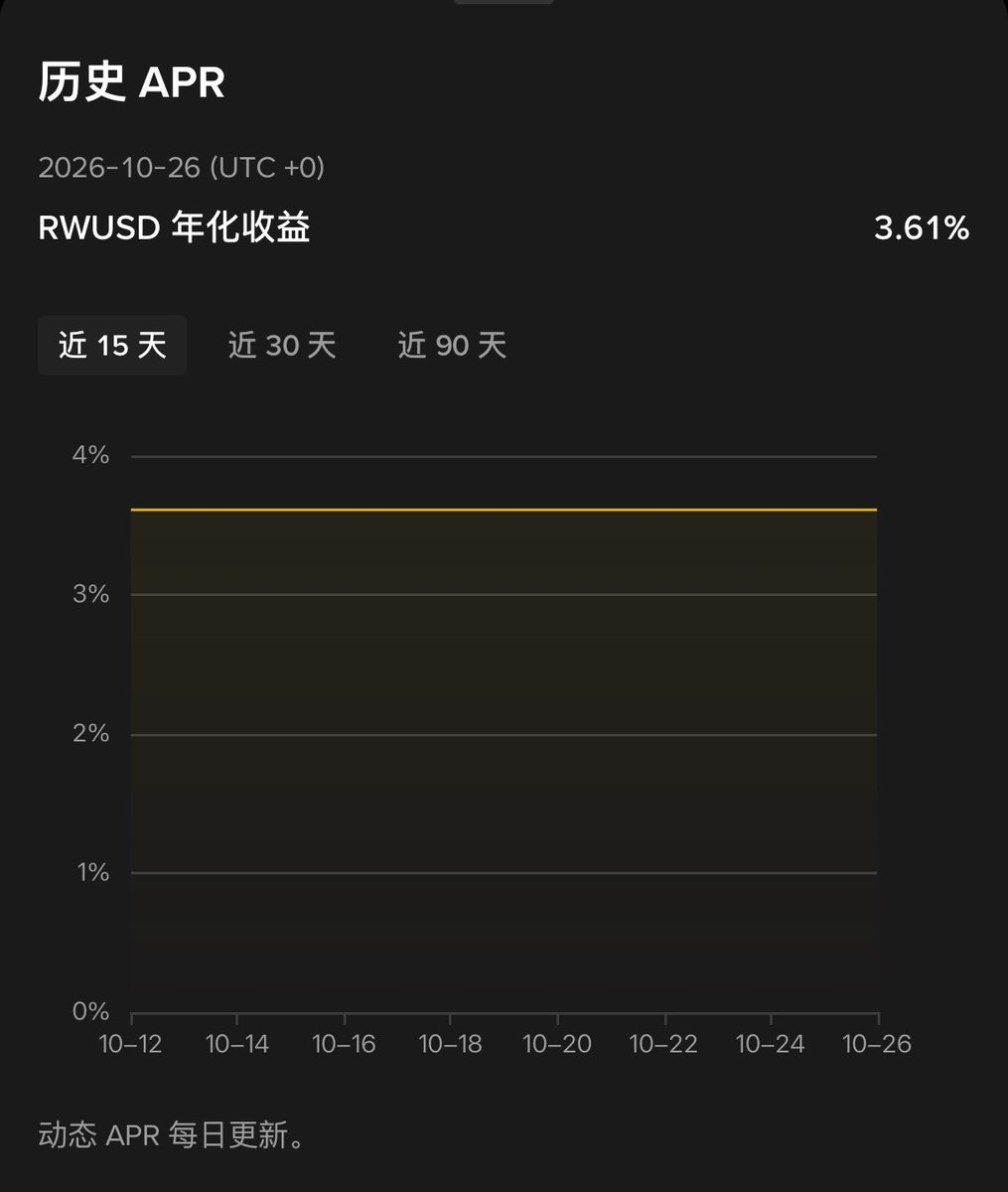
RWUSD is a flexible yield product launched by Binance. According to the official product page, the yield sources for RWUSD include Binance's institutional-level strategies and tokenized U.S. Treasury bonds and other fixed-income products managed by partners such as BlackRock, Circle, and Franklin Templeton; the yield APR is determined by Binance based on market conditions and product sustainability among other factors.
The core logic of this type of product is: users use designated stablecoins to subscribe to RWUSD and receive corresponding amounts of RWUSD as holding certificates; during the holding period, users receive RWUSD rewards daily according to the page rules.
The current product features displayed on the official page include:
- Flexible subscriptions;
- Supports standard redemption and quick redemption;
- Rewards are distributed daily;
- RWUSD can be used as margin under certain contract models;
- RWUSD can be used as collateral for VIP borrowing.
This means that RWUSD is not just about "earning yield by leaving it there," but also attempts to combine yield, trading margin, and collateral functions to improve fund turnover efficiency.
2. How is RWUSD Different from Traditional U.S. Treasury Bonds?
In terms of yield sources, RWUSD refers to real-world assets and tokenized U.S. Treasury bonds and other fixed-income products; but in terms of product nature, it is not equivalent to the user directly purchasing a U.S. Treasury bond.
Binance's official statement clarifies:
- RWUSD is a holding certificate for users' subscribed assets and accumulated yields;
- RWUSD is not a stablecoin, security, fund, tokenized real-world asset, or on-chain asset;
- RWUSD does not represent direct ownership of any real-world assets for the user;
- Upon successful redemption, RWUSD is converted to USDC at a 1:1 ratio, and may incur relevant redemption fees.
Therefore, RWUSD's advantages lie in its operational convenience, simple usage paths, and the ability to improve the utilization rate of funds within the Binance ecosystem; it is not the same product as holding U.S. Treasury bonds directly through traditional financial accounts in terms of legal structure, asset ownership, and service entities.
3. How to Understand RWUSD's Yields and Liquidity?
The yields of RWUSD are not fixed coupon interest. The official page states that the yield APR is determined by Binance based on market conditions and product sustainability factors, and yields begin to accumulate starting the day after subscription and are distributed in the form of RWUSD.
In terms of subscriptions and redemptions, users can choose:
- Quick Redemption: Instant return in USDC form, but may incur redemption fees;
- Standard Redemption: Return USDC at a time specified on the page, fee structures may vary.
This provides users with greater capital flexibility, especially suitable for those who do not wish to lock funds for a long time. However, "redeemable" does not mean there are no restrictions at any time. The official page also notes that in extreme market conditions or special situations, redemptions may be delayed, restricted, or suspended.
4. How Should One View RWUSD with 1 Million Funds?
Assuming a user has idle stablecoins equivalent to 1 million U.S. dollars, the current referenced APR is 3.6%, which roughly corresponds to an estimated reward for one year of: 1,000,000 × 3.6% = 36,000 RWUSD
An approximate daily estimation would be: 1,000,000 × 3.6% ÷ 365 ≈ 98.63 RWUSD/day
But this is just a static display value, not a fixed income promise. The actual rewards will be influenced by the following factors:
- Whether the APR changes;
- The yields start accumulating from the day after subscription;
- The snapshot rules for holding;
- The timings of subscriptions and redemptions;
- Fees for quick redemption or standard redemption;
- Product limits and regional applicability.
For large amounts of idle funds, users should pay more attention to fund efficiency and liquidity management, rather than just looking at annualized figures. The funds can be split for different uses: part for flexible reserve, part for yield allocation, and part for trading margins or other strategies.
5. RWUSD Can Also Serve as Margin, Further Enhancing Fund Efficiency
One differentiating feature of RWUSD is that under qualifying joint margin and unified account models, it can serve as margin for U-based contracts; the official page also indicates that RWUSD can serve as collateral for VIP borrowing.
For trading users, this provides a very intuitive logic of capital efficiency: with the same asset, under the fulfillment of rules, one can both earn yields and participate in margin or collateral scenarios.
This is more flexible than "keeping funds in a wealth management account and transferring them out for trading." Especially for users with high trading frequency who need to maintain margin balances, reducing the switching of funds between different accounts is itself an efficiency improvement.
Of course, contract margins themselves belong to high-risk scenarios. The ability of RWUSD to serve as margin does not mean that contract trading risks decrease; leverage, liquidations, price volatility, and account liabilities still exist.
6. USDC 2% APR Activity: Adding a Layer of Yield to Contract Margin
Binance has officially announced the USDC holding annualized activity, with the activity period from:
October 27, 2026, 08:00 to November 24, 2026, 07:59 (UTC+8)
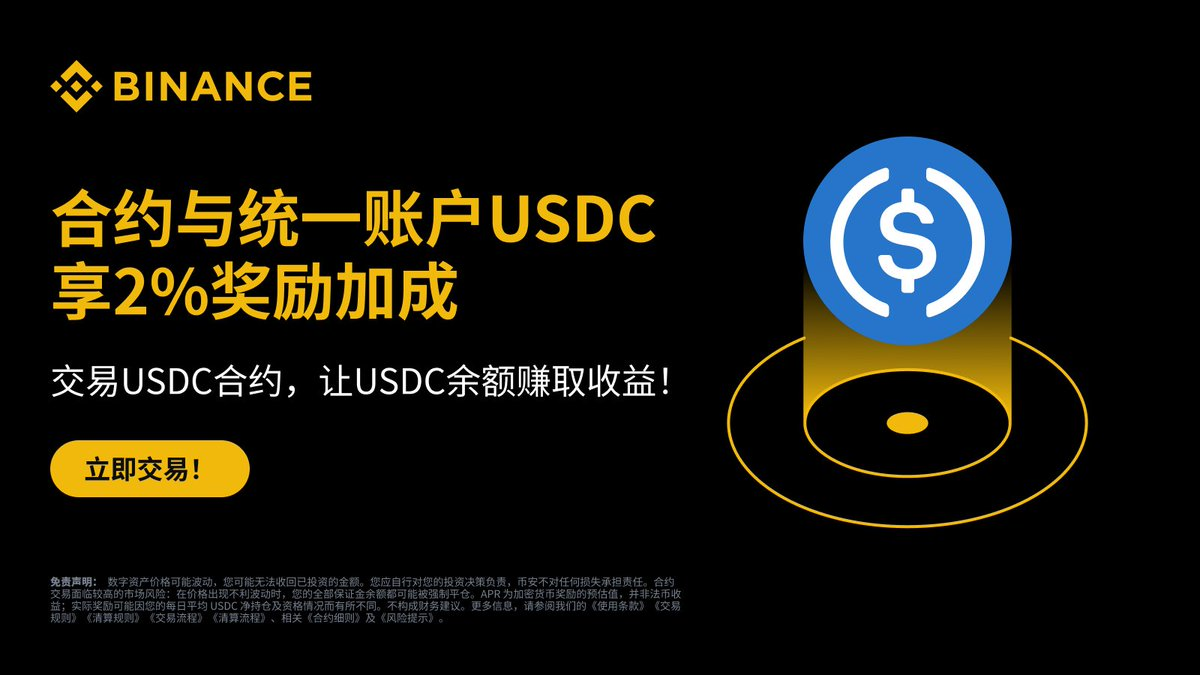
During the activity period, qualifying users can receive a 2% APR reward based on the net USDC balance in their Binance contract account and unified account.
The participation criteria are also very clear: users need to accumulate at least $2,500 in USDC-M contract trading volume each week to be eligible for that week's reward.
The activity is divided into four cycles:
- Week 1: October 27, 08:00 to November 3, 07:59;
- Week 2: November 3, 08:00 to November 10, 07:59;
- Week 3: November 10, 08:00 to November 17, 07:59;
- Week 4: November 17, 08:00 to November 24, 07:59.
7. Calculation Method for the USDC 2% Activity
The official rules state that the qualifying net USDC balance cap is $1,000,000, and any amount exceeding this will not be counted toward the reward.
The daily reward calculation method is:
Daily reward = min(daily average USDC net balance, $1,000,000) × 2% ÷ 365
For example, if a user's daily average USDC net balance over the week is $500,000 and meets the minimum of $2,500 in USDC-M contract trading volume for that week, then a rough calculation for the weekly reward would be:
500,000 × 2% ÷ 365 × 7 ≈ 191.78 USDC
If the daily average net balance is $1,000,000 and meets the weekly trading volume threshold, the weekly reward would be approximately: 1,000,000 × 2% ÷ 365 × 7 ≈ 383.56 USDC
Rewards are settled weekly and distributed to the spot account within the specified time after the corresponding cycle ends.
8. Which Users Are Most Suitable to Pay Attention to the USDC 2% Activity?
The key of this activity is not to force users to engage in contracts for the sake of 2% APR, but rather to provide an incentive for those already using USDC margin and USDC-M contracts.
Users who should pay more attention include:
- Those already engaging in USDC-M contract trading;
- Users who need to retain USDC margin in their contract accounts regularly;
- Users who naturally reach the $2,500 trading volume threshold each week;
- Those who wish to earn extra rewards on idle margin;
- Users able to strictly control their leverage and position risk.
If users are only looking to gain the 2% reward by opening more positions, inflating volume, or engaging in unnecessary trades, the trading costs and market risks may outweigh the rewards themselves. The true value of the activity lies in:generating extra efficiency from existing margin needs, rather than creating new trading demands.
9. How to Choose Between RWUSD and the USDC 2% Activity?
A simple scenario comparison can illustrate the difference:
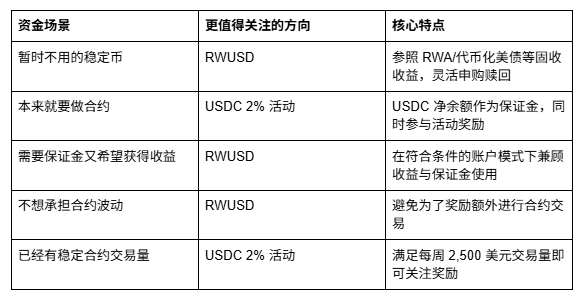
These two opportunities are not mutually exclusive but correspond to different asset management paths:
- RWUSD leans more towards managing the yield and liquidity of idle funds;
- USDC 2% leans more towards enhancing the efficiency of margin funds in trading accounts.
10. From a Data Analysis Perspective, What Indicators Should Be Tracked?
RWUSD Direction
- Current reference APR;
- Scale of RWUSD subscriptions;
- Daily amount of rewards distributed;
- Usage ratio of quick redemption to standard redemption;
- Changes in redemption fees;
- Usage of RWUSD as margin or collateral;
- Speed of fund inflows and outflows.
USDC 2% Activity Direction
- Net USDC balances in contract and unified accounts;
- Number of users reaching the $2,500 trading volume threshold each week;
- Average positions of participating accounts;
- Changes in USDC funds before and after the activity;
- Scale of rewards distributed;
- USDC-M contract trading volumes and market volatility.
By analyzing these data, one can determine whether the activity is actually enhancing users' fund efficiency or merely causing short-term fluctuations in funds and trading volumes.
Conclusion
For users with a large amount of idle stablecoins, simply keeping funds in accounts often does not fully utilize capital efficiency. RWUSD provides a yield entry associated with RWA, tokenized U.S. Treasury bonds, and fixed-income strategies, while retaining subscription, redemption, and partial margin usage functions.
For users already engaging in USDC-M contract trading, the 2% APR activity launched by Binance adds potential extra rewards for the net USDC balance in their contract accounts. Just achieve a trading volume threshold of $2,500 each week, and qualifying holdings can participate in that week's rewards.
The two products correspond to the scenarios of "idle funds" and "trading margin." The most important aspect to pay attention to is not just the APR on a page, but how Binance is integrating yields, margins, RWA, and trading functionalities into the same fund management system.
Generating efficiency from idle funds and allowing margin to undertake more tasks may be the core direction of the next phase of crypto asset management.
AiCoin User Exclusive Benefits
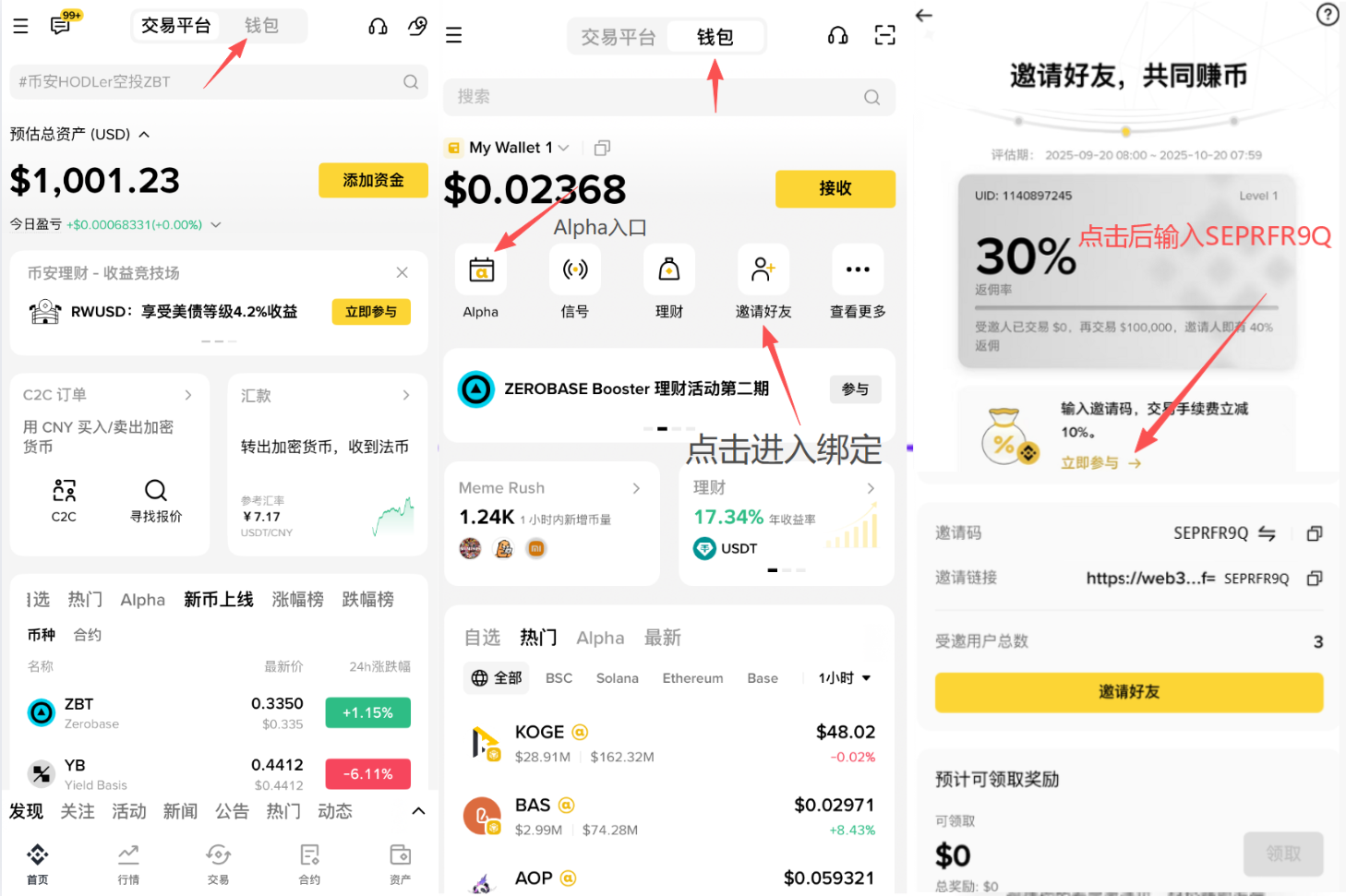
👉 Enter invitation code SEPRFR9Q when using the Binance wallet to enjoy a 10% fee rebate, making meme costs lower and more profitable
🔗 Exclusive Link:
https://web3.binance.com/referral?ref=SEPRFR9Q
免责声明:本文章仅代表作者个人观点,不代表本平台的立场和观点。本文章仅供信息分享,不构成对任何人的任何投资建议。用户与作者之间的任何争议,与本平台无关。如网页中刊载的文章或图片涉及侵权,请提供相关的权利证明和身份证明发送邮件到[email protected],本平台相关工作人员将会进行核查。