When the Federal Reserve raises interest rates, does Bitcoin have to drop? History is not that simple.
In 2017, the Federal Reserve continued to raise interest rates, and Bitcoin experienced a major bull market; in 2022, the Federal Reserve aggressively raised rates, and BTC sharply retraced from its previous highs.
Faced with interest rate hikes, why are the market performances so different? What should we focus on this time?
In the early morning of October 29, the Federal Reserve will announce its latest rate decision, followed by a monetary policy press conference chaired by Kevin Warsh. The market is concerned not only with whether rates will change but also with the Federal Reserve's assessment of inflation and future policies.
Before the meeting results are announced, looking back at previous rate hike cycles may help us better understand the relationship between interest rates, capital flows, and Bitcoin's price movements.
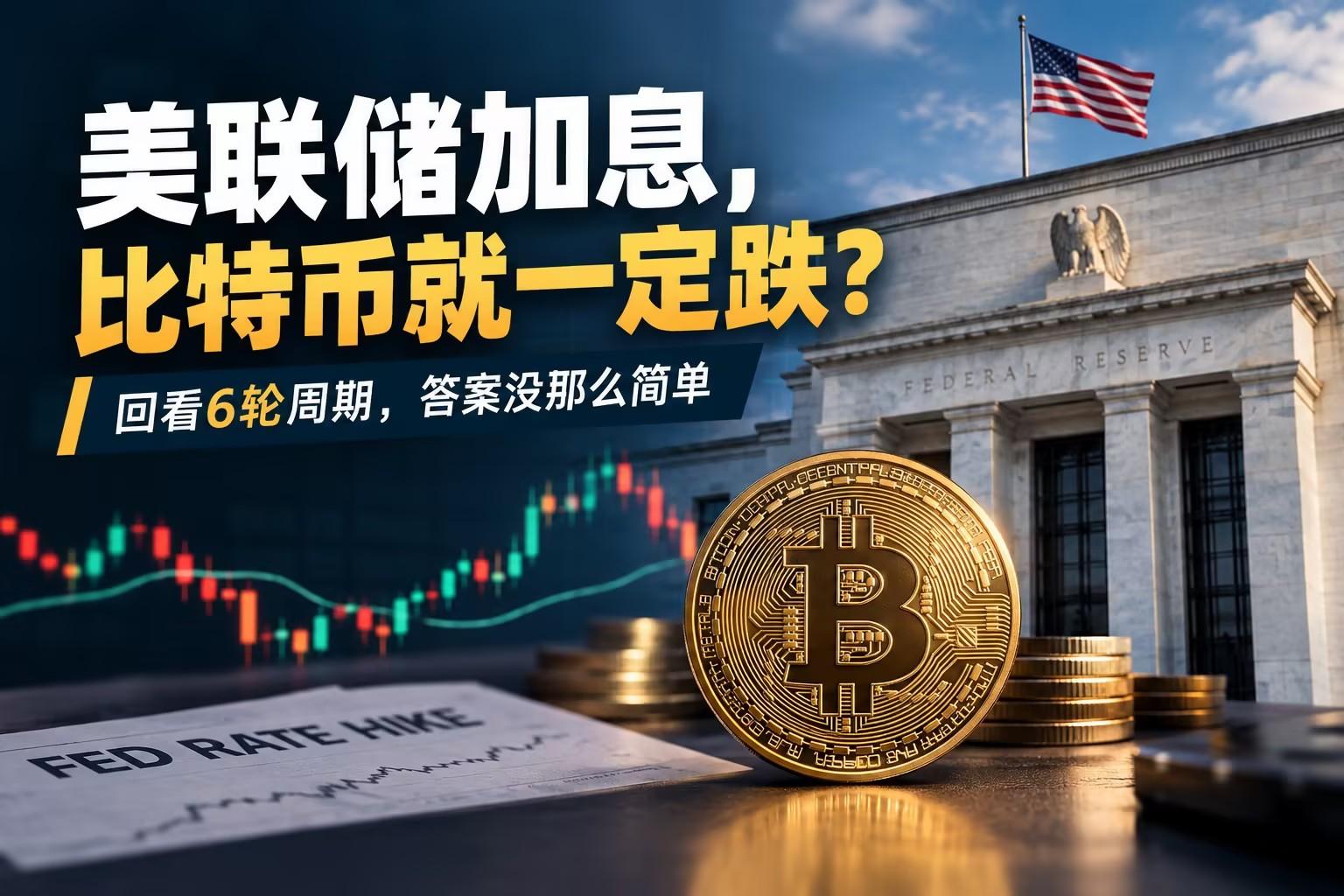
1. Review of 6 Rate Hike Cycles
- 1994–1995: The Federal Reserve raised rates by a total of 300 basis points, with rates increasing from about 3% to 6%.
- 1997: After a 25 basis point hike, it paused, indicating that policy would adjust according to economic conditions.
- 1999–2000: A total of 175 basis points raised, with rates increasing to 6.50%.
- 2004–2006: Continued to raise rates by 25 basis points 17 times, with rates rising from 1% to 5.25%.
- 2015–2018: Rates gradually increased to 2.25%–2.50%. During the same period, Bitcoin surged in 2017 and then significantly retraced in 2018.
- 2022–2023: The Federal Reserve raised rates by a total of 525 basis points, with rates increasing to 5.25%–5.50%. BTC sharply fell in 2022 and then gradually rebounded.
These cycles indicate that there is no simple correlation between interest rate hikes and the performance of risk assets.
The rise of BTC in 2017 was influenced by factors such as the heat of the crypto market and capital inflow; the drop in 2022, besides the high interest rate environment, was compounded by risks within the crypto industry itself. Relying solely on the price movements following any historical rate hike, it is difficult to predict the next market move.
2. Why might Bitcoin rise even when interest rates are increased?
First, check if the market has already priced in expectations.
If investors have already anticipated rate hikes, the price may not continue to drop after the decision is announced. Instead, a stronger-than-expected actual decision may trigger a new round of selling.
Second, see if capital is still willing to take on risk.
Rising rates increase the cost of capital and enhance the attractiveness of cash and short-term bonds, usually putting pressure on high-risk assets. However, if capital continues to flow in, BTC may still rise.
Finally, monitor changes in Bitcoin's own capital.
Funds flowing into spot ETFs, leverage positions, and liquidation situations all influence short-term trends. A bearish macro environment does not necessarily mean BTC will drop immediately; temporary price resistance does not prove a trend reversal.
3. What to focus on in the early morning of October 29?
This meeting can highlight three signals:
- Rate decision: Whether it meets market expectations or if there are unexpected changes.
- Warsh's remarks: Whether his statements about inflation, economy, and future rate paths are hawkish.
- The actual response of BTC: After the news is announced, whether there is a noticeable change in price, volume, and spot fund flows.
If the Federal Reserve's stance is more hawkish than market expectations, risk assets may be under pressure; if the tone is relatively mild, market sentiment may receive support. However, the ultimate trend still depends on how the market interprets the news and subsequent capital movements.
Volatility before and after the meeting may be amplified, so there is no need to rush to bet on a direction. Observe market reactions first, then consider whether to trade; this is usually more prudent than chasing after news to place orders.
4. What can ordinary investors do?
It is advisable to regard interest rates, inflation, and the dollar as macro references, while also observing BTC's price, trading volume, and capital flow trends. If there are currently no suitable entry opportunities, there is no need to force a trade.
If you do not have a Binance account yet, you can register through the link below, and afterward, you can learn about the trading and financial services supported by the platform according to your needs.
👉 Click the link to register for Binance:
https://jump.do/zh-Hans/xlink-proxy?id=3
(Invitation code: aicoin668, enjoy a 10% rebate)
Additionally, the Binance Wallet USDD Season 9 event will start on October 27, and eligible users can participate in the USDD liquidity pool activities through the Binance Wallet DeFi. Specific rules are subject to the event page.

Risk Warning: This article is for market information sharing only and does not constitute investment advice. Cryptocurrency asset prices are highly volatile, and DeFi products involve risks such as smart contracts; please make decisions cautiously according to your own risk tolerance.
免责声明:本文章仅代表作者个人观点,不代表本平台的立场和观点。本文章仅供信息分享,不构成对任何人的任何投资建议。用户与作者之间的任何争议,与本平台无关。如网页中刊载的文章或图片涉及侵权,请提供相关的权利证明和身份证明发送邮件到[email protected],本平台相关工作人员将会进行核查。