On October 22, technology stocks in the U.S. stock market faced significant selling.
The Nasdaq Composite Index fell by 2.60%, the S&P 500 Index dropped by 1.21%, while the Dow Jones Industrial Average slightly rose by 0.02%. The decline in semiconductor stocks was particularly pronounced, with the Philadelphia Semiconductor Index dropping by about 6.7%. The weakness in tech stocks dragged down the overall performance of the U.S. stock market.
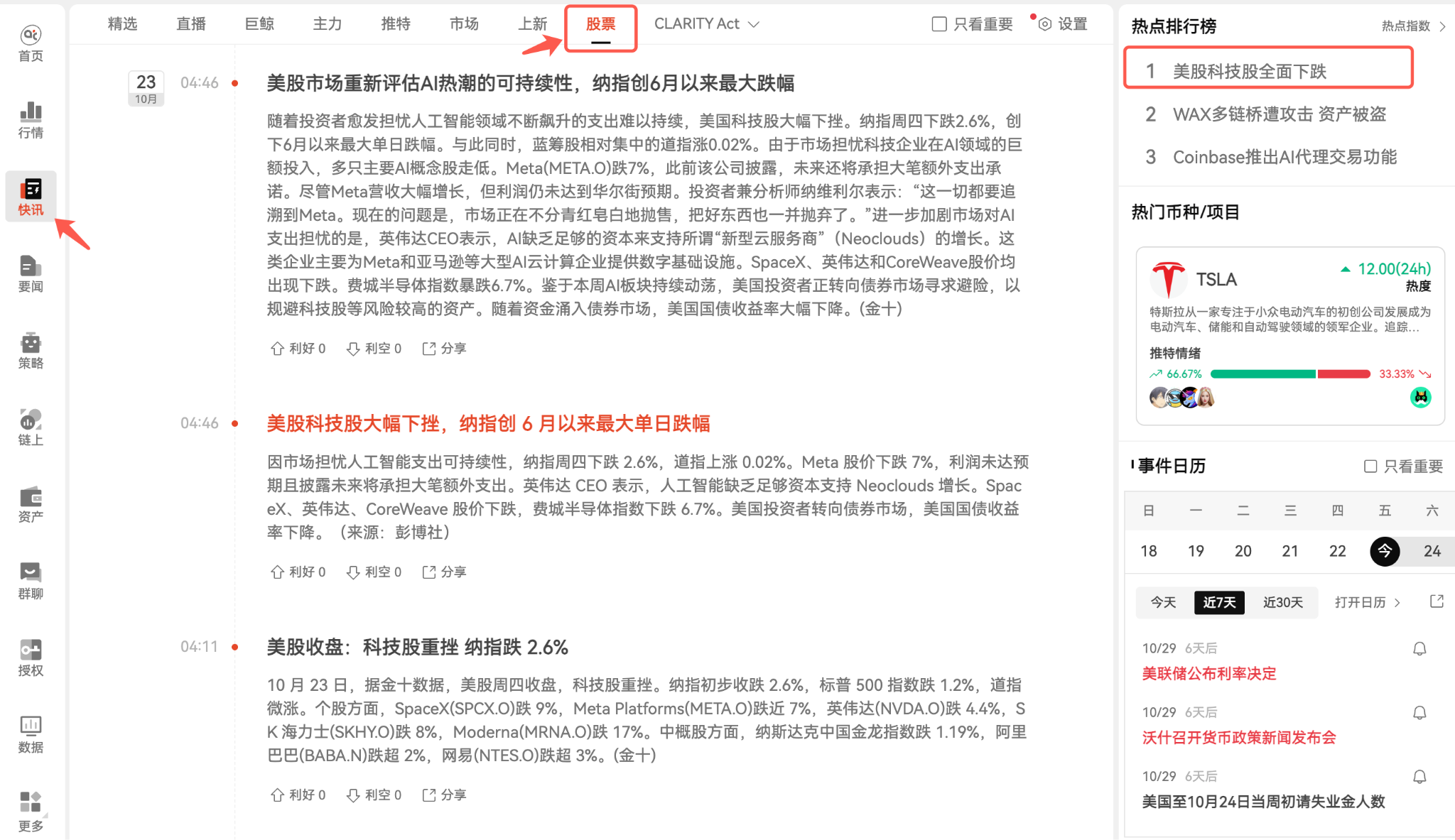
This latest drop has brought a question back to the forefront: How long can the AI investment boom last? When the market begins to reassess the inputs and returns of technology companies, how much impact will it have on Bitcoin?

In the coming week, earnings reports from companies like Microsoft, Google, and Amazon will be released, and the Federal Reserve will also announce its interest rate decision. The U.S. GDP and PCE inflation data will also be closely watched. Several key events occurring at once could affect the market's judgment regarding the AI industry's prospects, interest rate path, and risk appetite.
1. Nasdaq falls 2.6% in one day, what exactly is the market worried about?
U.S. tech stocks faced a heavy blow. The Nasdaq fell 2.6% on Thursday, marking the largest single-day drop since June; the Dow Jones Industrial Average was basically flat, rising by only 0.02%. The focal point of market concern is whether the increasing investments in the AI sector can be sustained and when these investments will translate into profits and cash flow.
1. Meta's earnings report raises concerns: Revenue grows, but stock price falls
Meta's stock price fell by about 7%. Despite a significant increase in revenue, profits did not meet Wall Street's expectations, and the company will also incur substantial additional spending commitments in the future, exacerbating market doubts about the returns on AI investments.
Investors were previously willing to pay a premium for the growth prospects of AI, but as investments in data centers, chips, and computing power continue to rise, the market begins to question: Can revenue keep pace with spending? How long will it take to recoup these investments?
Believing in the long-term prospects of AI does not mean any price is worth buying in. When market expectations are already very high, if increased spending does not lead to corresponding profits, stock prices may come under pressure.
2. Sell-off spreads to chips and AI infrastructure
On October 22, AMD and Intel both fell by about 8.1%, Nvidia dropped by approximately 4.4%, and Micron Technology fell by about 6.3%. The Philadelphia Semiconductor Index plummeted by 6.7%. Related companies like SpaceX and CoreWeave also saw their stock prices decline.
Nvidia's CEO's statements regarding financing and capital support for new cloud service providers (Neoclouds) have also made the market pay more attention to the funding needed for AI infrastructure expansion.
These companies provide computing power and cloud infrastructure to large tech firms. If financing pressures rise, or if clients slow their investments, the impact may propagate along the supply chain.
Therefore, moving forward, it is important not only to look at whether AI orders are growing but also to observe whether capital expenditures, financing ability, and cash flow can support sustained expansion.
3. Funds shifting to U.S. Treasuries, market risk appetite cools
As tech stocks declined, some U.S. investors turned to government bonds for safety, driving U.S. Treasury yields significantly lower.
This indicates that the market is reducing its exposure to high-risk assets. However, a drop in Treasury yields does not necessarily mean that tech stocks will immediately rebound; it remains to be seen whether this reflects an increase in risk aversion or a change in market expectations regarding future interest rate paths.
In the coming days, spending plans of large tech companies like Meta, earnings reports from the AI supply chain, as well as inflation and interest rate data, will all impact the market's judgment on this round of AI investment enthusiasm.
2. With U.S. stocks falling, will BTC drop too?
On October 22, U.S. tech stocks dropped significantly, and BTC also fell from nearly $85,000 to around $82,000.
There is indeed a correlation between the two, but they do not always move in sync. When the market is worried about inflation, rising interest rates, or tightening liquidity, investors may simultaneously reduce their holdings in tech stocks and crypto assets.
However, BTC is also influenced by its own factors, such as the flow of funds from spot ETFs, market leverage, and the supply and demand in the crypto market. Therefore, even if U.S. stocks decline, BTC may still resist declines relative to them; conversely, if U.S. stocks stabilize, BTC may not immediately rebound.
To judge the movements of both, three signals can be focused on:
- The Nasdaq's performance: Is it a temporary correction or a sustained decline that spreads to other sectors?
- The macro environment: Have expectations for interest rates, inflation, and the dollar changed?
- The flow of funds and price of BTC: Is trading volume increasing, are leverage liquidations rising, and how is ETF fund flow?
For newcomers, do not assume BTC will necessarily follow a decline just because the Nasdaq is falling. First observe the overall risk sentiment in the U.S. stock market, then combine it with BTC's own price and capital changes for a more accurate understanding of market conditions.
3. Outlook for next week's market: Key financial reports, interest rates, and economic data
From October 26 to 30, the market will enter a week filled with information.
Earnings reports from the storage and semiconductor supply chain, results from large tech companies like Microsoft and Google, the Federal Reserve's interest rate decision, as well as U.S. GDP and PCE inflation data, could all influence the market's judgment on tech stocks, interest rates, and risk assets.
1. Storage industry: Can AI demand continue to be realized?
Next week, companies in the storage supply chain like Seagate Technology (STX), SK Hynix (SKHY), and SanDisk (SNDK) are set to release their earnings. The specific disclosure times should be based on company announcements.
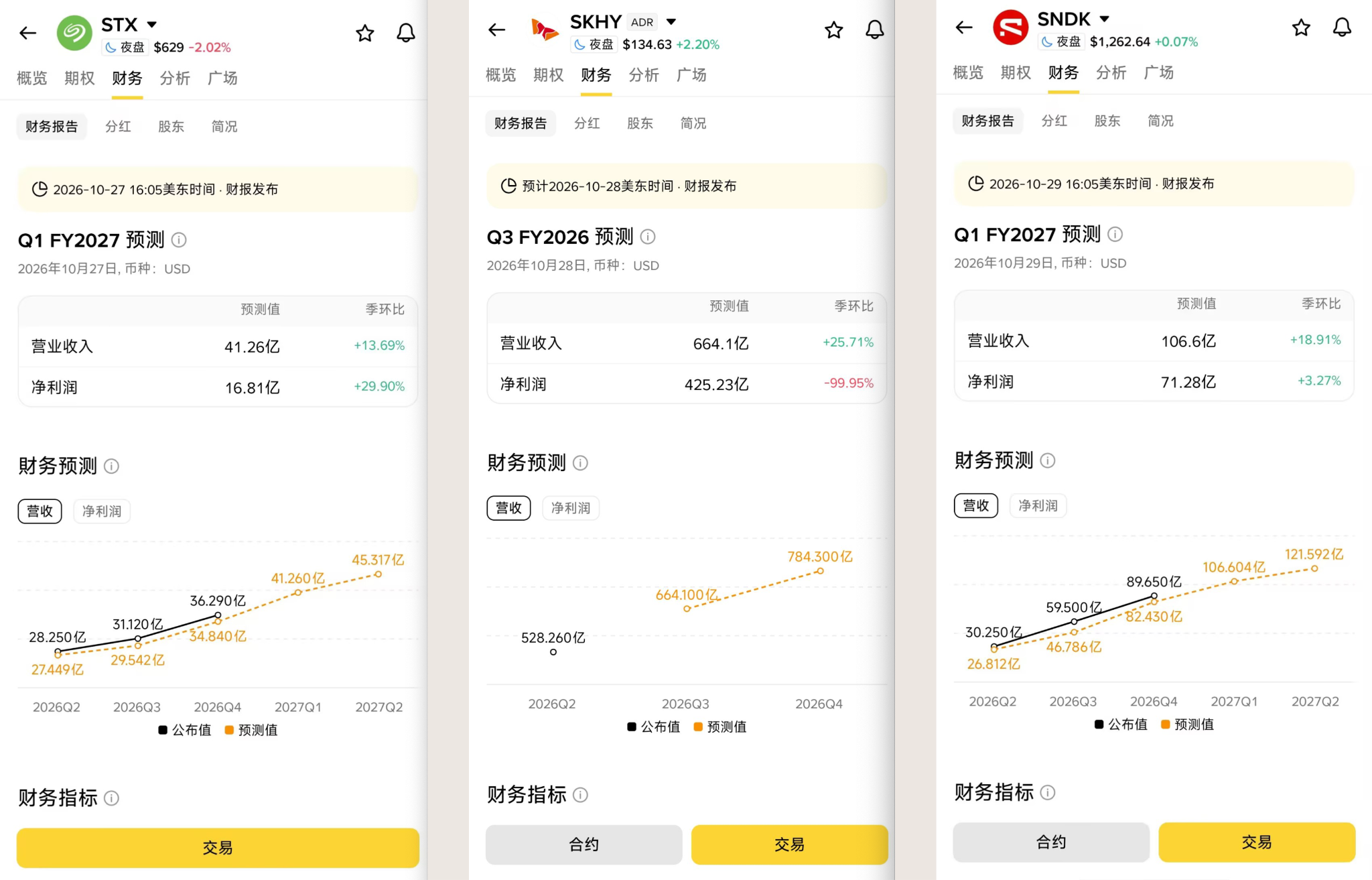
These earnings reports are worth observing together, as storage demand is closely linked to AI server construction, data center expansion, and enterprise-level hardware investments.
Key focus areas include enterprise-level storage demand, product prices, gross margins, and future orders. If earnings and guidance both strengthen, it will help validate the demand for AI infrastructure; if profit margins or future outlooks fall short of expectations, related stocks may still experience a correction.
2. Microsoft and Google: Can AI investments translate into revenue?
Microsoft (MSFT) and Google's parent company Alphabet (GOOGL) are set to announce their earnings after the U.S. stock market closes on October 28.
The earnings reports from both companies will provide an important window to observe cloud business performance, commercialization of AI products, and capital expenditures.
For Microsoft, attention can be given to Azure cloud business growth, demand for AI services, and whether increased capital expenditures lead to corresponding revenue and cash flow.
For Google, one can observe the growth of Google Cloud, the impact of AI on search and advertising, and how the company balances investments in AI infrastructure with profitability.
The common question for both companies is: As AI investments grow, can revenue and cash flow keep pace? If spending continues to climb without seeing commercial returns, market concerns over the valuation of tech stocks may intensify.
3. Federal Reserve decision: How does the market interpret the interest rate path?
The Federal Reserve will announce its decision on October 28 in the afternoon EST (early morning October 29).
Along with the interest rate decision, attention should also be paid to the Federal Reserve's comments on inflation, economic growth, and subsequent policies.
If the market lowers its expectations for rate cuts, high-valuation tech stocks and BTC may face pressure; if policy signals are milder than expected, risk assets may find support.
4. GDP and PCE: Can economic growth and inflation be balanced?
On October 29, the U.S. will release the initial GDP estimate for the third quarter and the personal income and expenditure data for September, including the PCE inflation indicator that the Federal Reserve pays attention to.
GDP reflects economic growth, while PCE helps assess inflationary pressures. If economic growth is strong but inflation remains high, the market may worry that interest rates will stay elevated; if inflation cools, it could ease policy pressures.
When looking at the data, do not just focus on the absolute numbers; compare actual results with market expectations. This often determines how the stock and crypto markets react after the data is released.
5. Companies like Amazon, Intel, Coinbase: Observation scope extends beyond AI
Next week, companies such as Amazon (AMZN), Intel (INTC), and Coinbase (COIN) are also set to publish earnings, with specific times based on company announcements.
For Amazon, observe the AWS cloud business and AI investments; for Intel, focus on product demand and manufacturing progress; for Coinbase, watch for trading activity and related business revenues.
Coinbase's earnings can provide insights into the operating status of crypto trading platforms, but they cannot directly be used to judge BTC's rise or fall. Combining earnings reports, macro data, and actual price movements will lead to a more comprehensive assessment.
4. What to focus on in next week's market?
Next week will be event-rich, with three key things to watch:
First, whether AI investments can be realized. Earnings reports from Microsoft, Google, and the storage supply chain will test if AI demand can translate into actual revenues.
Second, how interest rate expectations change. The Federal Reserve's decision, GDP, and PCE data could influence tech stock valuations and market risk appetite.
Third, whether BTC has its own capital support. Observe price, trading volume, and fund flows to determine if BTC fluctuates alongside U.S. stocks or is influenced by factors inherent to the crypto market itself.
For newcomers, there is no need to rush to judge rises and falls. First, look at the gap between data and market expectations, then observe how prices react to gradually build your own judgment framework.
Conclusion
Next week, earnings reports from tech giants, interest rate decisions, and inflation data will be concentrated. While paying attention to U.S. stocks, one can also monitor BTC's movements to see if there are changes in the correlation between the two markets.
If you want to understand both the U.S. stock market and the crypto market at the same time, you can start by familiarizing yourself with market trends and trading tools. If you don't have a Binance account yet, you can register through the link below to learn about the U.S. stock-related assets and trading methods supported by the platform.
👉 Click the link to register on Binance:
https://jump.do/zh-Hans/xlink-proxy?id=3
(Invitation code: aicoin668, enjoy 10% rebate)

For specific products, trading rules, and available regions, please refer to what is actually displayed in the Binance App.
During market fluctuations, there is also no need to rush to enter the market. If there are temporarily unused funds in your account, you can further explore the related financial products offered by Binance, comparing yield rules, redemption conditions, and risks before deciding if they are suitable for you.

Join our community to discuss and become stronger together!
Official Telegram community: https://t.me/aicoin_support
AiCoin Chinese Twitter: https://x.com/AiCoinzh
Binance Benefits Group: https://www.aicoin.com/link/chat?cid=gmLgwvKD1
Risk Disclaimer: Investing in U.S. stocks still requires one to bear market risks, regulatory risks, and local legal compliance risks (especially foreign exchange controls, overseas investment reporting, etc.). This article is intended for the sharing of market information and does not constitute investment advice. Both stocks and crypto assets involve risk, and financial products may also result in principal losses. The crypto market is highly volatile; please participate within your own risk tolerance.
免责声明:本文章仅代表作者个人观点,不代表本平台的立场和观点。本文章仅供信息分享,不构成对任何人的任何投资建议。用户与作者之间的任何争议,与本平台无关。如网页中刊载的文章或图片涉及侵权,请提供相关的权利证明和身份证明发送邮件到[email protected],本平台相关工作人员将会进行核查。