Author: AiPlot Research Institute
Focus: RWA / Digital Assets / In-depth Analysis of Financial Infrastructure
Website: https://aiplot.com/?utm_source=aicoin
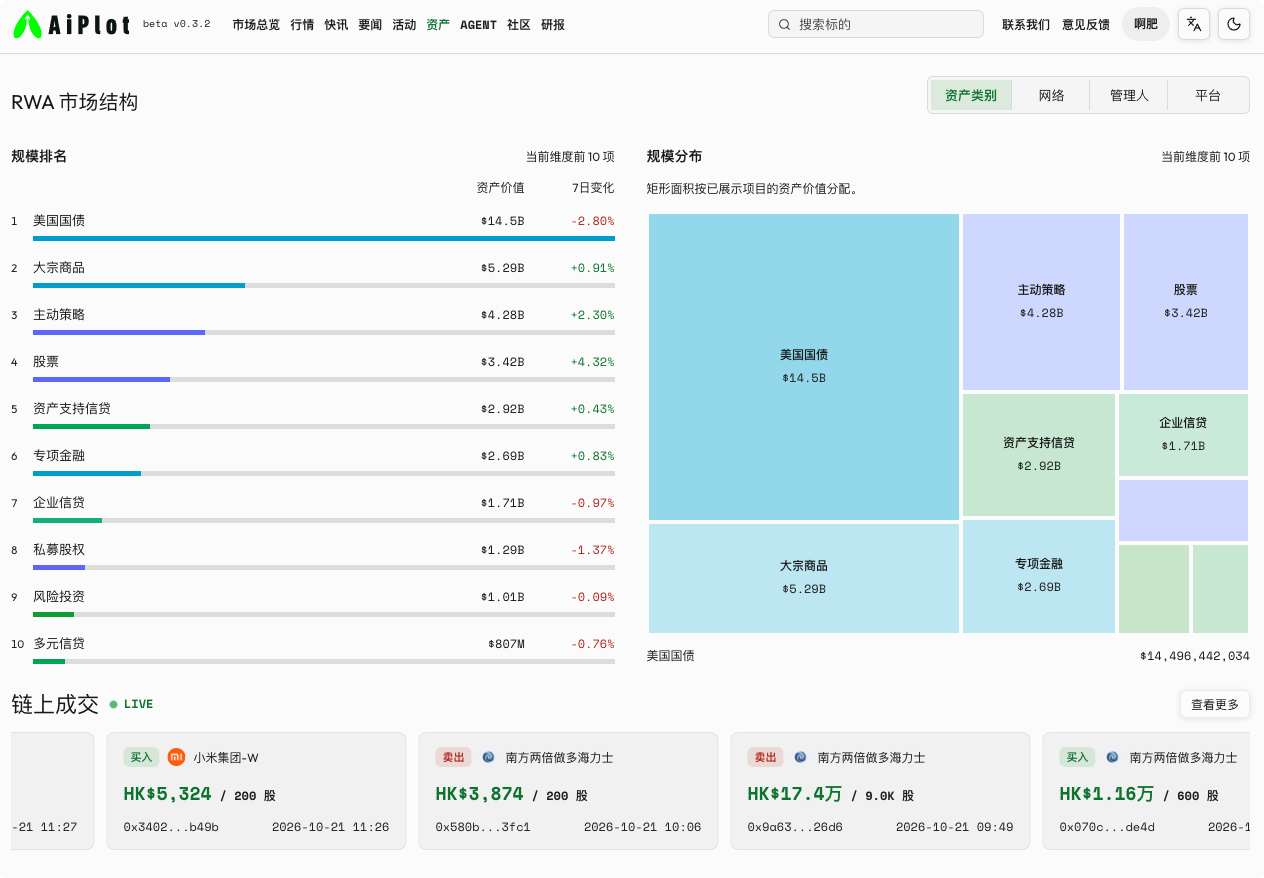
The narrative of RWA has mainly revolved around one question in the past: how to bring real-world stocks, bonds, gold, and real estate onto the blockchain, allowing more people to hold these assets.
However, the latest on-chain derivatives data is raising a different question:
What the market truly needs may not be long-term holding of stocks after tokenization, but rather enabling these assets to be traded 24 hours a day, 7 days a week, with leverage.
On October 20, information on X stated that the open interest in RWA perpetual contracts has reached approximately 5.64 billion USD, accounting for about 42.7% of the total open interest in all DeFi perpetual contracts, which is 13.2 billion USD.
The most noteworthy aspect of this figure is not just the size but the growth speed. RWA perpetual contracts were nearly nonexistent a year ago and now account for close to half of the DeFi perpetual market. The key infrastructure driving this change is HIP-3, launched by Hyperliquid on October 13, 2025.
This means that the next phase for RWA may not be "increasing the number of on-chain stockholders," but rather "increasing on-chain stock trading volume and leverage demand." The first large-scale application of tokenized stocks may not be digital holding certificates but a year-round global derivatives market.
1. What Does 5.64 Billion USD in Open Interest Mean?
Open interest represents the nominal value of leveraged positions that still exist in the market. It is not the market value of assets, nor cumulative trading volume, much less net inflow.
For example, if a trader opens a long position with a nominal value of 1 million USD, and another party opens a corresponding short position, the market's open interest may increase by 1 million USD. After these two positions close, the open interest decreases, but during that time, millions of dollars in trading volume may have been generated.
Therefore, the 5.64 billion USD in RWA perpetual contract open interest accurately expresses that a significant amount of funds in the market are establishing directional or hedging positions around real assets such as stocks, gold, and oil. It does not mean that 5.64 billion USD of actual stocks or commodities have already been purchased and custodied on-chain.
This distinction is crucial. Spot RWA focuses on ownership, custody, and redemption of underlying assets; RWA perpetual contracts focus on price volatility, margins, funding rates, and clearing mechanisms. The former resembles an asset registration system, while the latter resembles a trading system.
From the perspective of investment demand, the growth of RWA perpetual contracts indicates that users may be more concerned with three functionalities:
First, gaining long and short exposure to stock or commodity prices. Second, continuing trading during traditional market closures. Third, magnifying nominal positions with reduced margin.
This is entirely different from the desire of "I want to truly hold a stock."
2. Why HIP-3 Can Propel RWA Trading
Hyperliquid officially defines HIP-3 as Builder-deployed perpetuals, meaning perpetual contract markets created and operated by independent deployers.
Before HIP-3, trading platforms had to decide for themselves which markets to launch. HIP-3 hands over some market creation rights to external Builders. As long as the staking and protocol rules are met, deployers can create their own perp DEX and be responsible for market definitions, price oracles, leverage limits, contract specifications, and settlements when necessary.
Hyperliquid's official documentation shows that HIP-3 deployers need to stake 500,000 HYPE. Each perp DEX has independent margins, order books, and deployer settings. Deployers can also set additional fee-sharing.
The significance of this structure is that Hyperliquid does not need to establish a complete product team for every stock, commodity, and index. It provides the core matching, margin, and settlement infrastructure, while external teams are responsible for packaging new real assets into tradable contracts.
Hyperliquid is more like AWS rather than just an exchange with a fixed product menu. AWS does not need to develop each application personally, just provide the infrastructure; similarly, Hyperliquid does not need to design every market but allows Builders to deploy markets on its order book and settlement system.
This explains why RWA perpetual contracts can expand rapidly: the supply side is no longer decided by a single trading platform, and the speed of asset listing and product innovation is amplified by external Builders.
3. Why Equity Assets Surpass Gold and Oil
The open interest in stock-based RWA perpetual contracts has already surpassed that of gold and oil.
This seems somewhat counterintuitive. Gold and oil are the most traditional macro trading commodities, with mature futures and contract-for-difference markets; meanwhile, the demand for tokenized stock spots has not formed the same intensity of holding demand among crypto-native users.
However, if we replace the product from “spot stocks” to “stock perpetual contracts,” the demand becomes easier to understand.
Stock perpetual contracts can turn Nvidia, Tesla, Apple, SpaceX, or the Nasdaq index into collateralized trading objects with stablecoins. Users do not need to leave their on-chain accounts and do not have to wait for the US securities markets to open. As long as there is a price oracle, margin, and clearing mechanism, traders can establish long and short positions on weekends or during US nighttime.
This is attractive to two types of users.
Crypto traders are accustomed to trading BTC and ETH 24/7. For them, stock perpetual contracts offer another source of volatility without the need to switch back to traditional brokerage accounts.
Traditional financial traders may value trading hours and capital efficiency. After US stock market closes, if there is company news, macro data, or geopolitical changes, the traditional spot market cannot trade immediately, but on-chain perpetual contracts can still provide pricing expression tools.
Therefore, the advantage of stock-based RWA perpetual contracts is not necessarily that they are “closer to real stocks,” but rather that they “bring the price volatility of stocks into the trading hours and margin system that originally belong to the crypto market.”
4. High Market Concentration, RWA Perps Are Not Yet a Mature Multicenter Market
The size of 5.64 billion USD seems large, but data on deployers provided by Andrew Moh reveals another fact: this market is highly concentrated.
The open interest for TradeXYZ's RWA perpetual contracts is approximately 3.82 billion USD, accounting for about 68% of the entire RWA perpetual market. Variational is about 824.5 million USD, QFEX is about 268.2 million USD, and the scale of other platforms further declines.
The top ten platforms combined account for about 5.53 billion USD, making up approximately 98% of RWA perpetual contract open interest. In other words, although the market is permissionless on the protocol level, it still relies on a very few deployers for actual liquidity.
This leads to two judgments.
First, the current growth of RWA perpetual contracts may largely be the result of a few leading platforms rapidly expanding rather than the entire industry growing uniformly. If TradeXYZ's oracle, product rules, or risk management encounters problems, the entire sector may be affected.
Second, market concentration can enhance liquidity but also amplify single-point risks. Leading platforms possess deeper order books and stronger market-making abilities, attracting more traders; however, if their price sources or clearing rules deviate, the impact will also be broader.
Hyperliquid’s official documentation emphasizes that HIP-3 deployers are responsible for price oracles and may suffer reductions in their staking due to serious market manipulation issues. This indicates that the core risk of RWA perpetual contracts does not only reside in the underlying blockchain but in each specific market's external price sources and product designs.
5. OI Growth Does Not Equal RWA Spot Asset Growth
This is where misunderstandings about this market are most likely to arise.
If the open interest of RWA perpetual contracts reaches 5.64 billion USD, it should not be directly concluded that “there are already 5.64 billion USD of stocks and commodity assets on-chain.” Perpetual contracts can be cash-settled products, meaning traders only need margin and do not need to hold an equivalent amount of underlying stocks.
This creates a structural distinction:
- The core indicators of spot RWA are the scale of tokenized assets, custodial assets, holders, redemptions, and transfers;
- The core indicators of RWA Perps are open interest, trading volume, funding rates, liquidation volume, margin, and oracle quality.
Both use the RWA narrative, but their value chains are not the same.
The growth of spot tokens indicates that users are willing to have and hold exposure to certain real assets. The growth of perpetual contracts indicates that users are willing to trade price volatility. The former leans towards asset financialization, while the latter leans towards market financialization.
Therefore, one cannot conclude that a particular stock token does not have on-chain demand simply because its number of spot holders is low. Users may not be willing to hold tokens long-term but may be willing to trade their prices with leverage during significant earnings reports, macro data releases, or market fluctuations.
The demand may never have been to own tokenized stocks but rather to engage in leverage and all-weather trading around stocks.
6. Hyperliquid Obtained Liquidity, But Not All Value
The growth of RWA Perps is a clear product success for Hyperliquid but does not only have positive implications for the platform's economic model.
According to CoinDesk's analysis, HIP-3 Builder-deployed markets accounted for about 2% of Hyperliquid's perpetual trading volume at the beginning of 2026, rising to about half thereafter. During this period, Hyperliquid's trading activity and open interest grew, but the platform's quarterly total revenue fell from about 356.66 million USD in the third quarter of 2025 to about 201.84 million USD in the second quarter of 2026.
Market data shows that Hyperliquid's 30-day perpetual contract trading volume is approximately 208.59 billion USD, with fees of about 84.96 million USD and revenue of approximately 68.35 million USD. The page defines Perp Volume as the nominal amount of all perpetual trades including leverage and distinguishes Revenue from fee-sharing, Builder fees, and other protocol items.
This indicates that trading volume is not synonymous with platform revenue.
The mechanism of HIP-3 allows external deployers to obtain fee-sharing. Therefore, the platform gains more markets, more liquidity, and stronger network effects, but not every dollar of trading fees necessarily remains at the protocol level. As the share of Builder markets increases, Hyperliquid may experience a seemingly contradictory situation:
The more prosperous the market, the greater the market infrastructure and risk management responsibilities borne by the platform, but the net value capture per unit of trading activity may decline.
For HYPE value capture, it is necessary to observe perpetual trading volume, protocol revenue, Builder share, cost income, buyback amount, and open interest simultaneously, rather than only focusing on the single growth curve of RWA open interest.
7. The Core Risk of RWA Perpetual Contracts Is Not Volatility, but How Price Is Defined
Crypto-native assets have continuous on-chain trading prices. Stocks, oil, indices, and Pre-IPO companies require external price sources. Whether a RWA perpetual contract operates normally depends first on how it defines “current price.”
Hyperliquid's official documentation points out that HIP-3 deployers can design price oracles, but deployers need to carefully select underlying data sources that are economically meaningful and hard to manipulate.
This leads to four specific risks.
The first is distorted trading hours. US stocks are closed on weekends, but Token Perps still trade. Whether price changes during weekends are an early reflection of new information or merely price noise in a low liquidity environment needs to be handled with clear mark prices and funding rate mechanisms.
The second is insufficient underlying market liquidity. A single trade in a small overseas market may cause significant price changes in an associated RWA Perp, triggering on-chain liquidation. CoinDesk once reported that TradeXYZ's SK Hynix contract fell about 19% due to a trade in Korea's weak pre-market, triggering liquidation, after which the parties involved agreed to make compensation.
The third is the disconnect between cash settlement and underlying assets. Many traders do not own stocks and do not deliver stocks to the counterparty. Final settlement relies on price indices and margin accounts, not the stocks themselves. This makes the product resemble a derivative rather than a tokenized stock.
The fourth is the risk amplified by leverage. A spot token, even if it drops, typically does not trigger automatic liquidation; perpetual contracts, however, may be forcibly closed due to insufficient margin. In high-leverage and low-liquidity environments, price fluctuations, liquidations, and funding rates may amplify each other.
8. The Next Phase for RWA May Be “Tradeability First”
Past RWA products were often organized by asset class: tokenized government bonds, tokenized funds, tokenized stocks, tokenized gold.
But RWA Perps demonstrate another product organization approach: organizing assets by trading behavior. Users may not care about which legal form of token they are trading but are more concerned whether the market has sufficient volatility, liquidity, leverage, and trading hours.
This will drive issuers and trading platforms to make different choices.
They may prioritize launching markets with high visibility, obvious volatility, and frequent news, rather than prioritizing the assets that are best suited for long-term holding. The appeal of SpaceX, Nvidia, Tesla, and index products may lie precisely in their strong market narrative and continuous price fluctuations.
This also indicates that RWA competition does not only occur among issuers but also among trading entries. Whoever can provide a better order book, oracle, funding rate, leverage parameters, and clearing protection can potentially gain trading liquidity.
From this perspective, the core competitive advantage of RWA is shifting from “can assets be put on-chain” to “can assets form a continuous, credible, and controllable market on-chain.”
Conclusion: RWA May First Become Trading Infrastructure, Then Ownership Infrastructure
The open interest of RWA perpetual contracts reaching 5.64 billion USD, accounting for about 42.7% of the DeFi perpetual market, indicates that real assets have become an important source for on-chain trading.
But this does not mean that on-chain users suddenly began to hold large amounts of tokenized stocks long-term. A more accurate explanation is: the market has discovered that the prices of stocks and commodities can be traded on-chain around the clock, and they can also be combined with stablecoin collateral and leverage mechanisms.
The significance of HIP-3 lies in its transformation of this demand into a scalable market creation mechanism. Hyperliquid provides matching and settlement infrastructure, Builders provide assets, oracles, and product rules, while traders turn traditional assets into 24/7 long and short trading objects.
This is an important financial innovation, but it also brings new risks. The open interest of RWA perpetual contracts is not the market value of underlying assets, trading volume is not net inflow, and the position size does not equal stock ownership. What truly determines whether the market can develop long-term is whether the price oracle is reliable, whether the clearing system is robust, whether the Builder is overly concentrated, and whether trading growth can be converted into sustainable protocol revenue.
Therefore, the next phase for RWA may follow a path different from the early assumptions:
First turn real assets into on-chain tradable prices, and then gradually develop into on-chain holdable, combinable, and financeable ownership.
If this judgment holds true, then the core of RWA competition will no longer just be “who issued how many tokens,” but “who established the deepest, most stable, and most transparent real asset trading market.”
For more data and analysis, please follow Aiplot:
https://aiplot.com/?utm_source=aicoin
📖 Community Communication:
Telegram:
https://t.me/+IIYMcJigBAo4Mjg1
The content of this article represents only the author's personal views and does not reflect the position of this platform. The views, conclusions, and suggestions in this article are for investors' reference only and do not constitute any investment advice related to this platform. The market has risks, and investments should be made with caution.
免责声明:本文章仅代表作者个人观点,不代表本平台的立场和观点。本文章仅供信息分享,不构成对任何人的任何投资建议。用户与作者之间的任何争议,与本平台无关。如网页中刊载的文章或图片涉及侵权,请提供相关的权利证明和身份证明发送邮件到[email protected],本平台相关工作人员将会进行核查。