Author: AiPlot Research Institute
Focus: RWA / Digital Assets / In-depth Analysis of Financial Infrastructure
Website:https://aiplot.com/?utm_source=aicoin
Elon Musk said he wants to "give every child in America a share of SpaceX" next year. Based on the approximately 72 million people under 18 in the United States and a reference stock price of about $146, the nominal value of this plan would correspond to approximately $10.5 billion.

From a timing perspective, there's still time to prepare for pregnancy!
What is SpaceX currently worth? If you hold one share of SPCX today, how much can it earn if SpaceX's future value rises to $2.5 trillion, $3 trillion, or even $5 trillion?
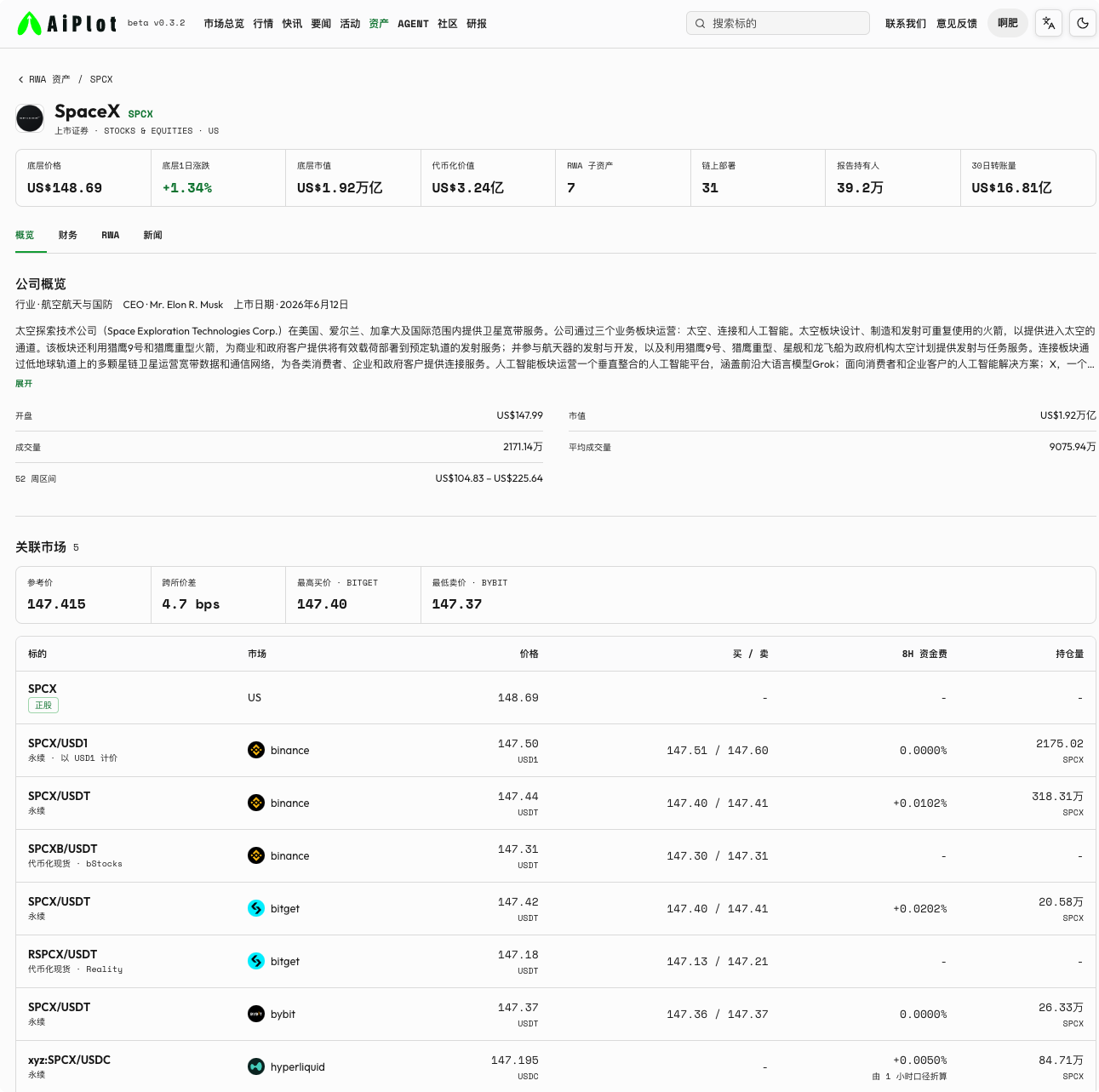
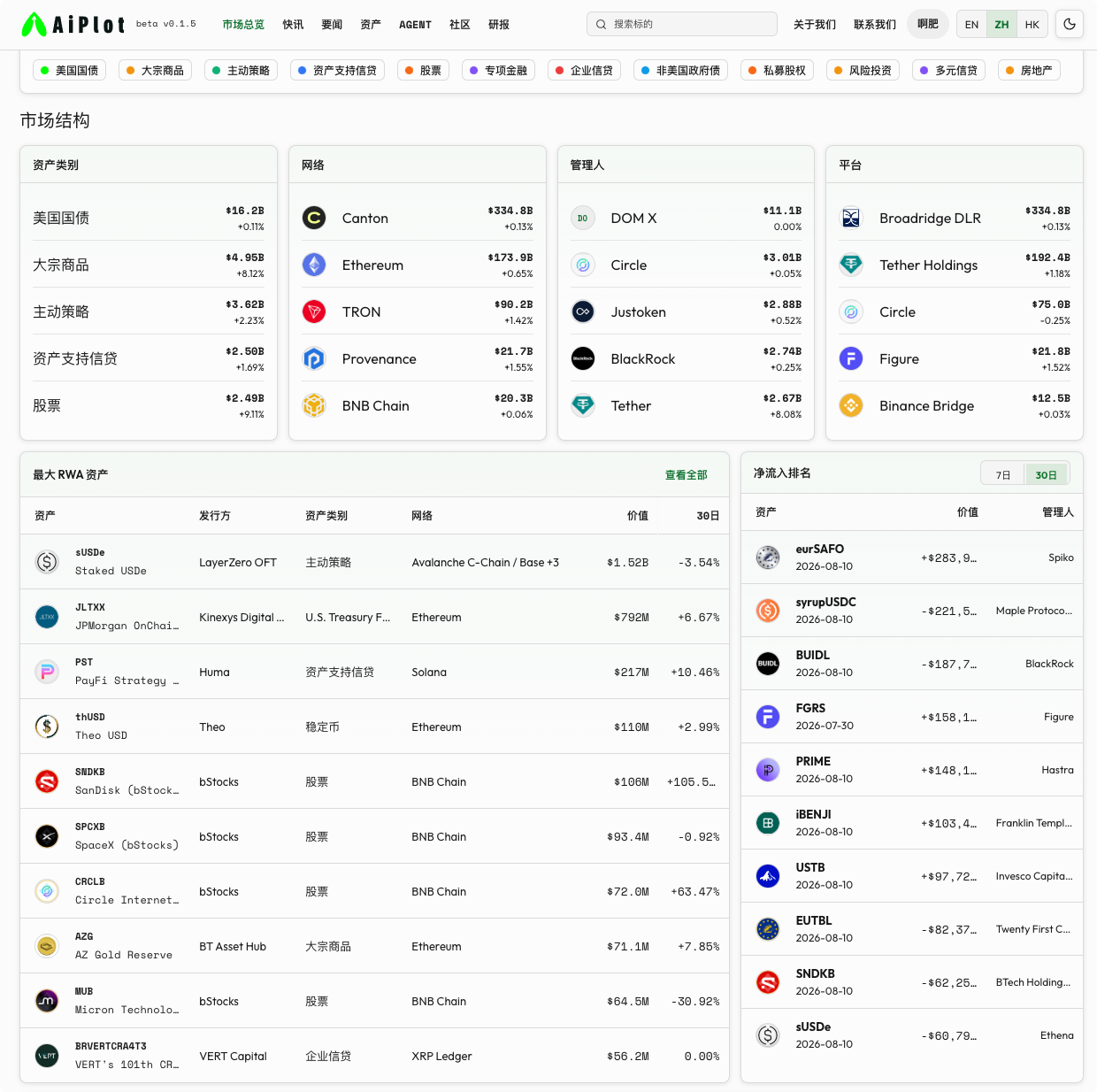
AiPlot data reality, October 19, 2026: The underlying price is approximately $148.69, the underlying market value is approximately $1.92 trillion, the tokenized value is approximately $323.72 million, with 7 RWA sub-assets and about 392,000 report holders, and a 30-day transaction volume of approximately $1.68 billion.
This article divides the valuation earnings into three parts:
- What does SpaceX's current $1.92 trillion valuation imply;
- How much is one share of SPCX worth under different market cap scenarios;
- What investors truly own between the tokenized value and the underlying company value.
1. First, let's clarify: How much company value does one share of SpaceX represent?
AiPlot's latest data shows that the SPCX price is $148.69, with an underlying market cap of approximately $1.92 trillion.
By dividing the market cap by the price per share, we can backtrack to an implied share number of about 12.91 billion shares:
Implied share number ≈ $1.92 trillion ÷ $148.69
≈ 12.91 billion shares
This is not the fully diluted share capital officially disclosed by SpaceX, but rather an analytical framework derived from the prices and market values displayed on the AiPlot platform. Its function is to establish a unified calculation framework: if SpaceX's valuation changes in the future while the number of shares does not undergo significant changes, then the price per share will roughly vary in line with market cap changes year-on-year.
In other words, currently holding one share of SPCX means you are essentially holding a small exposure to an estimated $1.92 trillion valuation of SpaceX.
2. How much can one share of SPCX earn under different valuations?
The following calculations use the current price of $148.69 and an implied share number of about 12.91 billion shares as a baseline, not considering taxes, transaction fees, dividends, share dilution, tokenization platform fees, or liquidity discounts.
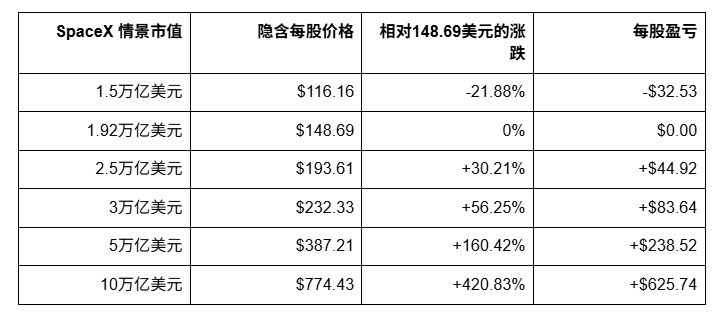
It answers the most direct question:
- If SpaceX's valuation grows from $1.92 trillion to $2.5 trillion, theoretically, each share would increase by about $44.92;
- If SpaceX reaches $3 trillion, each share would theoretically increase by about $83.64;
- If SpaceX reaches $5 trillion, each share would theoretically increase by about $238.52;
- If the valuation drops back to $1.5 trillion, each share could potentially lose about $32.53.
Therefore, the earnings from SPCX are not directly decided by "a word from Musk," but depend on whether SpaceX can convert its current high growth expectations into a higher company market cap in the future.
3. If every child in America actually gets a share, how much could they earn in the future?
According to CNBC, with an estimated 72 million American minors, if each child receives one share, based on the current price of $148.69, the nominal value each child would receive is approximately $148.69.
Under different valuation scenarios, the total value of 72 million shares would change as follows:
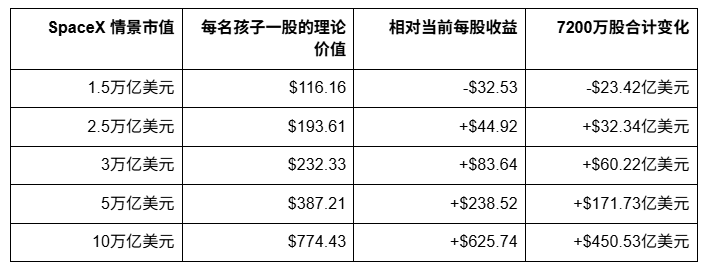
This also explains why "giving each child a share" has such viral potential: the absolute dollar amount of one share is not large, but if SpaceX continues to grow in the future, it could become a long-term tech asset to hold.
However, this is merely a scenario calculation of market cap and should not be understood to mean that each child will definitely be able to realize corresponding earnings. Actual earnings will also depend on whether the equity can be sold, if there are custodial restrictions, and whether future financing dilution or changes in equity categories occur.
4. What supports SpaceX's current valuation?
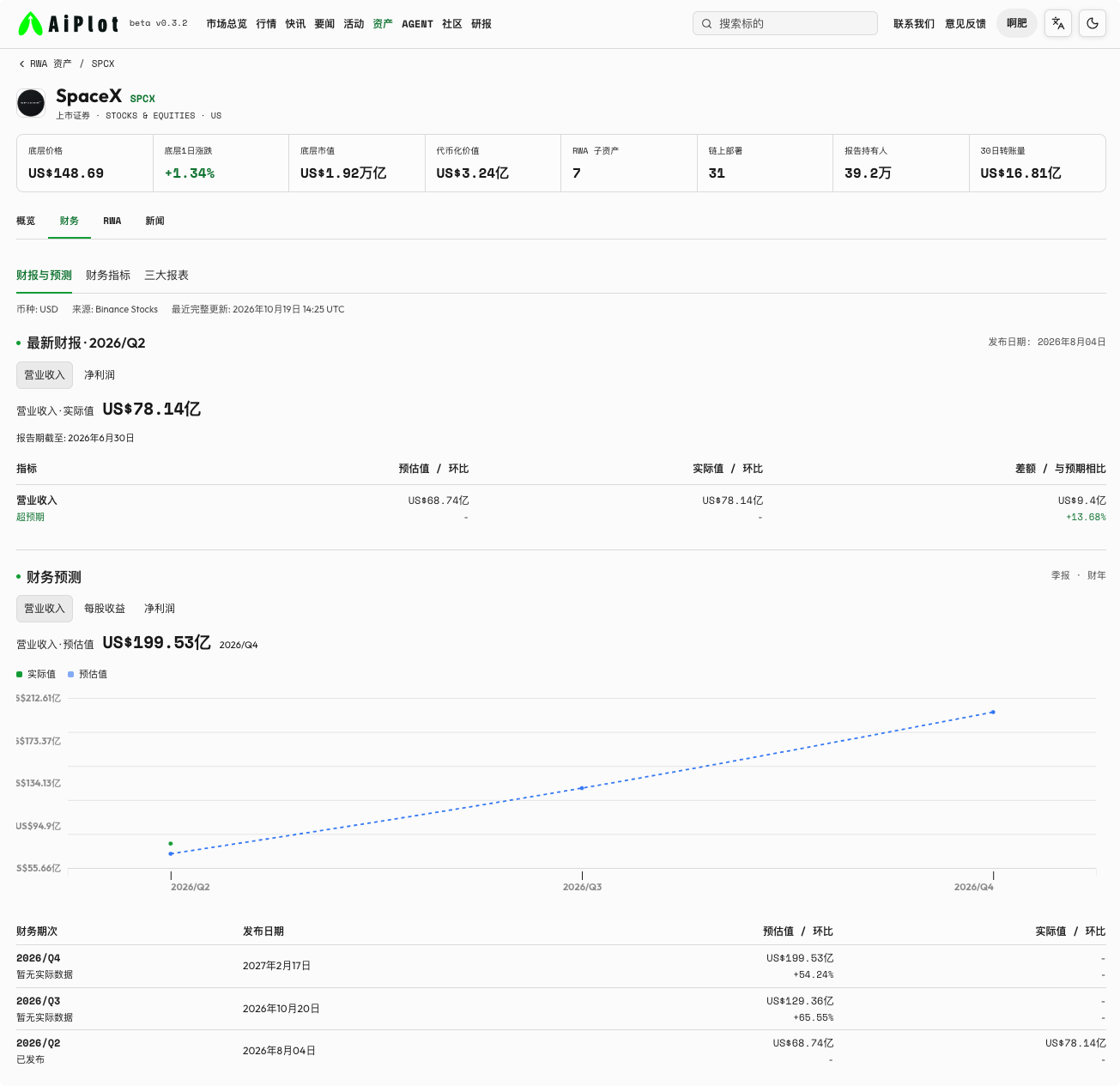
AiPlot data shows that SpaceX's revenue for the second quarter of 2026 is approximately $7.814 billion, exceeding market expectations of $6.874 billion by about $940 million, an overachievement of about 13.68%.
However, the revenue growth has not fully translated into profits:
- Net profit for Q2 2026 is approximately -$541 million;
- EPS is approximately -$0.09;
- ROE is around -0.64%;
- ROA is approximately -0.37%;
- Free cash flow is about -$15.95 billion.
Meanwhile, its revenue forecasts have noticeably accelerated:
- Estimated revenue for Q3 2026 is approximately $12.936 billion;
- Estimated revenue for Q4 2026 is approximately $19.953 billion;
- Estimated EPS for Q4 2026 is approximately $0.44;
- Estimated net profit for Q4 2026 is approximately $2.58 billion.
This set of data reveals the core contradiction of SpaceX's current valuation:
Revenue is growing very rapidly, but it is still in a state of loss and high capital investment; the market is not pricing today's profits but the leap in revenue, profits, and infrastructure status in the coming years.
If the revenue and profit forecasts for Q4 2026 are realized, the market will further believe that SpaceX is transitioning from a phase of heavy asset expansion to a phase of operational leverage release. Conversely, if revenue growth mainly relies on continued investment while cash flow remains negative for the long term, the $1.92 trillion valuation will take longer to be supported by fundamentals.
5. Is $1.92 trillion expensive or not?
Based on Q2 2026 single-quarter revenue of $7.814 billion, SpaceX's annualized revenue is approximately $31.256 billion. With a market cap of $1.92 trillion, the static price-to-sales ratio is approximately 61.4 times.
This multiple is very high, indicating that the market is not pricing SpaceX according to the revenue multiples of mature telecom or traditional aerospace companies. Investors are essentially paying for several types of future option values:
1. The value of Starlink's network infrastructure
If Starlink continues to expand into individual, corporate, maritime, aviation, and government customers, revenue may extend from satellite internet services to broader communication infrastructure.
2. Scale and cost advantages of launch services
If SpaceX can maintain launch frequency, reuse capabilities, and market share, the launch business may become a stable source of cash flow.
3. The combination of satellite networks with AI, cloud, and government demands
Starlink, satellite computing, and government communication demands could together form a new infrastructure market. The valuation space of this market is much larger than that of the pure rocket launch market.
4. Scarcity of private companies
SpaceX is currently not a typical publicly traded stock. The scarcity of private technology market-leading equity may itself obtain a liquidity premium and strategic investor premium.
Therefore, the $1.92 trillion valuation contains not only operational value but also scarcity and expectations of future capital market liquidity. The higher the valuation, the more it will need to be supported by real revenue and cash flow moving forward, rather than solely depending on the personal influence of the founder.
6. How big is the tokenized value of SPCX: still small in scale but widely distributed
AiPlot RWA page shows that the current tokenized value of SPCX is approximately $323.72 million, which is only about 0.0169% of the underlying market value of $1.92 trillion.
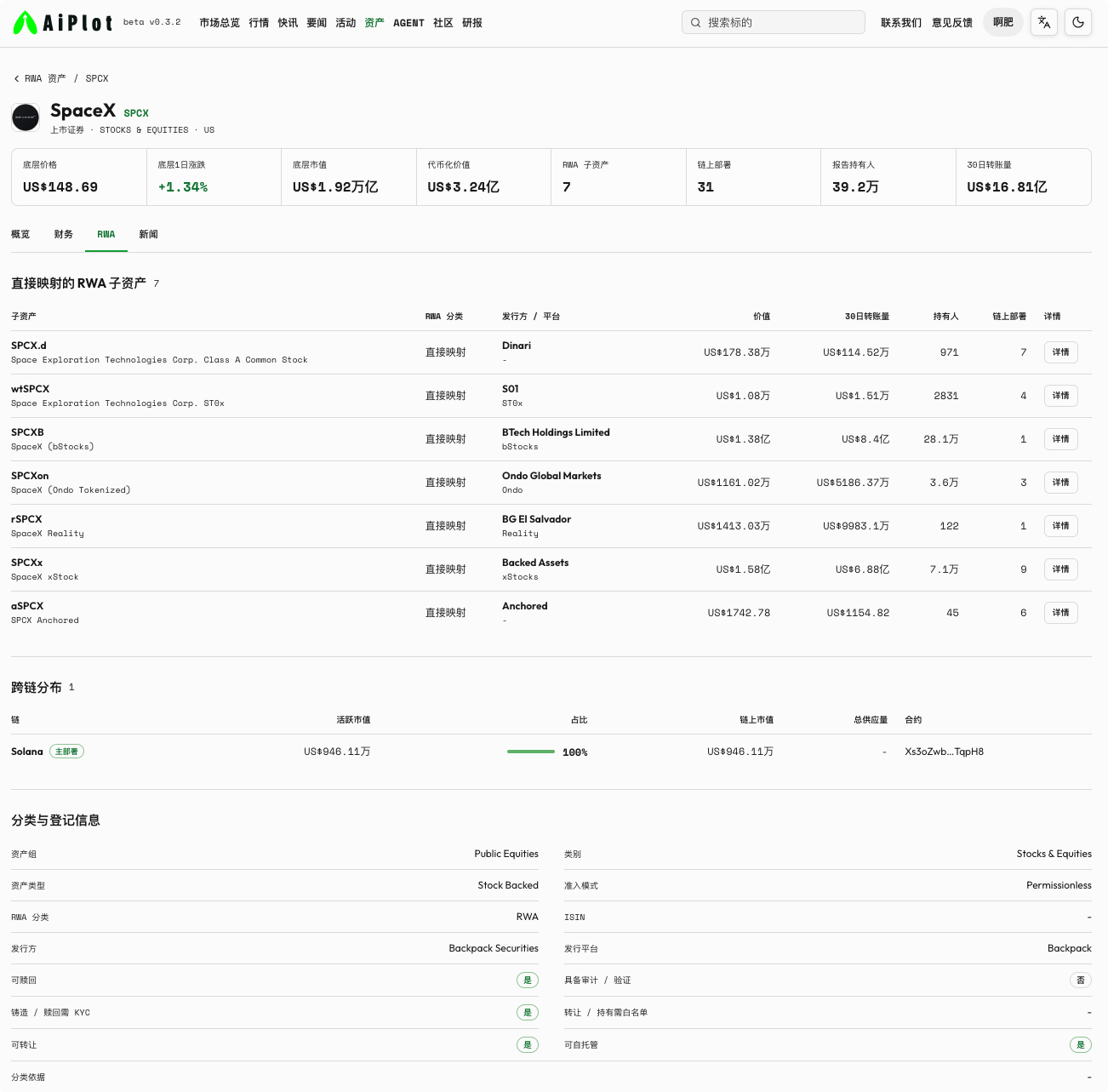
This means that the vast majority of SpaceX's underlying value has yet to enter the blockchain, and SPCX is currently more like a small-scale asset distribution and liquidity experiment, rather than a complete on-chain representation of SpaceX equity.
There are currently 7 directly mapped RWA products:
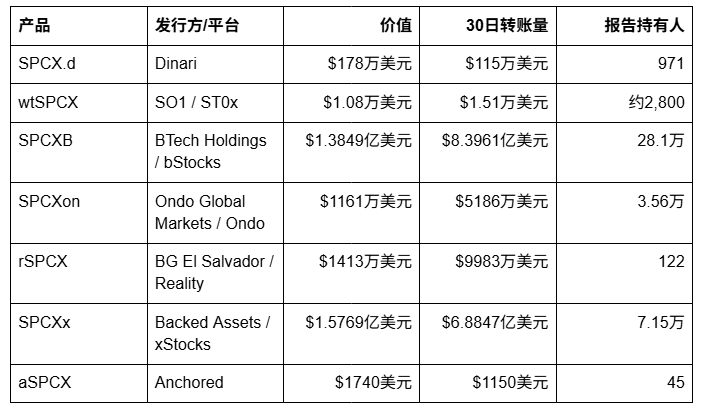
The data illustrates two facts.
First, the SPCX token market has multiple issuers, but the scale is highly concentrated in BTech's SPCXB and Backed Assets' SPCXx. Both together account for over 86% of the tokenized value listed on the page.
Second, the 30-day transaction volume of SPCX is approximately $1.68 billion, about 5.2 times the tokenized value. This indicates that the asset turnover is relatively active, but transaction volume cannot be directly understood as net inflow or the money investors ultimately earn. Transactions may include market-making, internal transfers between exchanges, cross-platform routing, and repeat trades of the same funds.
7. If becoming a shareholder of SPCX, where does the real money come from?
If an investor buys one SPCX representing a share of underlying economic exposure at $148.69, earnings mainly come from three parts.
First part: Capital gains from the increase in SpaceX's market value
This is the most direct source of earnings. If SpaceX's market value rises from $1.92 trillion to $3 trillion, the theoretical price per share would rise from $148.69 to about $232.33, yielding a book profit of about 56.25%.
But this assumes the number of shares remains unchanged. If the company issues more shares in the future, a large number of employee options are vested, or new financing causes dilution, the earnings per share would be lower than the simple year-on-year growth in market value.
Second part: Potential public market liquidity premium in the future
If SpaceX goes public, splits, or establishes a more open equity trading mechanism in the future, the market may offer a higher liquidity premium. The private equity discount may shrink, and the price discovery of SPCX may become more transparent.
However, an IPO is not a guaranteed event. Even if the company goes public, there may be lock-in periods, different share classes, and conversion issues between existing RWA products and publicly traded shares.
Third part: Dividends or other shareholder returns
Currently, SpaceX cannot be viewed as a stable dividend-paying asset. AiPlot platform data shows that it remains unprofitable and has negative free cash flow for Q2 2026. Therefore, the primary investment logic of SPCX at this stage is capital appreciation, not dividend income.
Although the page displays historical dividend records, such records need to be further confirmed to ensure they all correspond to the same underlying security, are part of the platform's standardized data, and can be extrapolated to the future. Just because the page has historical dividend fields does not mean SpaceX will continue to pay dividends.
Conclusion: SPCX is very attractive; are you ready to get pregnant?
Musk's statement about gifting shares has got the public thinking: if everyone could own a share of SpaceX, how much would they earn in the future? AiPlot quantifies this question further.
Under the current underlying valuation of $1.92 trillion and a price of $148.69:
- If SpaceX reaches $2.5 trillion, theoretical earnings per share would be approximately 30.21%;
- If SpaceX reaches $3 trillion, theoretical earnings per share would be approximately 56.25%;
- If SpaceX reaches $5 trillion, theoretical earnings per share would be approximately 160.42%;
- If SpaceX drops back to $1.5 trillion, theoretical loss per share would be approximately 21.88%.
The most valuable aspect to research about SPCX right now is not how big the $323.72 million tokenized market is, but how it is transforming an asset that only a few private investors could access into an investment exposure that ordinary users can discuss, compare, and calculate.
Hurry up and have kids!
For more data and analysis, please follow Aiplot:
https://aiplot.com/?utm_source=aicoin
📖 Community communication:
- Telegram:
https://t.me/+IIYMcJigBAo4Mjg1
The content of this article only represents the author's personal views and does not represent the stance of this platform. The opinions, conclusions, and suggestions in the article are for investor reference only and do not constitute any investment advice related to this platform. The market carries risks, and investment should be cautious.
免责声明:本文章仅代表作者个人观点,不代表本平台的立场和观点。本文章仅供信息分享,不构成对任何人的任何投资建议。用户与作者之间的任何争议,与本平台无关。如网页中刊载的文章或图片涉及侵权,请提供相关的权利证明和身份证明发送邮件到[email protected],本平台相关工作人员将会进行核查。