When the market discusses whether "Hyperliquid will launch options next," many people assume a traditional exchange mindset: first launch a complete options market, then add strike prices, expiration dates, volatility surfaces, and market-making rules.
However, the direction given by Jeff Yan on Bloomberg’s Odd Lots program is not simply about copying a traditional financial product list.

He said that Hyperliquid takes seriously the vision of "accommodating all finance," and even covering 90% of all finance would be a huge success; but he also emphasized that physical delivery still holds an important position in society, and Hyperliquid does not want to replace existing markets but hopes that this technology can also benefit traditional market operators.
More critically, in his view, perpetual contracts and futures with expiration dates are not the most essential distinctions. What truly matters is the order book clearing system, global distribution capability, and concentration of liquidity. The so-called "accommodating all finance" is more like a set of tools that can be combined rather than individually specifying the final products by Hyperliquid.
This provides a new perspective on understanding Hyperliquid:
It may not intend to become an exchange that puts all financial products directly on the shelf, but more likely wants to be a set of underlying primitives that allow developers to assemble financial products.
1. Traditional options are complex, not just because they have Calls and Puts
Ordinary people understand options typically only need to remember two things: Call is bullish, Put is bearish.
But the real options market is much more than that. A complete options product also needs to handle strike prices, expiration dates, volatility, margins, exercising and settlement, market maker quotes, and netting of risks between different contracts.
Market makers do not face a single-direction risk either.
- Delta represents the directional exposure brought about by changes in the underlying price;
- Gamma represents the speed of change of Delta; as prices approach critical areas, risks may change more rapidly;
- Vega reflects changes in implied volatility;
- Theta represents the decay of time value.
Thus, simply moving traditional options completely onto the blockchain does not just require adding a trading page. It requires new quoting systems, collateral rules, risk engines, and clearing mechanisms.
This is also why Jeff Yan emphasizes "primitives" rather than a specific fixed product. Rather than having the protocol team pre-determine all products, it is better to provide modular settlement and liquidity that can be combined, and then let developers design products for different user needs.
2. HIP-4 has already provided non-linearity, but it is not traditional options
The official definition of HIP-4 from Hyperliquid is a fully collateralized, outcome markets primitive that settles within a fixed range.
Its use includes prediction markets and products similar to bounded options. Compared to perpetual contracts, HIP-4 introduces non-linearity, fixed expiration times, and different expressions of derivatives, while not involving leverage and clearing.
But here it must be made clear: HIP-4 is not a traditional vanilla options market.
The first market described in the official documentation is a binary outcome market for BTC that settles daily at 06:00 UTC; Yes and No sides represent different settlement outcomes, and the initial version of the Outcome market has zero fees.
It is more like a fully collateralized outcome contract rather than a European Call or Put with continuous strike prices, volatility quotations, and standard exercise processes.
This does not mean that HIP-4 has a lower value. On the contrary, binary outcomes are non-linear products that are easier for ordinary users to understand and are more suitable as the first step in on-chain primitives.
From a developer's perspective, what matters is not whether it looks like CME options on the first day, but whether it provides a non-linear settlement module that can continue to be combined.
3. Why GuHype's static replication is enlightening?
GuHype's view is that using the non-linear exposure provided by HIP-4, combined with the linear price exposure from Perps, and paired with spot assets, can approximate the payoff shape of traditional vanilla options.
The key word here is: approximate, rather than fully replicate.
A simplified construction idea is:
HIP-4: Offers range or outcome-type non-linear returns
Perp: Provides continuous linear Delta exposure
Spot: Provides underlying asset holdings and potential settlement paths
Combined margin: Reduces capital fragmentation between different legs
Why can this approach come close to the shape of Calls or Puts?
Because the payoff of options is itself non-linear. By layering outcome contracts from different execution intervals, the payoff curve can be decomposed into multiple steps, with perpetual contracts used to fill in the linear portion beyond the steps.
But this will introduce significant errors:
- There may be overexposure or underexposure within the range;
- There may be uncovered linear tails beyond the maximum execution range;
- Rebalancing requires paying fees and slippage;
- There may be price basis differentials between HIP-4 outcome contracts and Perps;
- Delta and Gamma of the combination will change rapidly during market volatility;
- There may be a lack of liquidity in a specific range, distorting the entire replication strategy.
Therefore, static replication is not "getting an option for free," but a way to hand over product design and risk management to developers.
Developers need to decide for themselves: which price ranges to cover, how much spot to use, how to offset tail risk with Perps, how to manage rebalancing, and whether the end-users see a simple options interface or a set of underlying combinations.
4. Unified collateral and combined margin are the key to this route
If spots, perpetuals, and outcome markets are scattered across completely different platforms, static replication will quickly be undermined by capital efficiency.
Users must deposit separately, and market makers also have to maintain separate inventories. The profits of one market cannot automatically offset the losses of another, and the capital occupancy of the replication strategy will quickly rise.
Hyperliquid's combined margin design is a crucial foundation for this route. Official documentation shows that combined margin allows spots and perpetuals to be placed into a unified balance, with the spot balance used to collateralize borrowed assets, and profits and losses from spot and perpetuals can offset each other; the HIP-3 market is also included in combined margin.
This does not mean that all future outcome products will automatically receive unrestricted cross-market netting. Official documentation also lists supply limits, borrowing limits, collateral rates, interest, and account settlement conditions.
But structurally, unified collateral at least solves one key issue: different financial expressions can share a part of risk management infrastructure.
This is particularly important for market makers.
Traditional options market makers need to simultaneously manage Delta, Gamma, Vega, and inventory risk. If the risk of one leg can be partially hedged within the same order book and collateral system, capital efficiency may be higher than across multiple unconnected platforms.
For users, the value manifests as fewer account switches, more centralized margin management, and more combinable market expressions.
5. The product logic of Hyperliquid transitions from "direction" to "expression"
Perpetual contracts excel in expressing direction: bullish means going long, bearish means going short.
But in the financial market, user needs are not limited to directional judgments. Some want to limit maximum losses, some want to achieve range-based gains, some want to hedge tail risk, some only want to bet on an event outcome, while others hope to manage spot, perpetual, and earning strategies within the same account.
GuHype mentioned that what users truly need may not be more directional choices, but richer market expressions.
https://x.com/GuHype/status/2111336672180969864
This also explains why the outcome markets of HIP-4, spots, Perps, combined margin, and HyperEVM applications can be placed on the same product evolution path:
Spot: Holding assets
Perp: Expressing linear direction
HIP-4: Expressing non-linear and time-bound results
Combined margin: Connecting funds and risks of different positions
HyperEVM: Enabling developers to continue to combine and package
This is a different expansion approach from traditional exchanges. Traditional exchanges usually first define products and then let users trade; the primitive model first provides underlying capabilities and then allows different developers to decide which products are worth being used by users.
Currently, Hyperliquid's official public HIP list includes HIP-1, HIP-2, HIP-3, and HIP-4, but does not list HIP-5.
https://hyperliquid.gitbook.io/hyperliquid-docs/hyperliquid-improvement-proposals-hips
Therefore, discussions about "what HIP-5 will be" can only be seen as community speculation and cannot be written as officially announced options upgrades or confirmed launch plans.
What can truly be confirmed is that HIP-4 has already provided a non-linear, time-bound, fully collateralized market primitive; the official direction of positioning Hyperliquid as a financial application infrastructure has also been publicly expressed.
6. Ordinary users do not need to calculate Gamma themselves, but need to understand what the product expresses
Static replication is not a trading strategy that ordinary users must personally execute.
Developers can package complex combinations into more user-friendly products. But users still need to know what exactly they are buying: is it a binary outcome, or a linear perpetual; is it limited loss, or potentially triggering liquidation; is it fully collateralized, or does it include lending and margin; is it settled at expiration, or is it a continuous position.
On the AiCoin mobile terminal, users can start observing from the underlying asset itself:
- Look at price structures and volatility ranges;
- Watch if open interest is rapidly growing;
- Check if funding rates are crowded;
- Observe large order movements and liquidation distributions;
- Look for significant price differences between different markets.
When more combinable products emerge in the future, the inquiry should continue: where does the non-linear return of this product come from? Where is the collateral placed? How is the loss cap determined? How is settlement done at expiration? Who provides liquidity?
Understanding these questions is more important than simply chasing new products just because they have the word "options" in them.
Conclusion: Primitives must come first for truly on-chain options
Whether Hyperliquid will directly launch a traditional options market may not be the most important question.
The more important question is: can it provide sufficiently good order books, clearing, collateral, combined margin, and developer tools to let the market grow different financial products on its own?
If the answer is positive, then options will just be one of the outcomes.
Developers may combine HIP-4, Perps, and spots into products that closely resemble vanilla options; they may design binary options that are better suited for long-tail assets; or they may integrate prediction markets, earning strategies, and native token incentives.
These products may not all look like traditional finance, but they may be more aligned with the actual operational habits of on-chain users.
The "accommodation of all finance" that Jeff Yan speaks of should not be understood as Hyperliquid wanting to replace all exchanges or replicating all financial products in one day. It is more like a long-term construction goal: to break down the financial market into composable foundational capabilities so that users can ultimately employ the tools they truly need.
Exclusive benefit for AiCoin users
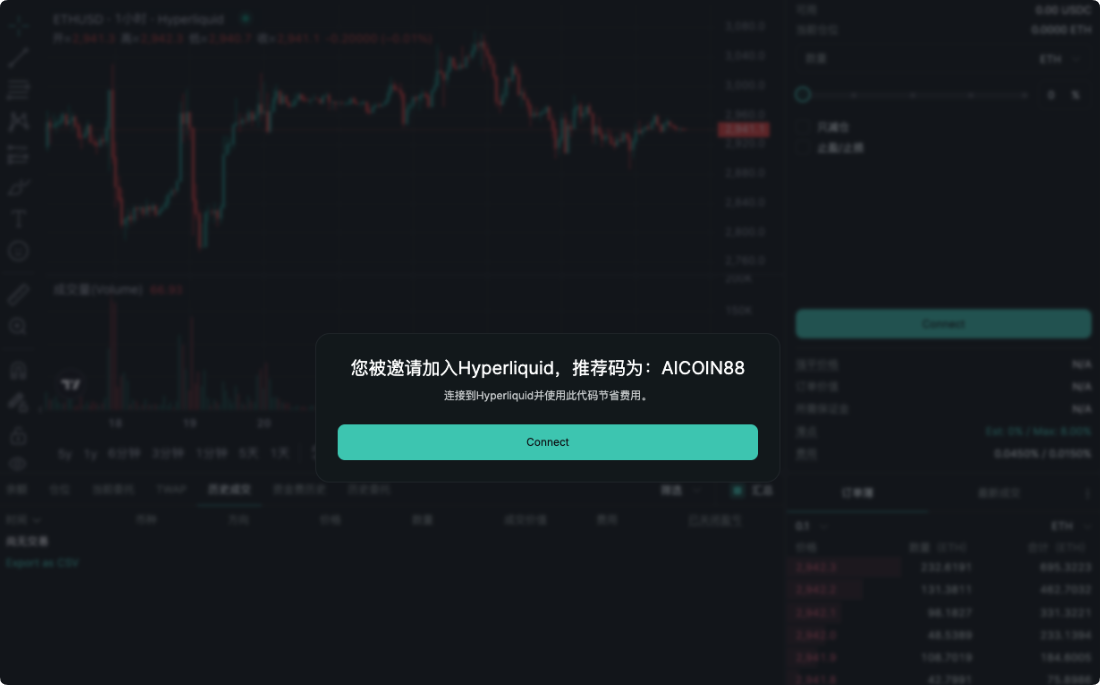
👉 Enter invitation code AICOIN88 when linking your Hyperliquid account to enjoy a 4% fee rebate
🔗 Exclusive registration link:
https://app.hyperliquid.xyz/join/AICOIN88
📖 Beginner's guide:
“AiCoin PC terminal Hyperliquid authorization trading tutorial”:
https://www.aicoin.com/zh-Hans/article/514197
“AiCoin mobile terminal Hyperliquid authorization trading tutorial”:
https://www.aicoin.com/zh-Hans/article/541383
“Zero-based entry! Hyperliquid first trade super detailed graphic tutorial”:
https://www.aicoin.com/zh-Hans/article/510225
📖 Community communication:
Telegram:
Discord:
AiCoin-Group chat:
https://www.aicoin.com/link/chat?cid=N6OVMor5g
The content of this article only represents the author's personal views and does not represent the stance of this platform. The viewpoints, conclusions, and suggestions in the text are for investors’ reference only and do not constitute any investment advice related to this platform. Investment in U.S. stocks still requires self-assumption of market risks, regulatory risks, and compliance risks with local laws and regulations (especially foreign exchange controls, offshore investment declarations, etc.)
免责声明:本文章仅代表作者个人观点,不代表本平台的立场和观点。本文章仅供信息分享,不构成对任何人的任何投资建议。用户与作者之间的任何争议,与本平台无关。如网页中刊载的文章或图片涉及侵权,请提供相关的权利证明和身份证明发送邮件到[email protected],本平台相关工作人员将会进行核查。