Last year, OKX has already signaled its extension towards a broader financial and Web3 scenario through global product events, and this trend has become even clearer with this year's OKX NOW.
If in the past the impression of OKX was more focused on being a "trading platform," then the signals released this year are very obvious: OKX is expanding from a single product capability further into the entire financial and Web3 ecosystem. Different segments such as trading, wallet, on-chain, payment, stablecoins, AI, and institutional services are being integrated into the same larger system.
In fact, this change did not suddenly occur this year. Since OKX began to focus on Web3, it has been continuously expanding the boundaries beyond the trading platform: from Web3 Wallet, self-custody, DEX, DeFi, to today’s further connections with payment, on-chain finance, and AI. Among the leading trading platforms, OKX can be said to be one of the players with the most complete and proactive ecological layout.
The reason I am particularly focused on this year's OKX NOW is precisely because of this.
Since entering the Web3 industry in 2017, I have experienced the most intense competition among exchanges and have watched the industry gradually shift from "whose trading volume is larger" to "who can provide more complete financial infrastructure." My most intuitive feeling from this year's OKX NOW is that this competition has moved forward a step: the leading platforms are not just competing on trading products but on the entire ecosystem's connectivity.
However, if I had to pick one change from the many unveiled at this year's OKX NOW that interests me the most and is worth long-term observation, I would choose AI.
Not because AI has appeared again at the fintech company’s conference, but because this time, AI is crossing a very critical boundary: moving from “helping you analyze” to truly “helping you execute.”
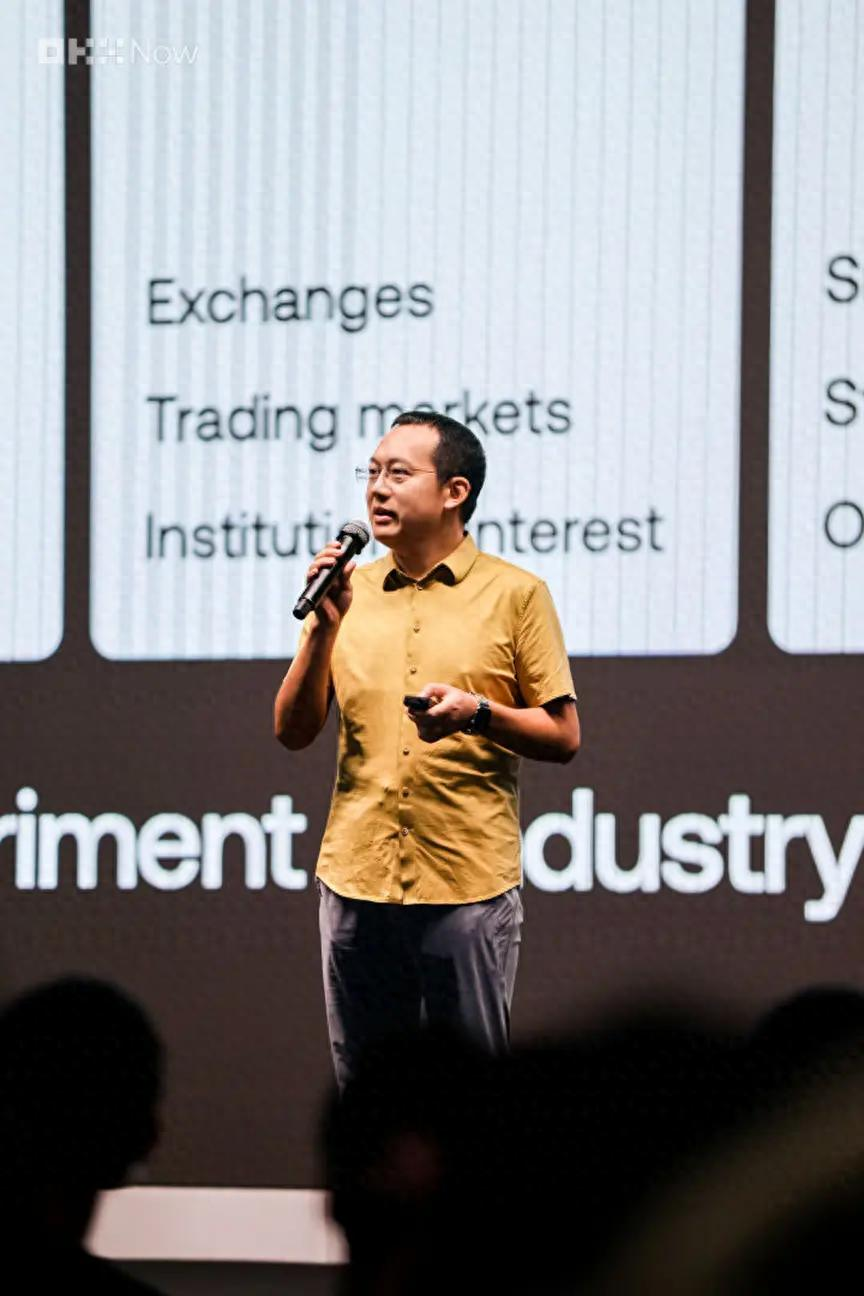
On October 6, at the OKX NOW Global Product and Ecosystem Conference held in Singapore, OKX disclosed a series of AI-related advancements. Among them, an AI Bot still in testing can allow users to generate trading strategies through natural language and further complete back-testing and deployment; the previously launched Agent Trade Kit allows AI Agents to read real-time market data and participate in trading execution within the range of user authorization.
This may just look like an upgrade of trading tools, but it may conceal a bigger change: the way humans interact with trading platforms is being redefined by AI.
The true value of AI trading may not be predicting price movements
In the past few years, whenever the market talked about “AI + trading,” the most common question was: Can AI predict whether Bitcoin will rise or fall tomorrow?
But I increasingly feel that this is not the most important value of AI entering the financial market. One of the real difficulties in financial markets is that the volume of information far exceeds human processing capacity. Prices, candlestick charts, order books, funding rates, macro news, social media, on-chain capital flows, whale addresses, position changes… even a professional trader cannot monitor all this information 24 hours a day.
Crypto is a truly 7x24 hour running market. Humans need sleep, experience fatigue, and are influenced by emotions, but AI does not. So what AI will first change may not be “predictive ability,” but rather the way information is processed.
In the past, a trader needed to constantly seek out information: opening market software, reading news, checking on-chain data, and then piecing these fragments into their judgment. In the future, this process may be entirely reversed. An AI Agent can continuously monitor the market, filter noise, look for anomalies, and only alert users when certain conditions are genuinely met.
What used to be “humans seeking opportunities” may shift to “AI filtering information, humans responsible for key decisions.” This is not just an efficiency improvement but a change in the relationship between traders and the market.
From “push the button” to “express your intention”
Today, when you open a mature trading platform, you will see a very complex interface: spot, futures, options, grids, take profit and stop loss, conditional orders, order books, position management… these functions are powerful in themselves, but the learning costs are also increasing.
Another idea represented by the Agent Trade Kit is that users no longer need to understand every complex interface but can directly tell AI what they want to do. For example, “help me check the volatility of BTC over the past week, and remind me if the conditions I set appear”; or further, “design a strategy according to my risk tolerance, backtest it with historical data, and only let me confirm after the results meet the requirements.”
The role of humans is beginning to change. In the past, we learned “where this button is” and “how to fill in this parameter”; in the future, we may need to learn more about: how to accurately tell AI what I want.
The most important revolutions of the internet era often accompany changes in interaction methods. The PC era was keyboard and mouse, the mobile internet era was touchscreen, and the generative AI era is turning natural language into the new operational interface. When this change enters the trading field, natural language itself may become the new trading interface.
The real breakthrough of Agent is that it gives AI "hands"
In the past, we could already hand over market data to ChatGPT for analysis. But the problem is that after the analysis is finished, AI's work often also ends. It tells you what to pay attention to, and then you close the chat window, open the trading platform, re-enter data, set parameters, and place orders.
In other words, past AI had a "brain" but did not have the "hands" that truly connect to the financial world.
Agent is changing that. Taking OKX Agent Trade Kit as an example, it connects AI with trading infrastructure through tool interfaces, enabling market data acquisition, account queries, strategy configurations and even trade execution to enter the same Agent workflow.
Thus, for the first time, the entire chain may be truly linked: information acquisition, market analysis, strategy formulation, backtesting verification, and assisted execution.
The AI Bot disclosed at this year's OKX NOW has also taken a step towards ordinary users. In the past, to create a set of automated trading strategies, you might need to understand Python, APIs, or even quantitative frameworks; in the future, "whether you can write code" may no longer be the first threshold. Instead, your ability to clearly express your goals, risks, and boundaries may become more important.
The more AI can trade, the more humans need to maintain control
However, there exists a fundamental difference between financial agents and ordinary AI applications. If AI writes a wrong article, it can regenerate; if AI draws a wrong picture, it can be deleted directly. But if AI executes a wrong order, the loss is real capital.
So, after AI enters the execution layer of trading, the real issues that the industry needs to solve are not just "how smart is AI," but rather: What exactly can AI do? How much can it move? When must it stop? Ultimately, who holds the decision-making power?
This may even be more important than the capabilities of the model itself. A future mature financial agent should have very clear boundaries of authority: it can only read market data but cannot manipulate assets, it can manage a small portion of funds but cannot operate the entire account, and it can automatically execute within a preset strategy, but once it exceeds risk thresholds, it must stop and return decision-making power to the user.
I believe this will become one of the most important competitive dimensions for AI financial products in the future. A truly good financial agent should not be a "fully automated robot" that dares to decide everything for you but should know when it can automate repetitive tasks and when it must stop.
AI has the ability, humans have the ultimate control.
This may be the prerequisite for agents to genuinely enter the financial world.
What OKX is really betting on may not just be an AI Bot
If we only look at the product level, AI Bot and Agent Trade Kit can be understood as new trading tools. But putting these changes into the larger AI and Web3 ecosystem of OKX makes things more interesting.
The products demonstrated on-site also include OnchainOS, Agentic Wallet, and OKX AI, further covering on-chain interactions, authorization execution, and professional agent services. Users can subscribe to different agent services, and developers can also encapsulate their strategies, capabilities, and expertise into services, submitting them for review and distribution in the market.
This means that Agent Trade Kit is not an isolated "AI trading plugin." It is forming a more complete set of tools, permissions, and service systems: on one end, users express their needs through natural language, while on the other end, it connects to market data, trading, wallets, on-chain interactions, and different types of professional agents.
If this system continues to improve, in the future users may not just face an AI Bot but a financial entry point capable of invoking different tools and professional agents based on tasks.
Star revealed in this OKX NOW presentation that AI has penetrated OKX's internal R&D, customer service, anti-fraud, and compliance processes. More importantly, he made a judgment about the future of finance: in the past, only high-net-worth individuals had private bankers because it was not economically viable for a professional advisor to serve ordinary users, and AI is changing this cost structure.
In the future, every ordinary person may have an AI advisor that understands their assets, cash flow, risk preferences, and financial goals.
If we continue along this path, the significance of Agent Trade Kit will not just be "let AI help you trade." Today, it helps users observe market conditions, manage strategies, and execute trades; in the future, it may gradually understand a person's asset situation, risk preferences, and long-term goals, connecting more financial products.
At that time, what users face may no longer be a financial app with dozens of menus, but an AI that truly understands them.
The next generation trading platform may only have one input box
For the past decade, trading platforms have been doing one thing: adding features. More trading varieties, more complex orders, richer data, and more sophisticated tools have ultimately made the entire financial system stronger and increasingly complex.
However, the AI era may bring about a very interesting reversal: as the underlying systems become more complex, the interfaces that users see actually become simpler.
Perhaps a few years from now, when an ordinary user opens a trading platform, they will no longer see a full screen of buttons but just one input box. It asks you: "What do you want to do today?"
You state your goals, and AI takes care of understanding, analyzing, invoking tools, and forming plans, while the key nodes involving real risk will pass the decision-making power back to you.
From GUI to natural language, from tools to Agents, from "humans operating financial software" to "humans expressing intentions, AI invoking financial infrastructure," this may be the true change that AI is bringing to the trading industry.
Thus, the most noteworthy aspect of this year's OKX NOW may not just be the emergence of another AI feature, but rather the emergence of a new trading paradigm: in the past we learned how to operate trading platforms, in the future, trading platforms may begin to learn how to understand us.
免责声明:本文章仅代表作者个人观点,不代表本平台的立场和观点。本文章仅供信息分享,不构成对任何人的任何投资建议。用户与作者之间的任何争议,与本平台无关。如网页中刊载的文章或图片涉及侵权,请提供相关的权利证明和身份证明发送邮件到support@aicoin.com,本平台相关工作人员将会进行核查。