Author: AiPlot Research Institute
Focus: RWA / Digital Assets / In-depth Analysis of Financial Infrastructure
1. Investment Conclusion: RWA is Transitioning from Public Chain Ranking to Functional Division Era
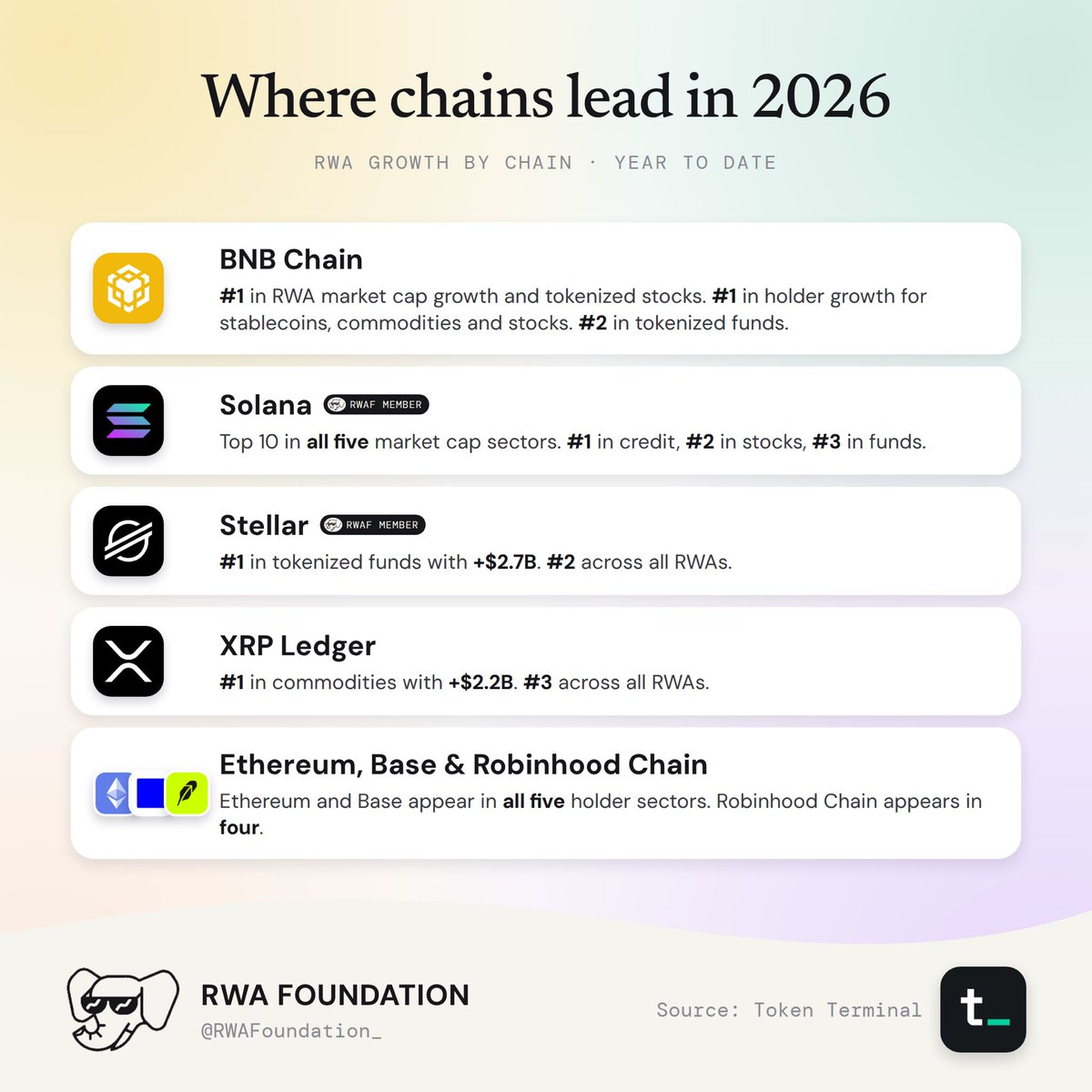
This year, the relative leading directions of different public chains in the RWA sector are:
- BNB Chain: Leading in RWA market capitalization growth and tokenized stock growth; leading in the growth of stablecoin, commodity, and stock holders;
- Solana: All five major RWA market capitalization sectors have entered the top ten, leading in the tokenized credit domain;
- Stellar: Leading in the tokenized fund sector, with an increase of over 2.7 billion dollars;
- XRPLedger: Leading in the commodity sector, with an increase of over 2.2 billion dollars;
- Ethereum and Base: Both are in core positions in the holder distribution across the five major sectors;
- Robinhood Chain: Excelling in the growth of new holders in stocks and commodities, as well as the distribution of stablecoins and tokenized assets.
If these conclusions are viewed only through the lens of ranking, it can easily be interpreted as “a few chains competing for the same market.” The market is showing two different standards of victory: the flow of capital and the flow of users are inconsistent.
As of September 2026:
- The total market capitalization of stablecoins reached 301.4 billion dollars;
- Tokenized funds have approximately 565,300 holders across 36 chains;
- The new holders of tokenized stocks are mainly concentrated in Solana, Robinhood Chain, and BNB Chain;
- Tokenized credit is the only sector showing significant contraction;
- Funding growth for tokenized funds and credit is more concentrated in Arbitrum;
- The funding growth for tokenized commodities is mainly driven by Ethereum and Tether's gold-backed assets.
This means that future RWA research cannot merely look at TVL or market cap, but also needs to track:
- Who attracted capital;
- Who gained users;
- Who controls asset issuance;
- Who provides real trading and lending scenarios.
2. First Distinguish Five Types of RWA: They Are Not the Same Market
Tokenized assets are divided into five sectors:
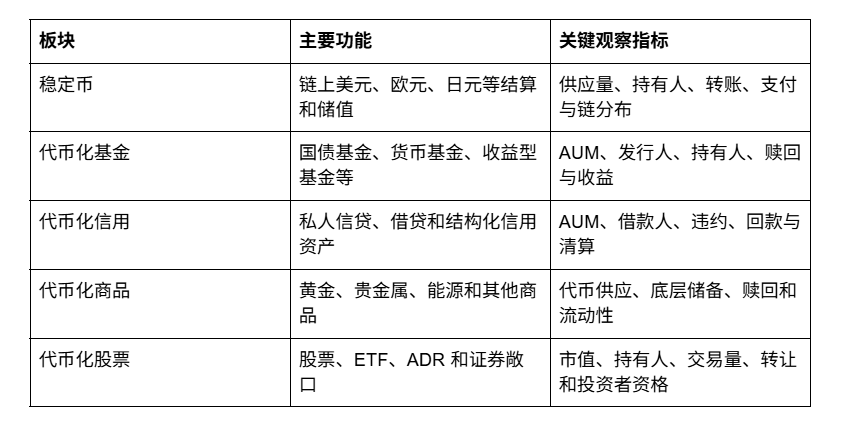
Different sectors correspond to different network needs:
- Stablecoins require high frequency, low cost, and widespread wallet coverage;
- Funds require issuance, custody, redemption, and compliant distribution;
- Credit requires risk control, lending, and settlement;
- Commodities require proof of reserves and redemption systems;
- Stocks require compliant transfers, trading depth, and retail entry points.
Therefore, a certain chain being number one in the growth of stablecoin holders does not mean it also has advantages in private credit; similarly, a chain that attracts a large amount of tokenized fund assets does not necessarily imply it has the largest user base for stocks.
3. Stablecoins: BNB Chain Gains Users, Tron and New Chains Take on Supply Growth
1. The Stablecoin Market Remains the Largest Liquidity Base for RWA
As of the end of September, the stablecoin market covers 193 assets, with a total market cap of 301.4 billion dollars, continuing to grow from the 298.8 billion dollars reported in August.
From the issuer perspective, the structure of newly added supply changed in September:
- Ethena's USDe increased 823.1 million dollars, surpassing USDC and USDT in single-month growth;
- USDC increased 592.7 million dollars;
- USDT increased 512.4 million dollars;
- USDS increased 276.2 million dollars;
- USD1 increased 239.7 million dollars;
- RLUSD increased 151.7 million dollars, slowing down compared to August.
This indicates that the stablecoin market is not just a “USDT vs USDC” duopoly, but also has seen the segmented expansion of yield-bearing stablecoins, new issuers, and non-dollar stablecoins.
2. On-chain Supply Growth and Holder Growth Come From Different Networks
In terms of stablecoin market capitalization growth:
- Tron increased 744.4 million dollars;
- HyperEVM increased 615.7 million dollars;
- Arc increased 465.9 million dollars;
- Solana increased 440.2 million dollars;
- Arbitrum One increased 271.3 million dollars;
- Robinhood Chain increased 243.6 million dollars.
But based on the new holders added:
- BNB Chain added 4.5 million stablecoin holders;
- Celo added approximately 870,700;
- Tron added approximately 813,300;
- Solana added approximately 800,500;
- Base added approximately 634,000.
This reveals two different network roles:
- Chains like Tron, HyperEVM, and Arc stand out in supply growth, possibly taking on large stablecoin issuance and capital migration;
- BNB Chain, Celo, Solana, and Base are stronger in user distribution, with higher numbers of new wallets and holders.
The 4.5 million new holders on BNB Chain is particularly noteworthy. It indicates that BNB Chain's advantage may not be solely in asset issuance, but rather in user coverage brought by wallets, trading, and consumption scenarios.
3. The Next Phase for Stablecoins is “From Balance to Use”
Growth in holders does not equal real economic activity. Further evaluation is needed:
- What is the average balance of new addresses;
- Are the new addresses from new users or existing users;
- Are stablecoins used for payments, transactions, lending, and cross-border settlements;
- Is supply growth due to long-term demand or short-term issuance;
- Is there a high concentration of stablecoins on new chains.
4. Tokenized Funds: Funding Leans Towards Arbitrum, Fund Ecosystem Still Highly Fragmented
1. Issuer Competition Does Not Show a Single Dominant Player
In September, the growth of tokenized funds saw WisdomTree increasing 206.1 million dollars, ranking first; Spiko increased 174.4 million dollars, ranking second. The top ten issuers combined increased by approximately 707 million dollars.
In terms of market share, the fund sector is more fragmented than stablecoins:
- Sky: 13.4%;
- Securitize: 10.9%;
- Spiko: 7.4%;
- Ondo Finance: 7.3%;
- Franklin Templeton: 7.2%;
- Circle: 7.0%;
- Tradable: 6.6%.
The top ten account for about 71.3%, with no single issuer close to the concentration of Tether in the stablecoin market.
This implies that the RWA market means: fund products rely more on differences in issuers, custodians, asset types, and compliant channels rather than a single stablecoin network effect.
2. Arbitrum Takes on Funds, Stellar Reflects Product Positioning
In terms of on-chain market size growth:
- Arbitrum One increased 167.2 million dollars;
- Stellar increased 86.4 million dollars;
- The two chains combined accounted for approximately 95% of the growth of the top ten chains;
- Plume, zkSync Era, and Fraxtal showed significantly lower growth.
This indicates that Arbitrum has developed a clear advantage in taking on fund capital. Possible reasons include:
- More mature DeFi liquidity and lending infrastructures;
- Greater connectivity with institutional issuers and financial protocols;
- Assets can further enter collateral, lending, and yield markets;
- The ecosystem has a relatively complete base of developers and institutional users.
Stellar's advantage appears more specialized, oriented towards payments, fund issuance, and institutional settlements. User-supplied charts indicate that Stellar's tokenized fund size has increased by over 2.7 billion dollars this year. 1 This data is different from the monthly growth metric, and cannot be directly added or compared, but both point to one fact:
Stellar's advantage in the tokenized fund sector reflects more asset issuance and institutional distribution rather than a broad DeFi user count.
3. Fund Holder Growth is Very Limited
Tokenized funds currently have approximately 565,300 holders, distributed across 36 chains. In September, the additional holders from issuers included:
- OnRe increased by 833;
- Ondo Finance increased by 753;
- Maple Finance increased by 680;
- Gauntlet increased by 384;
- USDai increased by 346.
Compared to the millions of new holders for stablecoins, fund products resemble “large, low-frequency, specialized” asset allocation tools.
This also explains why the fund sector might experience relatively high AUM growth, but the number of holders does not grow quickly:
- The average allocation size for individual investors is larger;
- Participation thresholds and accredited investor requirements are higher;
- Tokens are mainly used for asset registration and settlement, rather than high-frequency trading;
- Institutions manage large amounts of assets through limited wallets.
5. Tokenized Credit: The Most Concerning Contraction Signal Among the Five Major RWA Sectors
1. Credit is the Only Sector Showing Overall Contraction
In September, tokenized credit exhibited noticeable divergence. Among the nine major issuers, only two saw growth:
- USDai increased 91.3 million dollars;
- 3Jane increased 25.8 million dollars.
The other issuers contracted:
- Centrifuge decreased 120.4 million dollars;
- Securitize decreased 74.2 million dollars;
- Maple Finance decreased 64.3 million dollars;
- Hastra decreased 12.1 million dollars;
- Pareto decreased 8.7 million dollars.
The nine issuers collectively net reduced by approximately 164 million dollars.
2. Arbitrum is the Main Chain for Credit Assets
In terms of chain growth, Arbitrum One increased 90 million dollars, almost capturing all of the on-chain growth in the tokenized credit sector for September; Stellar increased 1.8 million dollars, BNB Chain increased 1 million dollars, while other chains showed minor changes.
This indicates a significant network concentration for credit assets:
- The asset scale is more reliant on a few issuers;
- On-chain growth is more reliant on Arbitrum;
- Other networks have yet to form stable supply and demand for credit assets.
3. Why Credit is Harder to Expand Compared to Stocks and Commodities
Tokenized credit naturally faces more complex issues:
- The credit quality of borrowers is difficult to standardize;
- Asset information tends to be less transparent than publicly traded stocks;
- Repayment cycles are longer;
- Valuation relies on models and private market data;
- Default and restructuring processes are complex;
- Secondary trading and liquidity depth are limited.
Therefore, credit RWA cannot rely solely on “asset tokenization” for growth. It requires continual borrower disclosure, cash flow monitoring, risk layering, legal enforcement, and loss absorption mechanisms.
From a research perspective, the contraction in the credit sector in September does not necessarily mean RWA failure, but it indicates:
The closer RWA is to real credit, the less it can depend on narratives and tokenization itself, and must rely on verifiable cash flow and risk control.
6. Tokenized Commodities: Tether Provides Capital, Robinhood and xStocks Provide Users
1. The Funding Growth in the Commodity Market is Highly Concentrated
Tokenized commodities in September saw growth almost entirely led by Tether, with its gold-backed token increasing by approximately 237 million dollars, more than 20 times that of the second place.
By chain:
- Ethereum increased 128.2 million dollars;
- Robinhood Chain increased 10.8 million dollars;
- HyperEVM increased 1.3 million dollars;
- Avalanche increased 680,000 dollars;
- Arbitrum One decreased 4.3 million dollars.
This indicates that the capital accumulation for significant commodity assets mainly occurs on Ethereum, with the core driver being gold-backed tokens, rather than collaborative growth among numerous different commodity issuers.
2. User Growth, However, Comes from Three Different Issuers
In terms of new holders by issuer:
- Tether added approximately 60,800;
- Robinhood added approximately 44,300;
- xStocks added approximately 36,700;
- Ondo Finance added approximately 4,200;
- st0x added approximately 3,600.
By chain:
- BNB Chain added approximately 59,300;
- Robinhood Chain added approximately 44,300;
- Solana added approximately 38,300;
- The three chains account for about 92% of the new holders in the top ten.
This is a valuable comparison:
Tether is responsible for enlarging commodity assets, while Robinhood and xStocks are responsible for distributing commodity exposure to more users.
The asset scale and user distribution can be accomplished by different entities, which is a manifestation of the gradual modularization of the RWA ecosystem.
7. Tokenized Stocks: Robinhood, BNB Chain, and Solana Compete for Users, Avalanche Competes for Capital
1. Stocks are One of the Strongest Retail Distribution Sectors
In September, all of the top ten major issuers of tokenized stocks saw growth:
- Securitize increased 245.7 million dollars;
- Binance bStocks increased 138.5 million dollars;
- xStocks increased 114.5 million dollars;
- Robinhood increased 100.3 million dollars;
- Ondo Finance increased 64 million dollars.
The top ten combined increased by approximately 704 million dollars, and the growth does not seem as concentrated on a single issuer as the commodity market.
2. Avalanche Leads in Market Capitalization Growth, Robinhood Chain Has User Advantage
In terms of on-chain tokenized stock market capitalization growth:
- Avalanche increased 245.5 million dollars;
- BNB Chain increased 144.1 million dollars;
- Robinhood Chain increased 98.7 million dollars;
- X Layer increased 97.7 million dollars;
- Ethereum increased 67.6 million dollars;
- Solana increased 26.3 million dollars.
In terms of new holders:
- Solana added 758,900;
- Robinhood Chain added 619,000;
- BNB Chain added 529,600;
- Base added 59,800;
- X Layer added 20,300;
- Ethereum added 5,600.
This indicates that stock RWA has at least three different competitive paths:
First, asset-contractive. Avalanche leads in market capitalization growth, possibly taking on larger stock token funds.
Second, retail distribution. Solana, Robinhood Chain, and BNB Chain attracting more new holders indicates stronger capabilities in wallet, trading entry, and consumer user reach.
Third, product issuance. The growth among issuers like Securitize, Binance bStocks, xStocks, Robinhood, and Ondo is relatively fragmented, with no single product completely monopolizing the market.
3. Robinhood Chain’s Advantage is Synergy between “Users and Assets”
Robinhood Chain’s performance in the growth of stock and commodity holders aligns with previous research conclusions: its core advantage is not just the chain itself, but the distribution network formed by Robinhood Wallet, retail brand, and Stock Tokens.
Robinhood’s competitiveness in stock RWA comes from:
- Users are already familiar with stocks and ETFs;
- Tokenized Stocks have a direct cognitive connection to traditional investment exposure;
- Wallet can provide on-chain entry;
- Stock Tokens can integrate with DEX and DeFi;
- Robinhood can connect stock assets with stablecoins, lending, and trading products.
However, user growth still needs further validation to see if it can convert to:
- Long-term holdings;
- Higher asset balances;
- Stablecoin usage;
- Lending and collateral;
- Non-speculative asset allocation.
8. Why Capital and Users Flow to Different Chains
1. Large Funds Prefer Mature, Deep Liquidity, and Institutional Infrastructure
Institutional capital usually places more emphasis on:
- Custody and redemption mechanisms;
- Asset issuance and compliance frameworks;
- Market depth;
- Oracles and settlement;
- Infrastructure stability;
- Connectivity with traditional financial institutions.
This explains the performance of Ethereum, Arbitrum, Avalanche, and Stellar in different RWA capital sectors.
2. Retail Users Prefer Low Costs, Easy Access, and Strong Narratives
New holders are typically more influenced by the following factors:
- Wallet coverage;
- Transaction fees;
- Airdrops and incentives;
- Trading platform access;
- Community activity;
- Familiar products like stocks, gold, and stablecoins.
This explains the user growth advantages of BNB Chain, Solana, and Robinhood Chain.
3. A Single Chain Struggles to Meet All Needs Simultaneously
The needs of institutional capital and retail users differ, and the infrastructure for asset issuance and asset utilization also varies. In the future, RWA is likely to be not unified on a single chain, but rather to form a multi-chain division of labor:
- Ethereum: High-value assets and deep settlements;
- Arbitrum: A combination of funds, credit, and DeFi;
- Stellar: Institutional issuance, payments, and fund distribution;
- BNB Chain: Retail users and stablecoin circulation;
- Solana: High-frequency trading and asset distribution;
- Robinhood Chain: Combination of stock RWA and retail finance apps;
- XRPLedger: Commodity and cross-border financial scenarios.
Conclusion: The Multi-chain Era of RWA has Begun, but the Market is Still Searching for a True Closed Loop
By 2026, the RWA market has formed multi-tiered competition:
- The stablecoin market reached about 301.4 billion dollars, with BNB Chain outstanding in new holders;
- The growth of tokenized funds is concentrated among issuers like WisdomTree and Spiko, and taken on by networks like Arbitrum and Stellar;
- Tokenized credit shows net contraction, with Arbitrum being one of the few chains still showing significant growth;
- The funding growth in the commodity market is highly reliant on Tether's gold tokens, but Robinhood and xStocks are more active in user distribution;
- The funding growth in the stock market is dispersed among various issuers, with Solana, Robinhood Chain, and BNB Chain obtaining the most new holders;
- Ethereum, Avalanche, Arbitrum, Stellar, BNB Chain, Solana, Robinhood Chain, and XRPLedger are forming different functional positions.
The most important conclusion is not “a certain chain is comprehensively victorious,” but rather: The RWA market is splitting into four competitive layers of capital onboarding, user distribution, asset issuance, and financial utilization.
The truly valuable networks in the future may not necessarily rank first on any monthly list but should be able to complete the following closed loop:
Asset Issuance → User Distribution → Trading Liquidity → Stablecoin Settlement → Collateral Lending → Risk Management → Protocol Revenue.
If a certain chain only holds significant assets but lacks users and financial utilization, it resembles an asset custody layer; if it only has a large number of holders but lacks long-term balances and trading depth, it resembles a distribution layer; only those that can simultaneously connect capital, users, and financial functionalities may become the true RWA infrastructure.
For more data and analysis, please follow Aiplot:
📖 Community Communication:
Telegram:
https://t.me/+IIYMcJigBAo4Mjg1
The content of this article only represents the author's personal views and does not represent the position of this platform. The opinions, conclusions, and suggestions in this text are for reference only and do not constitute any investment advice related to this platform. The market has risks, and investment requires caution.
免责声明:本文章仅代表作者个人观点,不代表本平台的立场和观点。本文章仅供信息分享,不构成对任何人的任何投资建议。用户与作者之间的任何争议,与本平台无关。如网页中刊载的文章或图片涉及侵权,请提供相关的权利证明和身份证明发送邮件到support@aicoin.com,本平台相关工作人员将会进行核查。