In the past, many people understood OKX in a simple way: buying coins, selling coins, and trading contracts.
However, as on-chain applications, RWA, payments, and AI gradually enter the financial lives of ordinary users, what users truly need is no longer just a trading page, but a unified entrance that can complete asset discovery, cross-chain transfers, on-chain transactions, investment, and management.
Star, the founder and CEO of OKX, stated during the OKX NOW sharing: “The exchange is the starting point, but not the ending point.”

The emphasis of this statement is not to pile up product names, but to reduce the number of times users switch between different accounts, networks, wallets, and applications, allowing funds to flow as smoothly as internet information.
A long-time user of OKX Wallet shared her usage changes: starting in 2024, she primarily used the wallet to connect to DApps, receive rewards, complete tasks, perform cross-chain operations, and exchange currencies; later, her usage expanded to cross-chain fund transfers, DEX trading, participating in new chains, and memes; now, she first opens the OKX Wallet to check if operations can be completed directly before performing any on-chain actions.
The value of this experience lies in its reflection of the change in user behavior: the wallet is no longer just a place to store assets but is becoming the first entrance for on-chain financial operations.
What users truly want is not more buttons, but less hassle
On-chain operations used to often require multiple steps:
- Find an available cross-chain bridge;
- Prepare the gas for the target network;
- Check for slippage and liquidity;
- Switch networks and wallets;
- Find the appropriate DEX;
- Verify the contract address;
- Finally confirm whether the transaction was successful.
For users familiar with DeFi, these steps have become habitual; but for ordinary users, the complexity of the process itself is the biggest hurdle.
OKX NOW's summary indicates that true "breadth" should not just be about showcasing Crypto, stocks, commodities, DeFi, and AI, but about reducing switches and lowering costs through unified accounts, underlying infrastructure, and asset views, allowing different financial services to truly connect.
This is also the product logic of OKX Wallet: not just putting more assets into the wallet, but allowing users to complete discovery, research, trading, and management within the same on-chain entrance.
Four product lines are converging into the same financial entrance
The core product lines displayed by OKX NOW can be summarized into four directions: Trading, Onchain, Payments, and AI.
1. Trading: Expanding from crypto assets to more tradeable assets
Trading remains the entry point for users into the financial market, but the trading targets are expanding.
OKX has launched TradFi perpetual contracts, Pre-IPO perpetual contracts, and unified tokenized stock trading products, attempting to incorporate tokenized stocks, precious metals, and commodity assets into a more unified trading experience.
The average daily trading volume of tokenized stocks and the TradFi perpetual market is about 3 billion US dollars, peaking at 9 billion US dollars.
The significance of these numbers isn't to prove that any specific asset will rise, but rather to indicate that there is genuine interest in all-weather, tokenized assets and global trading entrances. Users can observe stocks, crypto assets, and RWA through a more unified terminal.
It is important to note that tokenized stocks are not equivalent to those in traditional brokerage accounts. Users still need to verify the issuance mechanism, underlying support, trading hours, redemption conditions, regional qualifications, and actual rights.
2. Onchain: OKX Wallet is the entrance to the open network
The core value of OKX Wallet is to allow users to enter a multi-chain ecosystem from platform assets.
OKX Wallet supports over 100 public chains and can generate or activate on-chain wallets with one click from the OKX exchange account.
In practical use, users can view on-chain assets through the wallet, connect to DApps, conduct cross-chain transactions, exchanges, DEX trading, and liquidity operations, as well as explore RWA, lending, and yield scenarios on the X Layer.
The significance of the X Layer lies in providing the underlying environment for on-chain transactions and applications. This year, X Layer DeFi TVL increased by approximately 11 times and reached a historical high in September; the scale of on-chain tokenized RWA grew from about 2 billion US dollars to nearly 40 billion US dollars.
This data is better understood as indicators of ecological development rather than personal profit promises. TVL growth may come from asset prices, incentives, capital migration, and the launch of new protocols; users still need to independently assess the risks and sustainability of each protocol.
3. Payments: Bringing on-chain assets into real consumption scenarios
If assets can only circulate within the trading page, on-chain finance has still not completed the final step.
OKX NOW demonstrated payment directions such as OKX Money, OKX Pay, and OKX Card. OKX Money revolves around transfers, consumption, savings, and asset custody, and has already opened in over 30 countries; it was demonstrated on-site that a cross-border transfer from Singapore to Venezuela could be completed in seconds.
The significance of payment products lies in transforming stablecoins from "settlement assets in trading accounts" into digital funds that are more akin to everyday use.
However, the availability of payments highly depends on regions, regulations, identity verification, and product eligibility. Before actual use, users should confirm whether related functions are available locally and the specific rules for transfers, consumption, and exchanges.
4. AI: From providing information to executing within authorized limits
The potential changes in the AI product line are even greater: it doesn’t just answer "what should I buy," but gradually helps users view wallets, analyze assets, compare strategies, and execute actions within the boundaries of user authorization.
OKX has launched directions like Agent Trade Kit, OnchainOS, and Agentic Wallet, aiming to allow AI to access on-chain data, analyze addresses, discover opportunities, and execute on-chain actions within authorized limits.
The most crucial aspect here is not whether "AI will predict prices," but permissions and risk control:
- What assets can AI see?
- How large of a transaction can it execute?
- Is transaction-by-transaction confirmation needed?
- How to revoke authorization?
- Who bears the loss if an error occurs?
For ordinary users, the value of AI should first be reflected in reducing the costs of information organization and operations, rather than completely handing over investment decisions to automated tools.
Why might “wallets” become the new financial entrance?
Traditional accounts are often divided by institution and product: banks are responsible for deposits and payments, brokers are responsible for stocks, exchanges are responsible for asset trading, and wallets are responsible for on-chain assets.
However, real user needs do not separate along institutional boundaries. An individual may simultaneously need to:
- Hold stablecoins;
- Participate in on-chain lending;
- Trade RWA like xStocks;
- Transfer funds across chains;
- Make global payments;
- View their overall assets and risks.
If each demand requires different accounts and different operating paths, the financial experience will become fragmented.
The opportunity for OKX Wallet lies in its attempt to integrate these behaviors into a self-custodial, multi-chain, and composable entrance. For users, the most direct benefit is not "having more features," but being able to open a wallet first and then determine if the operation can be completed within the same set of infrastructure.
Where should new users start?
Step 1: Start from the asset view
First, understand what assets are in the wallet, what networks they are distributed across, and the use and risks of each asset, avoiding connecting to a large number of unfamiliar DApps from the beginning.
Step 2: Start with low-complexity operations
Familiarize yourself first with asset viewing, network switching, exchanges, and small transfers before considering liquidity, lending, RWA, or leveraged products.
Step 3: Compare real costs
Check gas, slippage, transaction fees, liquidity, and arrival times. On-chain transactions are faster and more open, but it doesn’t mean every transaction will have lower costs.
Step 4: Use order and risk control tools
For trading actions, set limit orders, take profits, and stop losses in advance; for authorizations and AI actions, set limits and permissions to reduce unnecessary risk exposure.
Step 5: Distinguish between “data” and “profit promises”
TVL, trading volume, user count, and APY are all observational indicators, not guarantees of profit. Any activities, RWA, lending, or liquidity products should be based on real-time rules and risk disclosures.
Conclusion: Transitioning from “I am looking for a function” to “the wallet connects me to the financial world”
A real transformation: initially opening the wallet for a certain project, and later, before performing on-chain operations, checking the OKX wallet to see if it can be completed directly.
This is the actual meaning of "the exchange is the starting point, but not the ending point."
The exchange is responsible for providing the starting point for assets and liquidity, while OKX Wallet further connects cross-chain, DEX, RWA, lending, payments, and AI. OKX is attempting to integrate trading, on-chain, payments, and intelligent capabilities into a broader fintech platform.
For users, the most important point is not a grand brand narrative, but whether each operation truly takes fewer steps, involves fewer switches, and experiences less unnecessary friction.
Exclusive benefits for AiCoin users
Using OKX Web3 Wallet, “Invest in assets worldwide”!
Bind the invite code 【AICOIN88】 to enjoy a 20% transaction cost saving (Gas optimization and other benefits)!
Download/upgrade the OKX Web3 Wallet now and catch the wave:
https://jump.do/xlink?checkProxy=true&proxyId=24
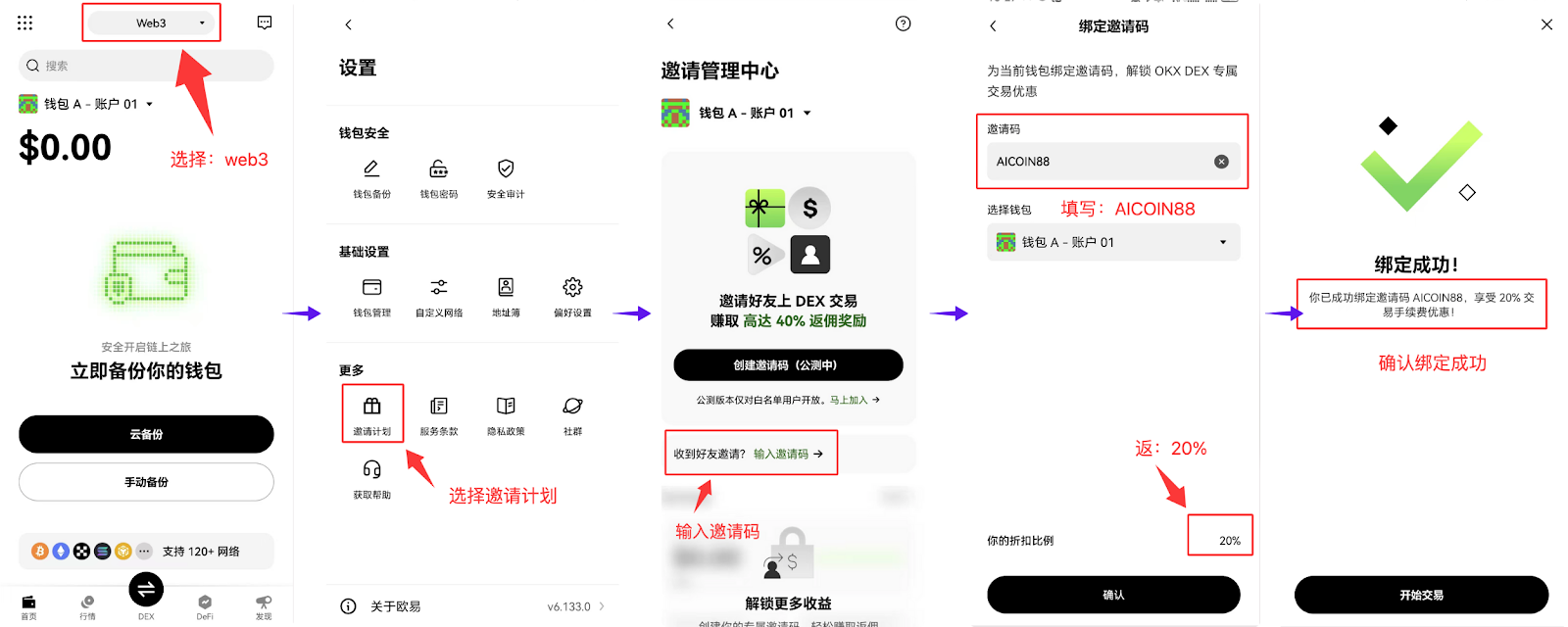
Use the exclusive invitation code 【AICOIN88】 to bind OKX Wallet, and the web can also be operated conveniently!
https://web3.okx.com/ul/joindex?ref=AICOIN88
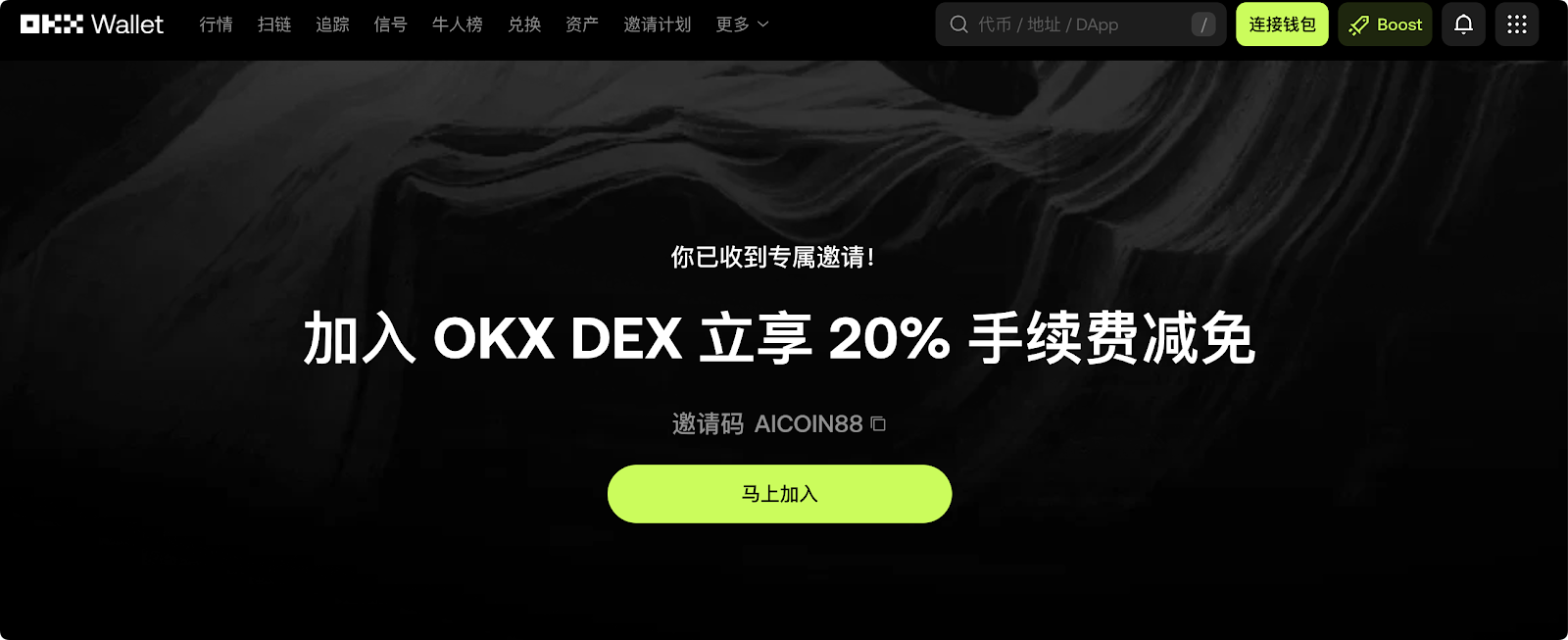
Don't wait, install the OKX Wallet, bind the discount, and reap new wealth!
免责声明:本文章仅代表作者个人观点,不代表本平台的立场和观点。本文章仅供信息分享,不构成对任何人的任何投资建议。用户与作者之间的任何争议,与本平台无关。如网页中刊载的文章或图片涉及侵权,请提供相关的权利证明和身份证明发送邮件到support@aicoin.com,本平台相关工作人员将会进行核查。