In on-chain trading, the hardest question is often not "Is there new money?", but rather: Which addresses are continuously making effective trades? How do they perform after buying? Can ordinary users discover these signals faster?
The OKX wallet's copy trading feature now aggregates Fomo smart money addresses. Users can monitor the buying dynamics and PNL of these addresses and directly follow trades on the trading terminal; simultaneously, they can set copy trading strategies based on their own judgment through rich custom parameters.
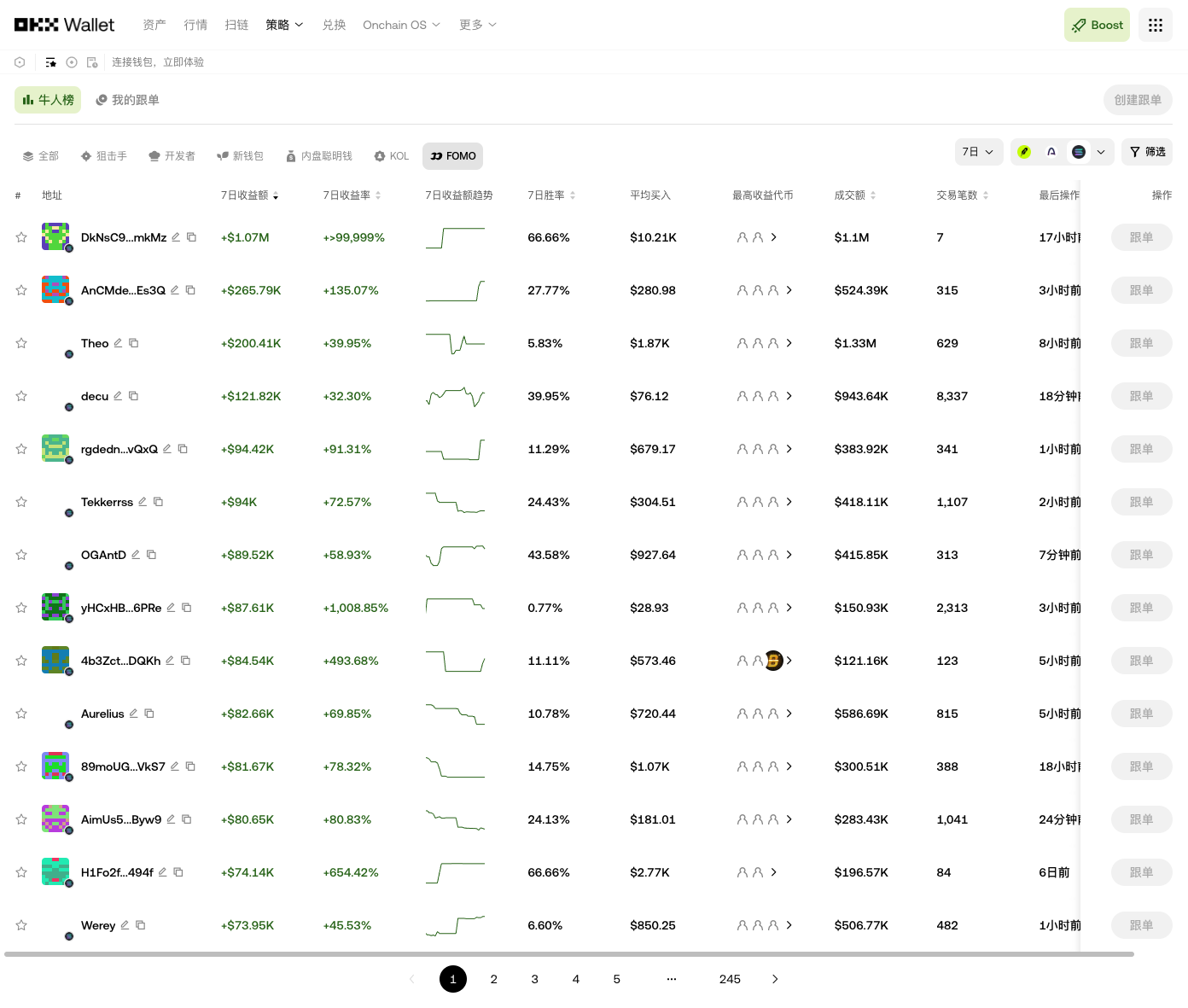
The significance of this feature is not to let users completely hand over decision-making to others, but rather to transform the decentralized wallet behaviors on-chain into more easily observed and executed data entry points. Users can first research an address before deciding whether to follow; they can choose to follow a specific trade or adjust their strategy based on their own position, amount, and risk boundaries.
Why are smart money addresses worth studying as data samples?
The biggest advantage on-chain is that every transaction can be recorded and tracked. What an address bought, when it was bought, how long it has been held, and whether it was sold in batches can often be observed through on-chain data.
In traditional markets, ordinary investors can usually only see publicly disclosed, news, or delayed quotes; on-chain markets provide another type of information: the behavioral data of real wallets.
Of course, "smart money" does not mean every trade is correct. A more reasonable approach is to use these addresses as research samples to observe whether they exhibit relatively stable behavioral characteristics:
- Whether they continuously discover early projects;
- Whether they can exit in time after buying;
- Whether they frequently engage in short-term high-frequency trading;
- Whether they concentrate on a specific chain or a type of asset;
- Whether there are instances of large profits from a single trade while overall losses exist;
- Whether PNL comes from realized gains or just unrealized paper profits.
This is also the value of OKX placing the address buying dynamics and PNL in the same entry point. Users need not only look at "who bought what" but should further judge whether these trades have produced sustainable results in the past.
PNL is not a leaderboard and should be read like this:
In the copy trading function, PNL is the most eye-catching metric but also the easiest to misinterpret.
An address showing high PNL may come from a very early purchase; it might also just be a position that has not yet been sold, and the profits remain unrealized. Short-term high returns do not equal long-term stability, nor do they guarantee that the next trade will also be profitable.
When analyzing the data, PNL can be broken down into four questions:
1. Have the profits been realized?
Profits from sold positions are fundamentally different in risk nature from unrealized gains. Users should prioritize whether addresses have truly exited rather than just look at the increases shown on the holding page.
2. Are profits concentrated in a single trade?
If an address's total PNL mainly comes from a single token, its strategy may rely heavily on randomness. In contrast, multiple cycles and multiple assets producing relatively stable results are more worth continuing research on.
3. Does the address frequently change hands?
High-frequency addresses may possess faster information and execution abilities, but ordinary users may encounter time lags, slippage, and gas costs when copying. Before following such an address, users should first assess whether their execution conditions match.
4. Does the address undertake the same risks?
An address may use extremely high positions to concentrate on small market cap tokens. Even if it has previously gained, it does not mean ordinary users should replicate the same risks. The core of copy trading is referencing behavior, not blindly imitating positions.
The true value of OKX copy trading: from "watching addresses" to "executable strategies"
In the past, once users discovered a wallet worth following, they typically had to manually copy the address, open a block explorer, track transactions, and switch back to a DEX to complete the exchange. This process was not only slow but also prone to price misses.
The OKX wallet's copy trading feature aggregates several steps into the trading terminal:
- Discover Fomo smart money addresses;
- View the address's buying dynamics;
- Observe the address's PNL and historical behavior;
- Set copy trading parameters;
- Execute or cancel the copy trade based on personal judgment.
The value of this path is to connect on-chain research with trading execution. Users do not need to switch back and forth between multiple tools, nor do they need to miss trading opportunities due to delays caused by manual operations.
However, "direct following" does not mean "automatic profit." Any on-chain trading can be affected by price changes, slippage, liquidity, gas, and network congestion. The price at which the smart money address buys may be completely different from the price when the user actually follows.
Custom parameters determine whether copy trading is suitable for you
The official site specifically mentions that OKX provides rich custom parameters, allowing users to set copy trading strategies according to their own judgment.
The focus of this part of the feature is not on having more parameters, but whether the user can formulate their risk preferences into clear rules. Consider focusing on the following dimensions:
Copy trading amount
Do not invest funds that you cannot afford to lose just because a certain address has high PNL. The copy trading amount should be independent of the scale of the funds in the followed address, prioritizing your total position and maximum loss settings.
Maximum single trade limit
The price and liquidity of small market cap tokens can change very quickly. Setting a maximum limit for a single trade can help avoid occupying too much funding in one copy trade.
Asset filtering
Users can choose whether to follow a specific type of token, a specific chain, or trades within a certain timeframe based on their research framework. Do not copy all trades from all addresses.
Slippage and execution conditions
There exists a time lag between the copy trade and the original address. Setting a reasonable slippage range can help avoid executing at significantly unfavorable prices during low liquidity. However, setting slippage too low may also result in orders not being executed.
Take profit and stop loss
If the product page provides relevant conditions, users can set take profit and stop loss based on prior trading plans. Copy trading strategies should not only include buying conditions, but also clearly define when to exit.
Which addresses are worth observing?
It is not recommended to choose addresses solely based on PNL from high to low. A more valuable filtering method is to establish a multi-dimensional observation framework:
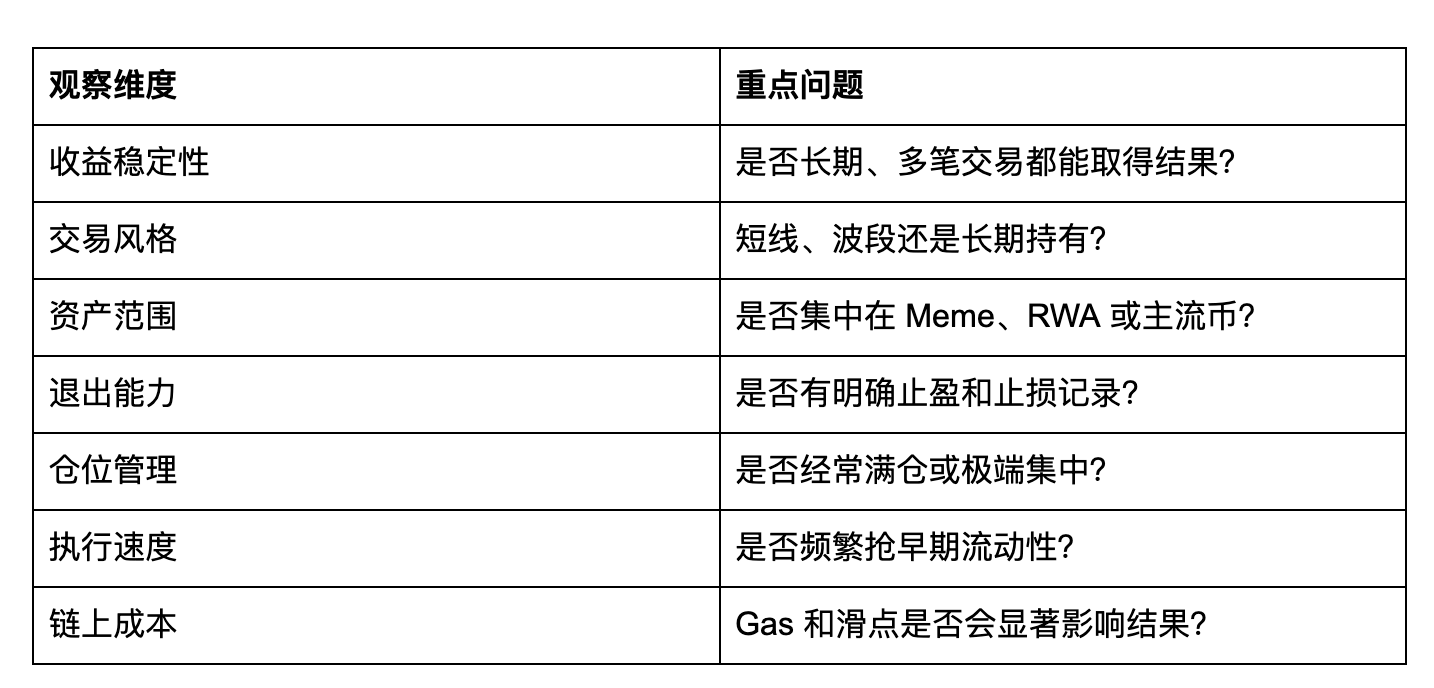
If an address only has records of short-term surges but lacks sufficient historical samples, it should not be directly regarded as a mature strategy. In contrast, an address with profits that may not necessarily be the highest, but possesses clear trading logic, stable position management, and complete exit records, may be more suitable as a research subject.
Five types of risks that are most easily overlooked in copy trading
First, time difference risk. The original address may have completed the buy, while the price may have changed when the user follows.
Second, liquidity risk. An address can execute trades during early low liquidity phases, but ordinary users may not be able to exit close to the price.
Third, contract risk. The target token may have high taxes, blacklists, trading pauses, or other contract permissions risks.
Fourth, sample bias. Users may only see addresses performing well recently and cannot infer their complete historical capabilities.
Fifth, strategy mismatch. The scale of funds, information speed, and risk tolerance of addresses may far exceed those of ordinary users. Copying the direction of trades does not equal copying the results of trades.
Therefore, copy trading is better understood as a tool for on-chain data research, rather than a profit guarantee tool.
A more prudent way to use it
Users can adopt a "observe first, then small investment, then evaluate" process:
Step 1: Establish an observation list
Focus on several Fomo addresses first, compare their trading styles and historical PNLs, and do not follow immediately.
Step 2: Split address types
Classify addresses into early discovery type, trend-following type, short-term trading type, and long-term holding type. Different types require different copy trading parameters.
Step 3: Small-scale verify execution differences
Use a small amount of capital to test the copy trading prices, slippage, trading speed, and exit process to confirm whether the actual results match the display on the page.
Step 4: Set personal exit rules
Even when following smart money, set your acceptable losses and target gains in advance; do not completely hand over sell decisions to others.
Step 5: Regular review
Observe the actual transaction price, gas, slippage, and gains and losses after copy trading, compare the original address earnings with your own, and then decide whether to continue.
Conclusion: The true "smart money" tool is to help users obtain information faster, not to make decisions for users
The OKX wallet now aggregates Fomo smart money addresses and places buying dynamics, PNL, and copy trading execution in one trading terminal. It resolves a real pain point in on-chain trading: users can discover active addresses in the market faster and set copy trading parameters based on their own judgments.
Exclusive benefits for AiCoin users
Use the OKX Web3 wallet to "invest in assets from all over the world"!
Bind invitation code 【AICOIN88】 and enjoy a 20% reduction in trading costs (such as Gas optimization and other benefits)!
Download/upgrade the OKX Web3 wallet now and catch the wind:
https://jump.do/xlink?checkProxy=true&proxyId=24
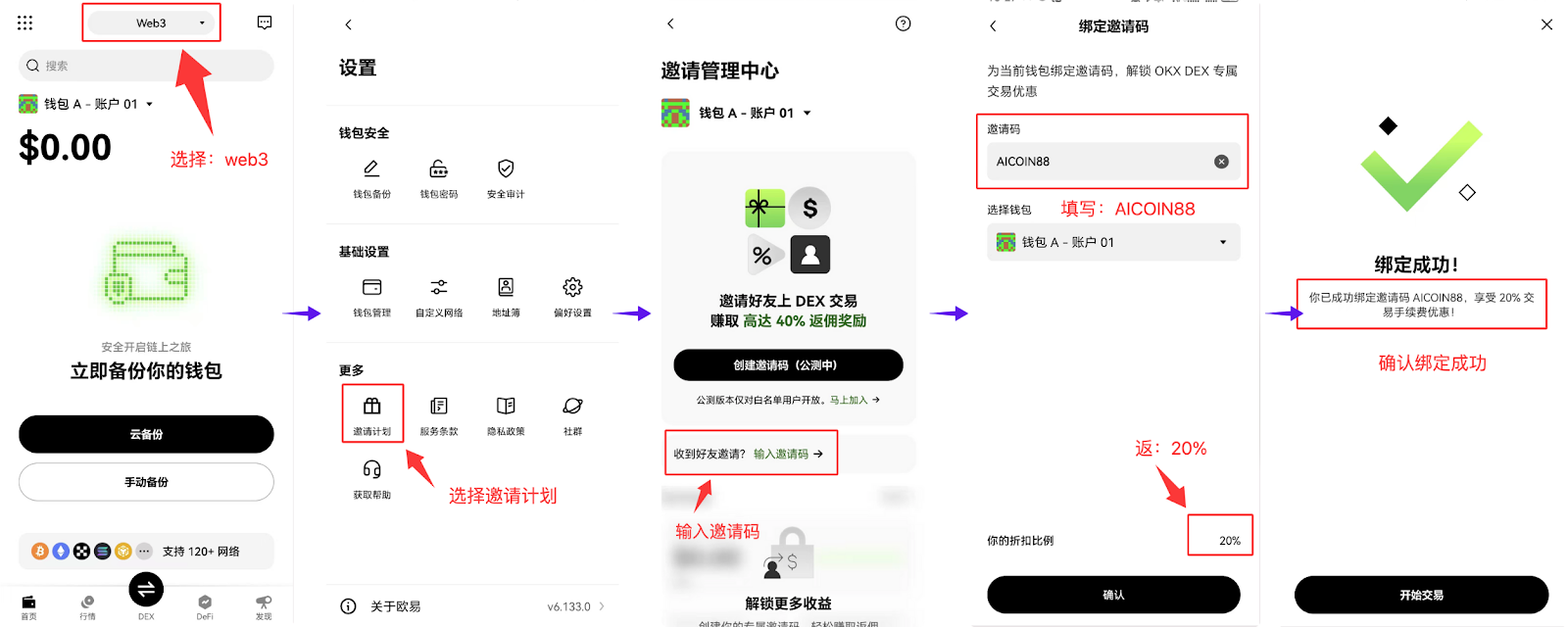
Use the exclusive invitation code 【AICOIN88】 to bind the OKX wallet, the web can also be operated easily!
https://web3.okx.com/ul/joindex?ref=AICOIN88
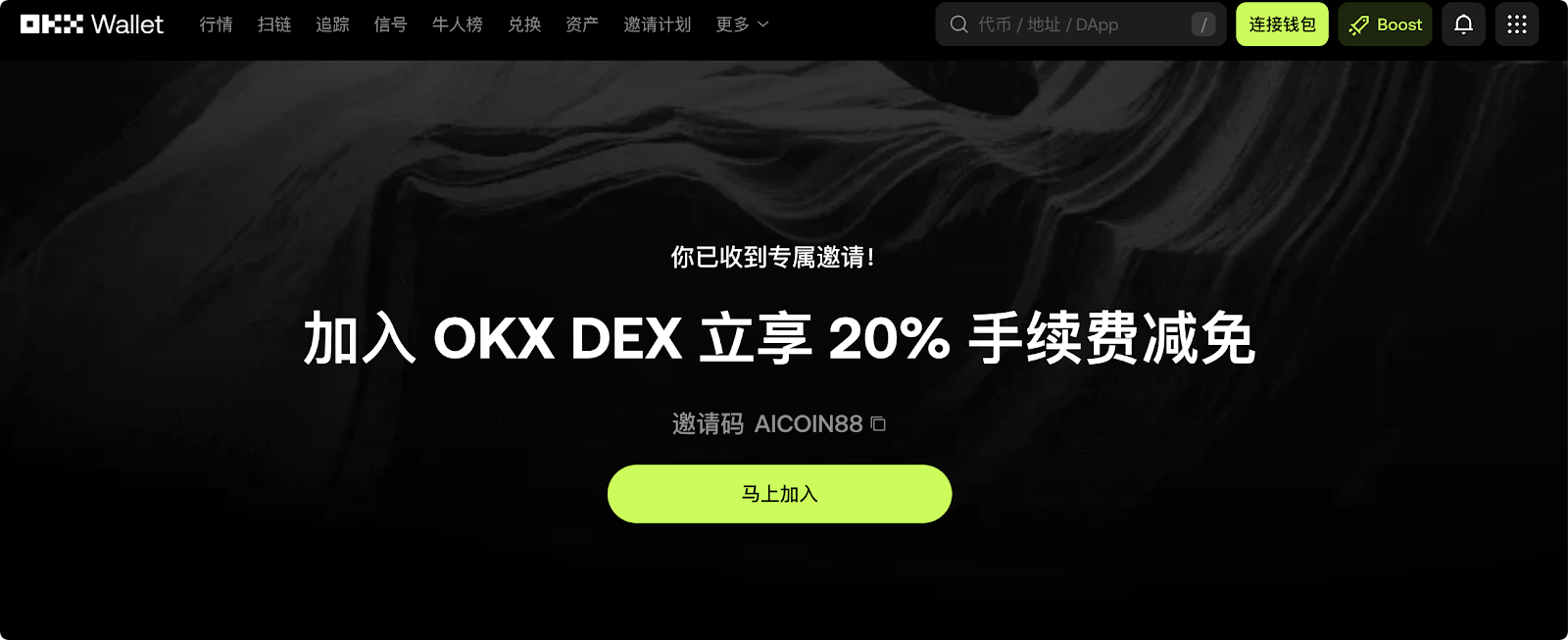
Don’t wait, install the OKX wallet, bind the benefits, and reap new wealth!
免责声明:本文章仅代表作者个人观点,不代表本平台的立场和观点。本文章仅供信息分享,不构成对任何人的任何投资建议。用户与作者之间的任何争议,与本平台无关。如网页中刊载的文章或图片涉及侵权,请提供相关的权利证明和身份证明发送邮件到support@aicoin.com,本平台相关工作人员将会进行核查。