“Hyperliquid will become the biggest challenger to centralized exchanges.”
Hyperliquid Daily quoted Zach Pandl, director of research at Grayscale, stating that Hyperliquid has already been competing with Binance for the top position in the perpetual contract space and has become one of the largest cryptocurrency derivatives trading venues by open interest.
This statement can easily be rewritten into a more exciting version: DEX is about to beat CEX.

However, this is not the most accurate or the most important understanding.
CEX still has a larger comprehensive scale in spot, derivatives, user distribution, fiat entry, and global product matrix.
What has truly changed is not that all institutions suddenly left CEX, but that for the first time they have a serious alternative that can accommodate larger positions while retaining transparency and self-custody on-chain.
Hyperliquid is not challenging a specific exchange’s logo, but the old structure that dictates “professional trading must hand over assets, execution, and settlement to the same centralized platform.”
Why couldn't institutions leave CEX in the past?
It is not because institutions inherently prefer centralization.
In high-frequency, large-scale, and leveraged trading, what traders care about first is the outcome:
- Can the order book accommodate large orders;
- Is the matching fast enough;
- Can orders be revoked in extreme market conditions;
- Are the margin and clearing systems stable;
- Are API, sub-accounts, and risk control tools mature;
- Can funds move in and out quickly.
Most on-chain trading platforms in the past could not meet these demands simultaneously.
Even if self-custody and transparent settlements are ideal, as long as there are execution delays, insufficient depth, and excessive slippage, professional funds will ultimately return to CEX.
Therefore, the dominance of CEX comes not only from branding but also from a long-standing reality: the available alternatives are too few.
Hyperliquid is changing this premise.
$9 billion in open interest, meaning it has passed the "usability threshold"
In a study released on September 21, Grayscale stated that Hyperliquid's average open interest in the second quarter of 2026 is about $9 billion, a 54% year-over-year increase, and it is the only platform among the primary perpetual trading venues it defined that has achieved growth.
Earlier in-depth reports from Grayscale showed that Hyperliquid processed approximately $2.9 trillion in perpetual contracts in 2025; as of May 2026, the open interest was about $7 billion, ranking third or fourth among global perpetual trading venues.
Another market snapshot from September 24 showed that Hyperliquid's 30-day perpetual trading volume at that time was approximately $220 billion, with open interest around $9.06 billion, accounting for more than half of the on-chain perpetual market open interest tracked by relevant data sources.
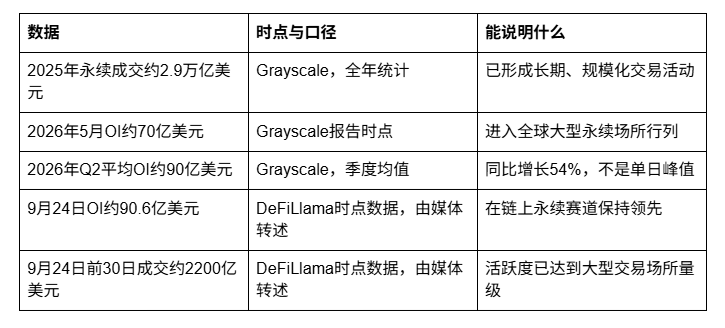
However, open interest needs to be interpreted with caution.
Open interest is the nominal value of contracts that have not yet been settled, not equivalent to platform deposits, user assets, nor does it represent a unilateral bullish sentiment from long positions; each open contract concurrently involves both long and short positions. Data collection methods across different platforms may also vary.
More importantly, a high open interest does not alone prove that funds are coming from institutions. On-chain addresses can be observed but may not necessarily confirm the ultimate controller.
This set of data truly demonstrates that: Hyperliquid has passed the market test of “professional funds willing to sustain large open positions.”
This is called institutional-grade capacity, not equivalent to all positions being held by institutions.
The first threshold Hyperliquid crossed: execution is approaching CEX
Grayscale's core assessment of Hyperliquid is that it offers a trading experience close to that of centralized exchanges while retaining the transparency and self-custody model of blockchain.
Official data shows that HyperBFT currently supports about 200,000 orders per second, with a block time of around 0.07 seconds; orders, cancellations, transactions, and settlements all occur on-chain and achieve single-block finality.
These characteristics combined are crucial.
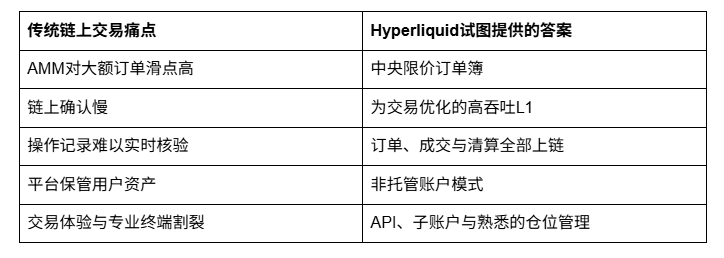
Grayscale also estimated based on 2025 BTC and ETH trading data that the fee for CEX futures is approximately 4 basis points on a volume-weighted average basis, while Hyperliquid's perpetual contracts are around 2 basis points.
However, this is merely an estimate based on publicly available base rates and does not fully account for VIP tiers, rebates, order book depth, slippage, and impact costs.
For institutions, nominal fees have never represented the total cost.
The actual execution cost is:
Total Cost = Fees + Bid-Ask Spread + Market Impact + Funding Rates + Asset Transfer Costs + Custody and Operational Risks
Hyperliquid is beginning to become a competitor, not because of a lower rate in a specific tier, but because it is the first time it has exhibited comparability in this total cost formula.
The second threshold: custody and trade execution are beginning to decouple
The traditional model of centralized exchanges consolidates multiple roles within the same company:
- The exchange is responsible for matching;
- The exchange holds assets;
- The exchange maintains internal ledgers;
- The exchange decides on withdrawals and account permissions;
- The exchange provides final settlement records.
This integrated structure is highly efficient, but it also creates a concentrated dependency on a single institution for traders.
Hyperliquid adopts a non-custodial design. Officials state that users' orders, trades, and settlements can be verified on a public ledger; institutions wishing to use professional custody services can choose providers like Anchorage, BitGo, FalconX, Fireblocks, and Komainu.
This means that institutions theoretically do not have to choose between "putting all assets on the exchange" and "not having access to a high-performance order book."
They can separate different functions:
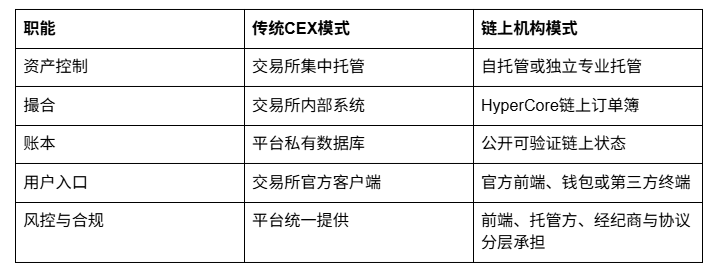
This separation does not automatically eliminate risks.
Private key management, smart contracts, validator concentration, stablecoins, oracle services, and public on-chain positions can introduce new issues. Grayscale also cautions that Hyperliquid's validator set is somewhat centralized, the software is not entirely open source, and growth in the U.S. market still relies on regulatory changes.
However, it provides a choice that was difficult for CEXs to offer in the past: traders can use a shared execution layer without having to concentrate all trust in one company.
The third threshold: institutions need more than just BTC and ETH
If Hyperliquid is merely an on-chain crypto perpetual exchange, its limit would still depend on the internal market share within the crypto market.
HIP-3 changed this.
Third-party builders can deploy perpetual markets for stocks, commodities, indices, and other assets on HyperCore. Grayscale points out that Hyperliquid now supports 24/7 markets related to stocks and commodities; S&P Dow Jones Indices has also licensed the S&P 500 index to TradeXYZ for use in Hyperliquid's perpetual contracts.
Research from Pantera further indicates that during traditional market closures, Hyperliquid's gold, silver, and oil markets have taken on price discovery roles; some traditional assets have temporarily reached 40% of the platform's trading volume.
What truly attracts institutions is not "being able to trade U.S. stocks on-chain," but rather two structural capabilities:
- The ability to express risk views even when traditional markets are closed;
- The ability to manage crypto, stocks, commodities, and indices within the same account and margin system.
For cross-market market-making, macro hedging, and event-driven capital, this is more important than simply adding a few trading pairs.
Institutions need an all-weather risk table, not just a new speculative button.
The real future is not CEX vs DEX, but a three-layer market
HYPERDaily summarizes the future as “Binance vs Hyperliquid.”
As a catchy headline, this rivalry is appealing; as a judgment of market structure, it remains overly simplistic.
The more likely scenario is not the disappearance of CEX but the gradual division of the trading system into three layers:
First Layer: On-Chain Liquidity and Execution
Hyperliquid provides order books, margin, clearing, settlement, and unified liquidity.
Second Layer: Regulated Client Entry
Brokers, futures exchanges, clearing agencies, or licensed fronts are responsible for KYC, customer protection, market access, and compliance monitoring.
Grayscale mentions that Payward plans to, pending regulatory approval, provide U.S. clients with on-chain perpetual contracts based on the licensed HIP-3* market via its CFTC-regulated Bitnomial exchange and clearinghouse.
This plan still requires regulatory approval and cannot be claimed that the U.S. market is open.
Third Layer: Centralized Distribution and Comprehensive Services
CEXs like Binance still have well-developed spot markets, fiat on-ramps, wealth management, lending, customer service, account recovery, and global user networks.
They may not necessarily be replaced by on-chain protocols; instead, they might become distributed entry points for on-chain liquidity, brokerage layers, or competitive execution venues.
Therefore, the next-generation trading market is more likely to be:
Multiple fronts with regulated entities → Connecting shared on-chain liquidity → Competing and collaborating with CEXs simultaneously
Hyperliquid’s goal is not to pack all financial functions into a single company but to allow the execution infrastructure to be called upon by different firms.
This is its deeper challenge to the traditional exchange model.
“Institutional readiness” and “institutions are already on board” must be separated
Seeing $9 billion in open interest, a list of professional custody options, and TradFi markets, it is easy to announce, “Wall Street has fully migrated.”
This still lacks evidence.
Institutional readiness means:
- The system can accommodate large positions;
- API and order books meet professional trading demands;
- Custody, risk control, and audit paths are beginning to improve;
- Stock, commodity, and index markets are gradually becoming available;
- Potential solutions for compliance fronts are emerging.
“Institutions are already on board” requires stricter proof:
- Verifiable institutional accounts or custody flow;
- Consistent, rather than event-driven, institutional trades;
- Market depth remains stable under stressed conditions;
- Compliance venues obtain actual approval and go live;
- Client assets, clearing, and dispute handling withstand genuine operational testing.
On-chain data can show the behavior of large addresses but cannot confirm just because of position size which institution it belongs to. Attributions of third-party addresses could also be incorrect.
Therefore, a more accurate conclusion is: Hyperliquid has several characteristics of an institutional-grade trading venue and has begun to attract the attention of professional funds; regarding the breadth and sustainability of institutional adoption, more verifiable data is still needed.
What should average traders observe?
For individual traders, the choice of “Binance or Hyperliquid” is not a matter of belief but rather of execution.
The same BTC, ETH, or HYPE position may encounter different prices, funding rates, open interest, and clearing structures across platforms. What truly matters is knowing where the risks and liquidity are moving.
On the AiCoin mobile platform, multiple markets’ professional candlesticks, funding rates, open interest, and large order movements can be observed simultaneously, and users can track the on-chain behaviors of large players concerning opening, reducing, and hedging positions through smart money. When there is a deviation in prices or funding rates between Hyperliquid and CEX, users can initially assess whether it’s due to short-term liquidity imbalances, crowded trading, or a new price discovery forming.
When on-chain execution is needed, users can also connect to Hyperliquid through AiCoin, completing market observations, position management, and trading entry links on mobile.
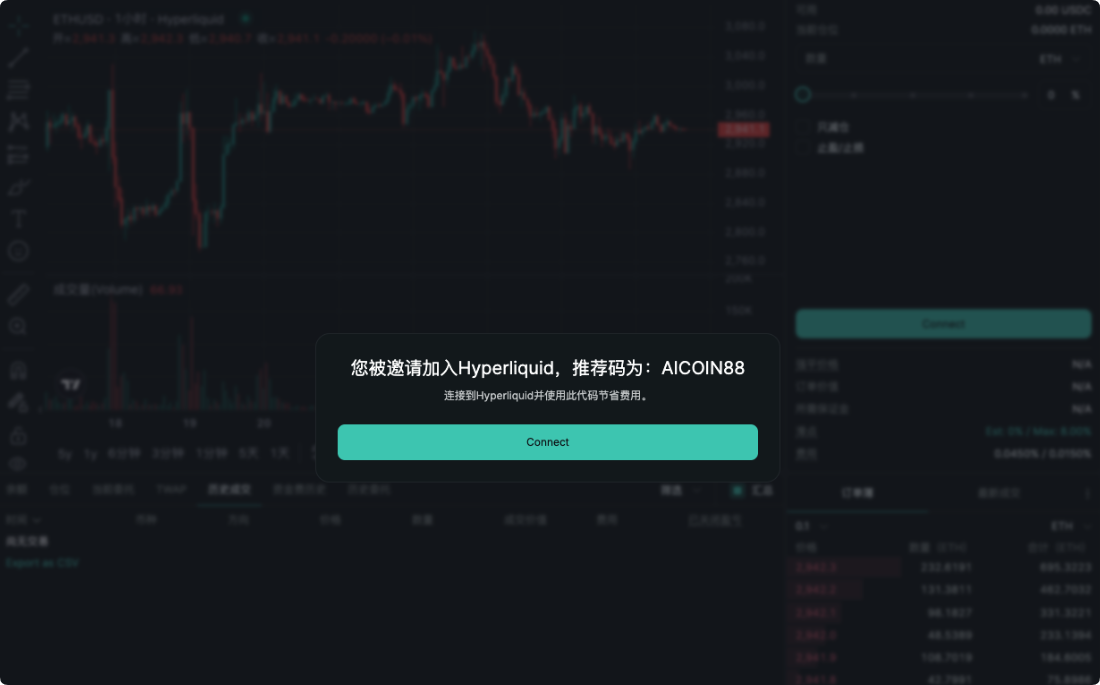
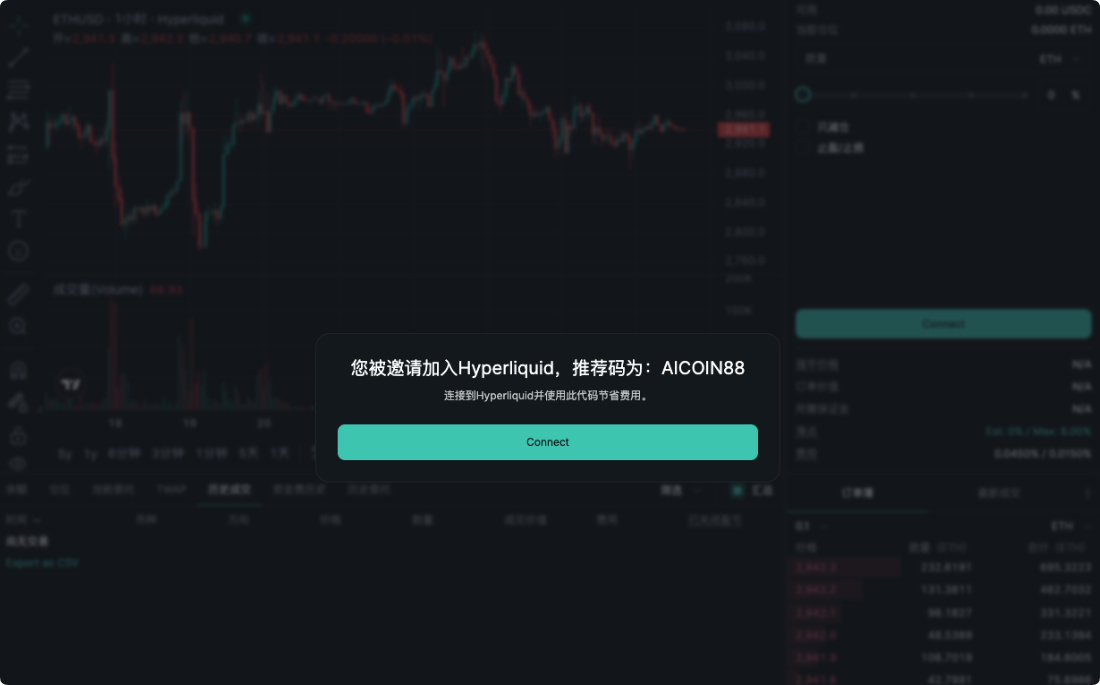
By connecting Hyperliquid through the exclusive AiCoin entrance and using the invitation code AICOIN88, users can receive 4% fee rebates:
Exclusive link: https://app.hyperliquid.xyz/join/AICOIN88
The rebates can help reduce some trading costs that comply with the activity rules, but cannot offset leverage, funding rates, slippage, smart contract, or liquidation risks.
Conclusion: The biggest change is that professional funds finally have a second answer
Binance still boasts a larger comprehensive business, broader user coverage, and a more complete centralized service system.
Hyperliquid does not automatically replace all CEXs with its $9 billion quarterly average open interest.
But the past binding relationship of “to achieve professional execution, one must accept centralized custody and closed ledgers” is beginning to be dismantled.
Hyperliquid has proven that an on-chain order book can handle trillions in annual perpetual transactions; traders can retain self-custody and public settlement in an experience close to that of CEX; institutions can also access independent custody, third-party fronts, and potentially forthcoming regulated entry points.
A true challenger does not necessarily take first place immediately, but makes the first place lose its status as the "only option" for the first time.
Therefore, the competition between Hyperliquid and Binance is not just a race on a trading volume leaderboard.
It represents a confrontation between two market structures: one that keeps assets, orders, and settlements internal to the platform; the other that creates execution as an open, transparent infrastructure callable by multiple entrances.
The future may not be a simple choice between CEX or DEX.
However, starting from institutions having a second usable answer, the power structure of exchanges has already changed.
Exclusive benefits for AiCoin users
👉 Enter invitation code AICOIN88 when binding your Hyperliquid account to enjoy a 4% fee rebate.
🔗 Exclusive registration link:
https://app.hyperliquid.xyz/join/AICOIN88
📖 Beginner's Guide:
- “AiCoin PC Hyperliquid Authorization Trading Tutorial”:
https://www.aicoin.com/zh-Hans/article/514197
- “AiCoin Mobile Hyperliquid Authorization Trading Tutorial”:
https://www.aicoin.com/zh-Hans/article/541383
- “Zero Basis Entry! Hyperliquid First Trading Detailed Illustrated Tutorial”:
https://www.aicoin.com/zh-Hans/article/510225
📖 Community Interaction:
- Telegram:
https://t.me/AiCoinWhaleData
- Discord:
https://discord.gg/D7UjAcFrah
- AiCoin Group Chat:
https://www.aicoin.com/link/chat?cid=N6OVMor5g
The content of this article only represents the author's personal views and does not represent the position of this platform. The viewpoints, conclusions, and suggestions in this article are for reference only and do not constitute any investment advice related to this platform. Investing in U.S. stocks still requires self-bearing market risks, regulatory risks, and compliance risks under local laws and regulations (especially foreign exchange controls and overseas investment reporting, etc.)
免责声明:本文章仅代表作者个人观点,不代表本平台的立场和观点。本文章仅供信息分享,不构成对任何人的任何投资建议。用户与作者之间的任何争议,与本平台无关。如网页中刊载的文章或图片涉及侵权,请提供相关的权利证明和身份证明发送邮件到[email protected],本平台相关工作人员将会进行核查。