Author: AiPlot Research Institute
Focus: RWA / Digital Assets / In-depth Analysis of Financial Infrastructure
1. Investment Conclusion: The Advantage of X Layer is Primarily Distribution, Not Scale Itself
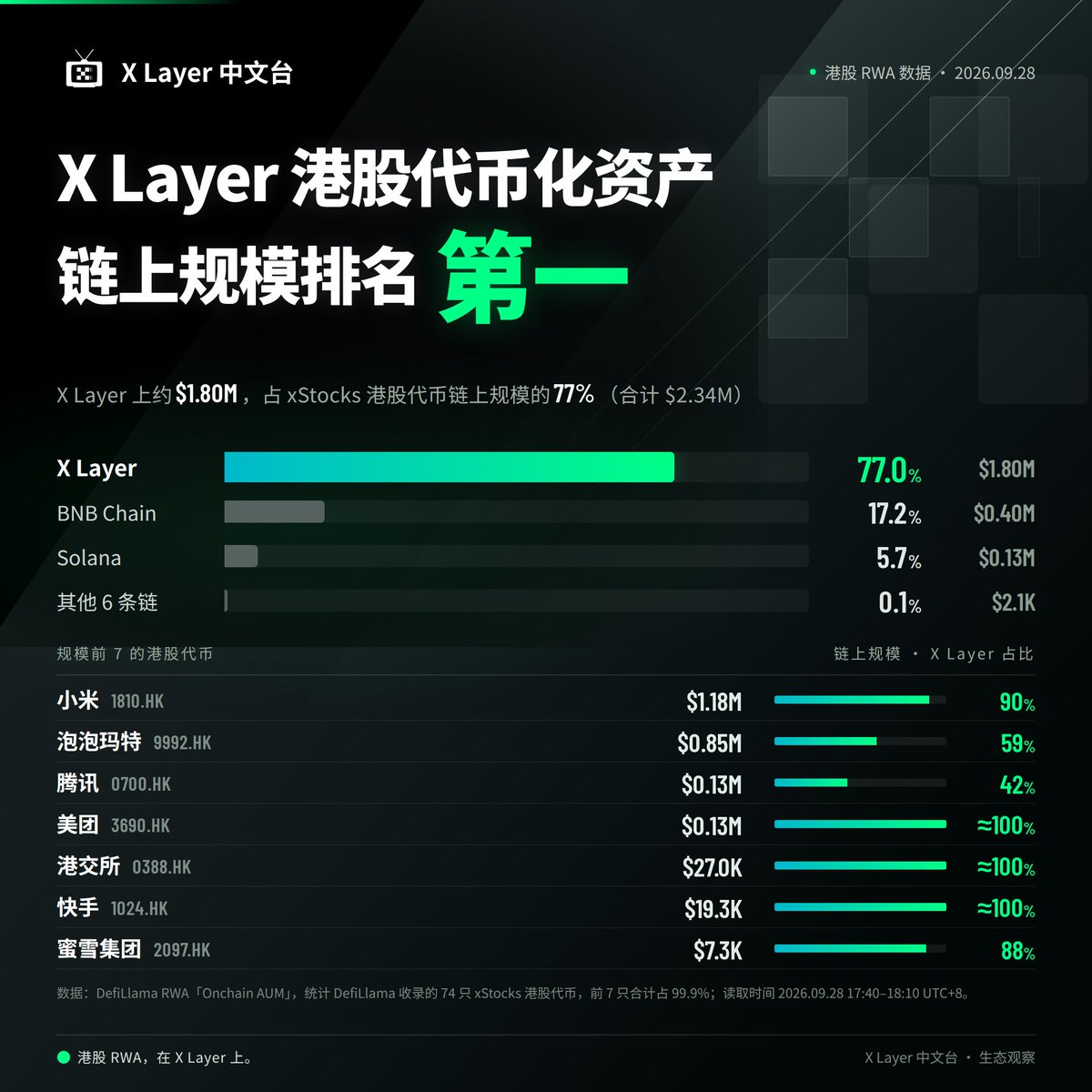
A set of data:
- The total on-chain scale of Hong Kong stock tokens is approximately $2.34 million;
- X Layer accounts for about $1.8 million, with a share of 77%;
- BNB Chain accounts for about $400,000, with a share of 17%;
- Solana accounts for about $130,000, with a share of 6%;
- Among the larger Hong Kong stock tokens, Xiaomi, Pop Mart, Meituan, Hong Kong Stock Exchange, Kuaishou, and Mixue Group lead in scale on X Layer;
- Pop Mart POPMTx has a total on-chain scale of approximately $850,000, of which about $500,000 is on X Layer, accounting for about 59%;
- The top seven Hong Kong stock tokens account for approximately 99.9% of the total scale, while the remaining 67 individual tokens have a scale of less than $1,000.
This set of data should draw two conclusions simultaneously.
First, X Layer has formed a clear network concentration. In the early stage of Hong Kong stock Tokenized RWA, asset issuance and user entry are concentrated on a specific chain, potentially generating positive feedback for liquidity, wallets, trading, and ecological incentives.
Second, the market has not yet moved beyond the early experimental phase. The total scale of $2.34 million is almost negligible compared to the traditional Hong Kong stock market; the top seven assets contribute nearly all of the asset scale, indicating that users are currently mainly buying a few high-profile and popular Hong Kong stocks, rather than systematically allocating a basket of Hong Kong stock assets.
Therefore, the current advantage of X Layer is more like:
In the early product—wallet—trading entry competition of Hong Kong stock RWA, X Layer has secured the strongest distribution position.
Whether it can upgrade to a true RWA financial infrastructure still needs to be observed with respect to the development of lending, collateral, stablecoin liquidity, and institutional asset issuance.
2. Why Hong Kong Stock Tokenization is a Separate RWA Market
1. Global Tokenized Equities are Expanding from U.S. Stocks to Regional Markets
xStocks initially focused on U.S. stocks and ETFs as primary assets, emphasizing 1:1 underlying support, on-chain settlement, cross-chain functionality, and 24/7 trading. In July 2026, xStocks announced plans to expand from U.S. stocks to international markets, with Hong Kong as its first stop, with future plans to cover markets such as the UK, EU, and South Korea.
The importance of this step is not just the addition of a few stocks, but rather the transition of tokenized stocks from the "on-chain replication of U.S. assets" stage to the "unified interface of global capital markets."
Traditional cross-border equity investment typically involves:
- Local brokerage accounts;
- Forex and local currency settlements;
- Different trading hours;
- Different securities registration and custodian systems;
- Different investor qualifications and transfer restrictions;
- Different handling of corporate actions.
If international stocks can be held, transferred, and settled through a unified token interface, it may theoretically reduce the operational friction in cross-market asset allocation. However, this does not eliminate local securities regulations and investor qualification requirements; it only standardizes some aspects of the financial infrastructure.
2. Hong Kong is a Natural Regional Testing Ground
The Hong Kong stock market has several characteristics suitable for RWA testing:
- Large enterprises with significant international investor interest;
- A connection between the market with mainland China, Asia, and global capital;
- Asset classes covering technology, consumer, internet, exchanges, and new economic companies;
- Compared to a unified global stock market, cross-border investment still faces notable account, time zone, and settlement friction.
Thus, the core value of Hong Kong Stock Tokenized RWA is not just to introduce users to Xiaomi, Meituan, or Pop Mart for the first time, but to enable these regional assets to be integrated into a unified on-chain wallet, stablecoins, and DeFi products.
3. How X Layer Achieved 77% of On-chain Scale for Hong Kong Stock Tokens
1. Synergy between Issuance and Distribution
X Layer is an EVM-compatible network driven by the OKX ecosystem, connecting OKX Wallet, trading platforms, on-chain applications, and xStocks tokenized equity assets. For early RWA, the biggest challenge is often not deploying contracts but finding users, wallets, liquidity, and trading entries.
Potential advantages of X Layer include:
- User distribution channel of OKX Wallet;
- Connections to the OKX ecosystem and trading users;
- Existing familiarity with stablecoins and trading assets;
- Cooperation with xStocks and quick listing mechanisms;
- Application access capabilities brought by Ethereum compatibility;
- Regional branding and Chinese market communication capabilities.
When the market scale is still small, distribution capability significantly outweighs the differences in underlying technology. Users may not choose Hong Kong stock tokens based on the performance of a chain's virtual machine, but because they can already see the assets in their wallets, trading entries exist, and stablecoins are accessible.
2. Chain selection for RWA is primarily channel selection
In traditional asset tokenization, competition between chains is not only about TPS, Gas, and security, but also includes:
- Who can enable qualified users to hold the assets;
- Who can place assets at the wallet and trading platform front-end;
- Who can provide stablecoin liquidity;
- Who can connect custodians, issuers, and compliance service providers;
- Who can drive assets into lending, AMM, and yield products;
- Who can allow asset issuers to continue obtaining user and transaction data.
Therefore, X Layer's current 77% share indicates that it holds an advantage in the "distribution channels of Hong Kong Stock RWA," rather than necessarily indicating that it possesses irreplaceable network effects in terms of technology.
3. How First-Mover Advantage Forms Network Effects
As early assets accumulate on X Layer, five positive feedback loops may emerge:
- Asset Effect: More Hong Kong stock tokens are listed on X Layer;
- Wallet Effect: Users use the X Layer wallet entry to hold Hong Kong stock RWA;
- Liquidity Effect: Trading depth and market-making resources concentrate on X Layer;
- Application Effect: Lending, DEX, yield, and portfolio applications prioritize supporting X Layer assets;
- Issuance Effect: New asset issuers choose networks with existing users and liquidity.
However, positive feedback can only be established if trading volume and active holders continue to grow. If scale predominantly comes from airdrops, subsidies, or single marketing events, then while on-chain AUM may be concentrated, liquidity may be insufficient, resulting in the network effects remaining at the balance sheet scale level.
4. How to Properly Understand $2.34 Million and 77% Share
1. AUM is Not Trading Volume
On-chain scale reflects token balances, estimated value, or the scale of assets included in protocols, and does not equate to:
- Daily trading volume;
- Bid-ask spreads;
- Active holders;
- Redemption capability;
- Market-making depth;
- Lending collateral balances.
A chain can have a high AUM, but if trading volume is low, holders are concentrated, or assets cannot be redeemed quickly, the RWA market remains fragile.
2. A High Market Share Does Not Mean the Market is Mature
X Layer's 77% share is quite prominent, but the denominator is only about $2.34 million. In an early market, a single wallet, an incentive program, or a major distribution channel can create significant variations in market share.
More valuable indicators for research include:
- Daily trading volume of Hong Kong stock tokens on X Layer;
- Bid-ask spreads and order depths;
- Actual number of holders of the assets;
- Net issuance versus net redemption of assets;
- Stablecoin balances and cross-chain liquidity;
- Trader retention rates;
- Whether there are second and third liquidity centers apart from POPMTx;
- Whether RWA has entered lending protocols as collateral.
3. Asset Concentration Indicates Users First Buy “Familiar Stories”
The top seven assets account for about 99.9%, indicating that the Hong Kong stock token market is currently not evenly distributed but highly concentrated on a few well-known companies. Xiaomi, Pop Mart, Meituan, Hong Kong Stock Exchange, Kuaishou, and Mixue Group have brand recognition, topicality, or industry representation, making it easier to attract early funding.
This is similar to the pattern in the early crypto market where users first traded top assets. However, for RWA to form long-term value, it must expand from “star asset trading” to:
- Broad-based portfolios;
- Sector baskets;
- Dividends and corporate actions;
- Lending and collateral;
- Institutional portfolios;
- Cross-asset allocation.
5. POPMTx: Why Pop Mart has Become a Liquidity Sample for Hong Kong Stock Tokens
X Layer officially noted POPMTx: with a total on-chain scale of approximately $850,000, about $500,000 of which is on X Layer, accounting for around 59%.
Pop Mart is a worthy case to study because it has:
- Clear brand recognition;
- High topicality and community dissemination;
- Relatively easy-to-understand consumer business;
- Connections to meme culture, IP, and collectible consumption;
- Price elasticity sufficient to attract the attention of crypto users.
The post also mentioned that a meme project priced in Pop Mart tokenized stocks on X Layer is currently being spread. This indicates that there may emerge a new combination in Hong Kong stock RWA:
The underlying asset is tokenized stocks, and the outer layer of application involves memes, trading, and community culture.
This could have dual effects:
- Meme enhances asset visibility and trading frequency;
- Tokenized stocks provide a recognizable real asset anchor for memes.
However, this may also increase risks. The price and liquidity of POPMTx could be influenced by four factors: the underlying Pop Mart stock, the xStocks issuance mechanism, the X Layer ecological incentives, and meme sentiment, suggesting that the RWA label should not be misunderstood as a low-risk label.
6. What Steps are Missing from “Hong Kong Stock Token” to “On-Chain Hong Kong Stock Market”
1. Trading Liquidity
The number of assets does not equate to market depth. X Layer needs to establish continuous market-making, cross-platform liquidity, and stablecoin trading pairs; otherwise, users can only buy but cannot sell at reasonable prices.
2. Corporate Actions
Hong Kong stocks involve corporate actions such as dividends, rights issues, stock splits, offerings, buybacks, and suspensions. Whether tokens receive economic dividends, how voting rights, ex-dividend dates, and corporate actions are handled, is an important part of asset authenticity.
3. Custody and Redemption
Users need to know who is custodian of the underlying stocks of the tokens, whether there is 1:1 support, whether issuers or holders can redeem, and how rights are protected in the event of issuer bankruptcy. Merely having stock codes and price tracking does not equate to owning the underlying securities.
4. Regulatory and Regional Restrictions
xStocks' official materials clearly state that related tokens are not offered to U.S. individuals and are subject to different regional qualifications and regulations. The availability of Hong Kong stock tokens also needs to be assessed based on the issuer, custodians, sales channels, and local securities rules.
5. DeFi Composability
The key for the next phase is not more Hong Kong stock tokens coming online, but whether they can enter:
- Lending markets like Aave;
- DEX and stablecoin liquidity pools;
- Structured yield products;
- Portfolio management and wealth management applications;
- Institutional capital and compliance custody systems.
If the Hong Kong stock assets on X Layer can be safely used as collateral for USDC or other stablecoins, the market can move from "on-chain display and trading" to "capital efficiency enhancement."
7. The Real Strategic Position of X Layer: Regional RWA Operating System
The long-term value of X Layer should not be measured solely by "the leading on-chain scale of Hong Kong stock tokens" but also by whether it can become a regional RWA operating system.
First Layer: Asset Issuance
Support xStocks and other issuers in converting Hong Kong stock companies, ETFs, funds, and bonds into on-chain assets.
Second Layer: User Distribution
Reach qualified investors in Asia and globally through OKX Wallet, trading platforms, and regional communities.
Third Layer: Trading and Liquidity
Provide stablecoin trading pairs, market makers, DEX, and cross-chain routing for Hong Kong stock tokens.
Fourth Layer: Lending and Collateral
Make tokenized stocks, funds, and other RWAs become collateral for stablecoin lending.
Fifth Layer: Institutional and Corporate Finance
Support asset managers, issuers, and enterprises in using on-chain assets to complete financing, cash management, and cross-border settlement.
Current data mainly demonstrates X Layer's advantages in the first and second layers, while the third layer still needs to be verified through actual trading depth, and the fourth and fifth layers are crucial for future valuation decisions.
8. Connection to Aave RWA Route: From Hosting Network to Financial Function
Aave's route is Crypto → Securities → Abundance Assets; the development of Hong Kong stock RWA on X Layer can be considered a regional case in the Securities stage.
Connecting both creates a complete chain:
Hong Kong stocks → xStocks tokenization → X Layer distribution and trading → stablecoin liquidity → collateral lending on protocols like Aave → portfolio and cross-asset finance.
If this chain holds, the significance of X Layer is not merely "a large scale of Hong Kong stock RWA," but rather becoming the main gateway for Hong Kong securities to enter on-chain finance.
However, it is essential to note that Aave has already supported seven types of Coinbase Tokenized Stocks as USDC collateral on Base, setting permissions, risk parameters, oracles, and borrowing limits for RWA.
Thus, for X Layer to push Hong Kong assets to the next stage, it needs to solve not just the simple access to a lending protocol, but:
- Whether qualified users can use it;
- Whether the RWA price source is reliable;
- Whether the assets have sufficient liquidity;
- How the collateral ratio is set;
- How to handle weekends, suspensions, and corporate actions;
- Whether liquidation can be truly executed;
- How the division of responsibilities is structured between issuers and protocol governance.
9. Competitive Landscape: Can X Layer's 77% Advantage be Sustained
1. Catch-up Room for BNB Chain and Solana
BNB Chain accounts for about 17%, and Solana accounts for about 6%.
BNB Chain may have a strong Asian user and trading ecosystem, while Solana offers high activity, low costs, and a robust asset trading culture. Both may compete for Hong Kong stock RWA liquidity through wallets, incentives, market making, and DeFi applications.
2. Cross-Chain Deployment May Weaken Single-Chain Moats
xStocks' official positioning emphasizes cross-chain and multi-platform distribution.
https://xstocks.fi/news/why-the-next-asset-class-for-xstocks-to-tokenize-is-the-rest-of-the-world
If the same asset can be issued and circulated on multiple chains, issuers may be reluctant to lock all liquidity into a single network.
X Layer's moat may come from three factors:
- Stronger OKX entry and user distribution;
- Deeper liquidity for Hong Kong stock tokens;
- Faster formation of trading, lending, and stablecoin application ecosystems.
If deployment is merely made first, while other chains can quickly replicate assets, then the 77% share may decrease as the market expands. Conversely, if X Layer can bind liquidity, wallets, lending, and asset issuance together, its leading advantage will have durability.
3. The Real Competition is the Closed Loop of "Assets—Users—Liquidity"
Ultimately, the competition between chains is not about AUM ranking, but:
- Why asset issuers choose this chain;
- Why users hold assets here;
- Why market makers provide liquidity here;
- Why DeFi protocols are deployed here;
- Why stablecoins settle here;
- Whether assets can achieve higher capital efficiency here.
Only with the formation of a closed loop can AUM be transformed from static balances to dynamic financial activities.
10. Risks: Small Scale, High Concentration, On-Chain Data Needs Continuous Verification
1. Data Snapshot Risks
The $2.34 million, $1.8 million, and 77% share quoted in this article are derived from the DefiLlama data snapshot dated September 28, 2026, and were relayed by the project. This data is time-sensitive and may fluctuate with asset prices, cross-chain balances, statistical scopes, and token supply changes.
2. Misalignment between Scale and Liquidity
AUM may derive from a few large holders or issuer balances, and may not necessarily represent tradable liquidity. It is essential to track trading volume, holder distribution, bid-ask spreads, and redemption capacities simultaneously.
3. High Concentration of Top Seven Assets
With the top seven assets accounting for approximately 99.9%, this indicates a high dependency of the overall market on a few assets. Any issuance, redemption, price, or compliance issues with a leading token could significantly impact the total scale.
4. RWA is Not Risk-Free Assets
Hong Kong stock tokens still carry market risks associated with the underlying stocks, issuer risks, custody risks, oracle risks, smart contract risks, cross-chain risks, and regional compliance risks.
5. Meme Influence May Amplify Volatility
The combination of POPMTx with meme narratives may increase attention and trading, but it could also lead investors to treat RWA assets as highly volatile speculative tools. The real support of the assets and price stability are two separate issues.
11. Conclusion: X Layer Has Won the First Battle for Hong Kong Stock RWA, But Not the Entire Market
As of the data snapshot on September 28, 2026, X Layer holds approximately 77% of the on-chain scale in xStocks Hong Kong stock tokenized assets, far exceeding BNB Chain and Solana.
This signifies that X Layer has achieved a clear lead in the early distribution phase of Hong Kong stock RWA, likely resulting from the combined effects of OKX Wallet, regional entry, asset collaboration, and ecological incentives.
However, this set of data does not yet prove that a mature on-chain capital market has formed for Hong Kong stock RWA. The total scale is still only about $2.34 million, and the top seven assets account for about 99.9%, indicating that the market is highly reliant on a small number of popular stocks. What truly determines X Layer's long-term value is not how many tokens it holds today, but whether it can complete four upgrades:
- Upgrading from asset listings to continuous issuances;
- Upgrading from on-chain balances to real trading liquidity;
- Upgrading from trading assets to DeFi collateral;
- Upgrading from a single RWA network to a regional on-chain capital market.
If X Layer can connect Hong Kong stock tokens with stablecoins, trading, lending, custody, and institutional asset issuance, it could become an important gateway for regional RWA in Asia. If asset scale remains concentrated in a few meme stocks and trading volume and lending demand do not increase, then "the first in on-chain Hong Kong stock RWA" is primarily an early market share label.
X Layer currently wins the entry competition for Hong Kong stock RWA; the next competition will be whether it can convert the entry into liquidity, collateral, and real financial operations.
For more data and analysis, please follow Aiplot:
📖 Community Communication:
Telegram:
https://t.me/+IIYMcJigBAo4Mjg1
The content of this article represents only the author's personal views and does not reflect the position of this platform. The views, conclusions, and suggestions in the text are for investors' reference only and do not constitute any investment advice related to this platform. The market has risks, and investment requires caution.
免责声明:本文章仅代表作者个人观点,不代表本平台的立场和观点。本文章仅供信息分享,不构成对任何人的任何投资建议。用户与作者之间的任何争议,与本平台无关。如网页中刊载的文章或图片涉及侵权,请提供相关的权利证明和身份证明发送邮件到[email protected],本平台相关工作人员将会进行核查。