Today.ai is a new work by Qi Junyuan, positioned as: Next Generation Personal Agent. Back in 2014, he purchased the domain today.ai, intending to create an AI personal assistant.
The overseas version of Today AI has been launched, and the domestic version will also be officially released.
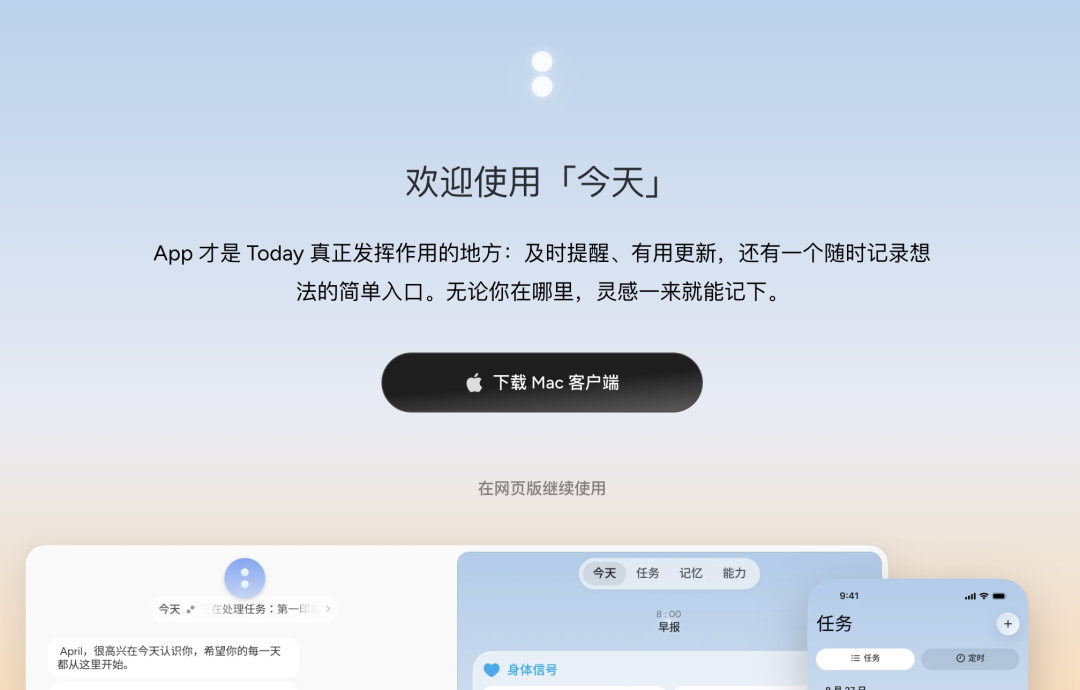
Today, I happened to visit the West Coast Dream Center, and went to their office at noon to chat with the team for over an hour, wanting to know how they built this Agent.
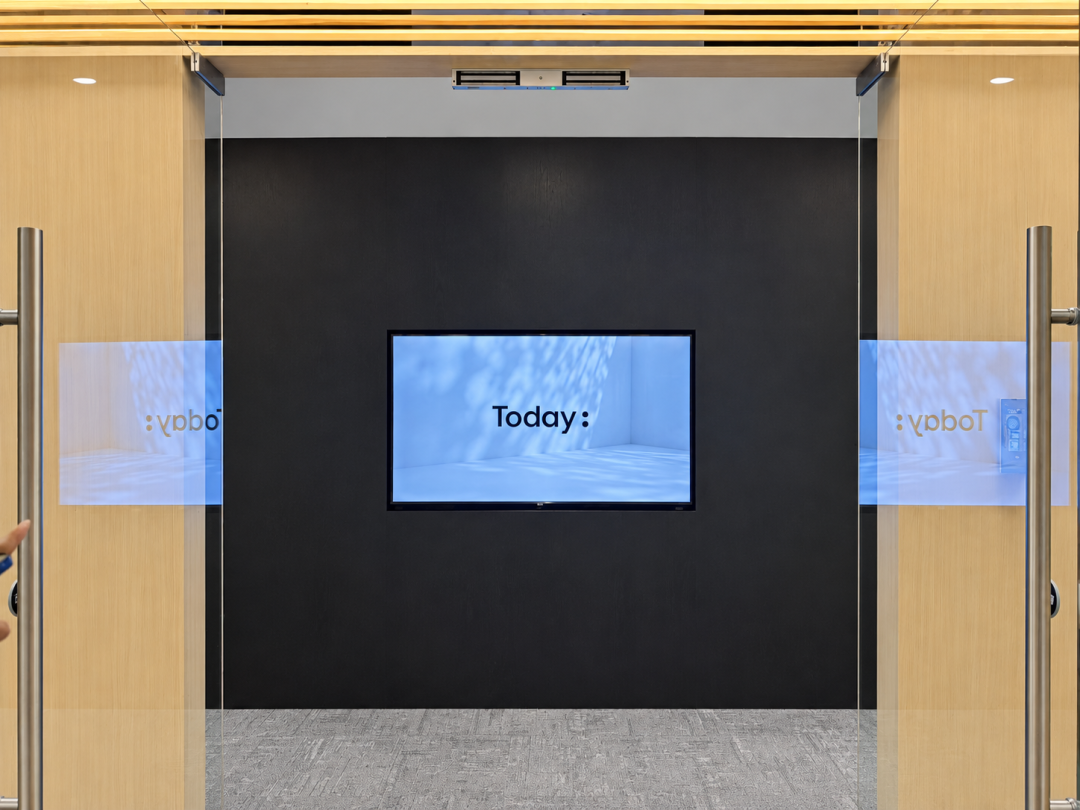 Today office entrance
What I most wanted to know was, how is Today’s understanding of Personal Agents different from other products? The team’s answer was: Long-term Memory and Proactivity.
Many Agents start from a specific task: I make a request, it calls tools, and delivers results. Today aims for the assistant to work long-term around the same person, accumulating understanding through use, affecting future arrangements, and helping judge the next worthwhile task.
In this exchange, we mainly discussed two questions: how it understands a person, and how it utilizes that understanding to proactively provide help.
This article【does not involve any actual tests】, it's just my insights from the Today team.
How Agents Understand You Better
“Once an Agent gets calendar and email access, does it understand you?” This was the question posed by the Today team.
Receiving an email often indicates that someone wants you to do something, like selling you something, meeting you, or getting you to handle tasks; conversely, emails you send out are usually more about introducing yourself, expressing your needs, or making commitments—these reflect your intentions.
These aspects are all information that an Agent can gain.
However, if it were a human secretary, they would also pay attention to behavioral information in the inbox, such as emails from certain sources that you haven't read, which is also information. Not reading doesn't necessarily mean disinterest; past interests may not always remain valid.
“If you simply write a very generic prompt and let the model remember what it considers important, the effect is usually poor.” Even with the same inbox, the memories and suggestions from two Agents could still differ significantly.
The Today team holds a view: Memory systems need to be designed for specific scenarios. What information to collect, how to understand human behavior, and what deserves to be remembered must all integrate an understanding of the scenario. Today will organize this understanding of the user in Memories, recording personal backgrounds and preferences. Subsequent interactions and feedback will continue to refine this memory, which will then influence future suggestions and actions.
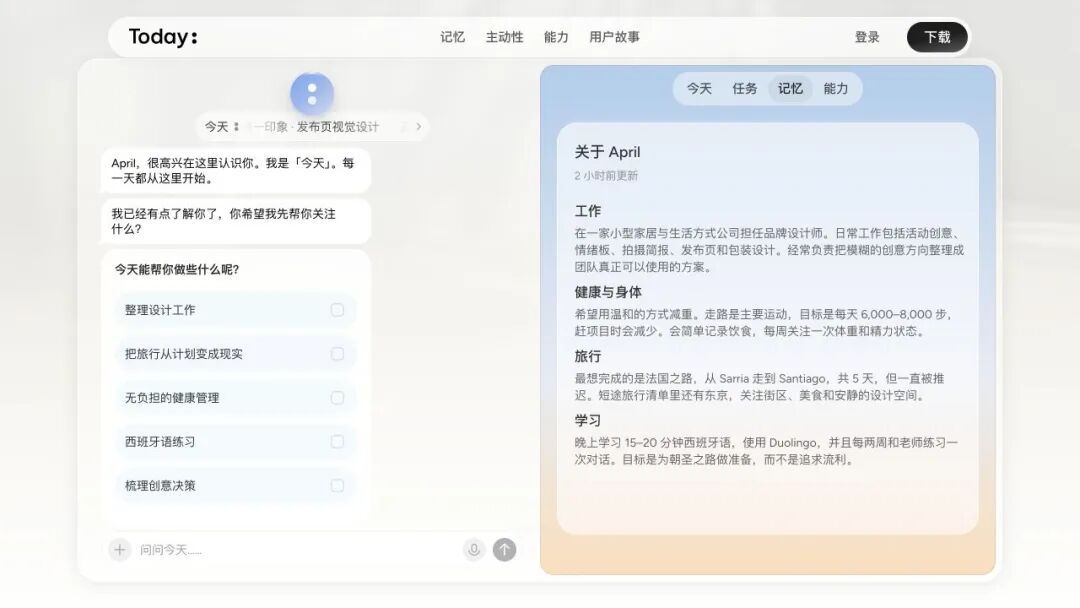 How memory organizes around work, health, travel, and learning (product example)
Upon hearing this, I became curious: “I see a lot of a priori experience here; people are only responsible for providing feedback. Will we become increasingly like a data annotation company?” The Today team disagreed with my speculation and told me: “This remains the job of product managers: if you understand a field well, integrate that understanding into the product so that more users can benefit.” For instance, information in the sent box is worth reviewing more; reading behavior is also worth documenting. These observations will impact what the system collects, how it organizes memory, and ultimately how it is used.
So I phrased it differently: A priori experience is to harness as data is to a model. They felt this phrasing was closer: Models can be the same, but understanding of people differs, leading to different assistants being created.
North Star Metric
I asked them, from the product operation perspective, what would be the North Star metric for a Personal Agent? The answer is DAU.
The frequency with which users actively initiate queries is prioritized very low. What they care most about is what problems the Agent has proactively helped users solve.
“We are making a proactive Agent, hoping that before users even speak up, the Agent has already taken care of things.” If the assistant understands my schedule, preferences, and ongoing tasks, this understanding should be utilized to reduce what I have to reiterate daily.
I have always felt that perception of time is a very important part of a Personal Agent. It needs to know what you originally planned to do, but also be aware of what has changed today.
In one of Today’s product examples, there is a scenario: you slept less than six hours last night, and there’s a brand review at ten in the morning. It will ask if you want to move today’s long-distance walk to the evening and prepare the review document first.
Memory provides the basis for Proactive.
This involves both the original plan and new developments. Today will also organize daily briefing in advance, so when users open the product, they can see what needs to be handled today.
 Proactive help and ongoing tasks (product example)
Using Today to Replace Your Foreign Teacher
Suki is Today’s PM, and she shared her language learning process with me: “For instance, my Today created a personalized language course entirely based on my current level. We first did a round of testing; after that, it set up a lot of scheduled tasks for me, telling me what to learn on Monday, Tuesday, and Wednesday.” “It will adjust the curriculum plan based on my feedback. For example, if I say I don't want to learn those words lately and want something more challenging, or change the topic, the next day's course plan will be adjusted. Its personalized part is that this tutorial is entirely for me.”
In daily life, Suki would also have Today incorporate familiar people into the course, becoming characters in it. Eventually, she found she preferred interactive learning and had it create a word game: “I feel the entire process completely replaced my foreign teacher.”
You will find that this is also a way of seeking demands: Look at what people are already spending money on. For example, when looking for a 1v1 coach, whether it's a foreign language tutor or a fitness coach, they will first understand your level, then arrange courses, follow up on learning, and adjust based on feedback. This happens to be something Agents can currently do.
A Personal AI must engage in everyday life, starting from specific needs to gain insights into human habits, while users gradually expand their usage scope. For instance, a user might come to learn a language, later asking it to help with travel arrangements. Where to travel and when to start will affect previous learning plans; the initial understanding of the person will have more utility.
Where to Go
For work Agents, whether the code runs is easy to evaluate, but for personal Agents, the situation is quite different.
Life scenarios are open-world problems and involve many subjective judgments. For example: “Help me email my neighbor to stop making noise.” Assuming the email gets sent, is this task considered a success? Perhaps not. My real need is not merely to “send an email,” but to “make them stop making noise.”
In handling this issue, factors like personal preferences, the relationship between the two parties... and so on, will influence the Agent's course of action, this brings us back to the a priori experience we discussed earlier.
For the past two years, I have experienced a sense of nihilism, and I also threw this question to the Today team: If something is created today, it may be overturned by the next wave of capability changes before it finishes its product cycle. Where should the product team focus their efforts today?
The answer given by Today’s co-founder, Gao Ce, remains Memory and Proactive.
In his view, understanding what kind of person a user has been over the long term, recent occurrences, and which tasks deserve proactive action—all of this requires the product to continuously organize and use relevant information, and cannot rely solely on the model's current working memory.
Appendix: Dreams from 12 Years Ago
The following content is an excerpt written by Qi Junyuan in 2014.
The changes brought on by mobile internet to people's lives are indeed enormous.
Product managers will forget the meetings they need to attend for the day if they leave the electronic calendar.
Moms will forget to pay the utility bills if they leave the task management app.
Media editors will miss the day's most important news if they leave the e-reader.
But do all these applications really make our lives easier?
For example, my to-do list has piled up to a few hundred items, and I lack even the courage to open it.
The unread software has become so filled that it can't even display the numbers, merely showing an infinite symbol.
The reason is simple: these tasks were not completed when I should have handled them, and later were constantly procrastinated, day after day, finally becoming an immovable massive boulder.
Therefore, our team began to build a product.
We hope it can understand all the things you need to do in a day better than you do.
From trivial to-do items to important work tasks,
from casual personal appointments to serious company meetings,
even every article that needs to be read.
Then it would gently remind you of what you should be handling at the moment.
Our expectations for it are simple: it should be simple and easy to use.
No matter who encounters it for the first time, they should be able to effortlessly create a schedule and add a task.
We have a basic requirement for it: it must adapt to your existing habits.
If you are accustomed to using Google Calendar, it should sync with Google Calendar and remind you on time.
If you are used to using Teambition for project management, it should allow you to see all tasks in the project and facilitate discussions with team members.
If you are accustomed to using Pocket to store articles you want to read carefully, it should provide the same reading experience while being more focused.
We have a beautiful expectation for it, hoping it not only makes your life more efficient but also more exciting.
Daily tech news, weekend design salons, monthly entrepreneur activities, etc.
With just a simple subscription, it will automatically remind you to participate at the right time.
We have a grand dream for it, hoping it can be so smart that it becomes your assistant.
After a few months of design and development, it has taken shape and has become the first app I check every morning.
So we named it "Today," hoping it can make your today different from yesterday.
免责声明:本文章仅代表作者个人观点,不代表本平台的立场和观点。本文章仅供信息分享,不构成对任何人的任何投资建议。用户与作者之间的任何争议,与本平台无关。如网页中刊载的文章或图片涉及侵权,请提供相关的权利证明和身份证明发送邮件到support@aicoin.com,本平台相关工作人员将会进行核查。


