Author: Motion Insight Beating
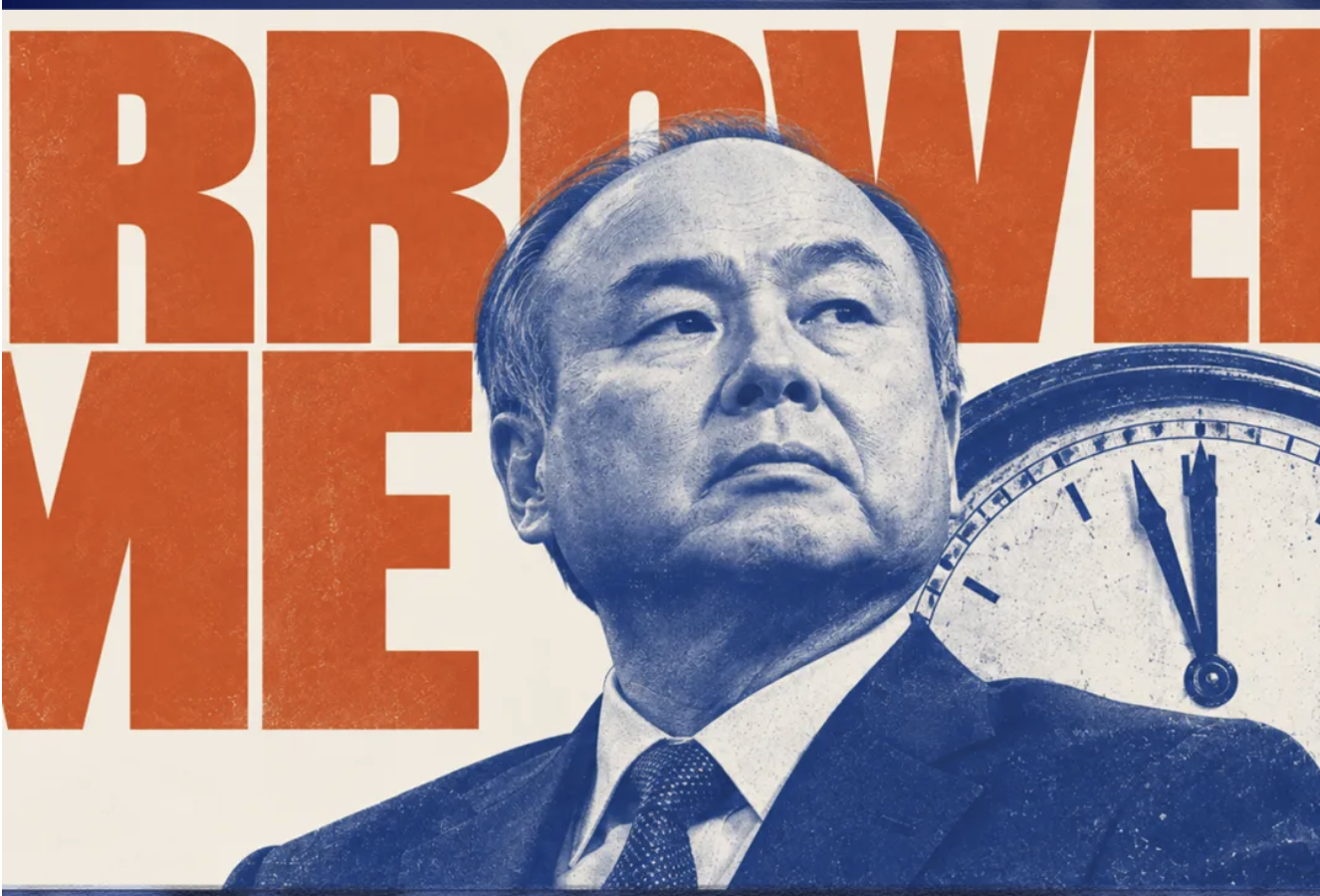
Masayoshi Son is borrowing money again.
This time it’s 10 billion dollars, plus 1 billion euros, all to buy OpenAI.
On September 21, Reuters unearthed SoftBank's latest bond issuance documents. Citigroup and JPMorgan are sitting side by side in the bookrunners section, trying to sell these high-risk notes in the public market. SoftBank's main credit rating still falls at BB+, which is a more dignified way to describe high yield bonds, but in fact, it's junk bonds.
The bond issuance timetable is very tight, with interest rates finalized on September 24, funds credited on the 29th, and immediately on October 1, this money must be transferred intact into OpenAI's account. This is the third investment tranche as agreed between both parties.
Billions of dollars will pass through SoftBank's accounts, staying for only two days.
A tech mogul claiming to see thirty years into the future is counting his cash flow by the day.
He never rushed like this for big deals before. Meeting Jack Ma in 1999, he invested 20 million dollars. At that time, everyone thought he was crazy, but he was using his own idle money, the outcome was his to bear, and he could wait a full fifteen years.
Back then, time was on his side.
Now, it has all reversed. The big narrative of changing the world is still on display, but underneath, he is racing against the calendar before each repayment deadline arrives.
Chips Locked in the Drawer
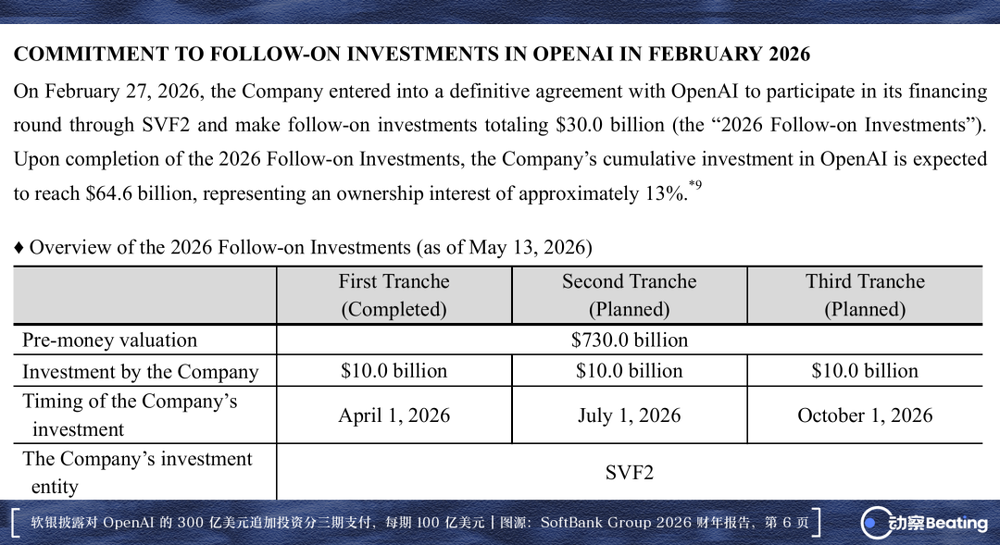
On February 27, SoftBank signed the final agreement with OpenAI.
A total investment of 30 billion dollars was divided into three tranches, each exactly 10 billion dollars, with deliveries scheduled on April 1, July 1, and October 1. Once the final payment is settled, the total amount SoftBank will have invested in this company will reach 64.6 billion dollars, translating to about 13% equity.
64.6 billion dollars is double what SoftBank spent to acquire Arm in 2016.
In this round, OpenAI's pre-investment valuation soared to 730 billion dollars, far surpassing SoftBank Group's own market value. The staggered payments were the result of compromise; OpenAI secured its cash flow for the next six months, while SoftBank carved out breathing space for itself.
But the price is that every three months, SoftBank has to arrange another 10 billion dollars among financial institutions.
What drove Masayoshi Son to make this decision was a roadshow document addressed to top investors.
The document showed that OpenAI expects revenues of 36 billion dollars in 2026, expanding to 350 billion dollars by 2030, with a cumulative income of 840 billion dollars over five years. A massive financing of 122 billion dollars finalized in March pushed its valuation to 852 billion dollars. Its competitor Anthropic is planning to go public, and Son, eyeing the rapidly expanding valuation, believes he has secured the most crucial seat in the era of superintelligence.
But behind this document, there are bottomless pits.
The same document predicts that during the five years from 2026 to 2030, OpenAI will accumulate a negative free cash flow of 278 billion dollars. Just the expenses for computing power and data center infrastructure will swallow 856 billion dollars, with single-item expenditures directly exceeding the total estimated revenue for the five years.
Each step of technological iteration is bleeding billions.
This is the reason it needs Masayoshi Son. A company with grand ambitions but continued losses desperately needs a buyer willing to front cash with the entire conglomerate's credit.
What SoftBank receives in return, however, is a stagnant asset.
The agreement clearly states that all the subscriptions are preferred shares, which cannot be converted into freely tradable shares until publicly listed. There are almost no institutions in the market willing to take on hundreds of billions of dollars in this arrangement. The equivalent of the 64.6 billion dollar holding certificate, before the actual IPO, is just a stack of papers locked in a safe.
Masayoshi Son is no stranger to waiting.
In 1995, betting on Yahoo, his paper profit once exceeded three hundred times, briefly elevating him to the status of the world's richest; his 20 million dollar investment in Alibaba lay dormant for over a decade, only to finally ring the bell on the NYSE.
These two fame-making battles have shaped his faith in major trends, but they also made him overlook a premise—back then, both Yahoo and Alibaba were underpinned by his own money.
His idle money could afford to be spent; the worst outcome would simply be to take a loss and withdraw. As long as he didn't leave the table, there was always a chance to wait for a miracle to happen.
In the official announcement on February 27, he spoke without hesitation:
“AI is changing the world at an unprecedented speed. OpenAI is the clear leader, possessing world-class technology and an unparalleled global user base. We are confident in its continued growth.”
He explained why he is optimistic but said nothing about the source of funds.
The grand vision belongs to the era; the cost of fulfilling it is written in another contract full of borrowing terms.
400 Billion Floating Bridge
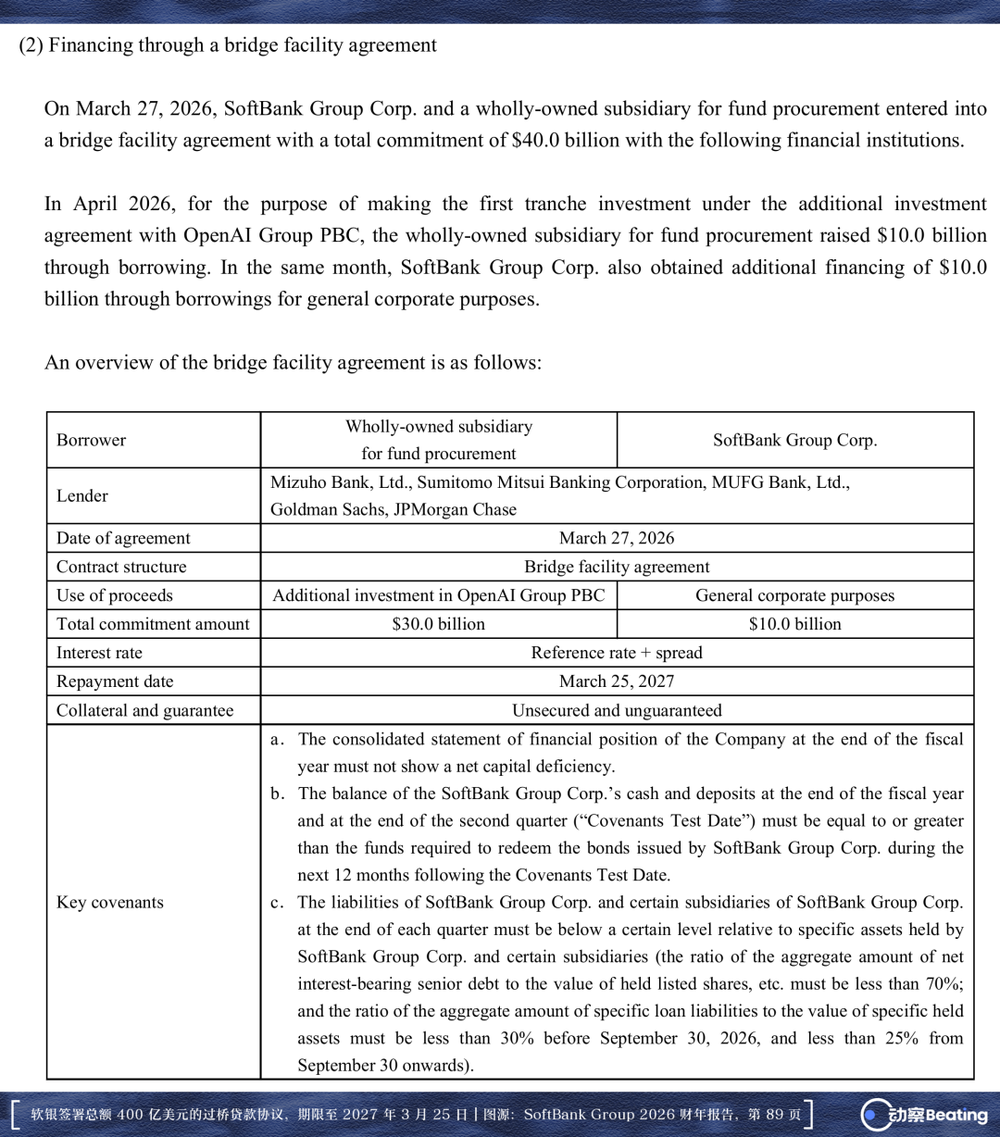
On March 27, SoftBank signed an unsecured bridge loan totaling 40 billion dollars.
Led by JPMorgan, Goldman Sachs, Mizuho, Sumitomo Mitsui, and Mitsubishi UFJ, backed by a consortium of more than twenty international banks. The whole loan had no physical asset collateral, with only a one-year term, due on March 25, 2027.
The reason Wall Street allowed this massive exposure was simply based on SoftBank's corporate credit, along with the Arm asset sitting at the bottom of the balance sheet. In the credit market, bridge loans are temporary transitional tools, aimed solely at covering gaps until long-term funds materialize.
But SoftBank's withdrawal speed was extremely fast.
On April 1, it withdrew 10 billion dollars for the first tranche, and on July 1, another 10 billion dollars for the second tranche. SoftBank also took an additional 10 billion dollars in April as liquidity reserves. The 40 billion dollar line was quickly drained to 30 billion.
September was even more subtle.
On September 9, SoftBank announced it would repay 25.9 billion dollars of the outstanding balance early on September 15. This loan had not been fully settled, and about 4.1 billion dollars still remained on the books; however, the official announcement made no mention of the source to plug this gap of over 20 billion dollars.
The swap was not a hasty move. In the initial investment announcement on February 27, SoftBank had already written that the funds would first be fronted by the bridge loan and then replaced with existing assets and long-term financing.
By the end of August, rumors spread that Mizuho was leading a 10 billion dollar two-year loan, with a margin of about 275 basis points, directly for absorbing the bridge loan. CFO Yoshimitsu Goto said during a conference call that there was no reason for SoftBank to delay the disposal until just before maturity; the replacement would only happen earlier.
What SoftBank was doing was replacing a one-year short-term debt with publicly issued bonds that would last three and a half to seven and a half years.
The goal was singular: to push the repayment dates back.
Masayoshi Son was subscribing to frontier equity that might take ten years or longer to cash out, but was paying bills with rigid debt due in a year.
This is his forte—to suppress probabilities with massive amounts of capital, making miracles happen. He once compared his investment style to using a large net for fishing rather than rod fishing.
But even the large net has its limits.
Years ago, the Vision Fund invested 11 billion dollars in WeWork, ultimately leading to liquidation, and in the 2023 fiscal year, SoftBank lost over 32 billion dollars. Even with such heavy losses, what was consumed were ultimately equity capital and fund shares; there was no creditor outside the door demanding repayment.
Fuse Hung on Valuation
What truly welded long-term technological prospects with present cash pressures was the loan signed on August 5.
This deal had been in protracted backstage negotiations since early spring. SoftBank’s initial goal was to borrow 10 billion dollars, but the investors had numerous concerns. Pricing equity for a company that isn’t even publicly listed, and whose business model isn’t fully closed-loop, is highly risky. Negotiations at one point hit a stalemate, and the loan amount was significantly reduced to 6 billion dollars.
By July, Masayoshi Son personally increased the stake, deciding that SoftBank Group would provide full legal guarantees, which finally prompted the consortium to relent and push the ceiling back to 10 billion dollars.
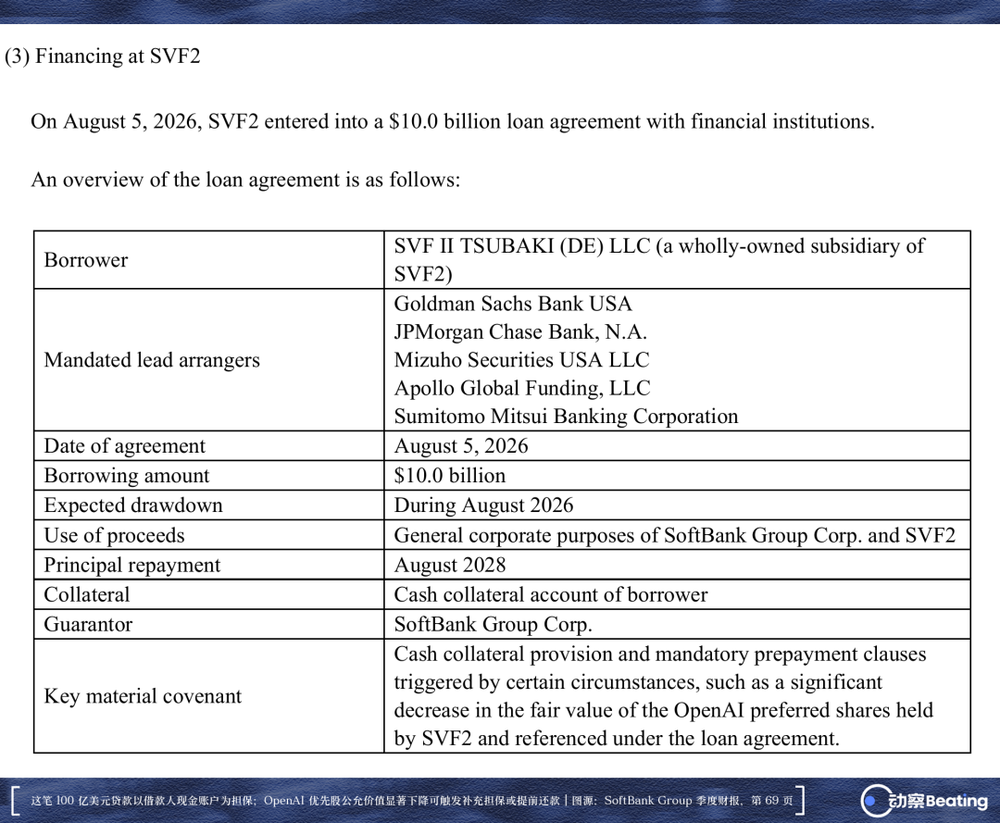
It was officially signed on August 5. The borrowing entity is SVF II TSUBAKI (DE) LLC, registered in Delaware, a wholly-owned subsidiary of Vision Fund II, with a two-year term due in August 2028. The leading banking syndicate includes heavyweights like Goldman Sachs, JPMorgan, Mizuho Securities, Apollo, and Sumitomo Mitsui.
During negotiations, the spread for this loan reportedly reached as high as 425 basis points, which was 150 basis points more expensive than ordinary loans taken to absorb the bridge loan. This reflects the risk premium that Wall Street charges for illiquid private equity. The contract specifies that the funds will not be injected directly but will be for general corporate purposes of SoftBank Group and Vision Fund II, serving as routine liquidity turnover.
External reports often summarize this transaction as SoftBank pledging OpenAI shares to borrow 10 billion.
However, the financial reports record a distinctly different structure. The legal collateral mentioned in the agreement has always been just a cash guarantee account under the borrower's name, and OpenAI shares have never actually been pledged.
That equity locked in the drawer acts as a taut slider in the entire structure. The contract specifies that if the fair value of OpenAI preferred shares referenced in the agreement significantly declines, it will trigger cash guarantee shortfall clauses and mandatory early repayment clauses.
The stock wasn’t handed over to the bank, but the price tag on the stock has become a target.
Should the valuation shrink, creditors will have the right to demand SoftBank to rapidly mobilize cash into the guarantee account or directly reclaim the loan principal and interest. At that point, SoftBank's preferred shares locked away still have no legal way to be liquidated; the stock wasn’t handed over, yet the valuation is a spring that the bank can pull at any time.
Extremely perilous.
In 2000, when the internet bubble burst, SoftBank's stock price plummeted by 90%. After that, Masayoshi Son also pledged SoftBank shares to borrow money from banks, but he was using his personal stock, which meant losses were only on his personal account, not affecting the group.
This time is completely different. Not a single share was pledged out, but SoftBank's stock price has become a metric for banks to gauge the safety of the loan. In the past, a drop in stock price only meant numbers on a balance sheet shrinking; now, if the stock price drops too much, it will directly force SoftBank to cough up cash.
This is even clearer compared to another margin loan made with Arm shares. That loan had non-recourse provisions for the group, meaning the bank could only seek repayment from Arm shares; however, for OpenAI, SBG serves as the guarantor, and Goto's words on the conference call were, “there is recourse to SBG.” When calculating LTV (loan-to-value ratio), the entire debt is counted against SoftBank Group's liabilities, with no adjustments made.
In other words, borrowing 10 billion dollars this time, the bank requires the entire asset-liability structure of SoftBank Group to back it up.
Goto stated during the call that he believed the safety cushion was “more than adequate.” But contract terms do not follow feelings; once the stock price falls below the stipulated level, SoftBank must either add collateral or repay early.
Worse, liquidity will be immediately locked up. When it comes time to add collateral, SoftBank must transfer cash into the guarantee account, which instantly freezes that money, preventing it from being used for new investments or repaying other debts.
Waiting Costs Money
When a stock price drops, extra collateral is needed, which is a problem that arises only when things go wrong. A more routine cost is the interest; as long as this money remains on the books, interest keeps mounting every quarter.
From April to June 2026, SoftBank Group and its financing subsidiary's interest expense has reached 281.65 billion yen, which is 147.3 billion yen more than the same period last year. Converted at a rate of 150, about 1.88 billion dollars.
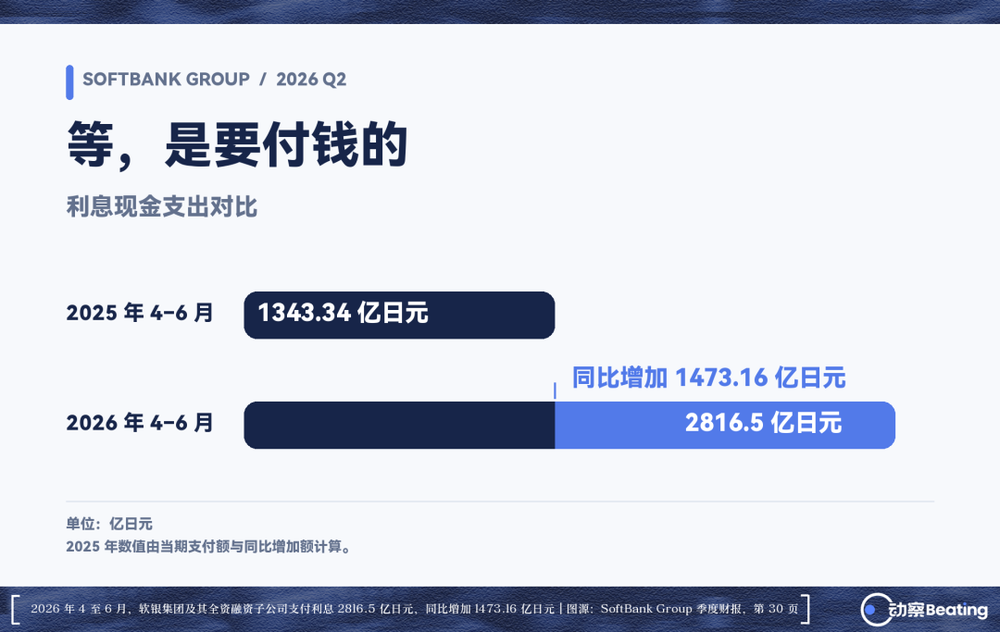
The 11.5 billion dollar Arm margin loan borrowed in December 2025, the 20 billion dollar bridge loan drawn in April 2026, and the rising balance of corporate bonds, compounded with global interest rates rising. Several large new debts stacked together, and interest has jumped to a new level.
SoftBank originally hoped that OpenAI would quickly ring the bell for public listing, which would allow the equity to be realized, making this rigid debt manageable.
However, Sam Altman stated in September to Fortune that, due to concerns about AI safety, now is an "inopportune time" to go public.
The phrase "inopportune time" translates to actual cash flow for SoftBank.
The bridge loan is due in March 2027, while the valuation-linked loan is scheduled for August 2028. Just holding 10 billion dollars of debt for an extra year, at an 8% interest rate, translates to 800 million dollars in interest.
What’s tougher is that OpenAI itself can’t stop.
A cumulative 278 billion dollar cash flow gap over five years translates to more than 55 billion a year. OpenAI's current burn rate demands round after round of financing to keep afloat.
SoftBank is the one putting in the most money; whether it can break even is entirely dependent on OpenAI reaching the public listing stage. If OpenAI runs out of money in the next round, what SoftBank has previously poured in will all go to zero.
Thus, it has no choice but to help; on one hand, it has to continue paying interest on the money already lent, and on the other hand, it needs to continue arranging funds for the next round to keep its investment alive until the IPO.
Trump Card
With so much debt, why is Wall Street still willing to lend him billions?
The answer is Arm.
This chip architecture design company, headquartered in Cambridge, UK, nearly monopolizes 99% of global smartphone processor architectures. In 2016, Masayoshi Son privatized it with 32 billion dollars in cash, raised by massively reducing his shares in Alibaba. By autumn of 2023, when it was relisted in the U.S., coinciding with the fervent demand for AI chips based on underlying computational efficiency, Arm's stock price skyrocketed nearly 270% within the year, with its market value once breaking beyond 300 billion dollars.
SoftBank still holds 90% of Arm shares, and the paper gains from this asset exceed 220 billion dollars.
Banks do not care how profound the large model is; they only recognize the hard currency in SoftBank's hands.
SoftBank’s management likes to show the market a metric: LTV (net liabilities divided by share value), used to measure the proportion of borrowing against total wealth. From March to June of this year, this figure dropped from 17% to 13%; on the surface, leverage seems to have contracted.
But this is just a numbers game.
During the same period, SoftBank's net liabilities actually rose from 82 trillion yen to 108 trillion yen. The borrowed money not only didn't decrease, but increased by a hefty 26 trillion; the so-called decline in leverage was purely due to Arm’s stock price soaring, which inflated the denominator in the formula.
However, asset appreciation does not equal cash in hand. The cash and equivalents on SoftBank's balance sheet have not only declined but have dropped from 35 trillion yen to 23 trillion yen, with cash flowing out to cover OpenAI's investment payments and repay old debts.
Relying on this passively inflated denominator, SoftBank depicts a decent sense of security in its financial reports, with the 13% level being far from the group’s 25% internal red line; S&P also upgraded its rating outlook from "negative" to "stable."
But this cannot mask the impending peak of repayments.
In the next two years, SoftBank has about 15 trillion yen of corporate bonds awaiting redemption, totaling around 900 million dollars, one payment next year and another the year after; private equity giant Apollo is also in negotiations to try to expand a NAV loan from 5.4 billion dollars to 9 billion dollars for Vision Fund II.
Wall Street is still keen to revolve around SoftBank because, at the very bottom of that balance sheet, lies Arm, which can be liquidated.
Years ago, British and EU regulators blocked Arm's merger with Nvidia, leaving Masayoshi Son with only a 1.25 billion dollar breakup fee; now, this chip company has become the last pillar supporting his entire credit chain.
On September 24, the final interest rate for the 10 billion dollar high-risk bond will be decided. This number is the public market's clear pricing of how much longer Masayoshi Son has to wait for OpenAI; the higher the pricing, the more Wall Street feels this wait is fraught with risk.
The settlement is due on September 29, and funds will be transferred on October 1. Then, the clock keeps ticking.
He waits for OpenAI to ring the bell, while creditors await to be repaid with principal and interest in March 2027.
Money does not wait for anyone.
免责声明:本文章仅代表作者个人观点,不代表本平台的立场和观点。本文章仅供信息分享,不构成对任何人的任何投资建议。用户与作者之间的任何争议,与本平台无关。如网页中刊载的文章或图片涉及侵权,请提供相关的权利证明和身份证明发送邮件到support@aicoin.com,本平台相关工作人员将会进行核查。


