Parents, sister, co-founder, investors in a chaotic battle.
Written by: Azuma, Odaily Planet Daily
With the U.S. Securities and Exchange Commission (SEC) officially releasing relevant exemption documents, asset tokenization has become one of the most prominent themes in this round of cryptocurrency recovery.
In recent years, more and more traditional financial assets, from U.S. bonds and funds to stocks, have begun to be moved onto the blockchain. Ondo, with its earlier strategic layout and faster advancement, has early on occupied the leading position in the field. However, just as Ondo's investment direction began to take off, the project suddenly encountered a problem that was completely outside of its business plan - the founder's sudden passing, and the battle for control over his estate is gradually evolving into a complex dispute involving corporate governance, family members, and even interstate courts.
The story begins in May of this year.
Founder suddenly passes away, De Bode takes over as CEO
In May of this year, Ondo founder Nathan Allman unexpectedly passed away at the age of 32.
At the time of his death, Nathan was not only the founder and CEO of Ondo but also the sole director and controlling shareholder of the company. His sudden passing left Ondo with a very direct question - who will take over the company?
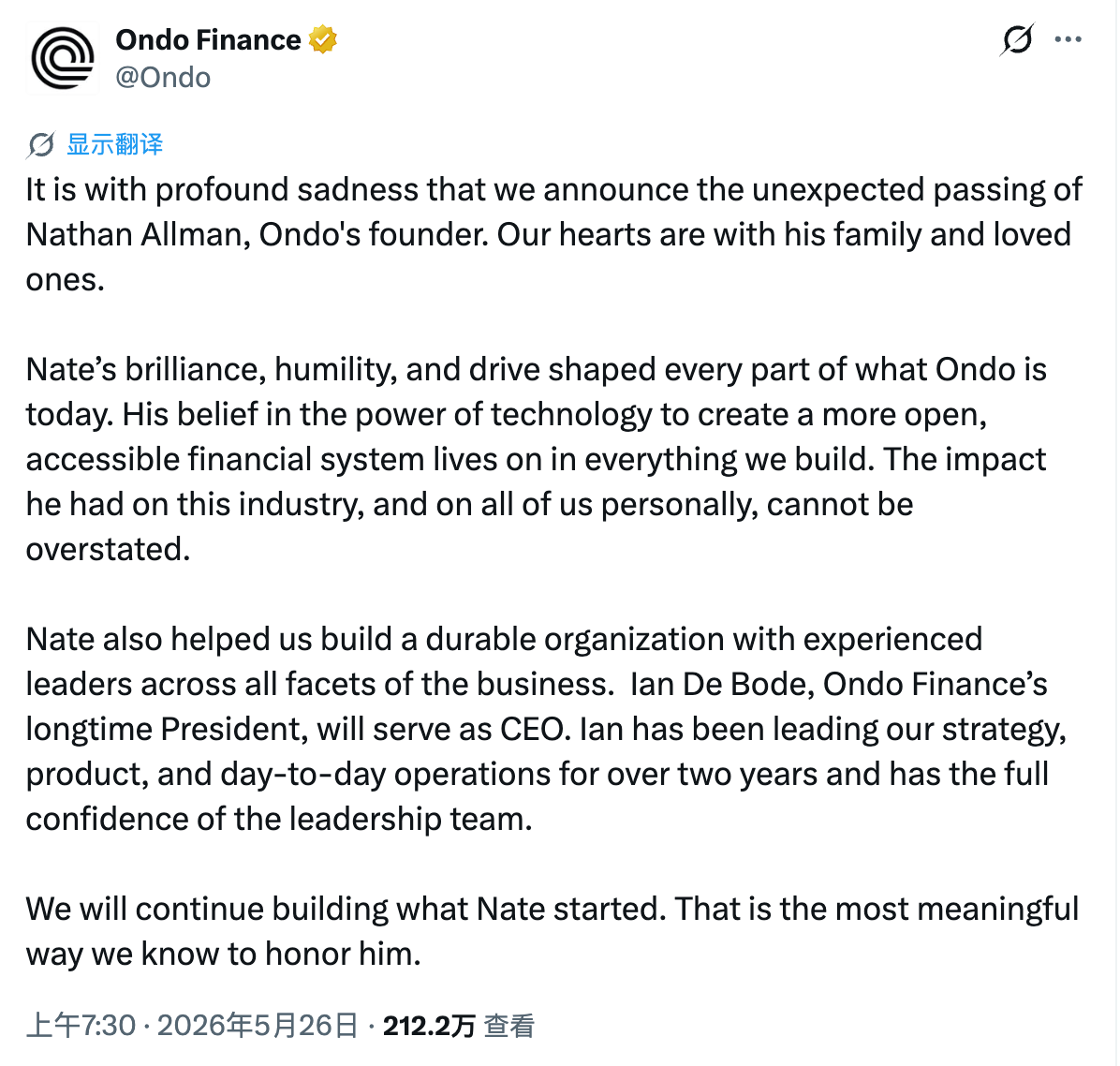
On May 26, Ondo officially announced Nathan's passing and declared that Ian De Bode, who had long served as president, would take over as CEO. The company's statement at that time was quite clear about this handover: De Bode had been responsible for the company's strategy, products, and daily operations for the past two years and had earned the trust of the management team; he would lead Ondo to continue advancing the business Nathan had founded.
From the company's operational perspective, this seemed to be a smooth management transition, but the problem is that while the CEO can be replaced, the ownership rights left by the founder cannot be inherited solely through a company announcement, and this is precisely the key to the company's long-term stable operation.
More critically, Nathan's death was so sudden that he left no will regarding future arrangements.
Parents intervene, battle for control begins
After Nathan's death, the court ruled that his mother, Kathleen Allman, and father, Lawrence Allman, were the legal heirs. According to subsequent legal documents, Nathan's estate includes his controlling interests in Ondo and a large number of ONDO tokens, both unlocked tokens and those that will be unlocked over the coming years.
In June, a Hawaii court appointed Kathleen as the personal representative of Nathan's estate. She then began to intervene in Ondo's corporate governance.
The conflict between the parties quickly became public. In July, Kathleen announced the restructuring of the Ondo board of directors as a shareholder, appointing herself as chairperson and interim CEO while attempting to remove De Bode from his positions. Nathan's sister, Tahnee Towill, was also appointed by Kathleen as a board member.
Kathleen subsequently filed a lawsuit in the Delaware Chancery Court, accusing De Bode of taking over as CEO without valid board authorization following Nathan's death, and attempting to further solidify her control.
One of the disputes involves the compensation and equity incentives package De Bode received after Nathan's death. According to the lawsuit documents from Kathleen's side, the package includes an annual salary and bonus of $900,000, a $1 million signing bonus, and 26 million restricted ONDO tokens, totaling over $11 million in value. Kathleen's side believes the arrangements are invalid and requests the court to declare the related appointments and reward arrangements legally ineffective.
De Bode, on the other hand, denies the allegations and claims Kathleen's lawsuit lacks basis, stating that the company has garnered support from major stakeholders and investors.
At this point, what was originally a management transition has officially turned into a battle for control of the company.
De Bode strikes back, family "traitor" emerging
The situation was already complicated, but in September, new developments emerged in the struggle. De Bode brought in an unexpected "ally."
On September 16, Nathan's half-sister, Lani Clinton, together with early Ondo investor David Chen (who had previously been proposed by De Bode to join the board), jointly filed with the Hawaii court seeking to establish limited guardianship over the portion of Nathan's estate inherited by Kathleen.
In the application, Lani raised a series of accusations regarding her mother Kathleen's cognitive abilities, long-term drinking, and financial management behaviors, arguing that Kathleen might no longer be capable of properly managing this portion of the estate - in addition to claiming her mother has a decades-long history of "pathological alcoholism," Lani also demanded the court obtain her mother's medical records and evaluate her for dementia.
The application also mentioned Kathleen's long-standing extravagant lifestyle, which included purchasing or attempting to purchase a Zeelander yacht worth approximately $4 million in Florida; traveling via private jet; requesting reimbursement from Ondo for a six-figure flight expense from Hawaii to California; and staying at a luxurious residence costing about $4,000 per night...
Chen also disclosed a text message from Kathleen, in which just nine days after her son’s death, Kathleen attempted to ask the company for money: "Hi, I believe everything will be resolved over time, but my biggest concern right now is cash flow, liquidity! The sooner, the better! For example, I have a $200,000 bill from a Newport pool contractor. I really want to buy that... yacht and other things."
Since the estate represented by Kathleen includes controlling interests in Ondo and a large number of ONDO tokens, these accusations ultimately directly relate to the control of Ondo.
It should be emphasized that the above content currently belongs to one-sided accusations in the lawsuit and not facts determined by the court. Kathleen's side currently denies the related allegations, stating they are unfounded. Kathleen also believes this lawsuit is merely a further action by De Bode's camp in the struggle for corporate control, claiming De Bode and Chen are colluding to replace her with a more compliant trustee.
Thus, a corporate governance dispute originally centered around the appointment of a CEO began to transform into two intertwined legal battles: one in Delaware regarding Ondo's corporate control, and the other surrounding the management rights of Nathan's estate in Hawaii... Both are actually contending for the same core assets - Nathan's ownership and token rights in Ondo.
The struggle is not yet over, hoping for the project's well-being
As of now, this struggle is still ongoing. According to a court order from early September, De Bode continues to serve as acting CEO and retains his board seat; the new lawsuit that emerged in mid-September has further publicized the internal disputes of the Allman family.
Ondo is still advancing its asset tokenization business. An increasing number of traditional assets such as U.S. bonds, funds, and stocks are entering the blockchain, and the industry itself is still developing rapidly.
However, for a project at the forefront of this field, the founder's sudden passing has already brought impacts far beyond a management transition. The intertwining of corporate control, inheritance, and family relations leaves an uncertain future. But for all ONDO token holders, we certainly do not wish to see a rapidly growing excellent project be held back due to this unexpected inheritance dispute.
免责声明:本文章仅代表作者个人观点,不代表本平台的立场和观点。本文章仅供信息分享,不构成对任何人的任何投资建议。用户与作者之间的任何争议,与本平台无关。如网页中刊载的文章或图片涉及侵权,请提供相关的权利证明和身份证明发送邮件到support@aicoin.com,本平台相关工作人员将会进行核查。


