Author: Gemini, Deep Tide TechFlow
Many times, our response to the crypto market is that the K-line leads, with reasons to follow.
After a rise, everyone starts discussing the fundamentals and highlights of a certain project, believing that a certain point has driven the increase; and the most popular point this year, clearly, is revenue.
In the past year, the market began to blindly believe in the "protocol income" metric, attempting to estimate crypto assets using the price-to-earnings ratio logic from traditional finance.
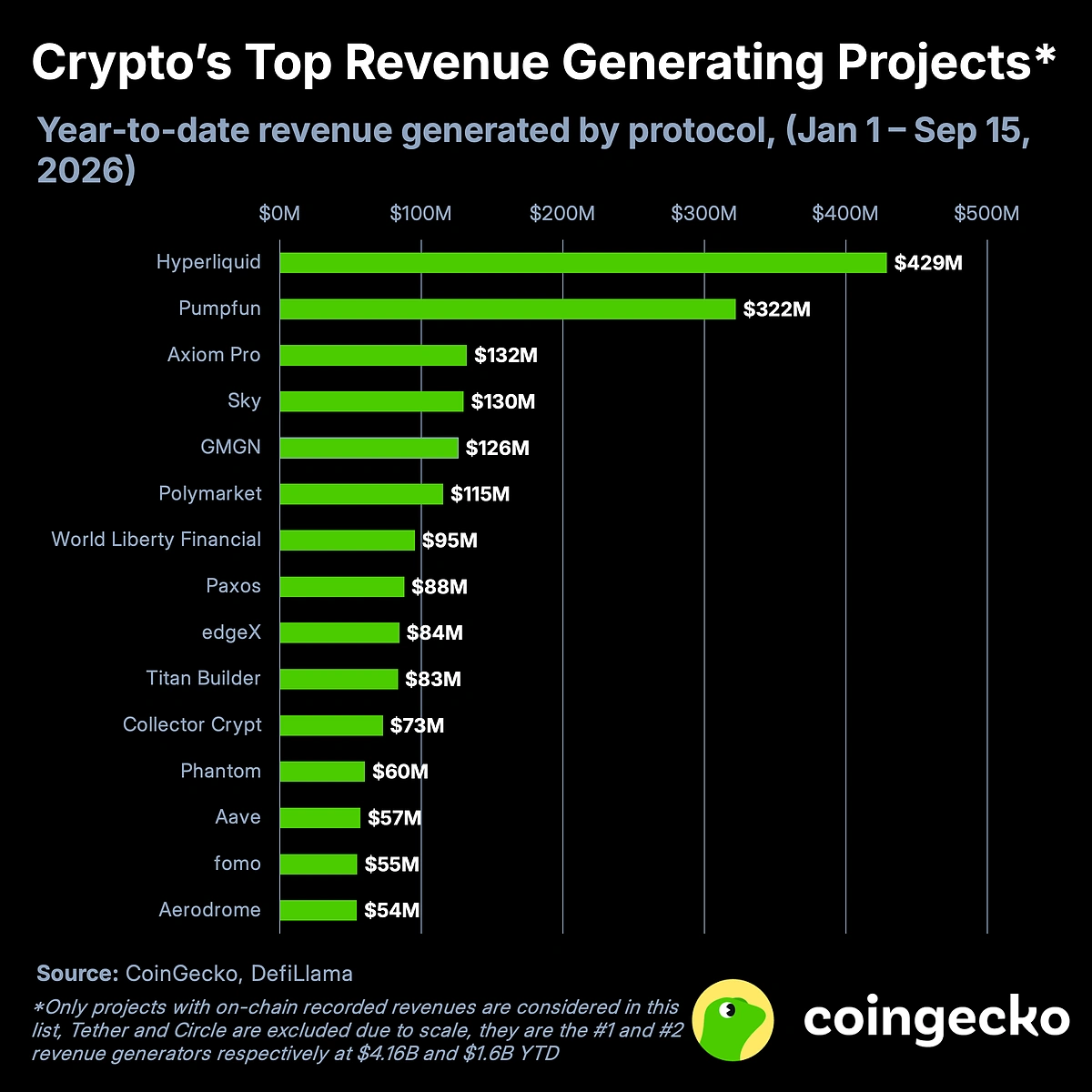
CoinGecko's 2026 Revenue Ranking revealed a highly enticing data point: in the first 8 and a half months of this year, non-stablecoin issuers in the crypto market generated a total income of $3.4 billion, with the top fifteen taking 56% of it.
However, if we place the astonishing income of these protocols alongside the prices of their tokens during the same period, we uncover a cruel truth: while the protocols are earning hand over fist, some holders in the secondary market may be experiencing endless declines.
The data from the top of the ranking proves that in the existing competitive crypto market, there are only two strong real demands:
Leverage trading and extreme speculation.
Hyperliquid and Pump.fun dominate the top two positions with $429 million and $322 million in annual revenue, respectively, collectively accounting for 22.1% of the total network revenue share.
But the most Alpha-value discovery on the list is not the underlying protocols, but Axiom Pro (third, $132 million) and GMGN (fifth, $126 million).
These two projects are not traditional on-chain smart contracts, but rather trading terminals. Axiom Pro relies on connecting to Hyperliquid for convenient derivatives trading, while GMGN capitalizes on the Pump.fun and Robinhood memecoin craze to siphon users.
In today's crypto market, value capture has become very evident, “Fat Frontend” is directly taking away the real transaction fees from users, and the ability to attract traffic has surpassed that of the vast majority of established DeFi protocols.
Why are half of the projects on the list “irrelevant to you”?
When you attempt to “buy into income-generating protocols,” you must recognize that nearly half of the projects in the top fifteen on the list have no way to support these income expectations or their income structures are completely unrelated to the on-chain tokens.
For example, ranking eighth is Paxos ($87.93 million) and seventh is World Liberty Financial ($95.37 million); their huge revenues are essentially “off-chain asset spread,” meaning profiting from interest on real-world assets. This net profit belongs to the issuing entities, and on-chain token holders have no right to dividends. Similarly, projects like Phantom (wallet, ranked 12) and Titan Builder (MEV, ranked 10) have excellent cash flow business models; they do not need to raise funds by issuing tokens, and naturally, there are no tokens in the secondary market to price these revenues.
Valuation Trap: The Double Squeeze of Value Capture and FDV
For projects that have actually issued tokens, income levels are not the only standard determining token prices.
Comparing data from the beginning of the year to now, HYPE has surged about 218%, PUMP has also increased about 83.6%, but Sky (nearly $130 million in revenue), which is also at the top of the list, has only slightly risen 0.8%, Aave ($56.81 million in revenue) has fallen 17.8%, and World Liberty Financial’s WLFI has plummeted over 61%.
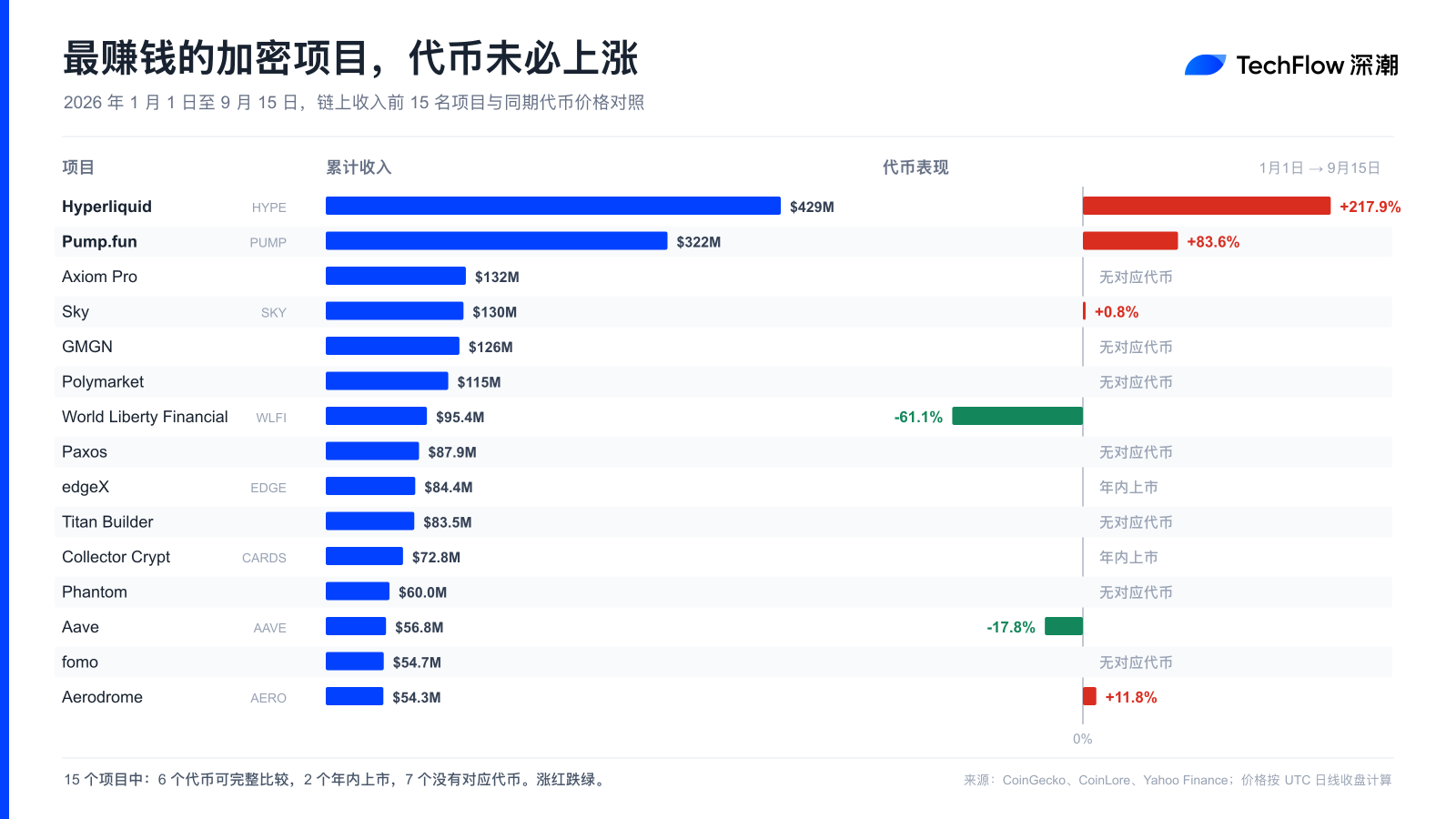
This divergence stems from the fracture of “value capture.” Charging fees for protocols is one thing, where this money flows is another. If tens of millions of dollars in income are all retained in the project's treasury, without converting into real buy orders through buybacks, burns, or dividends to stakers, then this income offers no support for the token price.
Moreover, many high-revenue projects are in a high-inflation cycle, releasing large amounts of unlocked tokens in the secondary market with extremely high fully diluted valuations (FDV). When the newly-added selling pressure far exceeds the buyback from income, the dollar revenue on the financial statements is absolutely powerless to prevent price declines.
So, stop being blindly superstitious about the “protocol income” on the data dashboard. Before paying for high-income protocols, traders not only need to see how much money it earned but also need to understand how this money was earned, and most importantly, whether this money will be distributed to token holders.
免责声明:本文章仅代表作者个人观点,不代表本平台的立场和观点。本文章仅供信息分享,不构成对任何人的任何投资建议。用户与作者之间的任何争议,与本平台无关。如网页中刊载的文章或图片涉及侵权,请提供相关的权利证明和身份证明发送邮件到support@aicoin.com,本平台相关工作人员将会进行核查。


