Robinhood CEO Vlad Tenev thinks crypto is about to do to sports betting what Robinhood once did to Wall Street commissions: eat its lunch.
Speaking with Jim Cramer on CNBC's "Mad Money," Tenev said crypto-linked contracts are already grabbing an outsized slice of Robinhood's prediction markets business. He expects sports wagers to fall into the minority within a few years.
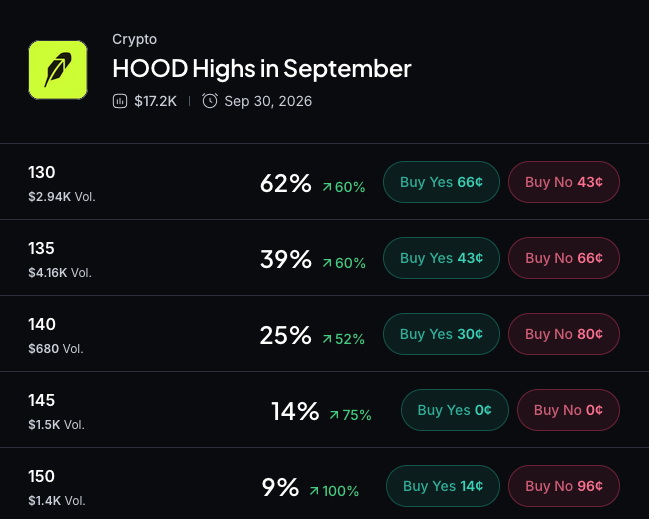
Myriad: How high will Robinhood stock go? Click to make your prediction.
Prediction markets, also called event contracts, let people trade yes-or-no bets on whether something will actually happen—a Federal Reserve rate decision, an election, a football game—instead of placing a wager through a sportsbook. The trades are regulated as derivatives by the Commodity Futures Trading Commission, the federal agency that also oversees futures and options, which is the exact distinction Tenev leans on to argue this isn't just gambling with better branding.
"We're already seeing other categories like crypto taking a disproportionate share," Tenev told Jim Cramer. "I think within a few years, sports will actually be in the minority, similar to active trading at large."
He called sports contracts a "wedge" that got the whole business moving. "Sports has been a great tool to bring people in, get liquidity, get interest, establish," he said, "but I think the industry is also expanding far beyond sports."
The numbers back the pivot, even if the timeline is still Tenev's own bet. Event-contract revenue at Robinhood surged more than tenfold year over year to $156 million in the second quarter of 2026, making prediction markets the company's fastest-growing business line while crypto trading revenue actually fell. Contracts traded 4.7 billion times in August alone, roughly 15 times the volume from a year earlier.
Robinhood built its event-contract hub on top of Kalshi, the exchange that fought and won a legal battle against the CFTC to offer election-related contracts. Robinhood then layered on Rothera, its own CFTC-licensed joint venture with trading firm Susquehanna, tested during this year's World Cup. This month it went further, taking minority equity stakes in Crypto.com and its prediction-market spinoff OG.com, adding a third partner to clear and settle trades.
Competition for that same pie is getting crowded. CME, Coinbase, and a handful of decentralized platforms are all racing to sign up traders for event contracts, a category crypto-native platforms like Polymarket helped popularize years before Wall Street brokerages showed up.
Tenev frames all of it, sports and crypto contracts alike, as one bet on ownership.
"We believe that ownership is essential, not just because if people are owners, they have skin in the game, they can benefit financially, but also a society where more people own high quality financial assets is inherently a more stable society," he said. It's the same pitch he uses to justify Robinhood's 3% match on retirement contributions.
Crypto contracts fit that pitch neatly because they turn an opinion into a trade. "You can directly, with prediction markets, monetize an idea or an insight," Tenev said, pointing to the Clarity Act, a bill in Congress that would settle which federal regulator polices digital assets, as an example.
"If you have a particular view on crypto market structure legislation, the Clarity Act, we have a market on that."
Not everyone in Washington is cheering, especially because the whole “we have a market on that” sounds too much as “we let you bet on anything.”
Lawmakers have introduced more than 10 bills since January targeting prediction markets, including the PREDICT Act, which would ban members of Congress and senior officials from trading contracts tied to political events. Critics argue that stacking sports and political wagers next to retirement accounts blurs the line between investing and gambling, a tension regulators are still sorting through.
Tenev isn't waiting for that debate to settle. His own math points to a specific milestone instead where sports contracts became the minority of Robinhood's event-contract business within, in his words, "a few years."
免责声明:本文章仅代表作者个人观点,不代表本平台的立场和观点。本文章仅供信息分享,不构成对任何人的任何投资建议。用户与作者之间的任何争议,与本平台无关。如网页中刊载的文章或图片涉及侵权,请提供相关的权利证明和身份证明发送邮件到support@aicoin.com,本平台相关工作人员将会进行核查。


