Author: Bitrace
There are organized crime networks in East Asia and Southeast Asia that have distinct regional characteristics, cultural attributes, and industry vertical languages, which constitute a high barrier to understanding for investigators and researchers—especially those who are unfamiliar with Chinese and Chinese culture.
Bitrace plans to continuously disclose and analyze this part of industry jargon to assist relevant personnel in better performing their work. This article is the second piece in this series, introducing the proprietary term in the Chinese online cryptocurrency money laundering field—Liao.
Liao Laundering
Liao has different meanings across various black and gray production verticals, specifically referring to legal currency related to illegal activities such as fraud extortion, online gambling, and human trafficking in the cryptocurrency money laundering field. In most cases, it pertains to the electronic balance of bank accounts or other financial platform accounts waiting to be laundered.
Currently, there are various forms of laundering for Liao, including Card-to-USDT, QR-to-USDT, Cash-to-USDT, Cash-to-MaterialAssets (usually precious metals or other high marketability goods), etc. Despite the different forms, the underlying logic is consistent—converting traceable electronic legal currency into untraceable cryptocurrency, goods, or cash to evade law enforcement or scrutiny from financial platforms.
This article will use the most common Card-to-USDT as an example for explanation.
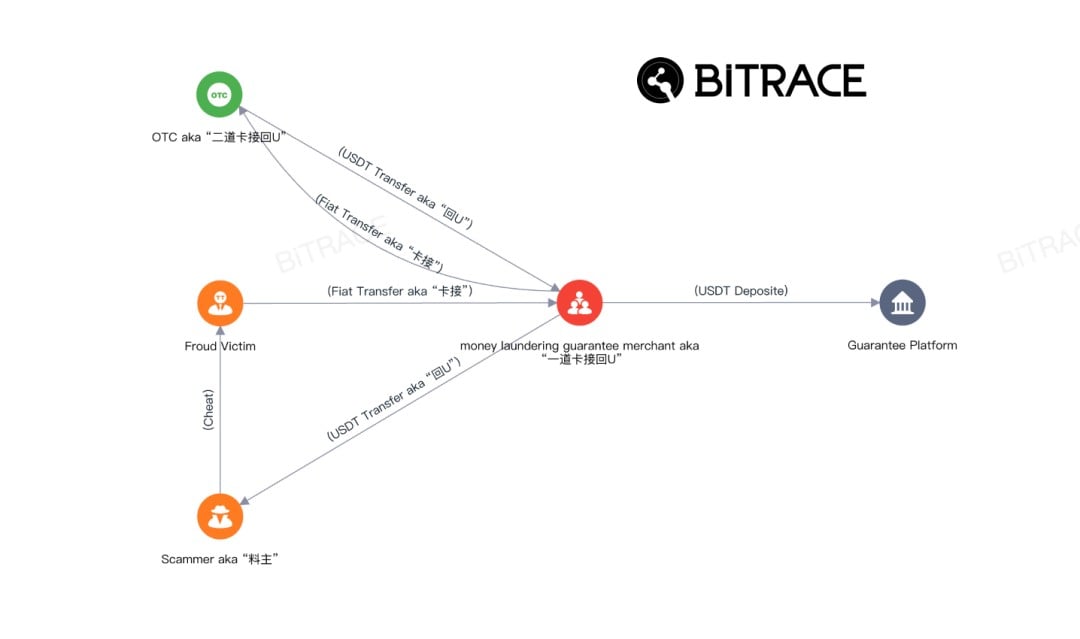
In a typical money laundering model for emotional fraud cases, a first-hand Card-to-USDT public group merchant needs to first stake on the guarantee platform and then accept orders to collect direct legal currency funds from victims using a bank card, later purchasing USDT at a high price from a cooperating second-hand Card-to-USDT public group merchant, eventually transferring part of the purchased USDT to the fraudsters. In this case, the first-hand and second-hand merchants jointly completed the laundering and earned revenue, but the actual money laundering activities are far more complex than this case, with deeper levels and more varied currency exchange methods.
In general, the lower the level, the closer it is to the victim, the higher the probability of the funds being judicially frozen, making first-line money launderers easier to apprehend, allowing laundering merchants to earn a higher percentage of commission income. In other words, first-hand Liao is more dangerous than second-hand Liao.
Type of Liao
In the previous chapter, we learned that Liao can be risk-classified according to different laundering stages, and the market pricing of laundering services corresponding to each stage. In this chapter, we will introduce more classification methods for Liao.
Classification by victim type
Pupil Liao: Refers to the defrauded funds from elementary school student victims; fraudsters usually approach the victims under the guise of video game recharges, idol support, and threaten the victims to secretly transfer funds from their parents, or else their parents will lose their jobs or face judicial investigation;
Part-time Job Liao: Refers to establishing false communities or apps to lure victims to transfer funds to specific accounts or purchase designated fake goods under the pretext of earning extra money; this type of fraud primarily targets groups such as stay-at-home moms and university students;
Se Liao or Porn Liao: Refers to inducing victims to participate in investment and financial management or tasks through prostitution or watching pornography, ultimately deceiving victims into paying funds, resulting in illegal income in this scenario;
Pig Butchering Scam Liao: Involves creating a fictitious persona to engage in online romance with target individuals, leading them to participate in fake investment projects, ultimately illegally obtaining large amounts of funds. When the victim is Chinese, this method is referred to as Pig Butchering Scam; when the victim is Western, it is called Sheep Butchering Scam.
Classification by crime type
Online Gambling Liao: Refers to the legal currency funds that gamblers deposit into online gambling platforms. These funds usually require simple laundering before circulation, commonly known as Running Point;
Ponzi Scheme Liao: Refers to the funds paid by pyramid scheme participants to their superiors in a Ponzi scheme; as Ponzi schemes can last for several months, money launderers have ample time to conduct their operations;
Chinese Authority Impersonation Liao: Refers to the funds illegally obtained by impersonating staff from Chinese public security and judicial bodies to defraud ordinary citizens. Many Chinese students have fallen victim to this method, prompting the FBI to create this translation in reports.
Liao Adulteration
The previous text briefly introduced several common types of Liao. Due to differences in illegal activities, life cycles, and victim types, the timing and intensity of judicial intervention can vary, which suggests to money laundering practitioners that different Liao have different toxicity and should be priced with different commission rates.
For example, few gamblers report themselves to online gambling platforms; gambling Liao is relatively low risk and applies the lowest commission rates. In the months before Ponzi schemes collapse, victims usually do not file complaints until it becomes impossible for the last people to recover their funds. A low rate applies initially, but a high rate applies at the end; fraud cases impersonating public security and judicial authorities generally prompt victims to quickly contact law enforcement, making funds the most easily frozen by the judiciary, thus incurring the highest laundering costs.
Thus, in the field of money laundering, there exists a relatively common deceptive behavior—Liao Adulteration, where the Liao owner claims that low-risk Liao is to be handled by the money laundering group, but what is actually delivered is other high-risk Liao. The purpose is to save on laundering costs, with the downside being that the money laundering group underestimates the toxicity of the Liao, leading to bank cards and cryptocurrency wallets being subjected to risk control.
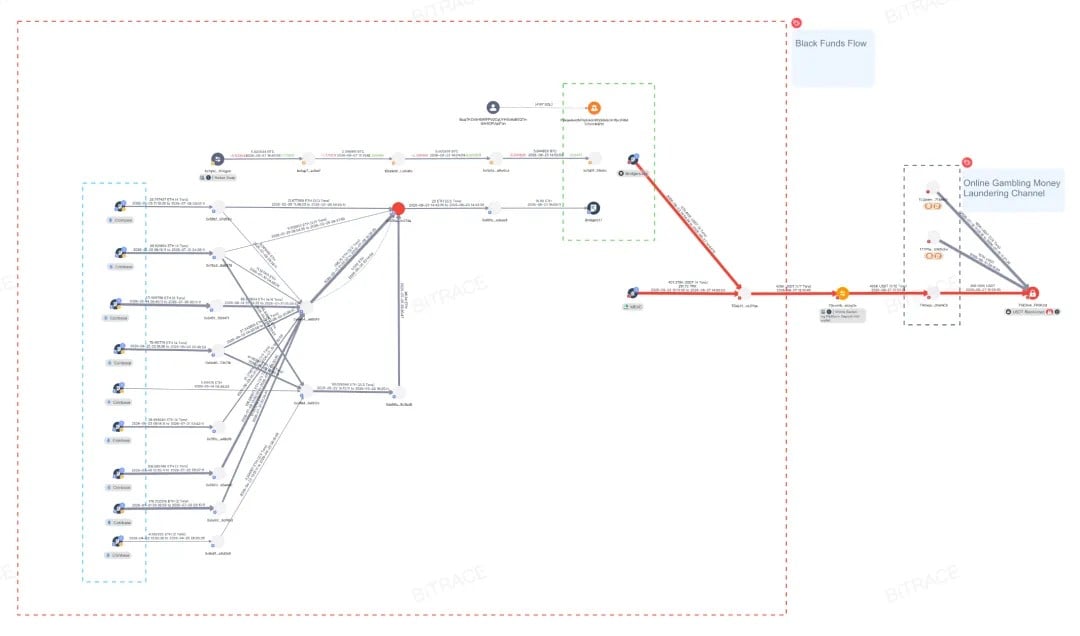
Take the Tron address TGEXn4HzdRHz83cNqGCobAzg558VFR9K2d, frozen by Tether on September 2, 2026, as an example; this address was a downstream laundering address for a gambling platform, which received a large amount of funds from a Coinbase incident. It was subjected to joint law enforcement collaboration between the exchange and Tether, ultimately resulting in a loss of over $625,000. This illustrates the consequences of Liao Adulteration.
In Conclusion
This article provides a brief introduction to the laundering methods, types of funds, and funding threats in the field of cryptocurrency money laundering from the perspective of an investigator. It aims to help researchers from different countries better mine intelligence on Chinese money laundering networks.
Exchange risk control departments and OTC practitioners should also remain vigilant to such threats to avoid their business addresses being subject to judicial restrictions.
免责声明:本文章仅代表作者个人观点,不代表本平台的立场和观点。本文章仅供信息分享,不构成对任何人的任何投资建议。用户与作者之间的任何争议,与本平台无关。如网页中刊载的文章或图片涉及侵权,请提供相关的权利证明和身份证明发送邮件到support@aicoin.com,本平台相关工作人员将会进行核查。


