Written by: Rita
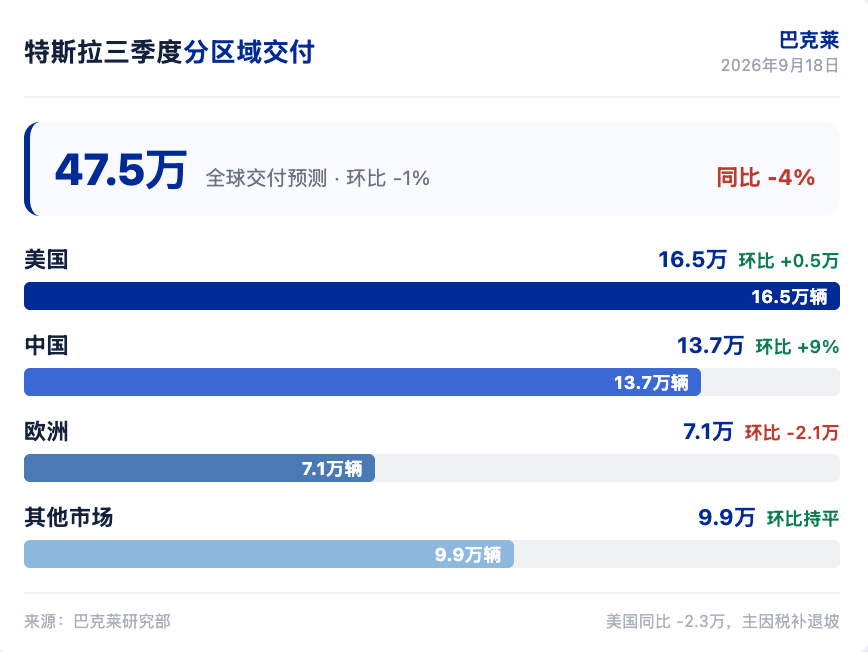
The market views Tesla as an AI company, but the growth in automotive deliveries is underestimated. In a report released on September 18, 2026, Barclays expects Tesla to deliver about 475,000 vehicles in the third quarter, a year-on-year decline of 4%, but higher than the market consensus of 466,000 vehicles. Barclays maintains a neutral rating on Tesla, with a target price of $370. The current price is $366.20, indicating an upside potential of about 1.0%.
Barclays analyst Dan Levy pointed out in the report that Tesla's fundamentals are overshadowed by AI efforts (Robotaxi, Optimus), but two areas of the automotive business remain highly correlated. The adoption rate of FSD is becoming a dual driver for sales and profit margins. Exports from the Shanghai factory are providing incremental global sales. The bank believes these two factors support the judgment that third-quarter deliveries will exceed expectations.
FSD Penetration Supports U.S. Demand
Buyers are increasingly choosing Tesla because of FSD. In the second quarter, FSD's penetration in North American deliveries exceeded 55%, far above the management's previous guidance of 20% to 30% in the mid-range. Management pointed out in the second-quarter conference call that FSD is a significant driver of demand in North America, with consumers specifically buying vehicles for FSD capabilities. In the third quarter, FSD is expected to continue driving U.S. sales, with increased attention on Tesla's autonomous driving efforts after the release of Cybercab in Austin.
U.S. deliveries in the third quarter are expected to be around 165,000 vehicles, an increase of about 5,000 vehicles quarter-on-quarter, but a year-on-year decline of 23,000 vehicles. The significant year-on-year decline is due to last year's third quarter being a peak for purchases before the expiration of the electric vehicle tax credit. Barclays believes that the incremental buyers brought by FSD partially offset the impact of subsidy declines.
Shanghai Exports as a Source of Global Increment
Barclays visited the Shanghai Gigafactory last week and reaffirmed Tesla's significant cost advantages in Shanghai. The bank believes that Shanghai exports accounted for at least 20% of Tesla's global sales this year, with many previously overlooked markets, such as Australia, Colombia, and regions in Asia outside China, now providing key sales increments.
The wholesale volume from Shanghai in July and August was 180,000 vehicles, a year-on-year increase of 19%, with exports growing by 92% year-on-year. Tesla continues to prioritize exports to support demand in Europe, Asia (excluding China), and other markets worldwide, especially in light of a weak domestic market in China. Exports supported a higher output, with production in July and August increasing by 23% year-on-year. Barclays believes that the profit margin from Shanghai exports benefits Tesla, as production costs in China are lower.
Europe Declines Quarter-on-Quarter, Increases Year-on-Year
Sales in Europe totaled about 21,000 vehicles in July and August, a quarter-on-quarter decrease of about 18,000 vehicles, a decline of 46%. Third-quarter deliveries in Europe are expected to be about 71,000 vehicles, a quarter-on-quarter decrease of about 21,000 vehicles, but an increase of about 8,000 vehicles year-on-year. Barclays points out that the quarter-on-quarter decline is expected, as August is summer holiday season in Europe, when car sales slow down. The bank expects September deliveries to account for about 70% of the total for the third quarter, higher than 57% in June of the second quarter and 63% in September of last year.
Year-on-year increases in Europe are expected to be about 8,000 vehicles, far lower than 36,000 vehicles in the second quarter and 23,000 vehicles in the first quarter. Barclays believes that European sales continue to benefit from imports of vehicles from Shanghai, which contribute to Tesla's profit margin due to lower costs in China.
Strong Wholesale, Weak Retail in China
The retail market in China is weak, with exports becoming the main source of growth. Retail sales in China for July and August were 77,000 vehicles, a year-on-year decline of 21%, while wholesale was 180,000 vehicles, a year-on-year increase of 19%, and exports grew by 92% year-on-year. Third-quarter deliveries in China are expected to be about 137,000 vehicles, a quarter-on-quarter increase of 9%, but a year-on-year decline of 19%. Tesla continues to prioritize exports to support demand in Europe, Asia (excluding China), and other markets worldwide.
Barclays expects Tesla to focus on domestic sales in China in September, in line with typical seasonal trends toward the end of the quarter. The bank anticipates September deliveries to be about 60,000 vehicles, significantly higher than the average of 39,000 vehicles in July and August. The September sales will be supported by incremental incentives. At the beginning of September, Tesla began offering new discounts of 10,000 yuan and 5,000 yuan for Model Y and Model 3 inventory vehicles delivered before the end of the month, in addition to existing promotions (paint, insurance, and financing subsidies).
Profits Steady Quarter-on-Quarter
Cost pressures and incentives are major headwinds. Barclays expects profits to remain flat or slightly decrease quarter-on-quarter in the third quarter, with a second-quarter profit margin (excluding regulatory credits and including equity incentives) of 16.3%. A slight decline in sales quarter-on-quarter poses a mild headwind for fixed cost absorption. Regional mix is expected to be a headwind, with declines in Europe and Asia-Pacific and an increase in China. Pricing and incentives are headwinds, with ongoing incremental incentives in China and financing incentives in the U.S. Raw materials present headwinds; prices of key automotive metals like steel, aluminum, and copper have risen, and inflation in gold and silver is also a headwind, as electric vehicles contain higher amounts of gold and silver than gasoline vehicles.
FSD is a tailwind. The second quarter FSD penetration rate was an unexpected tailwind for profit margins, with management noting that the FSD adoption rate exceeded 55% in North American deliveries. Barclays expects continued strong adoption rates in North America in the third quarter, with FSD potentially providing tailwinds in Europe as Tesla received temporary approvals to launch FSD in multiple countries in the second quarter, and a vote on EU-wide FSD approval is expected in October.
Maintaining Neutral Rating
Barclays expects third-quarter production to be about 480,000 vehicles, higher than the consensus estimate of 477,000 vehicles. Production in the second quarter was 452,000 vehicles. The bank expects a quarter-on-quarter inventory increase of about 5,000 vehicles, partially rebuilding the inventory decline of about 30,000 vehicles in the second quarter. Tesla plans to increase production across all factories by 2026, with a year-on-year production increase of 11% in the first half and an expected 7% year-on-year increase in the third quarter.
Barclays expects energy storage deployment of about 15.6 GWh, a year-on-year increase of 25% and a quarter-on-quarter increase of 16%. Profit margins are expected to improve from around 20% affected by warranty adjustments in the second quarter to the mid-high 20%, in line with management's long-term expectations.
Barclays maintains a neutral rating on Tesla, with a target price of $370. The bank believes that strong third-quarter deliveries will further validate that Tesla's automotive growth has reached a positive inflection point, a trend that has become more apparent after significantly exceeding expectations in second-quarter deliveries. Management pointed out in the second quarter that Tesla finished the quarter with the largest backlog of orders since 2023, indicating further growth potential ahead. Barclays will monitor whether management continues to see strong demand in the third quarter.
The FSD penetration rate and Shanghai exports are two independent supports for Tesla's automotive business, with the former validating demand and the latter validating cost advantages.

Disclaimer
This article is a compilation and interpretation of third-party broker research reports (Barclays, September 18, 2026) by ChaoXiang Research, combined with publicly available market information. The ratings, target prices, earnings forecasts and related judgments quoted in the text are the opinions of the broker's analysts and only represent the positions of their respective institutions and do not represent the views of ChaoXiang Research, nor do they constitute any investment advice.
The market has risks, and decisions should be made independently. This article should not be used as a basis for buying or selling any securities.
免责声明:本文章仅代表作者个人观点,不代表本平台的立场和观点。本文章仅供信息分享,不构成对任何人的任何投资建议。用户与作者之间的任何争议,与本平台无关。如网页中刊载的文章或图片涉及侵权,请提供相关的权利证明和身份证明发送邮件到support@aicoin.com,本平台相关工作人员将会进行核查。


