Written by: Xiaobing
On X, "Chasing Wind Lab" compiled the list of halted projects in which a16z Crypto invested this year, with a rhythmic cadence—almost one dying each month, as if someone is executing an exit plan according to the calendar.
In January, Entropy; in March, Yupp; in April, Foundation; in May, Syndicate; in June, Orchid Protocol; in July, Legend; in August, Proof of Play; in September, Linera.
Eight months, eight corpses.
According to statistics, out of the 189 projects a16z Crypto has invested in, 42 have already ceased operations or been sold off.
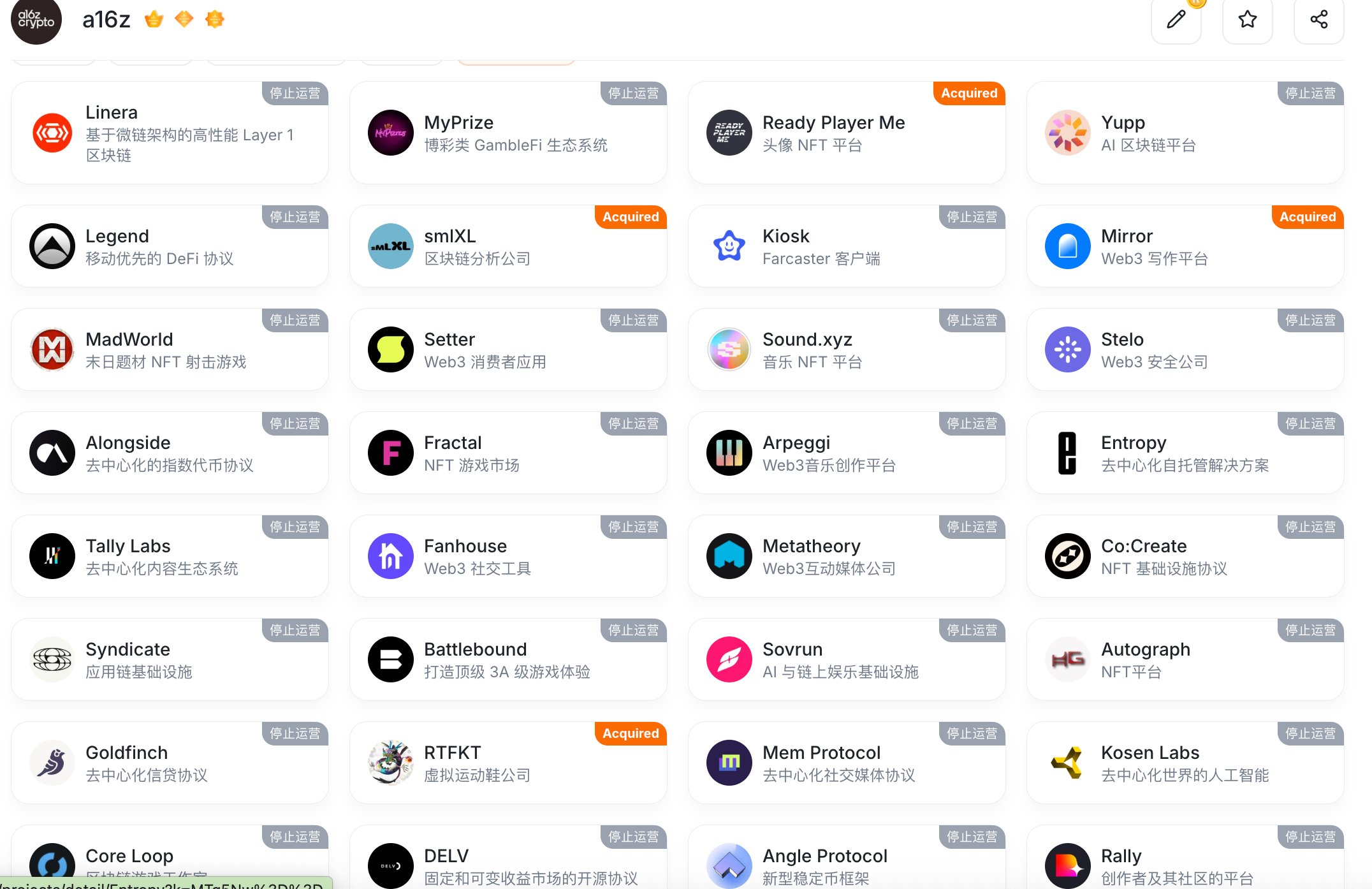
Looking over the funding records of those 42 projects, this is not merely "early investment naturally eliminating." Just Yupp, Syndicate, and Entropy alone burned $87 million. Yupp attracted 1.3 million users but still couldn't find a business model; Syndicate bet $27.8 million on the DAO tools track, only to discover the entire market was an order of magnitude smaller than expected; Entropy secured $25 million for decentralized custody, attempted multiple transformations, but failed every time.
The most ironic of all is Linera, which was founded by a former Meta engineer. It raised $12 million led by a16z, and just before its mainnet launch, it initiated a community token sale, aiming for $1.5 million but only managed to raise $848,000. 617 people could not gather $1.5 million. The investment halo of a16z is no longer worth the trust of $1.5 million in the retail market.
As a16z's portfolio sheds weight each month, the most dominant trading platform in the crypto industry is making history.
Hyperliquid, a perpetual contract DEX that rejected all VC investments. No seed round, no Series A, no strategic investors, no advisor token distribution, founder Jeff Yan used personal funds and early trading profits when launching the project.
On September 18, HYPE hit a historic high of $92.56, with a market cap exceeding $30 billion, ranking in the top ten among all crypto assets.
Putting these two data points together: a16z invested $87 million in Yupp, Syndicate, and Entropy, all gone to zero; Hyperliquid has zero external financing and a market cap of $30 billion.
This is a microcosm of the cryptocurrency industry systematically demystifying the assumption that "VC endorsement = quality assurance."
Three Structural Flaws in the VC Model in the Crypto World
Why is the endorsement of top VCs becoming increasingly ineffective in the crypto industry?
The issue is not that a16z's investment team lacks intelligence—they have invested in Coinbase, Solana, Uniswap. The problem lies in the friction between the VC business model and the operational logic of the crypto market, which has become three increasingly obvious points of conflict.
Time Mismatch.
Traditional VC investments in a SaaS company typically have a 7 to 10-year window from seed round to IPO. But the lifecycle of crypto projects has been drastically compressed; from fundraising to token issuance might only take 18 months, and from token issuance to the market forgetting you could be just six months. Linera struggled for years, only to run out of funds just before launching its mainnet. When Syndicate raised funds in 2021, DAO was a hot narrative, but by 2026 the entire track has shrunk to the point of not being able to sustain a company. The long-term holding model of VCs does not align with the rapid narrative turnover in the crypto market.
Incentive Mismatch.
VCs need to exit. Exiting means selling tokens at some point after launch. This creates inherent tension with the interests of retail investors; VCs have the strongest motivation to sell at the highest token price (usually shortly after launch), while retail investors have the strongest impulse to buy at the same moment.
Over the past two years, "VC tokens" have become a pejorative term in the crypto community, as too many projects experienced continuous selling pressure after token unlocks, with prices dropping as much as 80% or even 90% from their highs.
Narrative Dilution.
When a project announces "a16z led," it consumes the credit line of the a16z brand. When 8 of the 42 projects shut down in the same year, the brand's credit line rapidly depreciates. Linera's token sale only raised $848,000; this figure not only represents Linera's failure but also serves as a measuring stick for the devaluation of "a16z invested" in the minds of retail investors.
What Did Hyperliquid Do Right?
The success of Hyperliquid cannot be simply attributed to "no VCs, so it's good." Not having VCs is its characteristic, but what makes it a leader in the industry are several other factors.
Product First, Narrative Second.
When Hyperliquid launched in 2023, it barely did any marketing. No KOL promotion, no hints of "upcoming airdrops," no white paper roadshows.
What it did was simple: provide a better on-chain derivatives trading platform than centralized exchanges. Traders voted with their feet, as trading volume surged from zero to an average of $5.5 billion per day, relying on the product itself.
Community as Investors.
Hyperliquid turned early users into token holders through a points system and the subsequent HYPE airdrop. This means the initial distribution of tokens is given to those who use the product, not to those who write checks. When HYPE launched for trading, most holders were real users, motivated to continue using the platform (as trading volume drives token value), rather than cashing out immediately.
Revenue Drives Token Value, Not Narrative Drives Token Value. Hyperliquid's Assistance Fund uses protocol revenue to buy back HYPE on the open market, providing cash flow anchors for the token.
These three aspects mirror the logic of the VC model. VC projects typically move in a narrative-first manner (white paper → fundraising → development → token issuance → finding users); Hyperliquid is product-first (development → users → revenue → token issuance → users as holders).
The former faces the risk of breaking at every step with the question "Can the next step keep up?" while the latter's each step is a natural extension of the previous one.
VCs Won't Disappear, but the Halo is Gone
Once again, let me clarify, this article is not issuing a death sentence for the crypto VC model. a16z has invested in Coinbase, Solana, and Uniswap, and its successful cases are enough to cover the losses of those 42 failed projects, which is also the reason why the VC model can continue to operate.
But the crypto community has undergone a cognitive upgrade: VC endorsement is a signal, not a guarantee.
Retail investors in 2021 would immediately buy when they saw "a16z invested" or "Paradigm invested." Retail investors in 2026 will have more questions: What is the unlock timetable? How many tokens does the team have? Are there real users for the product? Where does the revenue come from?
This demystification is healthy.
a16z will continue to invest. Its next Coinbase might be coding in some garage. But the spell of the five words "a16z invested" has already devolved from an unconditional statement of trust to a reference information that requires validation.
In the 2026 crypto market, the strongest endorsement will be "who is using you," not "who funded you."
免责声明:本文章仅代表作者个人观点,不代表本平台的立场和观点。本文章仅供信息分享,不构成对任何人的任何投资建议。用户与作者之间的任何争议,与本平台无关。如网页中刊载的文章或图片涉及侵权,请提供相关的权利证明和身份证明发送邮件到support@aicoin.com,本平台相关工作人员将会进行核查。


