Written by: Rita
Markets are concerned that the restart of the global interest rate hike cycle could crush the stock market; JPMorgan's judgment is that earnings are the anchor. In its global market strategy report released on September 18, 2026, JPMorgan pointed out that central banks in developed markets are shifting to synchronized tightening. The Bank of Japan is tightening again, joining the European Central Bank, the Reserve Bank of Australia, the Reserve Bank of New Zealand, and the Norwegian central bank in raising rates. The Swedish central bank and the Bank of England are expected to follow later this year, with the Bank of Canada remaining the only developed market central bank to remain inactive.
JPMorgan analyst Fabio Bassi noted in the report that Fed Chair Warsh reiterated the commitment to price stability at a press conference, without providing additional forward guidance. The median in the dot plot indicates one more rate hike within the year, with rates unchanged in 2027, but 8 out of 18 committee members expect another hike next year. A reduction of 25 basis points is expected in 2028 and 2029. The neutral policy rate has been raised to 3.25%. JPMorgan expects a 25 basis point rate hike by the Fed in December, and if the macro benchmark of resilient economic growth and sticky inflation holds, there is a risk of a third rate hike in early 2027.
Global Central Banks Shift to Synchronized Tightening
The Fed's actions have reversed the "insurance-style rate cuts" implemented at the end of 2025 to address weakness in the labor market. JPMorgan believes that OIS forward market pricing is reasonable, raising the target yields of 2-year and 10-year U.S. Treasury bonds to 4.70% and 5.05%, respectively. The Bank of England maintained rates this week, but committee members emphasized that if the conflict in the Middle East continues, policy may tighten. JPMorgan expects the Bank of England to raise rates by 25 basis points in November and again in February next year. The Bank of Japan raised rates by 25 basis points, with two dissenting votes. JPMorgan expects the Bank of Japan to raise rates again in December. Regarding the European Central Bank, JPMorgan expects a rate hike in December and another one in March 2027, with market pricing at about 70 basis points in the same period.
Stock Market Still Anchored by Corporate Earnings
JPMorgan's core judgment is that as long as the rate hike cycle remains shallow, the stock market will be driven by earnings, with limited impact from interest rates. The bank's baseline scenario is that the limited reversal from last year's insurance-style rate cuts can be absorbed by risk assets. The risk lies in whether the curve starts to price a broader rate hike cycle and whether long-term yields significantly rise.
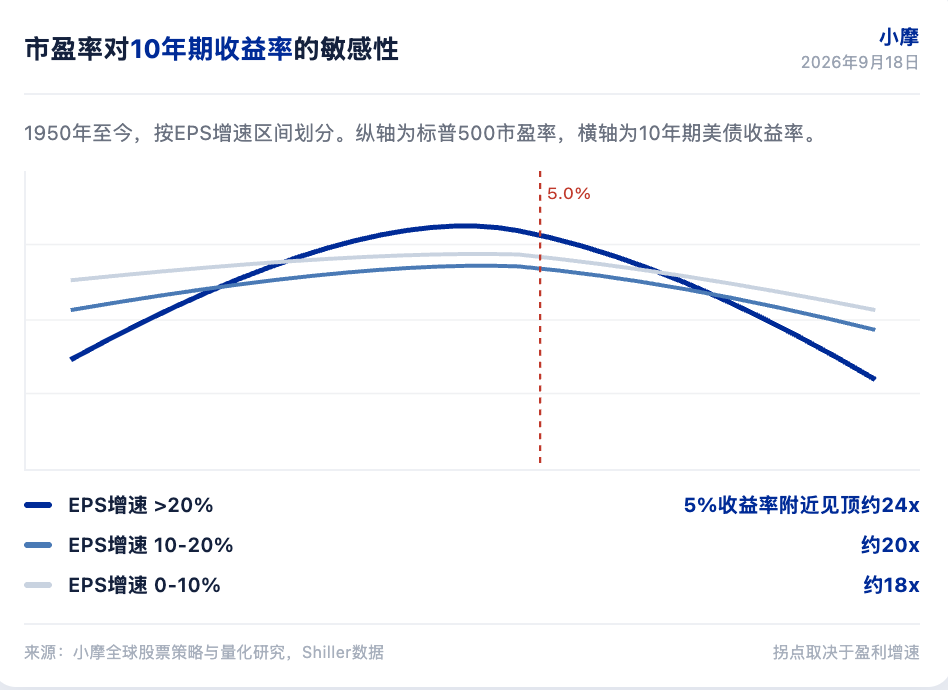
Based on long-term history, there is an inverse U-shaped relationship between the 10-year yield and the S&P 500 price-earnings ratio, with the turning point depending on the backdrop of earnings growth. The forward consensus on growth in earnings per share still exceeds 20%, with the S&P 500 trading at around 18 times expected earnings per share for 2027. If these growth forecasts materialize, history shows that the price-earnings ratio can remain supported, and the stock market could withstand a 10-year yield close to 6%.
JPMorgan points out that the direct impact of rising interest rates on fundamentals is gradual because corporate debt is predominantly fixed and long-term. Recent headwinds have been partially offset by rising profitability in financial stocks and increased returns on large cash balances. The more relevant second-order channel is whether the tightening of financial conditions marginally slows the AI capital expenditure cycle, and whether rising rates widen the spending gap across different income groups. This combination necessitates attention to balance sheet quality and profitability resilience, without assuming a uniform interest rate shock.
Large-cap Technology Dominates During Rate Hikes
JPMorgan analyzed the beta values of various sectors in the S&P 500 against the 1-year SOFR. Over the past month, the beta for communication services was +6%, with an R² of 56%; information technology beta was +3%, with an R² of 14%; energy beta was +7%, with an R² of 52%. These three sectors outperformed the index during rising interest rates. Healthcare beta was -8%, but outperformed due to its defensive attributes. Industrials beta was -13%, with an R² of 75%; real estate beta was -9%, with an R² of 80%, making it the most interest rate-sensitive lagging sector. Small-cap stock beta was -8%, with an R² of 81%, underperforming large caps by 3.4%. Large-cap stocks had a beta close to zero, making them relatively insensitive to interest rate changes. JPMorgan reaffirms its positive outlook on large-cap stocks, technology, and communication services.
Oil Prices Hard to Sustain Above $100
Heightened tensions in the Middle East have pushed Brent crude prices to $100-110 per barrel, up from the $75-100 per barrel range maintained since late May. JPMorgan believes that even in a scenario where conflict in the Middle East becomes "permanent," Brent will struggle to sustain prices above $100 per barrel. Supply shocks are largely offset by pre-war surpluses and incremental supply and inventory, with the key balancing factor being the destruction of price-sensitive demand brought about by rising refined oil prices. JPMorgan's commodity strategy team no longer has a clear baseline scenario for the end of the conflict with Iran; the threshold of pain for the U.S. economy has been crossed, but the exit strategy remains unclear. Brent prices are above an estimated fair value of about $90, indicating that the risk premium aligns with concerns over additional supply losses.
High Symbolic Significance of the U.S.-China Summit
JPMorgan noted that Chinese President Xi Jinping is expected to visit Washington from September 23-25 to hold the second summit with President Trump this year. The relationship has shifted from tariff friction to broader trade and technology conflicts, expanding sanctions, supply chain separation, and energy security tensions. The symbolic significance of the visit is high, but the substantive barriers are limited. JPMorgan's baseline scenario involves a strategic compromise within a managed decoupling framework, which does not amount to a comprehensive "big deal." Investors are increasingly wary of the risk that the summit may expand into transactional ties, such as easing trade policies in exchange for a de-escalation in the Middle East and/or maritime security cooperation. If realized, this could provide a temporary relief to the global cycle by lowering geopolitical risk premiums and improving confidence.
JPMorgan Overweights Stocks and Emerging Markets
JPMorgan maintains a positive outlook on global equities, expecting large-cap stocks, quality growth, and technology sectors to lead during Fed rate hikes. Limited rate hikes and a resilient macro cycle may support a broader rally. In terms of bonds, JPMorgan believes the short end of U.S. and German yields is relatively cheap compared to central bank benchmarks, but there is a persistent risk of the market pricing in more rate hikes. In foreign exchange, Fed expectations re-pricing and Warsh's hawkish comments have driven the dollar stronger; JPMorgan believes there is further room for the dollar to strengthen against developed market currencies. In emerging markets, JPMorgan is overweighting emerging market currencies with neutral interest rates. In credit, credit remains the most resilient asset class against Fed rate hikes, with a preference for investment-grade bonds in European credit, followed by high yield.
The global interest rate hike cycle has reopened, but JPMorgan believes this cycle is shallow. If inflation data continues to exceed expectations, forcing the Fed to shift from shallow hikes to a broader tightening cycle, can the earnings anchor sustain the stock market?
Disclaimer
This article is a collation and interpretation of third-party brokerage research reports (JPMorgan, September 18, 2026) by Trend Research, combined with publicly available market information. The ratings, target prices, earnings forecasts, and related judgments cited in this article reflect the views of the analysts at that brokerage and represent only their institution's stance, not the views of Trend Research, nor does it constitute any investment advice.
Market risks exist, and decisions should be made independently. This article should not be used as a basis for trading any securities.
免责声明:本文章仅代表作者个人观点,不代表本平台的立场和观点。本文章仅供信息分享,不构成对任何人的任何投资建议。用户与作者之间的任何争议,与本平台无关。如网页中刊载的文章或图片涉及侵权,请提供相关的权利证明和身份证明发送邮件到support@aicoin.com,本平台相关工作人员将会进行核查。


