Author: Bret Jensen
Translation: Deep Tide TechFlow
Deep Tide Introduction: OpenAI, Anthropic, and others suddenly and loudly urge for regulation, calling for a "slowdown in AI." On the surface, it appears to be an existential risk, but analysts are more skeptical of the motivations behind regulatory capture and federal bailouts; the deteriorating off-balance-sheet liabilities and free cash flow of hyperscale cloud providers, the share competition from Chinese open-source models, and whether the nearly $2 trillion valuation IPO of Anthropic can be realized are the signals worth paying close attention to.

In the past ten days, a significant shift has occurred in the zeitgeist surrounding AI. It began when a former safety employee of OpenAI (OPENAI) publicly stated after leaving Anthropic (ANTHRO) that the advancement of artificial intelligence is progressing too quickly, with at least a 10% chance it could end humanity. This is not new—since the debut of ChatGPT at the end of 2022, warnings about "AI sliding into a Skynet-style conclusion" have never ceased; on YouTube, searching "AI Doomsday" yields thousands of related videos.
However, this warning was received differently by mainstream media. This researcher, in his twenties and almost unknown at the beginning of this month, suddenly published a commentary in The Wall Street Journal and appeared on CNN and Joe Rogan's show. Following this, Anthropic's CEO publicly called for AI development to "slow down" and should be coordinated with China; Microsoft (MSFT) CEO, Sam Altman, and Elon Musk quickly supported this, while Chinese officials dismissed it as "alarmist."
Dario Amodei, the head of Anthropic, proposed that the first step in "regulating the pace of the frontier" is to embed third-party evaluators like METR: ensuring that the pace and safety policies are strictly enforced and that all safety incidents are reported and handled in a timely manner. What he did not say is that many of those sitting on METR are Amodei's friends, financiers, and former colleagues, many of whom are advocates of "Universal Altruism." One of the most famous proponents of this philosophy is Sam Bankman-Fried, who was sentenced to about 25 years in prison for orchestrating a large-scale cryptocurrency fraud.
In my view, the prescription Amodei has offered is fraught with conflicts of interest, much like an arsonist pushing his three brothers to oversee a fire investigation. That said, such reports are overwhelming and cannot be ignored. If this is a coordinated media battle—excuse me for not finding a better term—its unfolding is as brutal as five Stasi agents smashing in your door at midnight in East Berlin around 1985.
So, what might be behind this? I believe the narrative recently dominating the public discourse has at least two plausible reasons. First, major AI labs in the U.S. want to replicate the regulatory capture practiced by the U.S. tobacco industry—Philip Morris, now Altria (MO)—which has played this game for decades: pushing the federal government to establish a regulatory framework with extremely high compliance costs that only the largest model players can afford. In the political realm, many are already pushing in this direction.
The second possible motive is to provide a federal safety net for the entire AI ecosystem. OpenAI's CFO has previously hinted at similar ideas and then retracted them in November 2025. The rationale could be packaged as: AI development has become so critical to the U.S. economy and market that the federal government must step in when necessary; advocates will also play the national security card—America must maintain its leading position in this critical field against China.
I believe there are several other clues behind this new narrative. The first is related to large-scale AI infrastructure spending beginning to exert pressure on the credit markets. Initially, major hyperscale cloud providers were using cash from their balance sheets and annual free cash flow to cover AI capital expenditures.
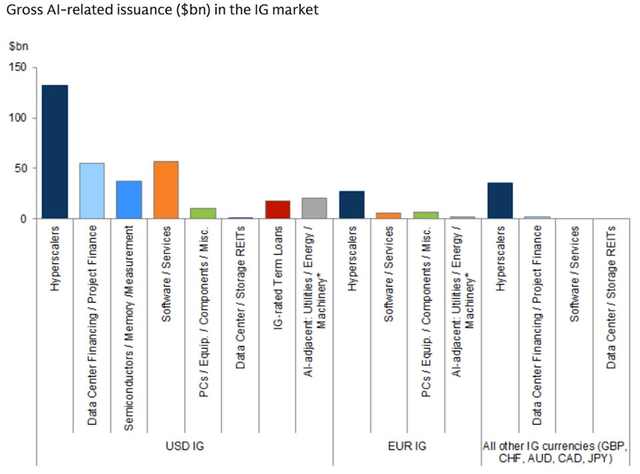
Over the past year, the situation has drastically changed, leading to massive debt and equity issuance to fund these projects.
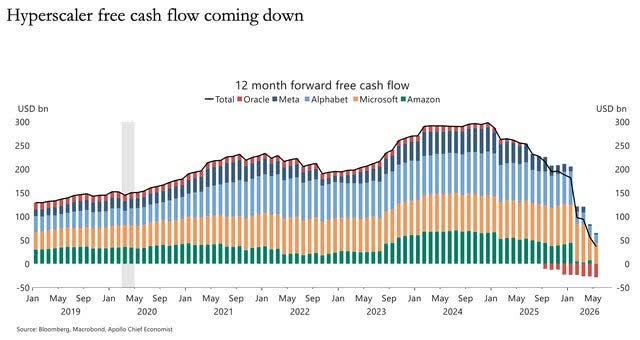
The five major hyperscale cloud providers now have a total of about $3 trillion in off-balance-sheet liabilities and report over $1.3 trillion in debts. The entire sector's free cash flow has significantly declined. Oracle (ORCL) reported a negative free cash flow of $23.7 billion for FY2026; Alphabet (GOOG) recorded a negative free cash flow of $5.9 billion in the second quarter—marking the first time this search giant has reported negative cash flow in a single quarter since going public in 2004.
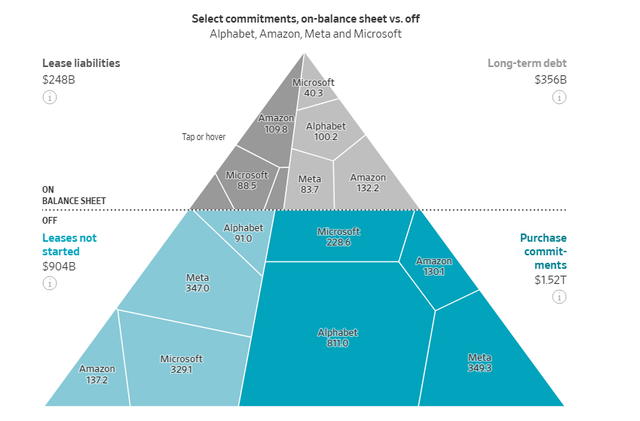
The credit market has also started to struggle under the weight of these new debts. The credit default swap prices concerning Oracle's debt have reached record highs; regarding the debt of emerging cloud provider CoreWeave (CRWV), the market is pricing in a reasonably significant probability of default over the next five years.
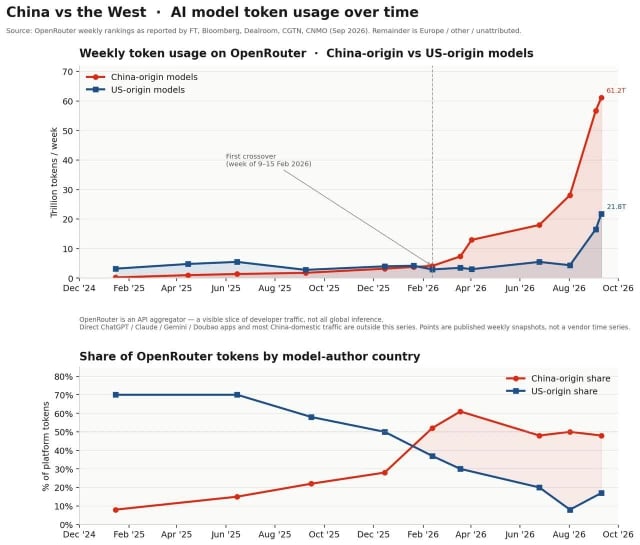
The second likely reason for the significant shift in narrative in September is that Chinese open-source models are beginning to offer near-frontier performance at prices far below those of frontier models and are quickly capturing token utilization share. Since this spring, when companies like Anthropic, OpenAI, and Microsoft switched their main frontier models from subscription-based to pay-per-use, this trend has accelerated further—previously common "tokenmaxxing" among many clients has been effectively crushed.
Regardless of the true reason for the narrative shift in September, the increasingly forceful promotion of the "doomsday" script does not resemble a healthy reaction from the AI ecosystem. Given the critical nature of AI infrastructure expansion to the market and the U.S. economy, prudent investors should closely track this unfolding clue.
Currently, most of the significant AI data centers being rapidly built across the U.S. are providing computational power primarily for two companies: OpenAI and Anthropic. Both are bleeding out financially, far from profitability. OpenAI just officially announced that its IPO has been postponed until 2027.
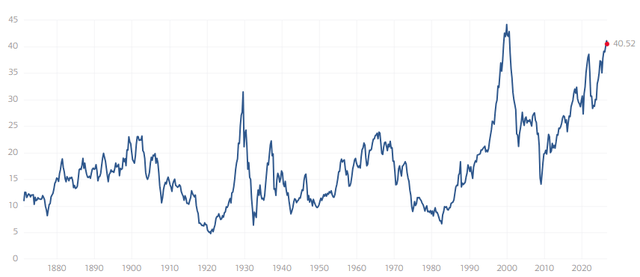
Anthropic is still pushing forward with its listing plan valued at approximately $2 trillion, with a time window of about one to two months. For investors and the entire market, this will be one of the most critical events for the remainder of 2026. If Anthropic's IPO receives enthusiastic support and is successfully launched, the bull market may continue; if the issuance falters or is postponed again, with the current valuation level, plus a series of issues such as the war in Iran, rising interest rates, a sluggish housing market, record diesel prices, and sluggish GDP growth, the market could indeed "swing wide open, with everyone vying for an escape."
Analysts disclose: The author/ his team have no positions in stocks, options, or similar derivatives of the companies mentioned in the text, nor any plans to establish them within the next 72 hours. This article is independently written by the author to express personal views; no compensation has been received from anyone other than Seeking Alpha, and there are no commercial relationships with the companies mentioned in the article.
免责声明:本文章仅代表作者个人观点,不代表本平台的立场和观点。本文章仅供信息分享,不构成对任何人的任何投资建议。用户与作者之间的任何争议,与本平台无关。如网页中刊载的文章或图片涉及侵权,请提供相关的权利证明和身份证明发送邮件到support@aicoin.com,本平台相关工作人员将会进行核查。


