Written by: Rita
How will crypto stocks perform after the procedural vote failure of the CLARITY Act? Bernstein provides the answer in a report released on September 16, 2026: buy-in fatigue. The firm notes that due to the limited time window and the breakdown in negotiations over ethical terms, there should be no hope for a re-vote. The preferred targets are Robinhood (HOOD), Circle (CRCL), and Figure (FIGR).
Bernstein analyst Gautam Chhugani pointed out in the report that after the legislative failure, regulatory clarity in the industry will shift to the institutional rulemaking of the CFTC and SEC. The firm expects rulemaking to be aggressive and rapid to make up for lost time in CLARITY negotiations. Stablecoins are unaffected, as they are governed by the GENIUS Act, allowing them to continue offering returns on idle balances.
Legislative Failure Shifts to Institutional Regulation
The CLARITY Act could have provided the industry with protection against political cycle changes. After the legislative failure, the industry will rely on institutional regulation and innovation exemptions. Bernstein lists five expected rules: token classification and financing exemptions; developer protections for DeFi protocols and self-custody infrastructure; innovation exemptions for equity tokenization and updates to transfer agent rules; faster approval for real-world asset perpetual futures; and classification corrections for federal sports event contracts.
These rules will determine the cadence of product rollout in the crypto industry before the midterm elections. Bernstein believes the SEC and CFTC's rulemaking will be quicker because legislative negotiations have already consumed time. The firm expects momentum to grow in the short term as products are launched. The 2028 U.S. election remains a potential tail risk, and regulatory conditions could be reversed. If the industry achieves critical scale in mainstream products like tokenization, the difficulty of reversal will increase.
Bernstein points out that another advantage of institutional rulemaking is its flexibility. Legislation requires bipartisan consensus, while rulemaking only requires internal decisions by regulatory agencies. The SEC and CFTC can advance product classification, exemptions, and approvals under the existing legal framework without waiting for Congress. The timeline for product rollout is more controllable, allowing crypto companies to plan their business rhythms in advance.
Stablecoins Unaffected by CLARITY
The compromise text of the CLARITY Act originally prohibited the earnings of idle stablecoin balances and linked rewards to activity tiers. After the bill's failure, distribution partners like Coinbase (COIN) can continue to offer returns on idle stablecoin balances. As such, stablecoins continue to serve as a substitute for savings deposits, providing full U.S. Treasury yields. Bernstein believes this is a positive factor for USDC adoption but notes that new yield-generating stablecoin competition will also emerge.
Stablecoins are governed by the GENIUS Act. Bernstein believes that market leader Circle, compliant with the GENIUS Act, is in a favorable position for broader financial services and payment adoption. Circle is the regulated leader in the U.S. stablecoin market, and investor positions are primarily driven by USDC supply growth and the narrative of new stablecoin competition. Circle's ARC chain launched on the day the report was released, and if it starts strongly, it could serve as a recent catalyst to push more USDC liquidity towards trading, equity tokenization, and DeFi yield vaults.
Bernstein notes that the regulatory certainty for stablecoins comes from the GENIUS Act, unrelated to CLARITY. Even if the legislation fails, the compliance path and yield model for stablecoins remain unaffected. USDC supply has remained stable after the bill's failure, indicating that market confidence in stablecoins has not been shaken. The firm believes stablecoins are the segment of the crypto industry least affected by legislative fluctuations, with their growth largely dependent on payment adoption and the demand for savings alternatives.
Strong Performance in Prediction Markets and On-Chain Revenue
Robinhood's profit growth is driven by record trading volumes in prediction markets and the recent launch of the Robinhood chain. The Robinhood chain offers stock tokens (offshore structure), with strong trading activity. Current on-chain gross revenue is about $1 million per day, despite declining gas fees. The third and fourth quarters are rich with catalysts, including a busy sports calendar and the upcoming midterm elections.
Figure is the leader in the credit tokenization market, with strong growth in housing mortgages. Figure's business model has minimal crypto exposure and should not be affected by the failure of CLARITY, although investors tend to trade it as part of a crypto basket. The recent acquisition of Kiavi could become a future catalyst as Figure expands its credit business from home equity lines to residential transitional loans and first-lien loans.
Bernstein believes that the product pipelines of Robinhood and Figure have low correlation with the CLARITY Act, and their growth is driven by actual demand for prediction markets, on-chain trading, and credit tokenization. The legislative failure will not change the pace of advancement for these businesses, which is why the firm prefers these two stocks during the pullback.
Three Preferred Stocks with Outperform Ratings
Bernstein gives outperform ratings to Circle, Coinbase, Figure, Robinhood, Strategy (MSTR), and Sharplink (SBET), and a market perform rating to Bullish (BLSH). As for target prices, Circle is set at $140, Coinbase at $330, Figure at $70, Robinhood at $160, Strategy at $350, Sharplink at $24, and Bullish at $50.
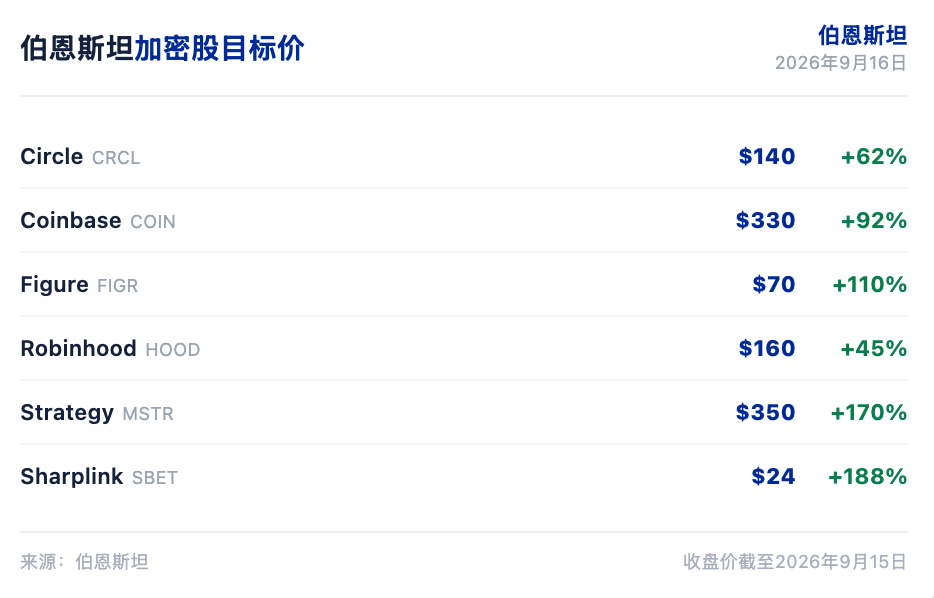
As of the close on September 15, 2026, Circle's stock price is $86.30, Coinbase's stock price is $172.11, Figure's stock price is $33.28, Robinhood's stock price is $110.45, Strategy's stock price is $129.60, Sharplink's stock price is $8.33, and Bullish's stock price is $35.46. Bernstein believes that the weakness in crypto stocks presents a buying opportunity, especially for stocks related to tokenization, perpetual futures, stablecoins, and prediction markets.
After the legislative failure, the speed at which the SEC and CFTC's rulemaking is implemented and which crypto products can first obtain innovation exemptions will determine the duration of this buying opportunity.

Disclaimer
This article is a compilation and interpretation of third-party brokerage research reports (Bernstein, September 16, 2026) by潮向研究, combined with publicly available market information. The ratings, target prices, earnings forecasts, and related judgments cited in this article are solely the views of the brokerage analysts and represent their respective institutions' positions, not those of潮向研究, and do not constitute any investment advice.
The market has risks, and decisions should be made independently. This article should not be used as a basis for buying or selling any securities.
免责声明:本文章仅代表作者个人观点,不代表本平台的立场和观点。本文章仅供信息分享,不构成对任何人的任何投资建议。用户与作者之间的任何争议,与本平台无关。如网页中刊载的文章或图片涉及侵权,请提供相关的权利证明和身份证明发送邮件到support@aicoin.com,本平台相关工作人员将会进行核查。


