Author: Deep Value Investing
Translation: Deep Tide TechFlow
Deep Tide Overview: Oracle's FY2027 Q1 report shows OCI growth reaching 121%, with customer prepayments of $11.36 billion, indicating that the fundamentals are largely acceptable; however, the hawkish CPI and macro noise are overshadowing the positive earnings report. Deep Value Investing has downgraded its rating from Buy to Neutral, noting that free cash flow remains negative and management has not provided a timeline for positive cash flow.
As we entered the Oracle (ORCL) earnings window, I was more concerned about the macro environment than the company delivering a disappointing performance. I had previously written:
On the risk side, I believe macroeconomic factors are becoming more relevant to risk assets. As I discussed in a recent article, the market's attention was focused on Friday's CPI.
The outcome was quite dramatic: After-hours stock price surged nearly 6% after the earnings report (FY2027 Q1), but fell back to pre-earnings release levels just before 10 AM on Friday, following a very hawkish August CPI release.
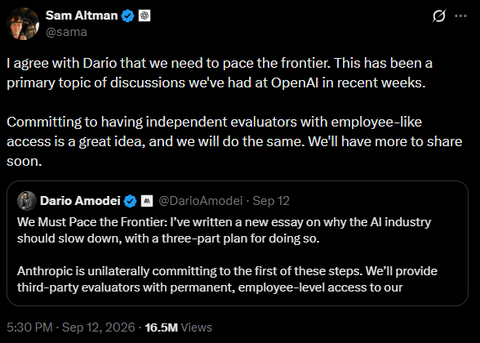
Just when I thought OpenAI's Astra had reversed market perception, Sam Altman himself posted, agreeing with Dario's assertion about "slowing the pace of the frontier."
I have explained in a recent article why slowing down frontier models may not be a good thing and used Google's Gemini as a typical case of "what happens when progress slows down."
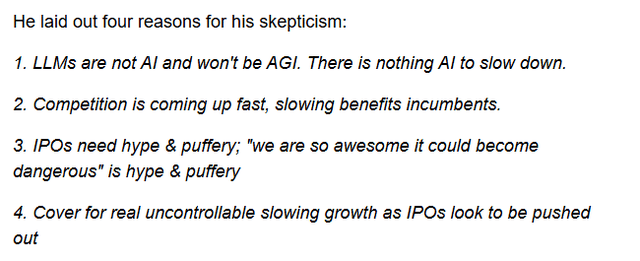
It needs to be clarified: I tend to side with Burry (I never thought I would write that), and I believe that the entire "slow the frontier" narrative could be rather self-serving for those in power.
Setting aside macro and short-term noise, this article will focus on the FY2027 Q1 earnings fundamentals, particularly looking at two pressure points: how Oracle is financing expansion and the growth story of the OCI segment.
I will start with the conclusion: Given the macro pressures, I am downgrading my rating to Neutral (a two cents worth of advice for high-risk speculators: never ignore macro factors).
Who Needs Cash?
For me, a highlight of the FY2027 Q1 report was the $11.36 billion deferred revenue from customer prepayments with a significant financing component, which naturally flowed into operating cash flow.
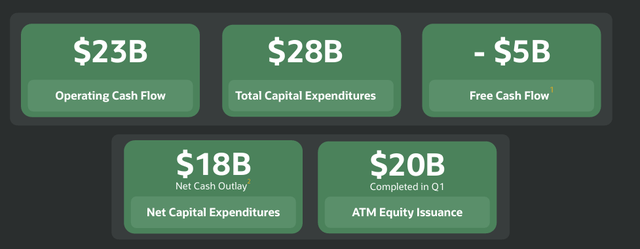
For reference, the operating cash flow for the previous quarter (FY2026 Q4) was $14.62 billion, while FY2026 Q1 was only $8.1 billion:
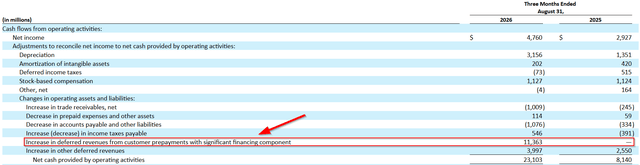
Before the earnings report, the street (specifically LSEG consensus expectations) anticipated a free cash flow outflow of $9.56 billion for the quarter. The actual reported figure was a negative $5.4 billion, largely due to these customer prepayments.
As shown in the table above, the FY2026 Q1 report did not include any customer prepayments. In fact, throughout the entire FY2026 fiscal year, capital expenditure-related prepayments totaled only $4.59 billion.
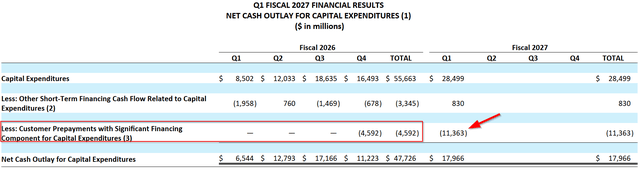
An interesting point is that the $11.36 billion in customer prepayments accounted for approximately 76% of the year-over-year increase in operating cash flow. This is a significant tailwind, making me wonder how long this positive momentum can last.
I still remember this segment from the FY2026 Q4 press release:

Compared to the $75 billion figure in the fourth quarter report, I was somewhat disappointed by the reading in the first quarter:
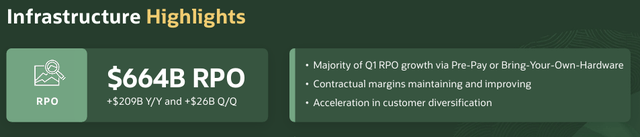
During the Q&A session of the earnings call, the CEO also added:
The vast majority of these new contracts are achieved through prepayments, bring-your-own-hardware, or similar mechanisms, so they do not require Oracle to invest additional capital.
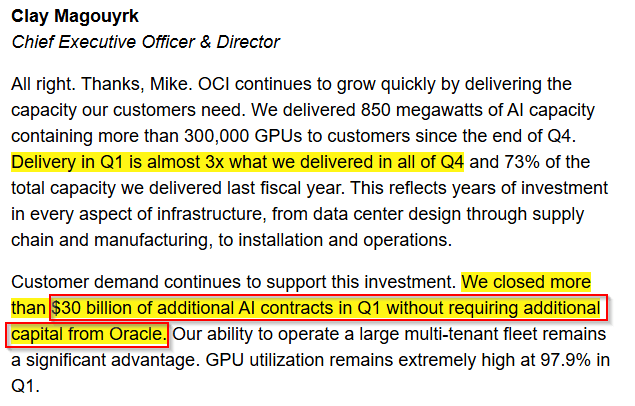
I like how that sounds, but the remaining performance obligation (RPO) total is far greater than those transactions with customer prepayments.
Looking at capital expenditures: The gross capital expenditures for the first quarter amounted to $28.50 billion. However, the company has an interesting metric called "net cash outlay for capital expenditures." It should be clarified that Oracle defines this metric as:
Net cash outlay for capital expenditures is defined as capital expenditures minus: (1) other short-term financing cash flows related to capital expenditures; and (2) customer prepayments with a significant financing component used for capital expenditures.
Therefore, after deducting the $11.36 billion in customer prepayments and the $830 million in net cash outflow from other short-term capital expenditure financing, Oracle disclosed a "net cash outlay for capital expenditures" of $17.97 billion (which sounds less alarming than the gross number of $28.5 billion).
In terms of capital expenditure guidance, management maintains the FY2027 gross capital expenditure guidance at $90 billion to $95 billion. In fact, they also guided net cash capital expenditures to not exceed $70 billion.
Before concluding this section, I want to add a segment from the Q&A that left me feeling mixed.
One analyst from Deutsche Bank asked one of the best questions of the session: "When can we expect the company to return to positive free cash flow?"
CFO Hilary Maxson replied:
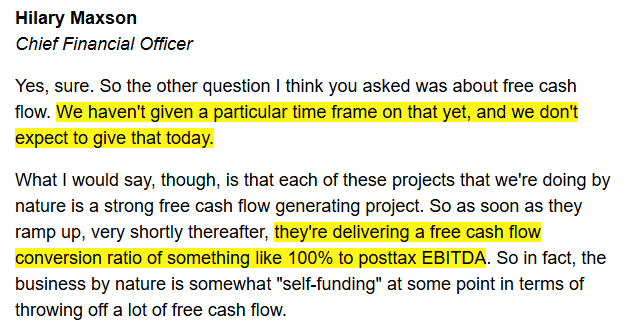
I like the sound of "approximately equivalent to 100% of after-tax EBITDA" for free cash flow conversion rate (although I would also like to know what it would be in EBIT terms, since depreciation is a significant factor).
From a timeline perspective, management indicated in March of this year that they had secured over 10 GW of power and data center capacity, anticipating that it would gradually come online over the next three years. They also stated that over 90% of the capacity had been fully financed through partners.
So far, Oracle has been converting this pipeline into online capacity. FY2026 added 1.2 GW, and FY2027 Q1 added another 850 MW, totaling about 2.05 GW delivered. Good job.
OCI Growth Soars into Three Digits
In the pre-earnings coverage, I wrote:
I hope FY2027 Q1 OCI growth exceeds the consensus expectations of 115%–116%.
As a result, FY2027 Q1 OCI year-over-year growth was recorded at 121%, exceeding street expectations by about 5–6 percentage points. Look at the accelerated year-over-year growth of infrastructure revenue below:
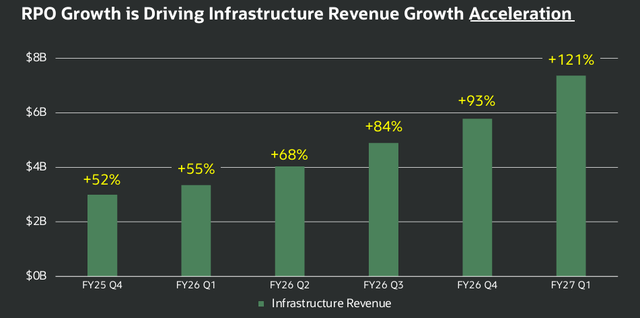
I hope this three-digit growth will at least be sustained for a few more quarters, which is one of my closely monitored items. Unfortunately, management does not separately guide the infrastructure business but combines SaaS and IaaS into total cloud revenue:
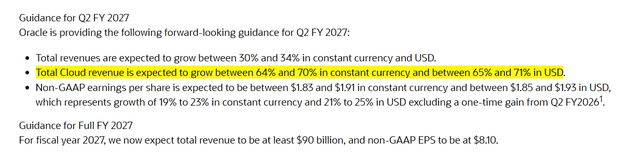
Given that total cloud revenue in Q1 grew by 62% year-over-year, while SaaS grew only 10% year-over-year ($4.22 billion), I believe it is reasonable to infer that growth mainly came from the infrastructure business. Q2 FY2027 guidance suggests further acceleration in total cloud revenue, which might also mean IaaS growth could rise another notch (assuming SaaS maintains low double-digit growth).
Finally, during the call, there was a statement about the infrastructure business that caught my attention:
All GPUs due for renewal in the first quarter were renewed or resold at a premium of about 20% relative to previous contracts. Most of those GPUs have been in use for four years or longer.
In my view, the approximately 20% resale premium over old contracts indicates that the broader AI supercycle is still largely ongoing.
Conclusion
If I were not looking at the stock price chart but only at the earnings report text, I would think the stock price should rise the next day.
So let's take a look at the trend below:
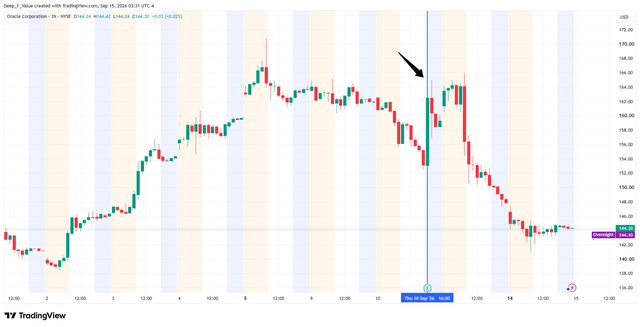
Now you understand why I'm so focused on macro factors, right?
My viewpoint is: Oracle delivered the right performance but hit the wrong timing. Last Friday's sell-off, in my view, was driven by the hawkish CPI report — August core CPI up 0.3% month-over-month, higher than the consensus expectation of 0.2%.
Interest rates, along with Dario's open letter about "slowing the frontier," are more important than the fundamentals at this moment; thus, even if the fundamentals are generally sound, I find it challenging to maintain a Buy rating.
In terms of valuation, I see a forward P/E ratio of about 23, which unfortunately does not scream premium. I believe this stock could have better days ahead, but it is likely to go through worse days before getting better. Before macro improvements occur, I am downgrading it to Hold. Setting aside short-term noise, I still like this name, but I am concerned it could get cheaper.
免责声明:本文章仅代表作者个人观点,不代表本平台的立场和观点。本文章仅供信息分享,不构成对任何人的任何投资建议。用户与作者之间的任何争议,与本平台无关。如网页中刊载的文章或图片涉及侵权,请提供相关的权利证明和身份证明发送邮件到support@aicoin.com,本平台相关工作人员将会进行核查。


