Author: Dustin Quasney
Translation: Deep Tide TechFlow
Deep Tide Introduction: Meta's 2026 capital expenditure guidance reaches $130 to $145 billion, with irrevocable contract commitments of about $349 billion, far exceeding its own needs. The author infers that it is hoarding scarce computing power, preparing to sell externally, and the potential fourth-largest cloud business has not yet been accounted for; around $650, approximately 23 times rolling price-to-earnings ratio, the core advertising business is roughly fairly valued, with AI/computing options almost included for free, the main risk being extraordinary CapEx and demand not meeting expectations.
Key Points
- Meta Platforms is aggressively ramping up AI infrastructure, intending to sell computing power capacity in a tight supply market.
- Meta's computing power commitment far exceeds internal needs, releasing a strategic signal to become a major AI cloud provider beyond AWS, Azure, and GCP.
- At about $650/share (approximately 23 times rolling price-to-earnings ratio), META still has about 28% revenue growth, along with unvalued free AI/cloud options.
- Risks include unprecedented capital expenditures and potential idleness if AI demand lags; however, the core business is solid, and downside potential is relatively limited.
I want to start with an observation and a question that has troubled me for a long time, yet I have never found a satisfactory answer: Why is Meta Platforms (META) spending so much on AI infrastructure?
Because once you look at the numbers, these expenditures are really hard to explain with conventional logic. Meta's guidance for capital expenditures in 2026 is $130 to $145 billion; they spent $31.1 billion in CapEx just in the second quarter. As of the most recent quarter, irrevocable contract commitments reached $349 billion, most of which is related to cloud capacity and infrastructure. To the author, these numbers seem almost insane.
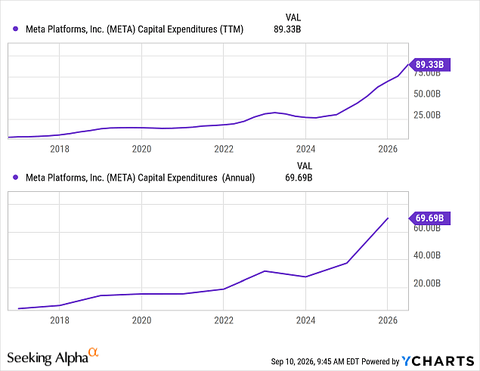
What is even more awkward is that Meta is neither an AI lab nor a cloud computing provider like AWS. At that time, it did not have a flagship model that could contribute hundreds of billions in ARR and needed to serve tens of millions of customers.
Meta's direct AI revenue (under the "other income" category of the Family of Apps) first crossed the $1 billion mark in the second quarter, mainly from paid messages and subscriptions on WhatsApp. Added to the fact that Meta was still lagging behind these AI labs in capability, such a level of CapEx seemed like a huge question mark in the author's eyes.
The author once felt frustrated by Meta's spending habits. The company had previously spent hundreds of billions on AR/VR, only to subsequently scale back significantly—resulting far from expectations.
Almost at the same time they were wrapping up that bet, they ramped up AI CapEx. It looked like they had found a new toy, replaying the metaverse narrative. The author thought to himself: here we go again.
But it turned out he was wrong. In just the last two months, Meta has continuously released AI products and model upgrades, with the pace of capability catch-up to top AI labs exceeding expectations. During the same time frame, there also began to be reports of Meta allegedly selling excess computing power. At that moment, the whole thing suddenly made sense.
The author looked back at the numbers, searched those reports, and reconsidered what Meta was doing, and the logic started to fully make sense. Meta's computing power commitment is on the scale of tens of gigawatts.
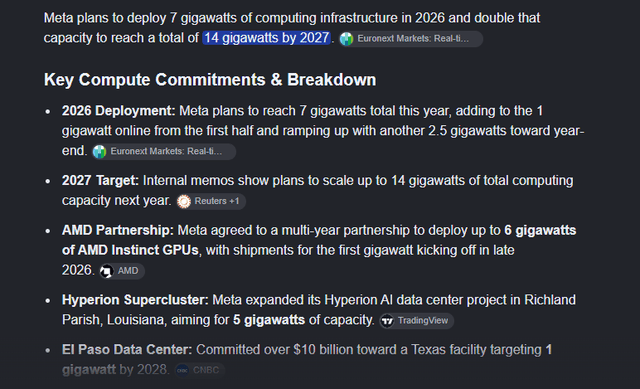
The Hyperion campus in Louisiana alone is expected to reach 5 GW. Faced with these commitments, the obvious question is: does your own AI model and infrastructure really need so much demand?
The answer is clear: no, it does not. Meta AI and the advertising model simply do not require that much computing power; they are far from it.
So why commit so much? The author believes it is to grab as large a share as possible in the limited computing supply and then sell the surplus for profit—just like what AWS, Azure, and GCP do.
Meta has not officially announced entering the cloud computing business. However, based on the layout, the author believes the intention is clear: to acquire as much scarce computing power as possible and then sell off the excess.
Placed within a broader AI strategy, this also makes sense. Meta is highly embracing open source. The author thinks one of the main reasons is the hope that AI will become commoditized like social media and search.
Once models become commodities, value will flow to those controlling the computing power needed to run these models.
Think about how NVIDIA (NVDA) built the moat around CUDA: not only the strongest GPUs but also locking developers into the software stack. The author believes Meta is fighting the same long-term battle with open-source large models.
Currently, Meta is clearly unable to compete on pure model capabilities with OpenAI or Anthropic. However, it can establish the base for a developer ecosystem and infrastructure to sell dedicated computing power in the present and the future.
To be honest, this is actually a smart move. Because AI labs are losing money—losing a lot of money. Where is that money flowing? Directly into the pockets of the computing power providers. The author believes that the real money in this AI cycle is in having that infrastructure where "other chatbots run on top of it."
The author believes its computing sales business has significant valuation potential, and the market is almost completely asleep regarding this.
Why That Sell-off Is a Gift
Meta's stock price hit an all-time high of approximately $798 around August, before being smashed down to around $520. At the time of writing, the stock price is about $650, still about 17% lower than the all-time high.
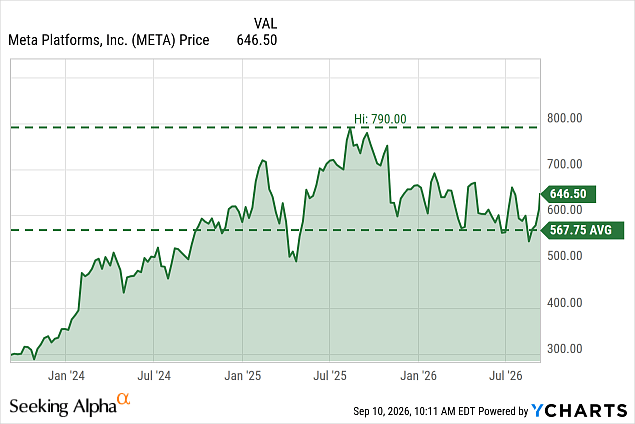
The author has a personal philosophy regarding blue chips and the "Seven Giants," which consistently works: whenever these companies pull back 10%–15% or more from historical highs, it is usually a good time to consider adding to long positions or opening a small position.
Because they have dominant market positions and strong compounding profitability. A pullback of 10%–15% from highs is almost always caused by temporary concerns or sector rotations.
Looking back at any of the seven giants over the past decade: buying in 10%–15% below prior highs, the expected value in the following months has almost always been positive. It may not yield immediate results, but buying high-quality compounders at a discount to relatively recent highs typically has positive outcomes.
Meta occupies a significant portion of the author's portfolio. During the sell-off, some positions were added, but the main strategy was to sell put options to lower the cost basis. So far, most of these puts have expired worthless due to Meta's rebound from its lows.
But what this article aims to say is: even if your Meta position is small or you are considering opening one, even if it has rebounded over 20% in the past few weeks, the author still believes it is not too late to buy now. Because around $650, the stock price corresponds to about 23 times the rolling price-to-earnings ratio—which is not expensive for a company with a revenue growth rate of about 28%.
AI Inflection Point
The author was previously frustrated by Meta's AI spending because it seemed excessive. What changed his view was the pace of progress over the past few months and the strategic signals truly revealed by the spending patterns.
- In July, Meta launched Muse Spark 1.1: a powerful agent and programming model, efficient, good at computer operations, tool calls, and multimodal capabilities.
- After rebuilding Meta AI and integrating Muse Spark, the number of users interacting daily with the assistant rose by about 60%.
- On September 2, Muse Spark 1.3 was released, with significant improvements in performance and token efficiency.
- The upcoming Muse Spark 1.3 max variant is expected to bring them to a level comparable to Opus 5.
- On September 8, the personal AI agent Muse was launched: capable of performing tasks and connecting user emails, calendars, payment methods, and other applications.
At this point, Meta's AI strategy begins to make economic sense: it finally has consumer-level AI products that can directly realize the value of computing power through subscriptions, and its distribution advantage is nearly unbeatable.
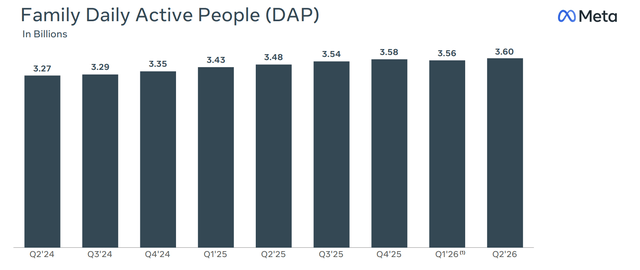
They have about 3.6 billion daily active users. OpenAI and Anthropic do not have this. If even just 1% of daily active users convert to paid Muse subscriptions within the next two years, that would mean about 36 million paying users, potentially corresponding to billions of dollars in annual subscription revenue.
Potential for Selling Computing Power
Meta's computing power commitment is on the scale of tens of gigawatts. As mentioned earlier, servicing Meta AI and ad optimization models simply does not require tens of gigawatts of capacity.
So why these commitments?
The author suggests listening to CEO Mark Zuckerberg's words during the second quarter earnings call. He was asked a similar question and responded in essence:
"We will soon release an API that allows business agents to operate... There is also the opportunity to directly sell computing power—I mentioned that we have received quite a few offers significantly above our purchase cost... Selling computing power is obviously a big opportunity."
The author believes Meta is building a computing power sales business and thinks this is a great move. Because the industry is falling short in this wave of AI adoption. Currently possessing computing power capacity is like having oil reserves during a supply shortage.
You cannot build a data center and get it operational in six months—all aspects related to building data centers are currently in short supply. This makes existing capacity even more precious.
Currently, the cloud infrastructure market is dominated by AWS, Azure, and GCP. By 2026, these three are expected to generate a combined annual cloud revenue of about $268 billion, and the market continues to grow at a rate of over 20% per year.
Meta does not need to capture a large share; this business is already substantial. If in the next five years they can build over 5 GW of AI computing power and sell even a portion of the excess capacity, the potential annual revenue stream could exceed $50 billion. Additionally, since Meta finances infrastructure with the capital cost of a large-cap company, rather than like CoreWeave (CRWV), this business's profit margins could be much better.
The author believes that once the market recognizes what Meta is building, the enterprise value potential for this computing sales business could reach between $500 billion to $1 trillion. Yet currently, the market is pricing this business at nearly zero.
Fair Valuation, Plus Free AI Options
Meta's stock price is around $650, with a market capitalization of about $1.65 trillion. Based on an expected rolling revenue of about $237 billion, the EV/Revenue is about 6.8 times—which corresponds to one of the fastest-growing mega-cap advertising businesses globally.
For the first half of the year, diluted EPS was $16.62. Based on this running rate annualized, by 2026 it is expected to be around the $28-$30 range, corresponding to about 23 times the adjusted price-to-earnings ratio.
The forward price-to-earnings ratio of the S&P 500 is also around 21-22 times. Therefore, using a multiple close to the index, you can buy Meta, with a revenue growth rate of about 28% and a new AI revenue stream ready to scale up. The author believes this is a very attractive deal right now.
If you factor in the upside potential of AI revenue, it appears quite undervalued. If in the next two to three years, Meta can contribute an additional $20 to $30 billion in AI-related revenue through subscriptions, API integration, etc., considering a 30% incremental profit margin, it could add approximately 8 to 12 dollars in EPS. This would push the EPS for 2028 or 2029 to around the $38-$42 range—meaning you are paying around 15-17 times the two-year forward price-to-earnings ratio for all this growth today.
And this does not even account for any terminal value of the computing sales business. If this business achieves even $50 billion in revenue in the next five years, it should enjoy a separate valuation multiple; the author believes it could approach 10-12 times revenue because it may be similar to AWS. Just this one aspect of enterprise value could reach $500 billion or more.
It can be said that Meta is currently roughly fairly valued and comes with near-term AI options. The reason for saying "fair" is that these options have not yet contributed significant tangible revenue.
Risks to Consider
Meta's rate of spending is unprecedented. If AI demand expansion does not meet expectations, the company could be left with hundreds of billions of dollars in depreciating assets. This risk is currently the same for every major hyper-scale cloud vendor—everyone is on the same boat.
If revenue growth fails to keep up, depreciation could compress profit margins. Moreover, the computing power sales business is still a new thing, not yet proven as a validated revenue stream. Currently, this is the strategy inferred from management statements, CapEx, and its positioning logic. If Meta decides to reserve all computing power for internal use and never scale up an external computing power business, then this argument completely falls apart, and the author would be wrong.
Conclusion
What Meta is actually doing is hoarding computing power in a market where "computing power is the most scarce resource among the most important technologies." They are constructing for sales, and Zuckerberg has basically said as much on the earnings call.
The author might be wrong about the computing business. But even so, the worst-case scenario is holding a company with about $240 billion in revenue, a growth rate of about 28%, and a valuation multiple close to the S&P 500. The author believes being wrong here is not too painful.
And if correct—Meta is building the fourth-largest cloud business—then the $650 stock price is pricing this at zero. The market will figure it out sooner or later. The author prefers sooner rather than later.
Disclosure
The analyst disclosure: The author/team holds beneficial long positions through stocks, options, or other derivatives on SPY, QQQ, MSFT, META, AMZN, AAPL, NVDA, AMD. This article was written by the author themselves and expresses their personal views. The author has not received compensation for this article from anyone other than Seeking Alpha and has no business relationship with any company mentioned in this article.
Seeking Alpha Disclosure: Past performance does not guarantee future results. This article is not an investment advice directed at any specific investor. The views above may not represent the overall position of Seeking Alpha. Seeking Alpha is not a licensed broker-dealer, U.S. investment adviser, or investment bank; its analysts are third-party authors, including professional and individual investors, and may not hold any licenses or certifications from any institution or regulatory authority.
免责声明:本文章仅代表作者个人观点,不代表本平台的立场和观点。本文章仅供信息分享,不构成对任何人的任何投资建议。用户与作者之间的任何争议,与本平台无关。如网页中刊载的文章或图片涉及侵权,请提供相关的权利证明和身份证明发送邮件到support@aicoin.com,本平台相关工作人员将会进行核查。


