There are no dead tracks, only failed forms.
The earliest prediction market was not called Polymarket, but Augur, which existed as far back as 2015. Looking at the design alone, it is almost a different creature from Polymarket.
The same script happens with DEXs. The first DEX on Ethereum was not Uniswap, but EtherDelta. As an on-chain order book, EtherDelta required users to place orders and fulfill orders themselves, making the experience extremely cumbersome, and the outcome of failure was written from the very beginning.
So in crypto, the stalling of tracks is often not due to incorrect demand, but due to incorrect forms. All the attempts we have failed at before, such as NFTs, GameFi, and SocialFi, will re-emerge in some unexpected moment, taking a different form.
For example, this year's hottest FOMO is essentially a variant of SocialFi. But the imagination of SocialFi is far beyond that.
1/ Previous SocialFi got one thing wrong
Past SocialFi platforms almost all made the same mistake of treating socialization as a product and trading as an added feature. Either they stuffed a wallet into a social platform, or added a comment section to a trading platform.
@MinddotWTF's design is completely different; socialization itself is the market structure.
Its core rules consist of only four:
▌ Posting is buying
When you post something on http://MIND.WTF and mention a word with $, such as $AI, the system will use the funds in your wallet to automatically purchase a certain amount of $AI tokens.
But this is not a paid post. The principal you invest will buy tokens along the keyword curve. You can continue to hold them or sell out at any time.
If you want to express your opinion, you must bet real money.
▌ One word is a market
Each keyword corresponds to one market only.
Why is this important? Because traditional Memecoin platforms have a fatal flaw: fragmentation with the same name. When a narrative explodes, dozens of coins with the same name emerge. After the hype, liquidity and communities are scattered among different coins.
http://MIND.WTF uses uniqueness to solve this issue.
No matter how many posts, whether ten or one hundred thousand, there is only one market under a word.
Content is infinite, assets are concentrated. Narratives constantly change, but public coordinates permanently exist.
▌ Holding tokens is voting
The rules are simple:
The voting direction is determined by your wallet signature
The voting weight is determined by the number of keyword tokens you hold
Each keyword is an independent governance unit
If you hold $AI, you can only like or oppose content from the $AI community; if you hold $DOGE, you cannot interfere with $AI matters.
Only those who truly care about the community and have invested can decide what content is seen.
▌ Trading is waves
The first three rules have made each keyword like a small independent country in operation. http://MIND.WTF is even more special as it maintains connections among these independent markets.
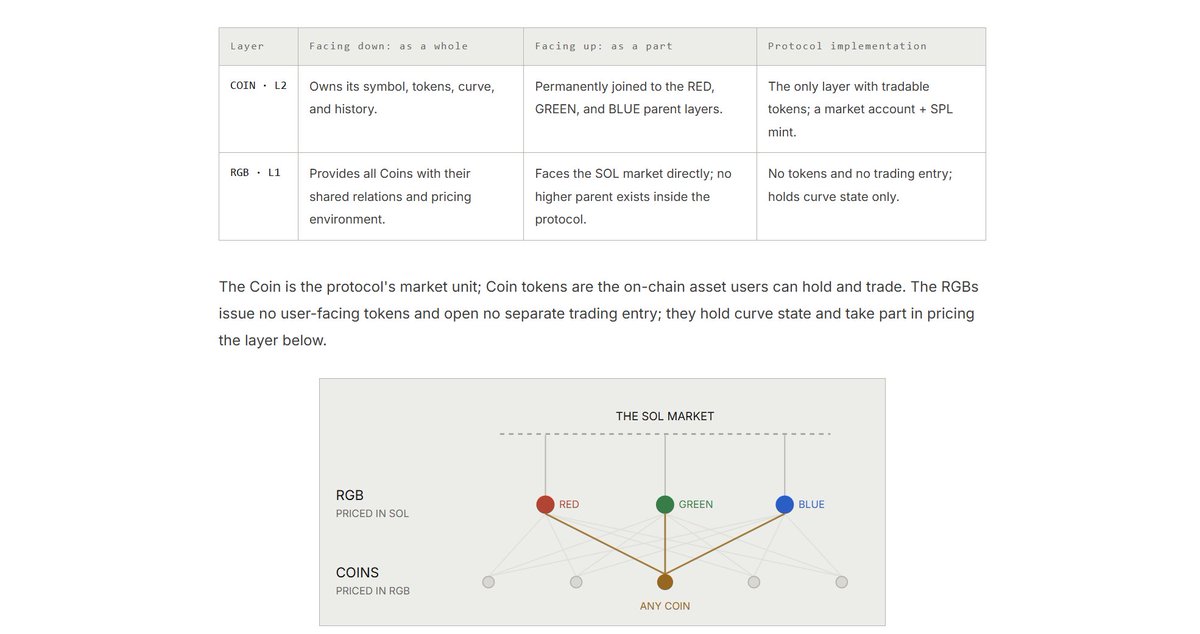
The platform has designed a public space called the "RGB layer." When you buy a keyword, it not only pushes the price of that word itself but also drives the entire platform upwards.
At the same time, users can gain two layers of extra benefits.
The first layer: Purchase quota cycle
It operates in the following way:
You use a purchase quota of 1 SOL to complete a buy
The system issues you 2 new invitation codes
Each invitation code corresponds to a 1 SOL purchase qualification
When a friend uses your invitation code to complete 1 SOL, you will regain your 1 SOL purchase quota
The regained quota can be used again and continue to generate new invitation codes
The purchase quota is not SOL gifted by the platform but a qualification for purchasing. Each time you buy, users still need to pay real funds.
The second layer: Fee sharing
Every time the users you have invited complete a buy through posting, 80% of the transaction fees will be directly shared with you.
These earnings will be automatically settled each time a purchase occurs, without needing to be manually claimed.
2/ SocialFi has evolved to 3.0
If we roughly divide SocialFi into three generations, the logic will be very clear.
1.0 Creator economy, represented by Rally. The core is helping creators to monetize.
2.0 Decentralized social graphs, represented by Lens and Farcaster. The core is returning relationships and data to users.
3.0 Attention as the market, represented by http://MIND.WTF. The core is unifying posting, trading, and governance into one action.
Comparing it with http://Friend.tech makes the distinction even clearer.
The logic of http://Friend.tech is that I pay to purchase your access, entering a private chat room. Social content and trading assets are separated.
The logic of http://MIND.WTF is that one keyword is one attention market. When you post expressing your view on the narrative, you must also bet capital on this narrative.
3/ A challenging experiment
http://MIND.WTF completely abandons the traditional plaza model of socialization, attempting to unify social expression, trading, and community governance into one atomic action.
Its advantage is that the design is highly imaginative, but the mechanism is relatively complex. As a highly experimental design, whether it can succeed is left to time to test.
Official website - https://mind.wtf
Here are some invitation codes for everyone:
wtf-pVTkyfR0Jt
wtf-yNR53hZc1L
wtf-bL9UhwKEBP
wtf-g4IK3aOVYw
wtf-yyIWDlPQvn
wtf-xJGbTXDjTy
wtf-FKUgKE3WbC
wtf-urWsrPtpQ5
wtf-sdMbC1cPxA
wtf-ShrbiVvA8y
DYOR
免责声明:本文章仅代表作者个人观点,不代表本平台的立场和观点。本文章仅供信息分享,不构成对任何人的任何投资建议。用户与作者之间的任何争议,与本平台无关。如网页中刊载的文章或图片涉及侵权,请提供相关的权利证明和身份证明发送邮件到support@aicoin.com,本平台相关工作人员将会进行核查。


