Summary of Key Points
● The global broad money supply remains above 100 trillion dollars, with dollar stablecoins amounting to approximately 311 billion dollars. The shortage in crypto is not that "there is no money in the world," but rather that money no longer needs to pass through crypto spot markets first to express risk preferences.
● Liquidity is being distributed to DEX perpetuals, US stocks and prediction markets, tokenized treasury bonds, AI, and primary markets. Bitcoin is still about 38% lower than its peak of approximately 126,000 dollars expected in October 2025.
● Centralized exchanges have not relinquished their leaders. In August, global CEX spot plus derivatives trading amounted to approximately 4.29 trillion dollars; Binance's spot trading was about 236 billion to 243 billion dollars, with contracts around 1.59 trillion to 1.67 trillion dollars, making the spot share about one quarter of the entire market and nearly half of the mainstream exchange sample, while the contract share is about 47%, and RWA perpetual share is about 60.9%. Depth remains concentrated.
● Hyperliquid represents an on-chain derivatives ledger, while Robinhood signifies retail brokerages transforming attention into stocks, options, and event contracts. Binance represents funds that still package fiat, major cryptocurrencies, contracts, and TradFi in the same deep ledger.
● A validated Binance account cannot cover all new channels, but it can consolidate most parts of the aforementioned "still needs an order book and fiat entry" into the same login state: spot, perpetuals, options, tokenized US stocks, US stock spot/options, Pre-IPO perpetuals, Earn, and new listings. Registration is the base of a layered market, not a guarantee of a bull market.
There is a saying that is quite easy to articulate recently: Crypto lacks liquidity, and even if a brief bullish trend occurs, it is hard to return to the era of all coins rising together a few years ago. The reason often given is—that money now has more destinations; on-chain DEX, US stocks, tokenized treasury bonds, all are more convenient than "buying another new coin."
This statement is half correct.
The mistake is "money has disappeared." The correct part is "money no longer needs to first pass through crypto to express risk preferences."
Around 2021, retail leverage, the expansion of stablecoins, and depth in centralized exchanges were almost one and the same pipeline. The pipeline was narrow; when the water came, altcoins were the first to erupt. By 2026, the pipelines have multiplied: the same dollar could purchase Nvidia, could buy gold, could buy on-chain treasury bonds, could bet on the World Cup in prediction markets, and could open BTC perpetuals on Hyperliquid. Crypto is still on the menu, just no longer monopolizing it.
There is no shortage of money globally; the shortage lies in the segment that "only prefers to enter exchange spot."
By mid-2026, the sum of broad money in the US, China, the Eurozone, and Japan has reached approximately 103.7 trillion dollars, with the US M2 around 23 trillion and China M2 around 52 trillion. The Federal Reserve's balance sheet remains around 6.7 trillion dollars, with net liquidity about 5.9 trillion dollars. The supply of dollar stablecoins is about 311 billion dollars, relative to US M2 about 1 to 75. On-chain dollars have already become an undeniable layer of parallel cash, but relative to the ocean of sovereign currencies, it remains shallow.
What has truly changed is the distribution, not the inventory. The relationship between global M2 tracked by CF Benchmarks and Bitcoin has weakened significantly after Q4 2025: broad money continues to increase, while Bitcoin retreats from its highs. The same batch of newly created liquidity is more parked in US treasury refinancing, AI capital expenditures, tokenized cash, and stock risk premiums. The "lack of liquidity" spoken by traders mostly refers to centralized spot becoming thinner, stablecoins resembling on-chain cash more, and new funds no longer making altcoins their first stop.
The recovery in August indicates that the existing stock is still present: CEX total trading volume increased to 4.29 trillion dollars, with spot at 891 billion and derivatives at 3.40 trillion. In July, DEX/CEX spot trading approached about 24%, largely because the denominator has shrunk. Short impulses may occur, but a single network driving all altcoins back to structure is very challenging.
Funds have moved to four wider rivers.
The first river is the on-chain order book, especially perpetuals. In August, DEX spot trading was about 205 billion dollars, with a share of about 18.7%. Hyperliquid's open interest returned to 14.6 to 14.7 billion dollars, accounting for more than 70% of reported perpetual DEX positions, with contract trading in August around 207 billion dollars. It relocated the centralized exchanges' order books and clearing to its own chain, serving professional trading, market-making, and speculative trading looking for new perpetual targets.
The second river is US stocks, options, and event contracts. Robinhood reported second-quarter revenue of 1.31 billion dollars; event contract revenue was 156 million, exceeding that season's crypto trading of 100 million. Retail brokerage accounts complete transactions for stocks, options, World Cup betting, and tokenized stocks all on the same interface, with crypto being just one column of choices.
The third river is the replacement with tokenized cash. On-chain RWA is about 38 billion to 46.2 billion dollars, with tokenized US treasury bonds around 15 billion dollars. While short-term rates remain high, money will linger in products like BENJI and BUIDL.
The fourth river is the traditional risk assets themselves. The S&P is around 7600 points, gold about 4400 dollars, and the yield on ten-year US treasuries is close to 4.8%. Crypto has become optional volatility rather than a default high-growth channel.
The centralized exchanges' leadership remains and is even more concentrated than the slogans suggest.
The on-chain has taken away the long tail and some leverage, but this does not mean that CEX has relinquished depth. By laying out August's data, Binance remains the settlement hub for the centralized market.
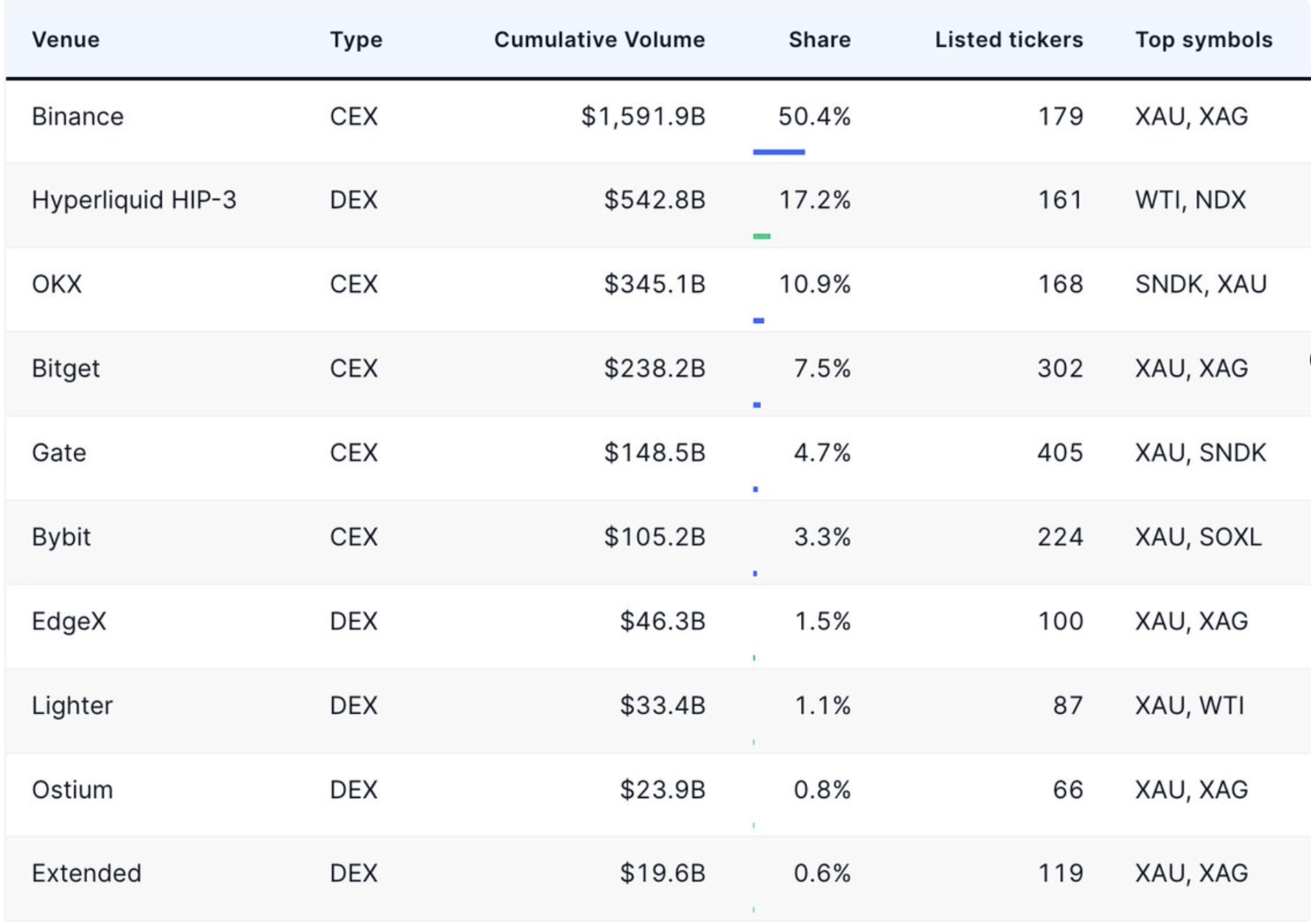
According to CoinDesk's statistics on global CEX: total spot volume is about 891 billion dollars, with Binance around 236 billion dollars, holding a share of 26.5%, up 20.6% month-over-month; total derivatives volume is about 3.40 trillion dollars, with Binance at around 1.59 trillion dollars, a share of 46.9%, the highest since November 2023, and marking the sixth consecutive month of growth. RWA perpetuals on CEX reached a new high of about 602 billion dollars, with Binance holding a share of 60.9%. OKX contracts are approximately 502 billion, Bybit about 321 billion, with distances being in different magnitudes.
Taking a narrower sample yields a higher concentration. According to Wu's statistics, the 14 mainstream exchanges recorded approximately 510.4 billion dollars in spot trading in August, with Binance approximately 243.1 billion dollars, holding a share of 47.6%; under another metric for derivatives, Binance was about 1.67 trillion dollars, with a share of about 47.7%, with the top three exchanges combined accounting for over 70%. Different metrics yield a consistent conclusion: Spot is judged by thickness, contracts by share, and RWA perpetuals by who takes on TradFi packaging; Binance remains the top in all three categories.
This explains why, after the diversion, there is still a need for a deep ledger account. Hyperliquid can offer perpetuals cheaper and more on-chain; Robinhood can better convert US retail attention into options and prediction markets. However, fiat entry, large BTC/ETH inflows and outflows, altcoin spot slippage, 24-hour prices for stock perpetuals, and tokenized stocks still highly rely on centralized order books. In August, Binance's TradFi perpetual trading was about 433.4 billion dollars, with equity-related perpetuals around 342.9 billion dollars; the platform also incorporated over a thousand US stocks/ETF options, more than 7000 US stock spots, and tokenized stocks into the same account. Depth is not evenly distributed to every new protocol; it is concentrated in the largest existing ledger.
What a Binance account can accommodate and what it cannot.
After the diversion, the rational use method is not "All in one," but rather to first have one that can complete fiat, major cryptocurrencies, and cross-market packaging. Based on the current product line (according to public announcement on the official website and subject to local legal restrictions, US users generally cannot access stocks and most TradFi packaging), after registration and identity verification, the same login state can roughly correspond to these flows mentioned earlier:
● Crypto spot with fiat entry: BTC, ETH, and hundreds of spot markets, corresponding to "money needs to have a deep ledger that can enter and exit."
● Crypto perpetuals and options: still nearly half of global CEX contract trading, corresponding to the portion of leverage that has not yet moved to Hyperliquid.
● TradFi perpetuals: stocks, ETFs, certain Pre-IPO (like SpaceX perpetuals), corresponding to "funds are moving to US stocks and primary narratives, but do not want to just wait for market open." In August, this type of perpetual was the most noticeable increment for the platform.
● US stock spots and options: In eligible regions, more than 7000 US stocks/ETFs can be traded, and over 1000 stock options with physical delivery, corresponding to Robinhood's demand for "buying stocks and doing options"—with different entrances but similar targets.
● Tokenized stocks bStocks: 1:1 custodial on-chain economic exposure, available for 24/7 trading, and bilateral conversion with stock positions on the platform, corresponding to RWA/tokenized US stocks on this layer.
● New listings, wealth management, and activities: Launchpool, Earn, etc., corresponding to keeping idle stablecoins on the platform rather than simply leaving them in on-chain treasury protocols.
It cannot replace the following: Hyperliquid's on-chain order book and self-custody clearing, Robinhood's US securities account and prediction markets, funds recognized by the Securities and Futures Commission on licensed platforms in Hong Kong, and bank savings in various jurisdictions. Binance is the merging point of deep ledgers and cross-market packaging, not the complete picture of global finance.
Therefore, the logic of inviting registrations is not "registering will bring us back to 2021." The logic is: funds have already been diverted, and you need at least one thick centralized entry to connect spot, contracts, and TradFi packaging with calculable slippage; then decide whether to split a portion of positions onto the on-chain or brokerage.
If you do not have an account yet:
https://jump.do/zh-Hans/xlink-proxy?id=3
Invitation code aicoin668
Complete identity verification and local compliance prompts, first enable fiat and spot, then check eligibility for contracts, stocks, and bStocks. Product availability varies by country/region; please read risk warnings before trading, especially for contracts and stock derivatives.
Registration itself does not create liquidity. It only determines whether you stand on the side of the market that in August still surpassed 200 billion dollars in spot and 1.5 trillion dollars in contracts within a fragmented market.
Crypto is looking more like a pipeline now, less like a unique main stage.
In the next two to three years, crypto will serve as a settlement layer (stablecoins and tokenized treasury bonds), a leverage layer (CEX and Hyperliquid coexisting), and a high Beta wrapper (only regaining thickness when other high-multiple assets surrender risk budgets). AI, US stocks, gold, RWA, and regulatory layers will continue to siphon attention away. The winners will be the ones capable of accessing fiat, treasury bonds, and risk assets simultaneously; the losers will be those who think all risk preferences still need to be converted into a certain altcoin market first.
Channels cannot return. What can be done is to acknowledge the diversion and separate accounts: place depth and cross-market packaging in the thickest CEX, on-chain leverage in order book public chains, coupon interest in tokenized cash, and event views in prediction markets. The money is still there. It just doesn't queue up; it only enters one door—and that door, which remains the widest centralized door, still reads Binance in the data.
免责声明:本文章仅代表作者个人观点,不代表本平台的立场和观点。本文章仅供信息分享,不构成对任何人的任何投资建议。用户与作者之间的任何争议,与本平台无关。如网页中刊载的文章或图片涉及侵权,请提供相关的权利证明和身份证明发送邮件到support@aicoin.com,本平台相关工作人员将会进行核查。