Author: imToken
If you play on-chain, it's highly likely that you have encountered these awkward situations:
You receive a stablecoin in a new address but can't send it out because a window pops up saying there is no ETH to pay for Gas; you want to swap a coin on a DEX but get stuck; you withdraw some USDC from an exchange only to realize you haven't prepared gas.....
In these cases, you often have to go elsewhere to find fiat channels or ask around to convert some "water," which is considered one of the classic beginner deterrents in the Crypto world.
Recently, Vitalik Buterin mentioned the progress of EIP-8141 (Frame Transactions), which once again presents new possibilities: in the future, a wallet can transfer value without holding ETH; Gas can be deducted directly from USDC, and even some applications might cover your Gas to attract users.
Once this news spread, it quickly fermented into a scary statement: "In the future, using Ethereum will not require ETH, so what value does ETH have?"
The answer is not that simple.
What users pay as fees and what the Ethereum protocol ultimately uses for fee settlement are, in fact, two entirely different things.
1. What does it mean to not pay Gas with ETH?
Let’s start with a normal Ethereum transaction today.
For example, Frank has 1000 USDC in his wallet, and he wants to send 100 USDC to a friend. However, as long as there is no ETH in his wallet, this transaction cannot be initiated.
The reason is simple: currently, the logic of ordinary Ethereum accounts is very rigid; the person initiating the transaction is also responsible for paying the network Gas—Frank signs, Frank initiates the transaction, and Frank’s ETH balance pays for the Gas; these three things are basically tied together.
EIP-8141 aims to separate these elements.
According to the current design, a Frame Transaction can be split into multiple different "Frames," each responsible for validating the transaction, confirming who pays for the Gas, and actually executing the user's operation.
Thus, in the future, when Frank makes a transfer, it could involve Frank still signing to prove, "This 100 USDC is indeed what I want to send," but another Paymaster or account takes out ETH to pay for the Gas to the Ethereum network, while Frank pays a small fee to this Paymaster in USDC.
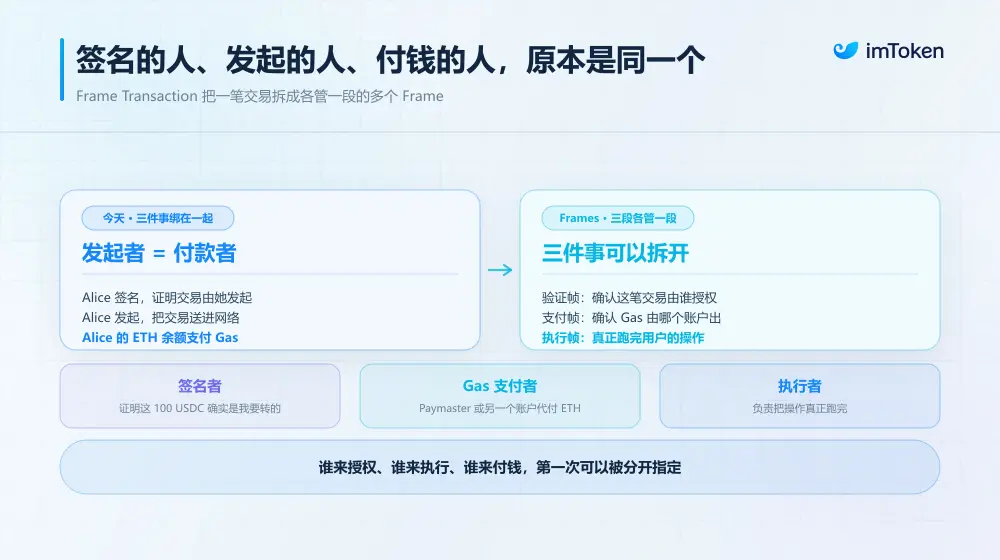
For Frank, he might only see a transfer of 100 USDC and a network fee of 0.1 USDC, and throughout the process, he doesn't even need to know how much ETH Gas costs nor do he need to prepare ETH in advance.
However, from the perspective of the Ethereum protocol, the situation has not turned into "Ethereum starts accepting USDC as Gas"; it’s just that someone on the backend pays Gas with ETH on Frank's behalf, then settles with Frank using USDC.
The official ERC-20 payment example provided by EIP-8141 follows this structure, where the Sponsor approves and bears the Gas, while users can transfer ERC-20 Tokens to the Sponsor as payment.
If we compare it to real-life consumption, it would be easier to understand.
When we use a Chinese yuan credit card in Japan, what the user perceives is "the deduction in yuan," while the merchant receives yen, but this does not mean that the underlying settlement currency in Japan has turned into yuan; the assets used for front-end payment and those for back-end settlement do not necessarily have to be the same thing.
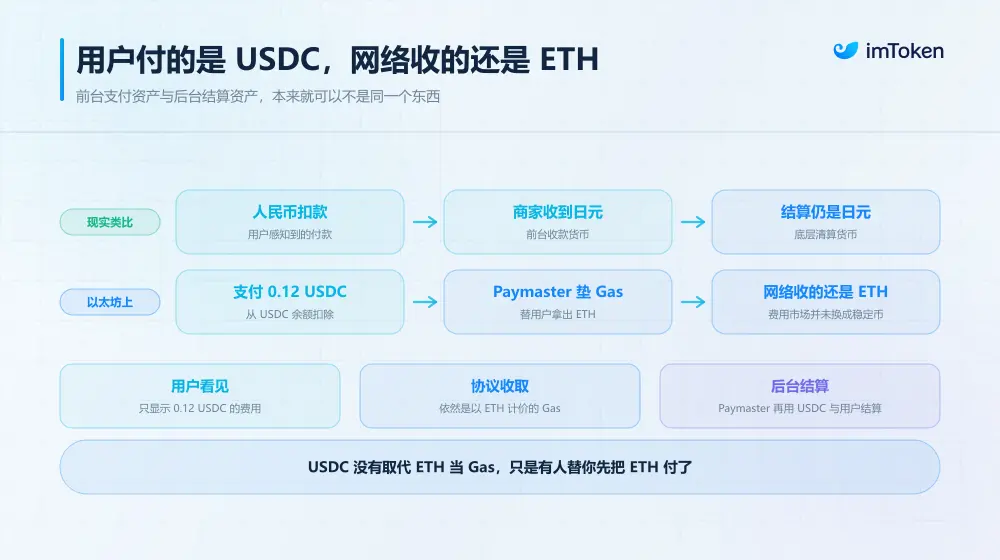
What EIP-8141 does is fundamentally a similar abstraction. Ultimately, users no longer have to personally hold ETH; they can have another account cover ETH Gas and then use assets like USDC to settle fees.
The two phrases may look like there is just a slight difference, but the meaning regarding ETH is entirely different.
2. Why does Ethereum want to 'hide' Gas?
In fact, the idea of "not needing to prepare ETH yourself" is not a brand-new concept.
Account Abstraction and Paymaster introduced by ERC-4337 already allow smart accounts to implement Gas Sponsorship, where applications can cover user transaction fees or allow users to use stablecoins to bear those costs.
However, what ERC-4337 can do is additive; it adds an infrastructure of UserOperation, Bundler, EntryPoint, and Paymaster outside of the protocol, while EIP-8141 attempts to integrate such capabilities more intrinsically into the Ethereum transaction structure itself.
Ultimately, the core point is to address a long-ignored problem: why should ordinary users have to understand what Gas is?
In real life, when you transfer two hundred dollars to a friend via WeChat, WeChat certainly does not pop up a window asking you to "first go buy a two-dollar settlement token from another platform."
But Crypto has been torturing people this way in the past.
In Ethereum, you need to prepare ETH; when it comes to Solana, you have to exchange for SOL, and on BNB Chain, you have to hold BNB; even if you switch to a new L2, the first reaction is to check if there’s enough starting capital in the wallet. Experienced users might handle a cross-chain transaction in two minutes, but for outsiders, this can be a chasm that makes them leave the webpage directly.
Besides hiding Gas, frame transactions can also resolve several stubborn issues.
For example, if you go to trade a new token on a DEX, you have to approve the transaction first, then swap it, with wallet pop-ups confirming twice. If the swap fails, the prior authorization remains on-chain for a long time, posing a theft risk.
However, if we use Frames, these two actions can be packaged into an atomic batch: if the swap fails, the prior authorization automatically rolls back, clean and neat.
This leads to a broader realm of possibilities, as in the future, who authorizes, who executes, who pays, and how verification is done can all be broken apart and recombined.
3. So is ETH a benefit or a drawback?
This is also where discussions are most prone to swing to two extremes.
One view is that "If you no longer need ETH to pay Gas, the value of ETH drops," while another view argues, "Lower user barriers lead to skyrocketing transaction volumes, which is therefore super bullish for ETH."
For a major structural reform affecting the underlying protocol usage experience, it is still difficult to draw conclusions, but one thing is certain: EIP-8141 does not eliminate ETH's role as the base layer for Gas and fee settlement in Ethereum.
Users may not perceive ETH, but the Paymasters, applications, or other accounts responsible for making payments on behalf of users still need to have the capacity to bear network fees priced in ETH, and the existing EIP-1559 fee market has not been replaced by stablecoins due to Frames.
What changes is only the position of ETH demand.
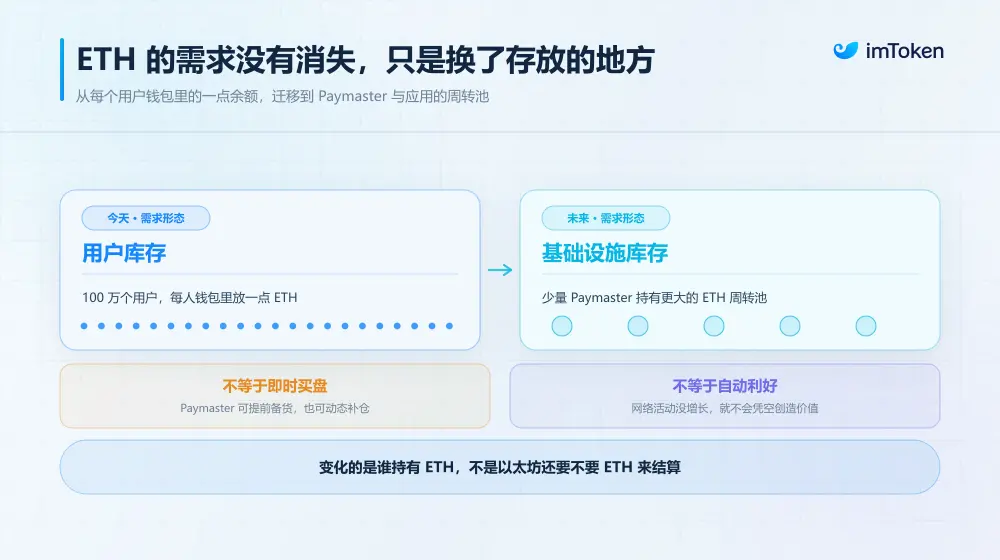
Today there might be a million users, each keeping a bit of ETH in their wallets for Gas; in the future, there may be fewer Paymasters, wallet service providers, and applications maintaining larger ETH turnover balances to uniformly handle Gas for a large number of ordinary users.
Of course, do not naively think that "every time a user pays with a stablecoin, someone on the backend will go to the secondary market to buy an equal amount of ETH." The payment providers have their own inventory management and hedging strategies, making it difficult to directly translate into instant buy orders envisioned by retail investors.
Paymasters can prepare inventory in advance, dynamically restock, or use other capital management strategies, therefore simply claiming "in the future, stablecoins can be used to pay Gas" makes it hard to directly predict how much additional buying pressure that will create for ETH.
The ultimate key factor has only one logic: After optimizing the experience, will it lead to more genuine demand for Ethereum usage, and can it ultimately enlarge the pie?
A simple calculation makes it very intuitive:
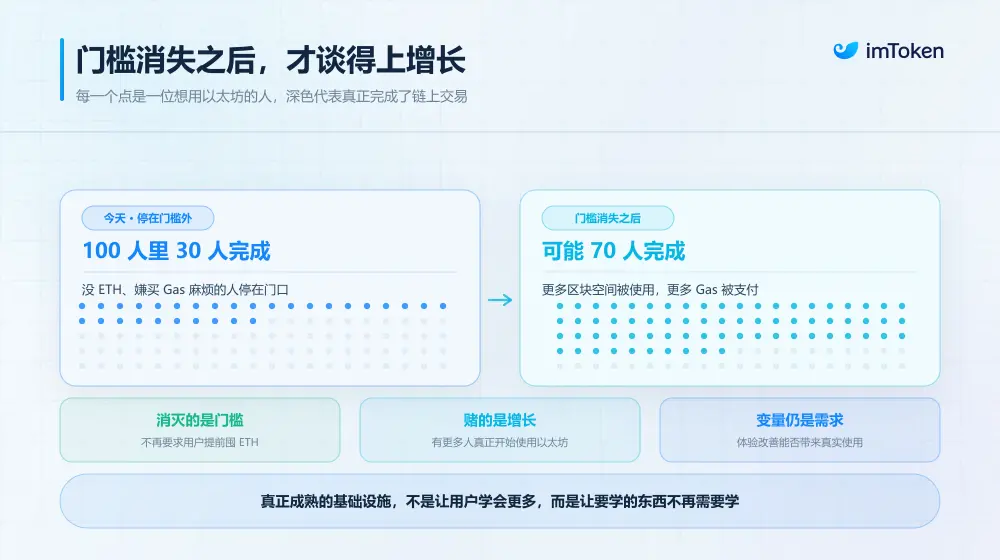
- If in the past there were 100 people planning to enter the market, 70 of whom dropped out due to buying Gas, calculating Gwei, and cross-chain hassles, resulting in only 30 completing transactions;
- In the future, if wallets can handle all these hassles in the backend and allow 80 people to smoothly finish transactions—even if they do not hold a single bit of ETH—the actual consumption and burning of ETH on the network will be far greater than before;
Conversely, if the entire ecosystem simply does not bring incremental activity, and just shifts "paying out of pocket" to "finding someone to pay on their behalf," it indeed will not create any new incremental value.
In Closing
From my perspective, it diminishes the notion that "every user must stock up on a bit of ETH to use Ethereum," but it bets that once this threshold disappears, more people will truly start using Ethereum.
For ordinary users, there is certainly no need to change their usage habits because of this EIP for now, but from the perspective of wallet development, the direction has already been made clear.
In the future, a user-friendly wallet might increasingly not require users to first understand Gas; users should be responsible for deciding where assets go and what operations to execute; the wallet should inform them of what the risks are and how much they will ultimately spend; as for which account to use for payment, whether to bill in ETH or stablecoins, and if there is an available Gas Sponsor, these complex protocol details should gradually be hidden in the backend.
truly mature infrastructure often works this way.
免责声明:本文章仅代表作者个人观点,不代表本平台的立场和观点。本文章仅供信息分享,不构成对任何人的任何投资建议。用户与作者之间的任何争议,与本平台无关。如网页中刊载的文章或图片涉及侵权,请提供相关的权利证明和身份证明发送邮件到support@aicoin.com,本平台相关工作人员将会进行核查。


