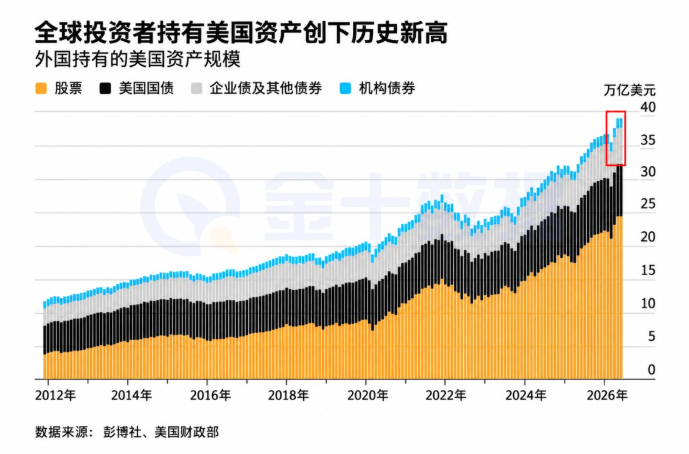
Jinshi sent a quite interesting picture!
Assets held by foreign investors in the United States have risen to about $39 trillion, a historic high, with nearly $20 trillion flowing into the U.S. stock market.
I went to look up the relevant data, as of the first quarter of 2026:
U.S. foreign assets: $43.37 trillion;
Foreign holdings of U.S. assets: $64.64 trillion;
Net international investment position: -$21.27 trillion.
In other words, the U.S. owes the world $21 trillion. If it were another ordinary debtor country, this number would be shocking.
But not for the United States; it can let asset price fluctuations allow creditors to bear external adjustments.
For example, foreigners currently hold nearly $20 trillion in U.S. stocks.
Assuming U.S. stocks fall by 20% overall, with other conditions unchanged, foreigners would lose $4 trillion on paper.
The U.S. does not need to export $4 trillion worth of goods, does not need a $4 trillion budget surplus, and does not need to repay anyone $4 trillion in cash; its external liabilities' market value will naturally decrease.
So, thinking about the problem the other way around is even more interesting:
If the entire world has already bet $64 trillion worth of assets on the United States, who is actually more afraid of a collapse of U.S. assets?
This is a very perverse self-reinforcing mechanism of capital, a reflexive capital cycle, which is beneficial for U.S. stocks in the long run!
免责声明:本文章仅代表作者个人观点,不代表本平台的立场和观点。本文章仅供信息分享,不构成对任何人的任何投资建议。用户与作者之间的任何争议,与本平台无关。如网页中刊载的文章或图片涉及侵权,请提供相关的权利证明和身份证明发送邮件到support@aicoin.com,本平台相关工作人员将会进行核查。


