The correlation with gold has reached a new high since 2020, but how is this script different this time?
Written by: Tanay Ved
Translated by: Saoirse, Foresight News
Introduction
For a long time, the core investment logic of Bitcoin has been as a scarce, non-sovereign monetary asset, often compared to gold. However, in certain market phases, its trends have also reflected those of high beta assets, influenced by market liquidity, interest rates, and risk appetite, resembling tech stocks. As the macro environment and the structure of Bitcoin investors evolve in different market cycles, the interconnection among these assets continues to change.
In this article, we will explore how the correlation among Bitcoin, gold, stocks, and the dollar shifts with the market cycle; why the current high correlation between Bitcoin and gold is worthy of attention; and how changes in real interest rates and recent macro data releases have affected Bitcoin's recent performance.
The Historical Correlation Cycle of Bitcoin
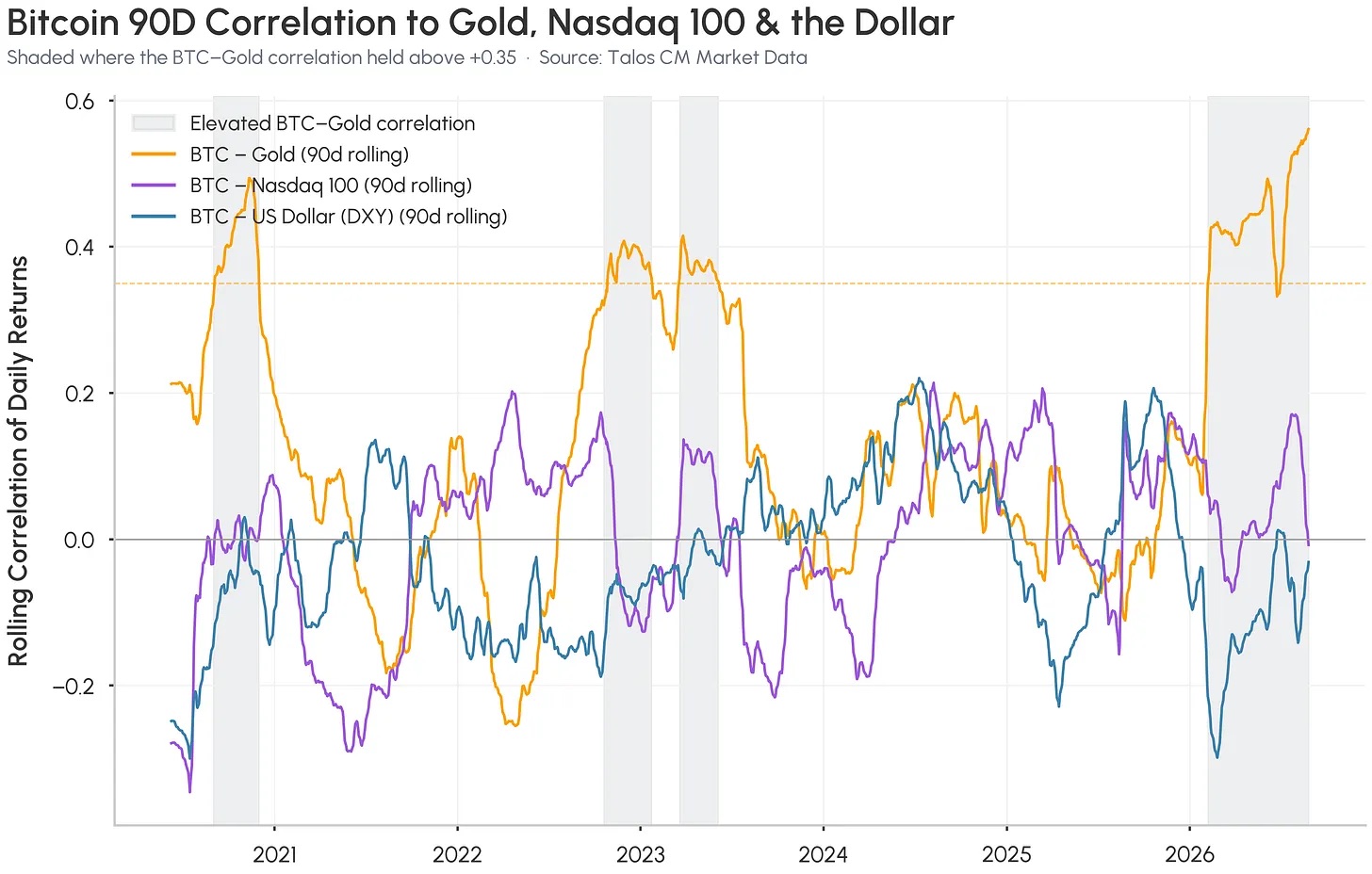
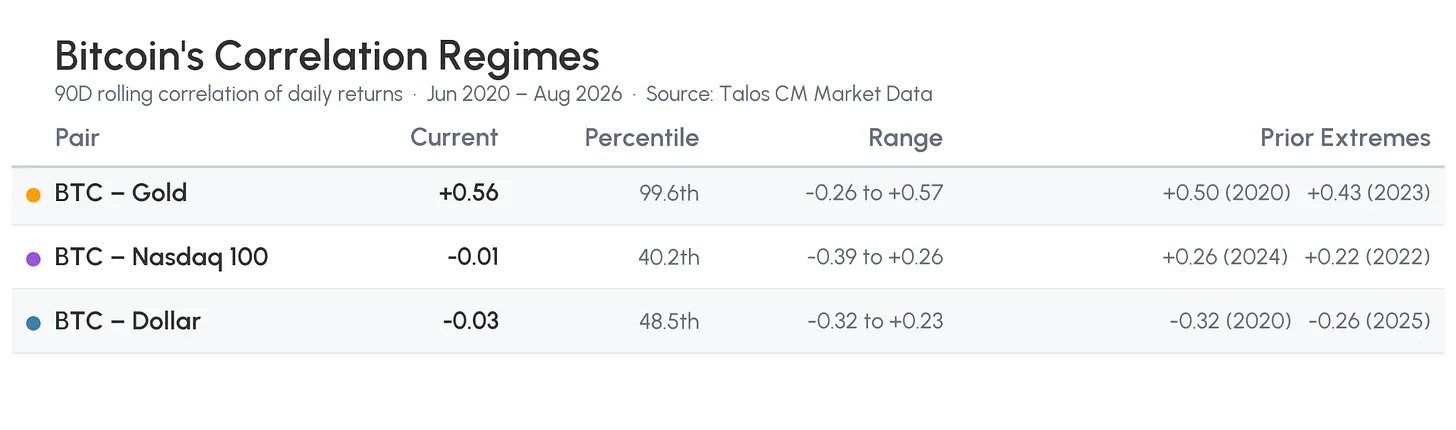
As discussed in our article "Is Bitcoin Decoupling from Traditional Markets?", the connection between Bitcoin and traditional assets changes with the market cycle. In different periods, Bitcoin has aligned with the fluctuations of growth stocks and tech stocks or has performed as a scarce store of value. The particularity of the current market is that the 90-day correlation coefficient between Bitcoin and gold has risen to +0.56, the highest level since 2020; whereas its correlation with the NASDAQ 100 and the dollar has fallen close to 0.
Data source: Talos CM market data
This divergence indicates that Bitcoin's price movements are no longer primarily driven by the risk beta of tech stocks, but are more aligned with the macro factors that support gold. Recently, Bitcoin and gold have been influenced by similar market conditions, including concerns over currency devaluation, sovereign debt, and real yield prospects.
Looking back at historical periods of high correlation between Bitcoin and gold helps in understanding the current situation:
- 2020: During the early phase of the COVID liquidity shock, Bitcoin and other risk assets dropped in tandem; subsequently, emergency monetary easing by the Federal Reserve and fiscal interventions suppressed yields, driving significant rebounds in both Bitcoin and gold.
- 2023: Multiple regional banks in the U.S. collapsed, and the Federal Reserve introduced emergency liquidity tools, reigniting market worries about financial system stress, leading to trading on interest rate cut expectations, benefiting both Bitcoin and gold.
- The current environment features characteristics of both previous periods: issues in the U.S. Treasury market have led the market to refocus on the long-term purchasing power of the dollar, favoring scarce assets. However, unlike in 2020, real yields remain elevated, limiting the Federal Reserve's capacity to cut rates. The rising correlation between Bitcoin and gold reflects this environment; if rates continue to rise, Bitcoin may still face pressure.
What Makes This Market Movement Unique?
Behind the rising correlation between Bitcoin and gold are two opposing macro forces. The U.S. Treasury has taken actions to support the long end of the bond market, with markets continuing to monitor government debt and the dollar's outlook; meanwhile, the Federal Reserve is still combatting inflation, with interest rates and real yields being core variables determining Bitcoin's short-term trajectory.
- U.S. Treasury Bond Purchases: After the U.S. Treasury announced an increase in the scale of long-term bond repurchases to maintain market liquidity, both Bitcoin and gold experienced increases. This action reduced long-term yields and weakened the dollar, causing the market to refocus on fiscal deficits, bond issuance scales, and the long-term purchasing power of the dollar. Although bond repurchases do not represent direct stimulus, they reignited the "currency devaluation trade," benefiting scarce assets like gold and Bitcoin.
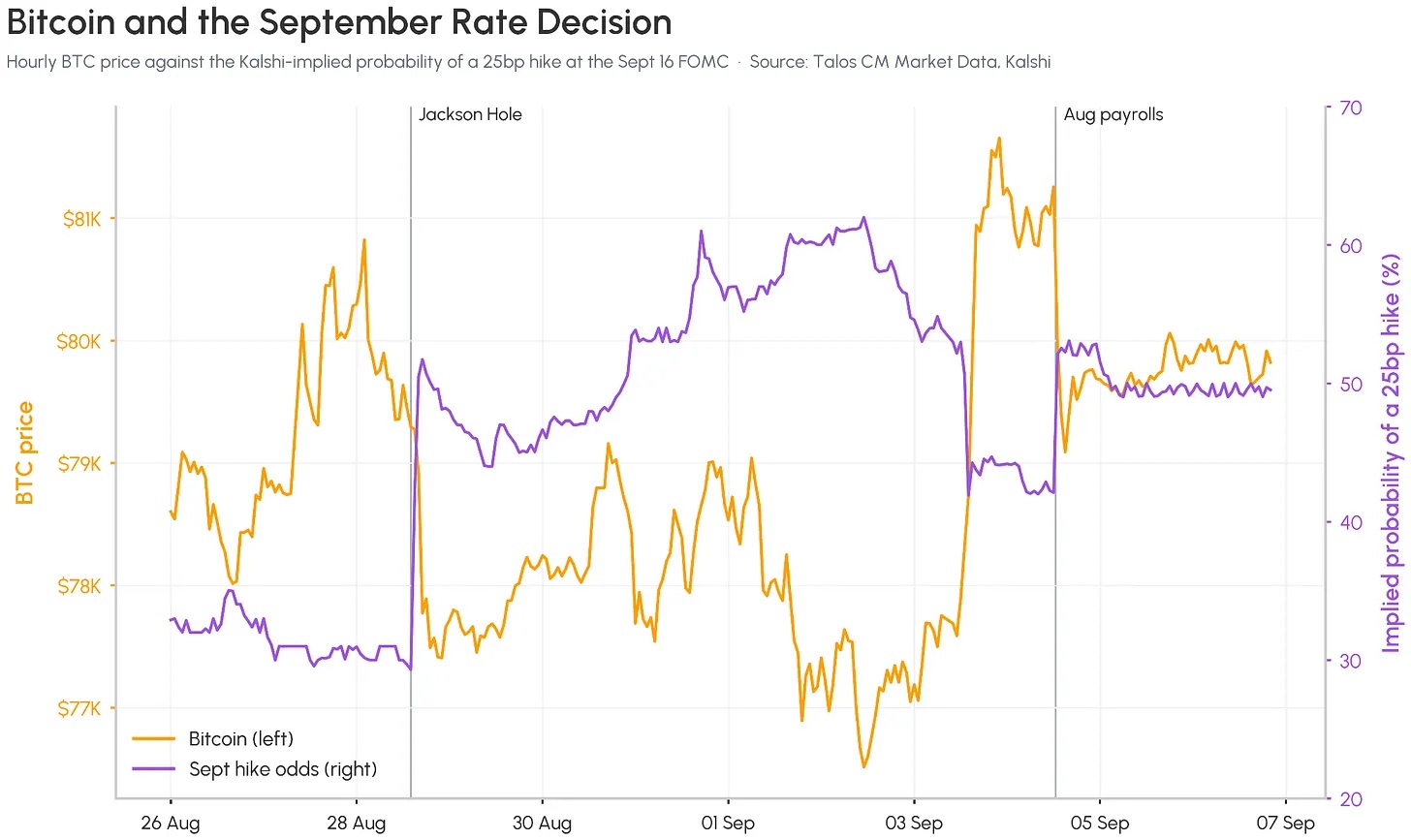
- Federal Reserve's Anti-Inflation Stance: The Federal Reserve faces the opposite dilemma. Strong employment data and ongoing inflation concerns could keep interest rates high for a longer period, pushing up real yields; the appeal of non-interest-bearing assets like Bitcoin may decline. After the non-farm payroll data was released on September 4, Bitcoin dropped, illustrating that stronger-than-expected employment data quickly raises rate hike expectations, pressuring Bitcoin's price.
Data source: Talos CM market data, Kalshi
After the Jackson Hole meeting, the market's implied probability of a 25 basis point hike at the September FOMC surged from 29% to 51% within four hours, during which Bitcoin dropped by 1.8%, clearly depicting Bitcoin's sensitivity to changes in Federal Reserve policy expectations. Similarly, the initial release of August non-farm data saw Bitcoin sold off; once the rate hike expectations materialized, the market adjusted to this impact.
Bitcoin's Response to Recent Macro Data
Inflation and economic growth-related data can alter the market's pricing of Federal Reserve policies. Non-farm payroll reports, Consumer Price Index (CPI), and Federal Open Market Committee (FOMC) interest rate decisions will lead the market to reassess the probabilities of further tightening or easing.
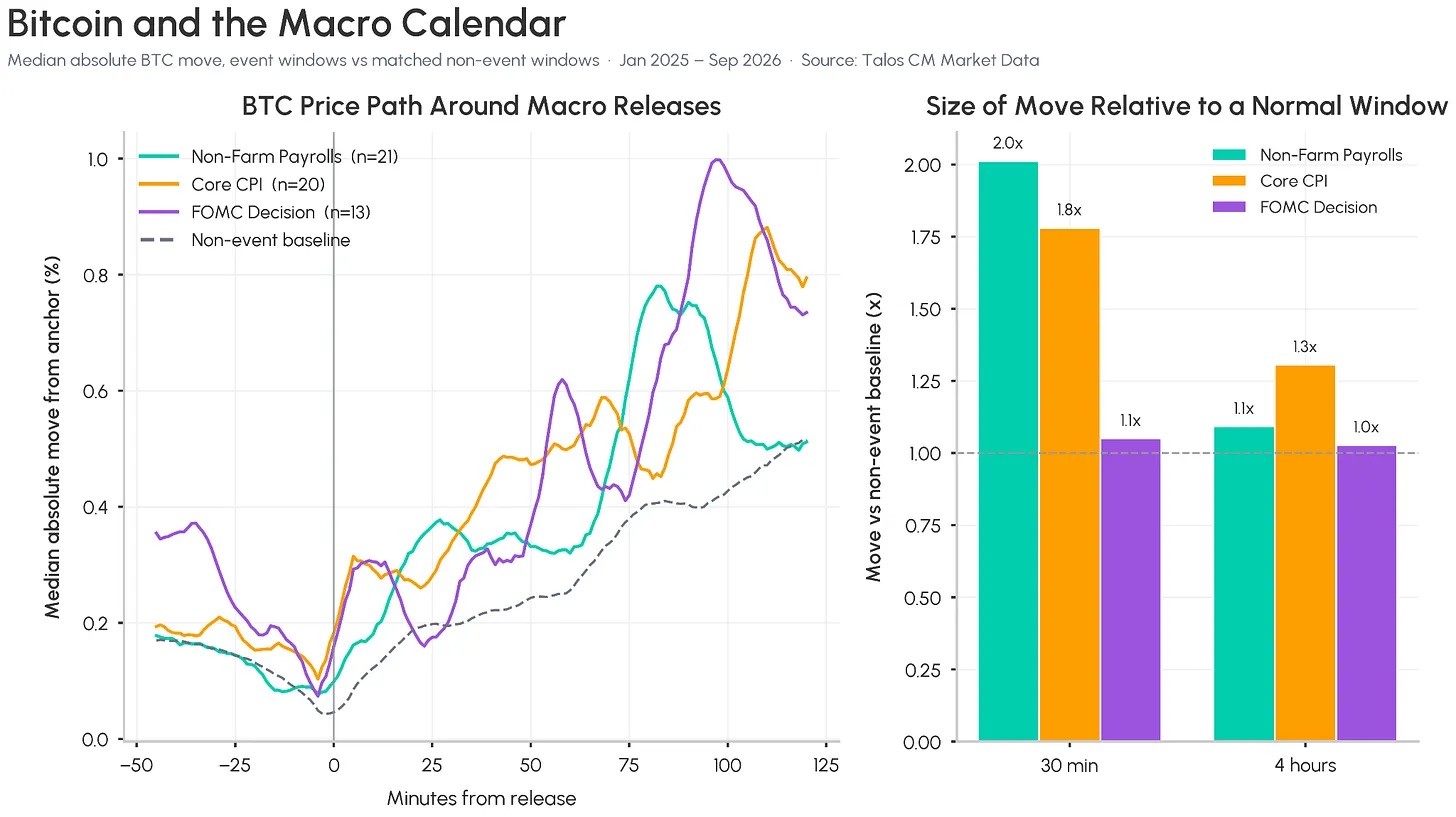
The following chart records the average absolute price volatility of Bitcoin before and after macro events from January 2025 to September 2026 and compares it with periods without significant events, measuring only the magnitude of volatility without distinguishing the direction of increases or decreases.
Data source: Talos CM market data
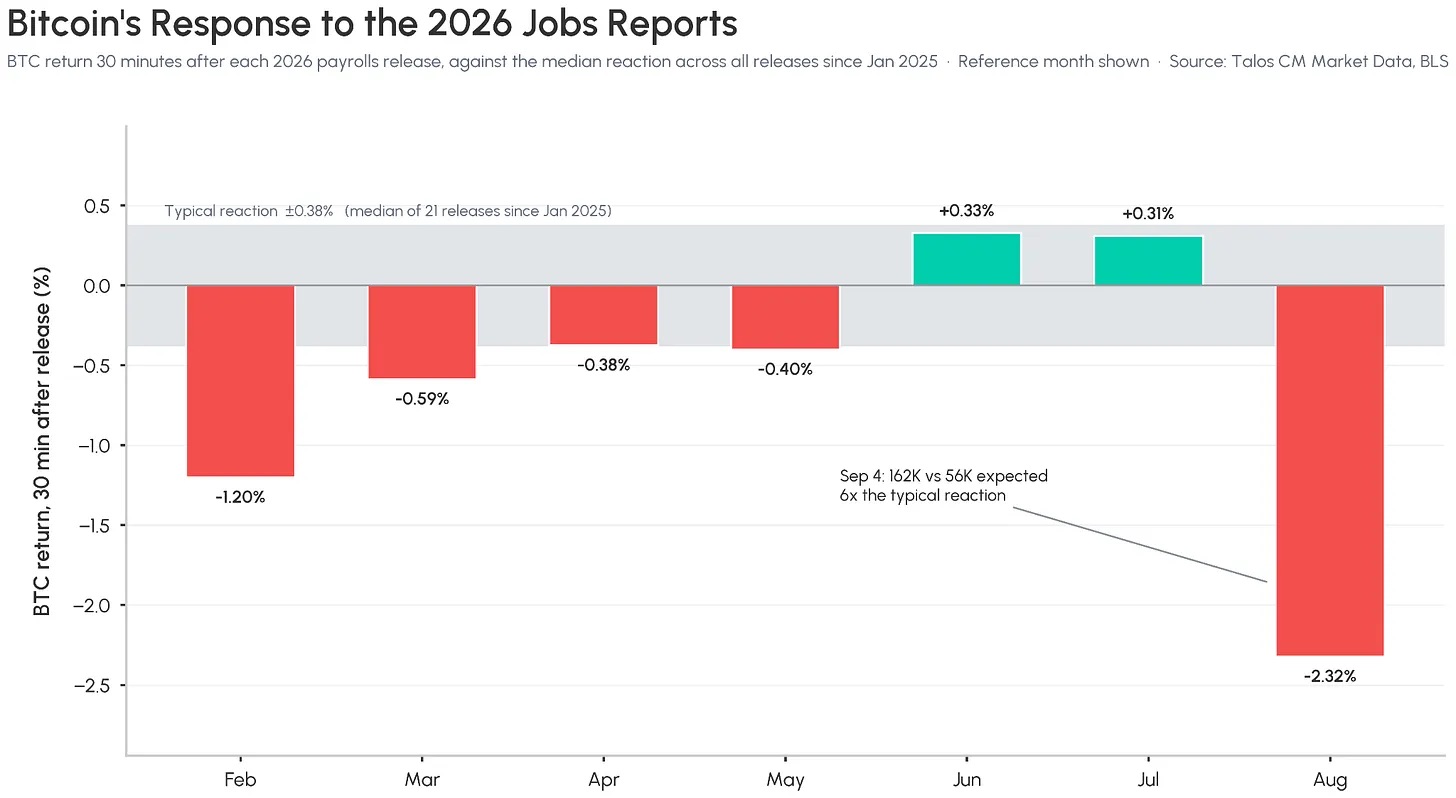
The immediate market response to employment reports is the strongest, with Bitcoin's volatility in the first 30 minutes after data release being twice that of regular periods. Core CPI data exhibited volatility 1.8 times that of typical levels during the same timeframe, and the effects lasted longer. In contrast, the volatility brought about by the FOMC decisions was close to baseline levels.
Data source: Talos CM market data
The non-farm data released on September 4 sharply highlighted the market's heightened sensitivity to employment data. In August, 162,000 new jobs were added, far exceeding the market expectation of 56,000; Bitcoin dropped by 2.32% within 30 minutes of the data being announced, with volatility reaching approximately six times the usual response to non-farm events.
Macro data sets the initial direction for the market, while perpetual futures positions, funding rates, open interest, and liquidations can amplify volatility and affect the duration of market movements. In the 30 minutes following the release of the data on September 4, Bitcoin's open interest dropped by 3%; the scale of long and short liquidations was roughly 5:1, at $119 million and $24 million, respectively.
The CPI to be released on September 11 is the most important leading indicator before the September FOMC meeting. Current rate hike expectations are at a delicate balance: if CPI exceeds expectations, it will intensify rate hike pressures; if CPI weakens, it may relieve pressure, benefitting Bitcoin and gold while bolstering overall risk appetite.
Conclusion
Bitcoin remains the core barometer of risk appetite in the crypto market. If the Federal Reserve shifts to a more contractionary policy path, it will likely suppress Bitcoin, altcoins, and leveraged positions; whereas a decline in inflation and favorable rate policies would drive a recovery in overall market risk appetite.
However, Bitcoin does not equate to the entire digital asset industry. On-chain transactions, tokenization, settlement, and prediction markets are creating independent sources of trading volume, fees, and liquidity, with their own growth drivers. The ongoing expansion of the Hyperliquid stock and commodity perpetual contract markets, preliminary progress in the HIP-4 prediction market, and the continued growth in the issuance scale of tokenized assets all indicate that the ecosystem’s development is independent of Bitcoin's price trends.
A loose interest rate environment can enhance market liquidity and risk appetite. But even under a pressured macro environment, the demand for stablecoins, on-chain yields, tokenized assets, settlement services, and round-the-clock trading infrastructure can continue to grow. Bitcoin may dictate short-term market sentiment, but the digital asset industry has the potential to sustain growth across different macro cycles.
免责声明:本文章仅代表作者个人观点,不代表本平台的立场和观点。本文章仅供信息分享,不构成对任何人的任何投资建议。用户与作者之间的任何争议,与本平台无关。如网页中刊载的文章或图片涉及侵权,请提供相关的权利证明和身份证明发送邮件到support@aicoin.com,本平台相关工作人员将会进行核查。


