Written by: Rita
OpenAI's latest release, GPT-6 Astra, is redefining the investment logic of AI infrastructure.
On September 7, Morgan Stanley released a technology industry strategy report stating that GPT-6 Astra not only completed training on 1 million GPUs, but its broad capabilities across reasoning, engineering, computational use, and physical world tasks are reshaping the market's perception of AI demand. Morgan Stanley believes that the risk of underestimating AI infrastructure investment currently exceeds the risk of overestimation, with investors' holdings in AI significantly decreasing. Macroeconomic uncertainties combined with recent market corrections have created a window for repositioning.
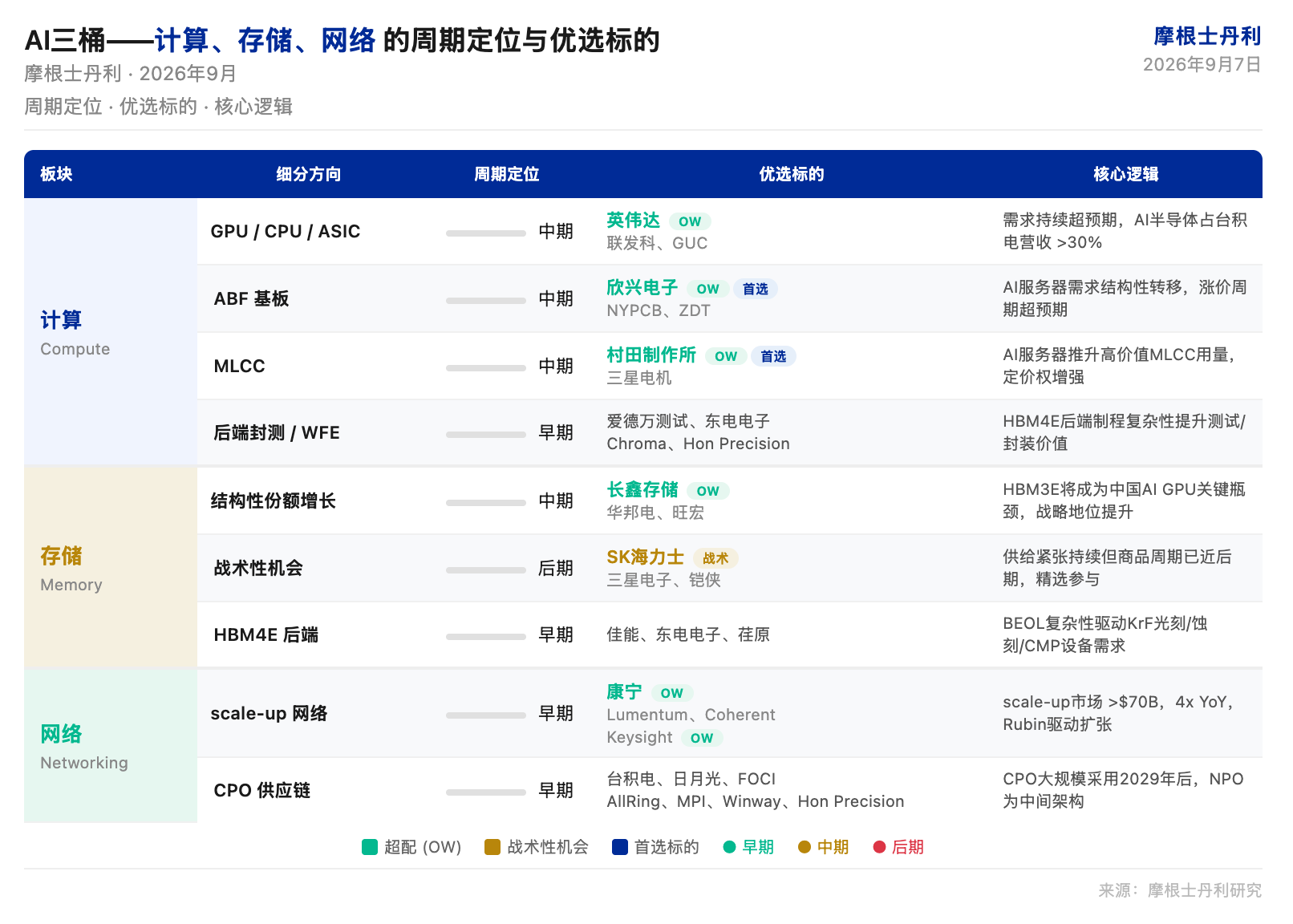
Morgan Stanley categorizes AI investments into three verticals: AI computing (most optimistic), storage (structurally optimistic but needs to be more selective), and networking (suboptimal choice). The report also notes that analog chips outside of AI are in the early stages of a cyclical recovery, providing valuable diversification opportunities.
Computing power remains the core of AI investment, and the component sector also benefits
Morgan Stanley has the strongest confidence in AI computing power, with the core logic being that demand continues to exceed expectations, and there is still momentum for earnings revisions. GPUs, CPUs, and ASICs are the direct beneficiaries, with TSMC's revenue growth guidance for 2026 being revised upwards to over 40%, and AI semiconductors expected to account for more than 30% of its revenue. TSMC has raised its capital expenditure for 2026 to $60 billion to $64 billion, further validating the strength of AI demand.
Opportunities in computing power are spreading to a wider range of components. The demand structure for ABF substrates has shifted from PCs and servers towards AI GPUs/ASICs and networking equipment. Morgan Stanley expects the ABF price increase cycle to be stronger and earlier than previously anticipated, with Unimicron as the preferred target. MLCCs also benefit, as AI servers' increased power density and performance requirements drive a significant rise in the usage of high-value MLCCs, with Murata Manufacturing listed as the preferred choice, and Samsung Electronics also gaining attention due to dual benefits from ABF and MLCC.
The storage cycle is entering its later stage; targets need to be carefully selected
The fundamentals of storage chips remain strong, but the cycle is transitioning to its later stage. Morgan Stanley expects the annual growth rate of DRAM monthly prices to peak in the fourth quarter of 2026, with the pace of price increases gradually narrowing, and the speed of earnings revisions has already begun to slow down. The supply growth of DRAM bits for 2026 has been revised up from 25% to 31%, while the complexity of HBM4E's backend process is changing the paradigm of memory manufacturing. HBM is evolving from dedicated 3D memory stacks to highly integrated customized Chiplet logic systems.
The complexity of HBM4E's backend process may delay the growth of DRAM supply, subsequently affecting NAND supply. At this stage of the cycle, emphasis should be placed on targets that demonstrate structural share growth, localization, and downstream AI exposure, rather than those tied to commodity prices. Changxin Memory is the only storage target rated as overweight, with its HBM3E expected to become a key bottleneck for China's AI GPUs in 2027, enhancing its strategic importance in the domestic AI supply chain. SK Hynix, Samsung, and Kioxia are viewed as tactical opportunities, provided that supply constraints persist, but they are already in the later stages of the commodity cycle.
Networking opportunities lie in scale-up expansion; large-scale adoption of CPO still requires time
Networking is the second largest opportunity in AI infrastructure, but the market has misconceptions about it. The opportunity lies in the rapid expansion of scale-up network size rather than a simple replacement of copper cables with optical fibers. The market opportunity for scale-up networking has exceeded $70 billion, more than four times that estimated for the same period last year, primarily driven by Nvidia's Rubin expanding the scale-up domain to 144 GPUs and Rubin Ultra extending to 576 GPUs.
The lifespan of copper cables may be longer than the market anticipates. In short-distance rack interconnections, copper cables still hold advantages in latency, power consumption, and cost, with improvements in SerDes, retimers, and active copper cables extending their lifespan. Optical solutions only become necessary when challenges arise in cross-rack expansion, bandwidth density, and electrical I/O power consumption within the scale-up domain. The technology evolution path is from copper cables to NPO/hybrid architectures to CPO, rather than a simple binary switch. Large-scale adoption of CPO is expected from 2029 onwards, with limited adoption scale in 2028.
In scale-up networking, Corning, Lumentum, and Coherent are favored, while Keysight has been upgraded to overweight due to increased testing complexity. In the CPO supply chain, TSMC, ASE, FOCI, AllRing, MPI, Winway, and Hon Precision are listed as overweight.
Analog chips provide non-AI diversification opportunities
Analog chips are in the early stages of a cyclical recovery. The performance in the second quarter of 2026 confirmed that the industry is at the starting point of an upward cycle, a trend that is expected to continue at least until the second half of 2026, characterized by continuous improvement in prices, inventory replenishment, and positive order-to-shipment ratios.
In the global coverage of analog chips, STMicroelectronics, NXP, and Renesas Electronics are the preferred choices. These companies have diversified their presence in end markets outside the AI wave, providing valuable cyclical diversification opportunities.
The significance of GPT-6 Astra goes beyond just a model upgrade; it alters the way AI demand is formed. As model intelligence improves, making more workloads economically viable, the number, duration, and complexity of reasoning workloads will increase. The bottleneck in AI infrastructure is shifting from "will demand come" to "can physical constraints support large-scale delivery of intelligence." At this stage, the risk of undervaluing investments has exceeded the risk of overvaluation.
Disclaimer
This article is a compilation and interpretation of third-party brokerage research reports (Morgan Stanley, September 7, 2026) by ChaoXiang Research, along with the sorting of public market information. The ratings, target prices, earnings forecasts, and related judgments quoted in this article represent the views of the brokerage's analysts and only reflect their institution's position, not the views of ChaoXiang Research, and do not constitute any investment advice.
Markets are risky, and decisions should be made independently. This article should not serve as a basis for buying or selling any securities.
免责声明:本文章仅代表作者个人观点,不代表本平台的立场和观点。本文章仅供信息分享,不构成对任何人的任何投资建议。用户与作者之间的任何争议,与本平台无关。如网页中刊载的文章或图片涉及侵权,请提供相关的权利证明和身份证明发送邮件到[email protected],本平台相关工作人员将会进行核查。
